The 6T40 and its bigger brother the 6T45 are GM's small transverse six-speeds. They sit behind the 1.4 turbo and 1.8 in the Cruze and Sonic, the 2.4 in the Equinox, Terrain, Malibu and Captiva Sport, and the four-cylinder Regal, LaCrosse and Verano, and later the Trax, Encore and Envista. Per GM bulletin PI0670A the family covers RPOs MHC, MHH, MH7, MH8 and MH9, and GM's current capacity chart lists the Trax unit as RPO MNH. There are a lot of them on the road, and most are now past 100,000 miles.
They are not a bad design, but they have a short list of failures that repeat. This is that list, in the order I see it on the bench, with the GM bulletin, ATRA or Sonnax reference behind each one and the check that confirms it before you pull the unit.
First: Gen 1 or Gen 2 Controls?
The single biggest mistake on these units is running the wrong diagnostic tree. The 6T40 uses a TEHCM — the TCM and control solenoid valve body built into one assembly and bolted inside the case. GM changed that assembly partway through, and the two versions do not diagnose the same way.
GM's PI0670A spells out the split for the 2012 model year. Gen 1 controls: Cruze and Sonic with the 1.8 (LUW), Captiva Sport with the 3.0 (LFW), and the Orlando. Gen 2 controls: Cruze with the 1.4 turbo (LUJ), Sonic with the 1.4 (LUV), Captiva Sport with the 2.4 (LEA), Equinox, Malibu, Terrain, LaCrosse, Regal and Verano. On Gen 2 the scan tool's Control Solenoid Valve and TEHCM Performance Test works and GM says it must be used. On Gen 1 that test is not functional, so you are relying on inspection.
Gen 1 has one more weak point Gen 2 does not. According to GEARS magazine (ATRA), the Gen I units used pressure switches with a high failure rate from loose retaining rivets. The switches were eliminated for the 2012 model year and later.
| Symptom | Most likely cause | First check |
|---|---|---|
| No reverse, slip or flare into 3rd or 5th, P0776 | Broken 3-5-R wave plate or cut 3-5-R piston lips | Pan magnet for steel; teardown to see the piston |
| Falls out of gear at a stop, P2723 | Cracked 1-2-3-4 clutch apply piston | Code history, then teardown |
| Fluid out of the vent, P0218 over-temp | Overfill, or a bad fluid level control valve | Level check at 185-205°F |
| Hesitation then a bump on launch (2012 Cruze 1.8) | Neutral Idle calibration | TCM software level |
| Wet bellhousing seam | Torque converter seal | Dye and trace the leak |
1. The 3-5-Reverse Clutch: No Reverse, No 3rd, No 5th
This is the failure that fills the bench. The 3-5-R clutch applies in 3rd, 5th and reverse, so when it goes the driver loses all three together. GM's PI0670A lists the complaints as a slip or no reverse, a slip or flare into 3rd, a slip or flare into 5th, and the check engine light with P0776 active or in history. P0776 is the TCM telling you it commanded pressure control solenoid 2 and did not see the clutch come in.
The usual root cause is the waved plate in that clutch pack. Sonnax's tech bulletin explains that the plate breaks at stress points at the tooth corners, and that even OE plates that look fine to the eye can carry micro fractures and be close to failing. GM shot-peened the plate to fix it, which reduced the breakage but did not end it because the teeth stayed. Sonnax lists the problem across Gen 1, 2 and 3 of the 6T40/45/50 and the Gen 3 6T41/46/51. The 2007-2009 units are the worst, but later ones break too. For the full breakdown of how that plate fails, see our 6T40/6T45 wave plate failure guide.
How to diagnose it without wasting a TEHCM
PI0670A gives the order for a Gen 1 unit: inspect the valve body, inspect the pump, inspect the 3-5-R housing, inspect the 3-5-R piston for cut or damaged sealing lips, and only then, if none of that is the cause, replace the TEHCM. GM puts it in writing: do not replace the TEHCM before you visually inspect the 3-5-R clutch and piston.
The same bulletin kills a test a lot of us grew up with. Do not air check the 3-5-R clutch through the case feed ports. GM found that air testing through the case frequently leads to the wrong call on the piston. The only reliable way to judge the 3-5-R piston is to take the unit apart and look at it. If the pan magnet is carrying steel slivers, you already have your answer.
The repair
Replace the wave plate, the 3-5-R piston and the frictions, and clean every passage the debris could reach. Broken plate fragments go through the valve body and score bores, so inspect it hard or replace it. On the rebuild, Sonnax's Drum Saver kit 144555K replaces the OE plate with a shot-peened plate that has no teeth at all, with a steel cupping plate to locate it in the drum. With no teeth there are no tooth corners to crack, and it can also save a drum with damaged splines.
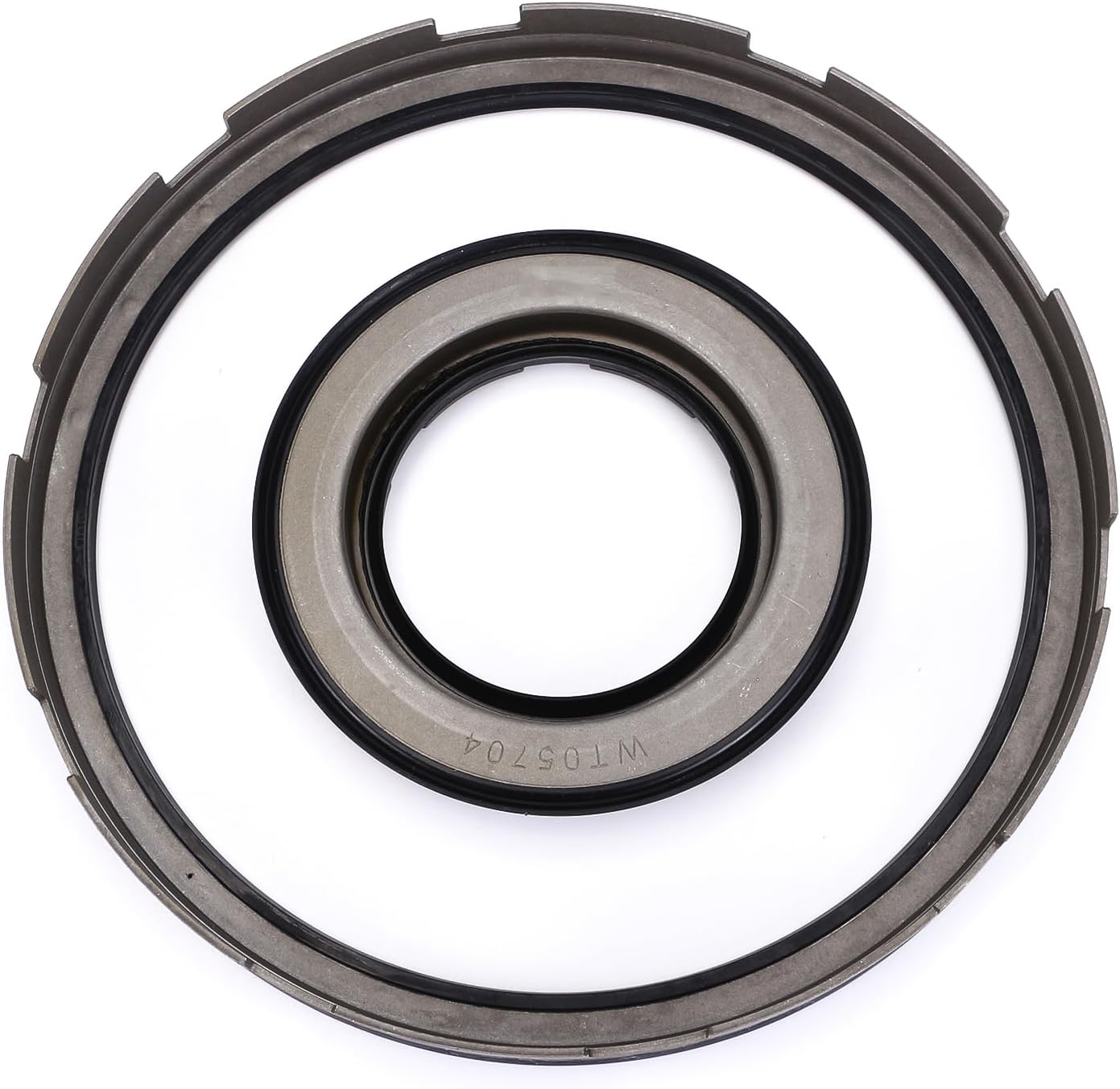
6T40 Bonded Piston Set 2012-Up
A failed 3-5-R clutch almost always means cut piston lips, and GEARS recommends replacing the bonded pistons on every rebuild. This set covers the pistons for 2012-up units.
Shop the 6T40 piston set at Core Transmission Parts →2. Falls Out of Gear at a Stop: The Cracked 1-2-3-4 Piston
The second failure is quieter and easy to misdiagnose. The car comes to a stop and drops out of gear, and the TCM sets P2723, pressure control solenoid 5 performance — stuck off. GEARS traced the root cause to a cracked 1-2-3-4 clutch apply piston. Solenoid 5 controls the 1-2-3-4 clutch regulator, so the code points at the circuit, but the solenoid is usually innocent. The piston is a bonded part; once it cracks, the 1-2-3-4 clutch cannot hold what the solenoid commands.
The fix is the piston, and the lesson is to never reuse them. GEARS is direct about it: always replace the bonded pistons during a rebuild. A kit that reuses the old pistons to save a few dollars is how you get a comeback at 5,000 miles.
3. Overfill, Vent Leaks and Overheating
This is the one owners cause themselves. The 6T40 is easy to overfill, and GEARS notes the synthetic fluid's expansion rate is very sensitive to temperature. As little as half a quart overfull can push fluid out of the vent. GEARS also reports that overfilling will make the unit overheat and set P0218, transmission fluid over temperature.
The reason the level is so touchy is a part most people never see. The case carries a thermally controlled standpipe, the fluid level control valve, with a bimetal strip inside. Below about 60°C (140°F) it lets fluid drain from the control valve body cover. Above 60°C it closes and traps fluid there, raising the working level so the hydraulics have enough oil. If the thermostatic element is damaged or loose, GEARS says you get foaming or an incorrect level no matter how carefully you fill it.
How to check it right
There is no dipstick to lean on. Per GEARS, check it with the engine running, the selector in Park, and fluid temperature at 85-95°C (185-205°F) on the scan tool, through the check plug near the axle seal. A cold check is meaningless because of the level control valve.
ATRA technical bulletin #1725 for the 6T35/6T40/6T50 adds the steps that make the reading repeatable: cycle the shifter through every range with a 3-second pause in each, idle at 500-800 rpm for at least 3 minutes so the foam settles, then pull the level set plug with the vehicle level and let it run until it drips. ATRA also shows how narrow the window is: set it at 95°C and the unit ends up underfilled, set it at 85°C and it ends up overfilled, with vent-tube discharge, foaming or pump cavitation as the result. For what the full service should cost and why the filter is not part of it, see our 6T40 fluid change cost guide.
For a service, GM's 2025 TechLink capacity chart lists the 6T40 at 4.0-6.0 liters (4.2-6.3 quarts) for a fluid change, using DEXRON VI. That is a range, not a fill target. Put back about what came out and set the final level hot. GEARS adds that a cold unit drains only about 50 percent of its fluid when you pull the plug, so a single drain-and-fill is a partial change. Do two with a drive in between if the fluid is dark.
4. Hesitation and a Bump on Launch
Some 2012 Cruze owners with the 1.8 and the MH8 6T40 complained of a slight hesitation when they released the brake and pressed the gas, followed by a bump or jerk as the car moved. GM's PI0640 explains the cause, and it is not mechanical. It is a feature called Neutral Idle: at a stop with the brake on, the TCM puts the transmission into a neutral state to save fuel, then re-engages it when the brake is released. The re-engagement is what the driver feels.
GM released a calibration that eliminates Neutral Idle, for vehicles built on or before November 18, 2011. The fix is a TCM reflash with SPS, and GM's checklist matters here: battery voltage between 12 and 15.5 volts the whole time on a proper maintainer, never a battery charger. On anything with a launch complaint, check the software level before you touch hardware. A reflash is cheap; a converter is not.
5. Fluid Leaks: Converter Seal and Auxiliary Pump
If there is ATF at the seam between the engine and transmission, suspect the converter seal first. GM's PI0950 covers 6T30/6T40/6T45/6T50 applications from the 2008 Malibu through 2013 Cruze, Equinox, Terrain, Sonic, Verano and more, built before February 1, 2013. GM released a converter seal with a more robust sealing material, P/N 24256953, and recommends installing a new one any time the transmission is out for any reason. It is also in seal kits 24269583, 24267774, 24267569 and 24267776. GM also says not to pull the transmission just for this seal unless it is actually the leak.
On the 2014 Malibu with the start/stop system, look on top of the transmission as well. GM's PI1071A documents leaks at the auxiliary fluid pump seal. After replacing it, GM's leak check is to run the engine at 4,000 RPM in Park for at least 30 seconds, shut it off and inspect the pump area.
6. Harsh Shifts: Software, Adapts and Line Pressure
Not every harsh-shifting 6T40 needs parts. GM Preliminary Information PI0724B covers a harsh 2-3 upshift on 2011 Equinox, Terrain and Captiva 2.4L models with the 6T45 that shows up when the driver lifts off the throttle just before or during the shift. The fix is a TCM calibration update through SPS, with the battery held at 12 to 15.5 volts during programming.
At the other end, GM's PI0324F lists harsh shifts as one symptom of no or low line pressure from a damaged fluid pump on 2011-2014 6T30/6T40/6T45/6T50 units, often with P0776, P0796, P2714 or P2723 and often under 10,000 miles. GM's instruction is to perform a line pressure check before replacing the TEHCM or the valve body. Our 6T40 harsh shift guide walks through the full diagnostic order, including adapts, fluid level and valve body bore wear.
Before You Condemn the Transmission
GEARS makes a point worth repeating: pull codes from every module first, and check for bulletins and software updates before the unit comes out. They note that E85 in a vehicle that is not flex-fuel will set O2 and knock sensor codes that can make the drivability feel like a transmission problem. Because the TEHCM is inside the case, there is little you can test from outside. Confirm power, ground, the brake light signal, the park/neutral signal and serial data at the connector, then use the scan tool to watch solenoid commands and the input and output speed sensors.
After any internal repair, valve body or TEHCM work, or a software update, run the adaptive learn. Per GEARS, block the wheels and set the parking brake, hold the service brake, zero throttle, fluid at 70-100°C (155-215°F), and cycle Park to Reverse three times to purge air from the reverse clutch. Then run Transmission Adaptive Values Learn from the scan tool, shut the engine off and let the TCM power down before restarting. Skipping this is the source of most "rebuilt but still shifts bad" calls.
If the car is in limp mode with U0101 (lost communication with the TCM), do not order a TEHCM yet. GM bulletin PIP4990C says U0101 on 6T30/40/45 units is frequently caused outside the TEHCM, and lists the transmission connector pins, the underhood fuse block, the TCM ground and harness rub-through on top of the transmission as the places to inspect first, with powers and grounds load checked. Our 6T40 limp mode guide covers the default gears and the full diagnostic order.
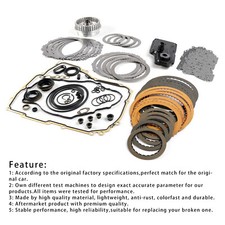
6T40 and 6T45 master rebuild kits, bonded piston sets, valve bodies, pumps and filter kits — shipped fast from the USA.
Shop 6T40 parts →Related guides
- GM 6T40/6T45 Wave Plate Failure
- 6T40 Shift Solenoid Symptoms and Replacement
- 6T40 Limp Mode Causes and Fix
- P0776 Diagnosis and Fix on the Bigger 6T70
- 6T70 Common Problems and Fixes
- Valve Body Cleaning and Inspection
- 6T40 Fluid Change Cost
FAQ
What is the most common 6T40 transmission problem?
Loss of the 3-5-Reverse clutch, which takes out reverse, 3rd and 5th together and usually sets P0776. The cause is typically a cracked 3-5-R wave plate or cut sealing lips on the 3-5-R piston. GM bulletin PI0670A says the only reliable way to judge the piston is to take the unit apart and look at it.
What causes a 6T40 to fall out of gear at a stop?
GEARS magazine traced this complaint, with code P2723, to a cracked 1-2-3-4 clutch apply piston. The code names pressure control solenoid 5, but the piston is the usual failure. Always replace the bonded pistons when the unit is rebuilt.
How much fluid does a 6T40 take?
GM's TechLink capacity chart lists 4.0-6.0 liters (4.2-6.3 quarts) of DEXRON VI for a fluid change. Refill with about what drained, then set the level through the check plug with the engine running in Park and fluid at 185-205 degrees F. As little as half a quart overfull can push fluid out of the vent.
Should I replace the TEHCM for a P0776 on a 6T40?
Not first. GM's PI0670A says to inspect the valve body, pump, 3-5-R housing and 3-5-R piston before replacing the TEHCM, and not to replace it before visually inspecting the 3-5-R clutch and piston. On Gen 2 controls, also run the scan tool's TEHCM performance test.
Why does my 2012 Cruze hesitate and bump when pulling away?
On 2012 Cruze 1.8 models built on or before November 18, 2011, GM's PI0640 blames a Neutral Idle feature that puts the transmission in neutral at a stop. GM released a TCM calibration that removes it, so a reflash is the fix.
Sources
- General Motors — Preliminary Information PI0670A, "Diagnostic Tips for DTC P0776, Slips in or No Reverse, Third, Fifth," February 2012 (via NHTSA). Backs the 6T30/6T40/6T45/6T50 applications and RPOs, the no reverse and 3rd/5th slip or flare complaints with P0776, the Gen 1 and Gen 2 controls vehicle lists, the non-functional TEHCM performance test on Gen 1, the inspection order ending with TEHCM replacement, and the warning against air checking the 3-5-R clutch through the case. nhtsa.gov (PDF)
- ATRA / GEARS Magazine — "6T40/45 Diagnosis and Fixes." Backs the cracked 1-2-3-4 piston with P2723, the advice to always replace bonded pistons, the half-quart overfill vent leak and P0218, the Gen I pressure switch rivet failures ending in 2012, the fluid level control valve and its 60°C behavior, the 185-205°F level check, the 50 percent cold drain, the E85 note, the external electrical checks and the adaptive learn procedure. gearsmagazine.com
- Sonnax — "GM 6T40 & 6T70 Drum Saver Kits: Protection Against 3-5-R Failures & Comebacks." Backs the wave plate cracking at tooth corners, micro fractures in OE plates, shot peening reducing but not eliminating failures, the affected Gen 1-3 6T40/45/50 and 6T41/46/51 units, and the toothless 144555K kit. sonnax.com
- General Motors — Preliminary Information PI0640, "Hesitation or Bump on Launch from a Stop," January 2012 (via NHTSA). Backs the 2012 Cruze 1.8 (LUW) MH8 application built on or before November 18, 2011, the Neutral Idle cause, the calibration that removes it, and the 12-15.5 volt programming requirement. nhtsa.gov (PDF)
- General Motors — Preliminary Information PI0950, "Automatic Transmission Fluid Leak from Torque Converter Housing Area," April 2013 (via NHTSA). Backs the covered 6T30/6T40/6T45/6T50 vehicles built before February 1, 2013, the revised converter seal P/N 24256953, the seal kit numbers, and the guidance on when to replace it. nhtsa.gov (PDF)
- GM TechLink — "2025 Transmission Capacities & Fluids." Backs the 6T40 (RPO MNH) fluid change capacity of 4.0-6.0 L (4.2-6.3 qt) and DEXRON VI as the specified fluid. gm-techlink.com (PDF)
- ATRA — Technical Bulletin #1725, "6T35, 6T40, 6T50 Fluid Level and Condition Check Procedures," February 2016. Backs the range-cycling and 3-minute idle steps, the drip check at the level set plug, and the 85-95°C (185-203°F) window with the underfill and overfill consequences. atracom.blob.core.windows.net (PDF)
- General Motors — Preliminary Information PI0724B, "Harsh 2-3 Shift," January 2013 (via NHTSA). Backs the 2011 Equinox, Terrain and Captiva 2.4L 6T45 harsh 2-3 on throttle release and the TCM calibration correction. static.nhtsa.gov (PDF)
- General Motors — Preliminary Information PI0324F, December 2013 (via NHTSA). Backs harsh shifts from low line pressure caused by a damaged fluid pump, DTCs P0776, P0796, P2714 and P2723, and the line pressure check before TEHCM or valve body replacement. static.nhtsa.gov (PDF)
- General Motors — Preliminary Information PIP4990C, "MIL Setting DTC U0101 Current Or History," February 2016 (via NHTSA). Backs U0101 on 6T30/40/45 units frequently being caused outside the TEHCM and the connector pin, underhood fuse block, TCM ground and harness chafe inspections with load-checked powers and grounds. static.nhtsa.gov (PDF)
Also referenced: GM Preliminary Information PI1071A, "Transmission Fluid Leak at Auxiliary Pump Seal," November 2013, nhtsa.gov (PDF) — the 2014 Malibu 6T40 (MNH) auxiliary pump seal leak and the 4,000 RPM for 30 seconds leak check.