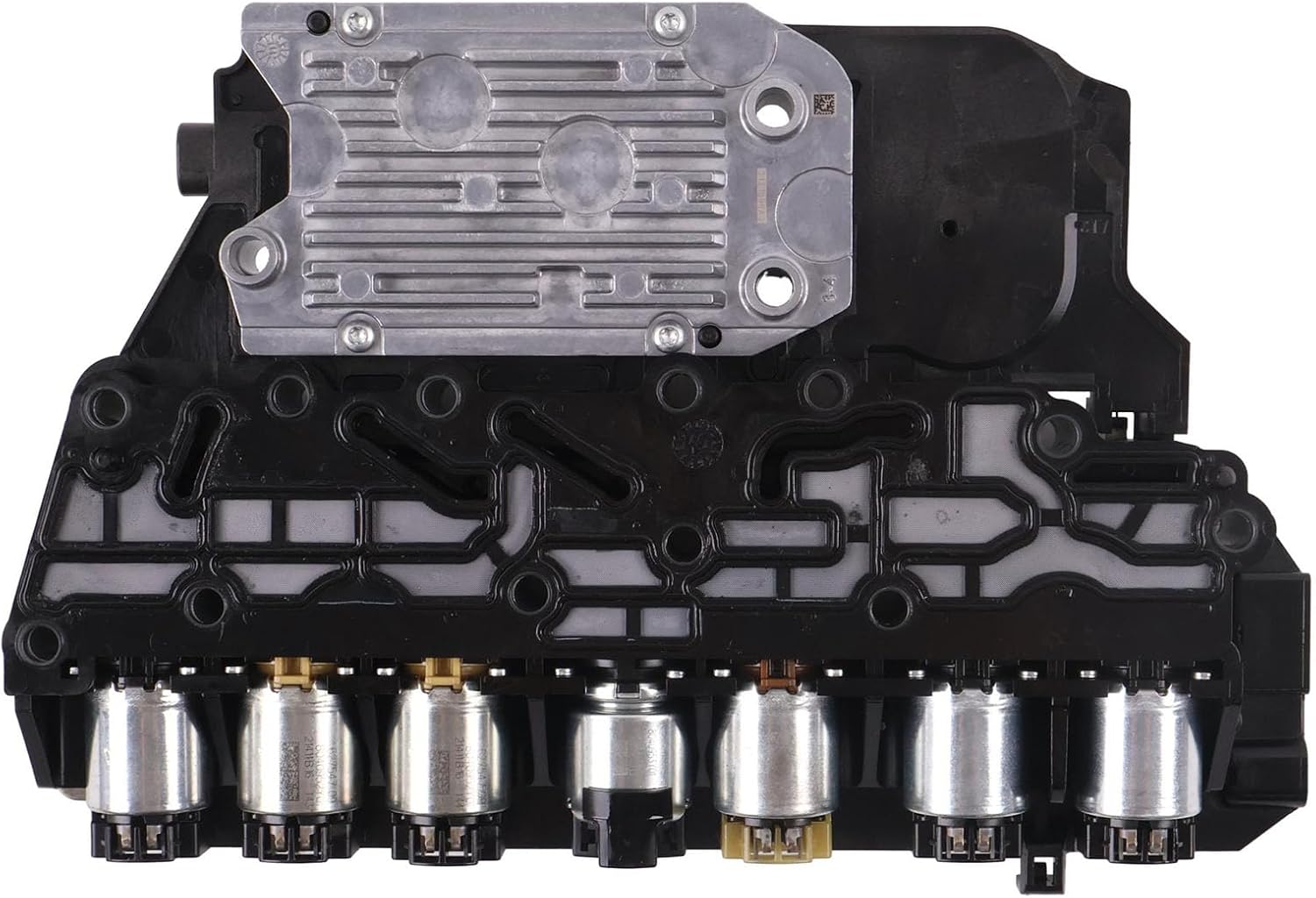
P0751 on a 6T40 is one of the more misunderstood codes on this unit, because the name points you at the wrong part. The generic scan tool definition is "Shift Solenoid A Performance." People read that and order a shift solenoid. On a 6T40, though, the single on/off shift solenoid does not shift gears by itself. It moves one valve, the clutch select valve, and that valve decides which clutch a shared pressure control circuit feeds. When P0751 sets, the TCM is telling you that the clutch select circuit did not move when it was told to. The solenoid is one suspect. The valve, its bore, its end plug and the screen in front of the solenoid are the others.
This guide covers the 6T40 and 6T45 family in the Cruze, Sonic, Malibu, Equinox, Terrain, Encore, Trax and their cousins. It walks through what GM's monitor actually checks, why the failure shows up as a 4th-gear ratio when the TCM wanted 1st, and the order I test parts so the customer does not pay for a module they did not need.
What GM's monitor actually checks
GM's 2011 OBD monitor tables include a 6T40 Unique Section, and P0751 is listed there as Shift Solenoid Valve A Stuck Off. The component column calls the part the Mode 2 Multiplex Valve [1]. That name tells you more than the generic code description does. The TCM is not measuring solenoid current for this code. It is watching what the gear train does when it asks the multiplex valve to switch.
Here is the logic, straight from the table [1]:
- Commanded gear: 1st Lock. That is 1st gear with the low/reverse clutch applied for engine braking, not the freewheeling 1st you get from the one-way clutch on a normal launch.
- Fail condition: gear slip of 400 RPM or more, with the calculated ratio sitting between about 1.329 and 1.529.
- Timing: a 0.3-second fail timer that has to accumulate repeated fail counts before the code matures.
- MIL: two trips. The first failure stores a pending code. A second failed trip turns the lamp on.
- Enables: ignition voltage 9 to 31.99 V, engine speed 400 to 7,500 RPM, fluid temperature at or above about -6.7 C, a completed shift, a valid throttle signal from the ECM, and no input or output speed sensor faults.
Look at that ratio window. The 6T40 runs 4.584 in 1st and 1.446 in 4th. A window of 1.329 to 1.529 is centered on 4th gear. So GM's monitor is looking for a very specific failure: the TCM asked for 1st Lock and the transmission delivered 4th. Factory service information describes it the same way, as 1st Lock commanded while the closest calculated ratio is 4th gear. The sister code P0752 (stuck on) runs the opposite test with 3rd gear commanded, and the table uses the C456/CBR1 pressure switch as a cross check on Gen 1 units [1].
Why a stuck clutch select valve gives you 4th instead of 1st
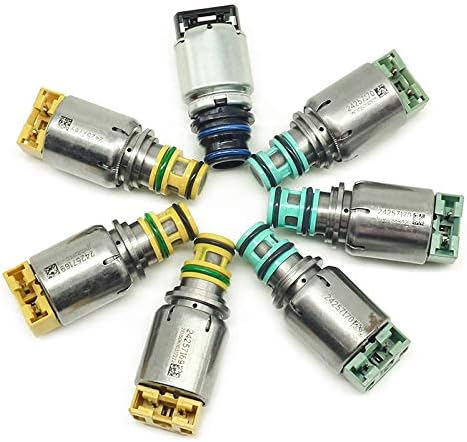
The 6T40 gets six speeds out of five clutches with pressure control solenoids doing the shifting. GEARS magazine's breakdown of the solenoids lays it out [2]. PCS3 feeds the R-1/4-5-6 clutch regulator valve. In other words, one pressure control solenoid and one regulator valve serve two different clutches: the low/reverse clutch and the 4-5-6 clutch. Sonnax's vacuum test guide shows the same thing from the valve body side. There is a single Low/Reverse & 4-5-6 Clutch Regulator Valve and a matching boost valve [4].
Something has to steer that shared oil to the right clutch, and that is the clutch select valve. GEARS describes the shift solenoid as an on/off, normally closed solenoid that controls oil to the clutch select valve [2]. GM's own solenoid legend in bulletin PIP6095 labels the same solenoid Clutch Select (On/Off), sitting alongside CBR1/C456, C1234, TCC, C35R, CB26 and Line [5].
Now put the pieces together. In 1st Lock, the 1-2-3-4 clutch is on and the TCM wants the low/reverse clutch on too, for engine braking. It energizes the shift solenoid, the clutch select valve strokes, and PCS3 oil goes to the low/reverse clutch. If the solenoid does not open, or the valve does not move, that same regulated oil goes to the 4-5-6 clutch instead. The 1-2-3-4 clutch plus the 4-5-6 clutch is 4th gear. That is exactly the ratio GM's monitor is looking for.
This is why the customer complaint is often vague. 1st Lock is used for manual low and engine braking, not for every launch. A lot of P0751 cars drive normally most of the time. What they notice is a lack of engine braking in L or manual 1st, a flare or bump when the TCM tries to grab 1st Lock on a downhill coast, or a check engine light that shows up after a couple of drives. If you get a 6T40 with P0751 in history and no complaint, that is why.
The usual causes, most likely first
- Debris at the clutch select solenoid. The 6T-family solenoids are sensitive to debris. A wear particle under the shift solenoid valve keeps it from opening fully.
- Clutch select valve stuck or worn in its bore. Sonnax lists the clutch select valve in the 6T40 control valve body with "various shift concerns" and "shift codes" as its failure symptoms [4]. Factory service information also calls out debris, sediment, a scored bore and a missing or damaged check ball in this circuit.
- Solenoid screen damage. On 2025-2026 Trax and Envista units built after May 1, 2025, GM's PIP6095 describes valve over-travel in normally high solenoids contacting or rupturing the solenoid screen [5]. That bulletin is aimed at harsh garage shifts, and the clutch select solenoid is not one of the normally high units, but it is a good reminder: pull the module and look at every screen. A torn screen lets debris into the whole solenoid block.
- The solenoid itself. An open or shorted coil usually sets a circuit code (P0973 or P0974) rather than P0751. A solenoid that is electrically fine but mechanically slow or sticking sets P0751.
- Low line or actuator feed oil. The shift solenoid is fed from the actuator feed limit circuit. Sonnax lists low clutch oil pressure and "no 4th, 5th or 6th" as actuator feed limit valve symptoms [4]. If feed oil is low, the select valve may not stroke even with a good solenoid.
Diagnosis, in the order I run it
1. Clean up codes and check for software
GM's monitor will not run with an input or output speed sensor fault present, and it needs a valid throttle and torque signal from the ECM [1]. Fix those first. GEARS also makes the point that a 6T40 should be checked for TSBs and reflashes before anyone pulls it, because some units were removed for problems a software update fixed [3]. Note any P0973 or P0974 alongside P0751. Those are circuit codes for the same solenoid and change the direction of the diagnosis.
2. Check the fluid
Check level hot through the check plug. GEARS gives 85 to 95 C (185 to 205 F) for the hot check [3]. Low fluid starves the actuator feed circuit. Pull the pan and look at what is in it. Fine clutch material and metal flakes tell you the debris is coming from somewhere and a solenoid alone will not fix the car.
3. Run the solenoid cleaning routine
Many scan tools have a 6T40 solenoid cleaning routine. The TEHCM cycles the solenoids while the system is pressurized to try to flush debris off the valves. GEARS says to do this before attempting any deeper diagnosis [3]. Clear the code afterward and road test with manual 1st and a downhill coast to make the TCM command 1st Lock. If the code stays away for several drives, you got lucky, and you should still recommend a fluid and filter service.
4. Air test the solenoid off the car
If the code comes back, the TEHCM comes out. GEARS describes the factory method: mount tool DT 48616 on the control solenoid assembly at 5 Nm (44 lb-in), feed it 90 to 100 psi of regulated shop air, and command each solenoid on and off with a scan tool through cable DT48616-10. The gauge should show pressure and then exhaust as the solenoid cycles. A solenoid that does not change the gauge reading has failed [3].
Without the kit, the bench test from the GEARS solenoid article still works. Measure the shift solenoid at 16 to 20 ohms (the pressure control solenoids are 3 to 5 ohms) with the solenoid out of the TEHCM. The shift solenoid is the only one you can energize directly with 12 volts. Never put 12 volts on a pressure control solenoid [2]. Since it is normally closed, it should block air when off and pass it cleanly when energized.
5. Vacuum test the clutch select valve
If the solenoid passes, the problem is in the valve body. Pull the clutch select valve. In the Gen 2 and Gen 3 body, Sonnax shows it in a shared bore, with the clutch select valve inboard and a shuttle valve outboard [4]. Look for scoring, varnish and a valve that does not drop freely under its own weight. Vacuum test the bore and the end plugs. Sonnax notes that worn or leaking o-ringed end plugs cause pressure loss, burnt clutches and shift concerns [4]. While the body is apart, check the Low/Reverse & 4-5-6 regulator and boost valves too. They share the circuit, and Sonnax ties wear there to burnt low/reverse and 4-5-6 clutches and a 3-4 flare [4].
6. Check the clutches before you button it up
A car that has been running with P0751 for a while may have slipped the low/reverse or 4-5-6 clutch during failed 1st Lock events. If the pan has a lot of friction material, plan on an overhaul, not just a solenoid or valve repair.
The fix
- Solenoid stuck or failed the air test: GM services the TEHCM as an assembly, and a new module needs programming. Rebuilders often replace the solenoid set instead and keep the original module, which avoids programming. Match the generation first. GEARS says the eighth character of the TEHCM number tells you: 1, 2 or 3 is Gen 1, and B, C or D is Gen 2. They are not interchangeable [2].
- Clutch select valve stuck or bore worn: clean, free it up and vacuum test again. If the bore leaks, replace the valve body. A worn bore will stick again.
- 2025-2026 Trax or Envista with a damaged screen: follow PIP6095. GM's parts list there includes the control solenoid valve and transmission control module assembly 24052399, control valve body 24265971, filter plate 24263196 and gasket and harness seal kit 24053920 [5]. Those numbers are for the bulletin vehicles only. Do not assume they fit an older unit.
- Debris source: find it. A new solenoid in contaminated oil will hang up again.
- After any repair: refill with DEXRON VI. GM's 2026 TechLink capacity chart lists the current 6T40 at 4.0 to 6.0 liters (4.2 to 6.3 quarts) [6]. Check the level hot. Clear codes, run the adaptive learn procedure for the vehicle, and road test through manual 1st and a coast-down until the monitor reports a pass.
Clutch select solenoid failed the air test?
Core Transmission Parts carries a 6T40 solenoid valve kit for 2008-up units. That covers the solenoid set when the module housing and TCM are good. Check your TEHCM generation before you order.
View the 6T40 solenoid kit →FAQ
What does P0751 mean on a 6T40?
GM calls it Shift Solenoid Valve A Stuck Off. The TCM commanded 1st Lock and measured a gear ratio close to 4th, with 400 RPM or more of slip. On the 6T40 that means the clutch select valve, controlled by the on/off shift solenoid, did not send oil to the low/reverse clutch. It takes two failed trips to turn on the check engine light.
Is P0751 the solenoid or the valve body?
It can be either. The shift solenoid lives in the TEHCM, and debris can keep it from opening. The clutch select valve lives in the control valve body, and Sonnax lists shift codes as a symptom of that valve sticking. Air test the solenoid first, and vacuum test the valve and end plugs if the solenoid passes.
Can I drive with P0751?
Usually yes, for a short time, because 1st Lock is only used for engine braking and manual low. You will lose engine braking in low and may feel a flare when the TCM tries to grab 1st Lock. The bigger risk is the cause: debris in the oil can take out other solenoids and clutches, so get it diagnosed soon.
What is the difference between P0751 and P0973?
P0973 and P0974 are electrical codes for the shift solenoid control circuit. P0751 is a performance code. The circuit checks out, but the gear train did not respond the way the TCM expected. With P0751 alone, look at mechanical causes first: debris, a sticking solenoid valve, or a stuck clutch select valve.
What fluid does the 6T40 take after the repair?
DEXRON VI. GM's 2026 TechLink capacity chart lists 4.0 to 6.0 liters (4.2 to 6.3 quarts) for the current 6T40 applications. Check the level hot through the check plug at 85 to 95 C (185 to 205 F).
Shop the 6T40 solenoid kit →
Need parts for this job?
6T40 TEHCM modules, solenoid sets, valve bodies, gasket kits and rebuild kits, with secure checkout.
Shop 6T40 parts →Sources
- General Motors — 2011 OBD monitor tables, "11OBDG08 TRANS Diagnostics," 6T40 Unique Section. Backs the "Shift Solenoid Valve A Stuck Off" descriptor and "Mode 2 Multiplex Valve" component, the 1st Lock command, the 400 RPM slip and 1.329-1.529 ratio window, the 0.3 s fail timer, the two-trip MIL, the voltage, RPM and temperature enables, and the P0752 3rd-gear test with the C456/CBR1 switch. gsi.ext.gm.com PDF
- GEARS Magazine (ATRA) — "Understanding GM 6T40 Solenoids." Backs the on/off normally closed shift solenoid controlling the clutch select valve, PCS3 feeding the R-1/4-5-6 regulator valve, the 16-20 ohm shift solenoid and 3-5 ohm PCS specs, the 12-volt warning, and the eighth-character TEHCM generation ID. gearsmagazine.com
- GEARS Magazine (ATRA) — "6T40/45 Diagnosis & Fixes." Backs the TSB and reflash check, the 85-95 C hot level check, the scan tool solenoid cleaning routine, and the DT 48616 air test at 5 Nm and 90-100 psi. gearsmagazine.com
- Sonnax — GM 6T30/40/45/50 (Gen 2) and Gen 3 6T40 Vacuum Test Guide (PDF). Backs the clutch select valve and shuttle valve location and the "shift codes" symptom, the shared Low/Reverse & 4-5-6 regulator and boost valves, the actuator feed limit valve symptoms, and the o-ringed end plug leak symptoms. sonnax vacuum test guide PDF
- GM bulletin PIP6095C (February 2026), via NHTSA. Backs the solenoid legend naming the Clutch Select (On/Off) solenoid, the screen contact and rupture condition on 2025-2026 Trax and Envista built after May 1, 2025, and the 24052399, 24265971, 24263196 and 24053920 part numbers. static.nhtsa.gov PDF
- GM TechLink — 2026 Transmission Fluid Capacities chart. Backs DEXRON VI and the 4.0-6.0 L (4.2-6.3 qt) capacity for the current 6T40. gm-techlink.com PDF