Two on/off solenoids run every upshift and downshift in a 4L60-E. That is the whole electronic shift strategy: solenoid A (the 1-2) and solenoid B (the 2-3), each one either fed 12 volts by the PCM or grounded through a low-side driver. Everything else in the unit responds to what those two do. When one stops doing its job, the symptom is not subtle, and it is not random — it is fully predictable from the state table.
That is the part most people skip. Know which solenoid should be energized in which gear and the road test tells you what is wrong before you ever pull the pan. Skip it and you replace a $30 pair of solenoids on a truck that had a $6 problem, or a valve body on a truck that had a bad PCM driver.
The state table, and why the default is third gear
ATRA publishes solenoid application charts in GEARS that sort two-solenoid units into three shift patterns. The 4L60-E is a Type 1, and Type 1 looks like this:
| Gear | Solenoid A (1-2) | Solenoid B (2-3) |
|---|---|---|
| 1st | ON | ON |
| 2nd | OFF | ON |
| 3rd | OFF | OFF |
| 4th | ON | OFF |
Read down the third-gear row. Both solenoids off. That is not an accident — it is the failsafe. Kill power to the whole solenoid feed circuit and the valve body lands mechanically in third, which is why a 4L60-E that loses its transmission fuse still drives home in one gear instead of leaving the customer on the shoulder. It also means "stuck in third, no shifts" is a power-feed complaint far more often than it is a solenoid complaint. Two solenoids do not die the same afternoon. A shared fuse, a shared ground, or a PCM does.
Now read the table sideways, because that is where diagnosis happens:
- Solenoid A stuck off. The unit can reach 2nd (OFF/ON) and 3rd (OFF/OFF) but cannot make 1st or 4th. Second-gear starts, no overdrive.
- Solenoid A stuck on. 1st (ON/ON) and 4th (ON/OFF) are still available, 2nd and 3rd are not. The unit jumps 1st to 4th and falls on its face.
- Solenoid B stuck on. 1st and 2nd work, 3rd and 4th do not. This is the classic complaint: shifts fine to second, then the engine just revs.
- Solenoid B stuck off. 3rd and 4th are available, 1st and 2nd are not — a third-gear start with a stumble off the line.
Match the customer's description to that list before you touch anything. It costs nothing and it narrows the job to one circuit.
What the codes actually tell you
The 4L60-E sets P0751 / P0752 / P0753 against solenoid A and P0756 / P0757 / P0758 against solenoid B. The electrical codes — P0753 and P0758 — mean the PCM saw something wrong with the circuit itself: open, short, or current draw outside the window. The performance and stuck codes mean the PCM commanded a shift, watched the input and output speed sensors, and did not get the ratio it asked for.
That distinction matters, because a ratio-based code cannot tell the difference between a dead solenoid and a shift valve that would not stroke. P0730 and the stuck-solenoid codes come out of the same math. The solenoid gets blamed because it is the cheapest thing in the circuit, not because the code identified it.
One more thing to know before you start pulling connectors: unplugging the case pass-through connector with the engine running will light up the dash with codes that have nothing to do with the original complaint. ATRA's bulletin on this unit lists them outright — DTCs 59, 67 and 82 with key on and engine off, and 59, 66, 67, 73 and 82 with the engine running. Clear them after you reconnect, or you will spend the afternoon diagnosing your own footprints. Same bulletin, same page: squeeze the two tabs toward each other and pull straight up, no twisting and no prying with a screwdriver. Bent pins there hand you an intermittent solenoid code that outlives the repair.
Electrical testing: the numbers and the pins
Both shift solenoids share a power feed and are switched to ground by low-side drivers in the PCM. At the case connector, ATRA Technical Bulletin #269 maps them this way: the 1-2 solenoid reads across pins E and A, the 2-3 solenoid across pins E and B, both in the 20-40 ohm range. The rest of that chart is worth having on the wall:
| Device | Case connector pins | Spec |
|---|---|---|
| 1-2 shift solenoid (A) | E & A | 20-40 ohms |
| 2-3 shift solenoid (B) | E & B | 20-40 ohms |
| Pressure control (EPC) solenoid | C & D | 3.5-8.0 ohms |
| TCC solenoid | E & T | 20-40 ohms |
| 3-2 control solenoid | E & S | 9-14 ohms |
| Output / vehicle speed sensor | — | 1260-1540 ohms |
GM's own diagnostic charts run tighter than that field bulletin: 19-31 ohms for the shift solenoids, as Gordon Kehler cites in his Transmission Digest write-up of a 2001 S-10 with a stored P0758. Use 19-31 as the number you judge a part by, and 20-40 as the number that tells you a circuit is not open or shorted. Either way, note the pressure control solenoid sitting at 3.5-8.0 ohms. It is a different animal, it draws several times the current, and it does not belong in the same test routine as the shift solenoids.
Resistance is a screen, not a verdict
A cold ohm reading puts a few milliamps through a coil that normally carries half an amp. Plenty of solenoids pass that and fail under real load. Load-test the circuit instead: put an ammeter inline from the driver terminal to ground with the key on, and use a remote starter button so you can cycle it by hand.
Kehler's numbers from that S-10 are a good calibration point. Testing at PCM connector C2, terminals 51 and 52, with a battery maintainer holding voltage steady, the 1-2 circuit drew 0.49 amps — 26.5 ohms by Ohm's law, dead center of spec. The 2-3 circuit calculated to 27 ohms. Both clicked and clacked on the remote button, repeatably. Every static and dynamic electrical test on that truck passed, and the truck still would not shift into third.
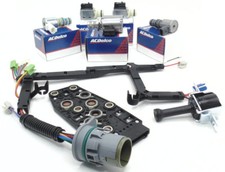
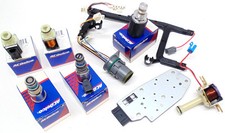
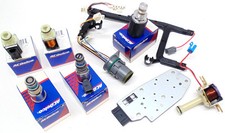
4L60E Master Solenoid Kit, 7-Piece (1993-2008)
Shift solenoids A and B, EPC, TCC, 3-2 control and the seals to go with them. If the pan is already down and the unit is past 150k, doing the set once beats doing one solenoid three times.
View the kit →The scope test that finds what the meter cannot
The reason that S-10 was still broken is the reason a lab scope belongs in this diagnosis. The complaint was a commanded third gear that would not arrive — the scan tool showed 3rd commanded while gear ratio stayed at 1.6:1 (second), then 4th commanded with the ratio still at 1.6:1, and then, twenty-odd seconds later, the shift would finally land and the ratio would drop to 0.69:1. From a stop in manual third, the ratio change lagged the command by 20 to 25 seconds, cold or hot.
The tell was audible before it was visible. Commanding solenoid A on and off through the scan tool gave a clean "click clack." Commanding solenoid B gave the click going on and no clack coming off.
Back-probe the control circuits, leave the PCM connected, and put a scope on the low-side driver. When the driver is off the circuit is open and sits at source voltage; when the driver turns on it should be pulled to zero. Solenoid A's trace snapped between 13V and 0V with square edges. Solenoid B's trace made the same trip — but the turn-off took 15 to 27 seconds to complete. The solenoid was fine. The driver inside the PCM was failing slowly instead of failing outright, which is exactly the failure mode that a resistance check, a current check, and a click test all walk right past. The repair was a PCM.
Two things to take from that. First, if you are going to condemn a PCM, capture the waveform — nobody approves that repair on a hunch. Second, "the solenoid clicks" is not a pass. It tells you the armature moved once. It says nothing about how fast it let go.
FNIRSI 1013D Plus 2-Channel Automotive Oscilloscope
You cannot see a slow driver turn-off with a meter. Two channels back-probed across both shift solenoid control wires put one trace snapping and the other dragging side by side in a single capture, which is the whole argument.
View the scope →Three hydraulic faults that impersonate a bad solenoid
1. AFL valve bore wear
The shift solenoids do not run on line pressure. They run on actuator feed limit oil. Per Sonnax, the AFL valve in the 4L60-E takes line pressure and regulates it to approximately 115 psi, then feeds the shift solenoids, the pressure control solenoid, the TCC solenoid, the 3-2 control solenoid and the 2-3 shift valve lineup off that regulated supply.
The AFL valve has a large reaction area on its spring end, which side-loads it into the bore, and the EPC solenoid oscillating the torque signal keeps the valve working constantly. So the bore wears. As it does, feed pressure to the shift solenoids drops, the shift valves stop stroking cleanly, and the PCM starts setting solenoid and ratio codes on solenoids that are electrically perfect. Sonnax's guidance is that AFL and solenoid modulator locations should always be vacuum tested for wear. Note also that the same leak starving the solenoids drags line pressure down with it — so a low-pressure complaint and a solenoid code on the same unit are usually one problem, not two.
2. A leaking 1-2 accumulator piston seal
Second-gear starts look electrical and frequently are not. Wayne Colonna documented a 1993 C1500 with the 5.0 that started in second: the scanner showed first gear commanded, both solenoids confirmed on with a voltage check, and the shop had already replaced the solenoids and then the entire valve body assembly with no change.
The hydraulics explain it. The 4L60-E valve body sits in second gear by default with the engine off. It takes 48 psi of line and AFL pressure to overcome the 1-2 shift valve spring and stroke the valve into first. Line pressure on that truck checked out at 62 psi in Drive, which ruled out the pump, the AFL valve and the forward accumulator piston. The actual fault was a missing rubber seal on the 1-2 accumulator piston, letting accumulator pressure feed past into the band apply circuit — which also showed up as a bind-up in manual low on the road test. One seal, after a solenoid set and a valve body.
3. The internal wiring harness
The harness inside the pan carries every solenoid circuit through one connector, and it ages in hot fluid. GM thought highly enough of the problem on later units to write a bulletin about it: PIP5009G directs technicians to replace the internal wiring harness and TCC enable solenoid, part number 24237980, any time repairs are performed on a 4L60-E in a 2012 Colorado, Canyon, Express, Savana, Silverado or Sierra built after 10/01/11, and specifically when a P0741 is set with a harsh 1-2 shift. The bulletin also gives a date-code check so you do not replace a part somebody already replaced: any solenoid produced on or after April 17, 2012 (date code 4172# or higher) is already the updated part. And before installing the new one, it has you stroke the converter clutch valve in the pump cover — it should move freely at least 3/8 in.
That bulletin is year-specific; the lesson is not. If you are in the pan on any high-mileage 4L60-E and the harness is original, replace it while the pan is down. Chasing an intermittent solenoid circuit through a cracked harness insulator is a bad way to spend a Thursday.
Shift solenoids, EPC and TCC solenoids, internal harnesses, filters, pan gaskets and valve body components for the 4L60E — shipped fast from the USA.
Shop 4L60E parts →Replacing the solenoids
The shift solenoids on a 4L60-E are pan-accessible. The transmission stays in the vehicle.
- Drain and drop the pan. Read what is in it before you go any further — clutch material or bronze on the magnet turns a solenoid replacement into a teardown conversation with the customer.
- Remove the filter and its seal. The seal usually stays up in the pump bore. Get it out; a doubled seal is a guaranteed comeback.
- Unclip the internal harness connectors from both shift solenoids. The 1-2 and 2-3 solenoids are physically identical — same part, same resistance — so mark which is which before removal, or verify position against a valve body layout on reassembly. Putting them back swapped gives you a unit that shifts 1st to 4th and back, with no codes.
- Pull the retaining bracket and bolt, remove the solenoid straight out of its bore, and replace both O-rings. Do not reuse them. Lube the new ones with ATF before install.
- Reinstall to the published torque for your model year. These are small fasteners into an aluminum casting — a click-type inch-pound wrench, never an impact.
- New filter, new filter seal, new pan gasket. Pan bolts go around the rail in a crossing pattern to spec, not run down one after another, or you will pull the rail out of flat and chase a leak you created.
- Refill with the DEXRON specification listed for that year and unit — DEXRON VI on later applications, and it supersedes DEXRON III on the earlier ones. Plan on roughly five quarts for a pan-and-filter service on a shallow pan, and confirm against the capacity table for your vehicle before you buy the case.
Then clear codes and drive it. Adaptive shift pressure learn happens on its own over normal driving, so give it a mix of light and moderate throttle upshifts through all four gears before you decide the shift feel is wrong.
The short version
Put the state table in front of you and let the symptom name the circuit. Ohm the case connector to rule out open and shorted, then load-test it, because a coil that passes at five milliamps can still fail at half an amp. If the electrical side checks out and the shift still will not arrive, scope the low-side driver before you condemn anything expensive. And if the solenoid and its driver are both clean, the fault is hydraulic — AFL bore wear, an accumulator seal, a stuck valve — not the $30 part you were about to order.
Sources
- GEARS Magazine (ATRA) — "Solenoid Application Charts," January/February 2006, p. 77-78 (PDF). Backs the 4L60E being a Type 1 two-solenoid unit and the Type 1 state table itself: 1st ON/ON, 2nd OFF/ON, 3rd OFF/OFF, 4th ON/OFF for the 1-2 (SSA) and 2-3 (SSB) solenoids, and the premise that knowing which solenoids should be energized in each range is the critical first step in electronic transmission diagnosis. atracom.blob.core.windows.net (PDF)
- ATRA Technical Bulletin #269 — "GM 4L60-E Solenoid/Switch Resistances," issued 1995 (PDF). Backs the case connector pin map and resistance values: 1-2 shift solenoid at pins E and A and 2-3 shift solenoid at pins E and B, both 20-40 ohms; pressure control solenoid pins C and D at 3.5-8.0 ohms; TCC solenoid pins E and T at 20-40 ohms; 3-2 control solenoid pins E and S at 9-14 ohms; output/vehicle speed sensor at 1260-1540 ohms; the connector removal and installation cautions; and the DTCs that set when the pass-through connector is disconnected (59, 67, 82 key on engine off; 59, 66, 67, 73, 82 engine running). atracom.blob.core.windows.net (PDF)
- Transmission Digest — "Diagnosing an unusual problem: A slow-to-respond solenoid," Gordon Kehler, January 26, 2023. Backs the 2001 S-10 case: the stored P0758, the GM diagnostic chart solenoid resistance specification of 19-31 ohms, the observed gear ratios of 1.6:1 in second and 0.69:1 in fourth with the 20-to-25-second lag between commanded and actual gear, the "click clack" scan-tool command test and the missing turn-off clack on solenoid B, testing at PCM connector C2 terminals 51 and 52, the 0.49 amp reading calculating to 26.5 ohms and the 2-3 circuit calculating to 27 ohms, and the lab scope capture of the low-side driver showing a 15-to-27-second turn-off time that condemned the PCM. transmissiondigest.com
- Transmission Digest — "Fixing 4L60-E 1-2 shift issues," Wayne Colonna, July 5, 2022. Backs the 1993 C1500 second-gear-start case: solenoids and then the complete valve body replaced without effect, the valve body defaulting to second gear with the engine off, the 48 psi of line and AFL pressure required to overcome the 1-2 shift valve spring and stroke into first, the 62 psi line pressure reading in Drive that ruled out the pump, AFL valve and forward accumulator piston, and the missing 1-2 accumulator piston seal feeding accumulator pressure into the band apply circuit. transmissiondigest.com
- Sonnax — "Hydraulics Fundamentals Part VII: AFL/Solenoid Modulator Valves," April 20, 2020. Backs the AFL valve regulating line pressure to approximately 115 psi in the 4L60-E and feeding the shift solenoids, pressure control solenoid, TCC solenoid, 3-2 control solenoid and the 2-3 shift valve lineup; the large reaction area on the spring end causing side-loading and bore wear; worn bores producing low actuator feed and line pressure, restricted or flooded solenoid feed, shift and shift-timing problems and solenoid codes; and the recommendation that these locations always be vacuum tested for wear. sonnax.com
- General Motors Service Bulletin PIP5009G, November 2012, via NHTSA (PDF). Backs the direction to replace the internal wiring harness and TCC enable solenoid part number 24237980 any time transmission repairs are performed, the affected models (2012 Chevrolet Colorado, Express and Silverado; 2012 GMC Canyon, Savana and Sierra with the 4L60E, RPO M30, built after 10/01/11), the P0741-with-harsh-1-2-shift condition, the solenoid date-code check with 4172# or greater not requiring replacement, and the instruction to verify the converter clutch valve in the pump cover strokes freely at least 3/8 in. static.nhtsa.gov (PDF)