A slipping 6T40 or 6T45 is one of the most common complaints on Cruze, Malibu, Equinox, Terrain, Sonic, Regal and Trax. The customer calls it slipping. On the road test it turns out to be one of four different things: a flare on one specific shift, a drop to neutral at a stop, a surge at steady cruise, or a true slip under load in one or more gears. Each points somewhere different, and the 6T40 is a clutch-to-clutch unit, so the gears that slip tell you which clutch or circuit to look at.
This guide walks through reading the slip pattern, the known pattern failures GM and the rebuild trade have documented, what to check before you pull the unit, and what a lasting fix needs. Bulletin numbers and specs are cited, with the full source list at the bottom.

Step 1: Figure Out Which Gears Slip
Every forward gear in a 6T40 holds two clutches, and every shift releases one while applying another. That is why "slipping" on this unit is rarely general. It is almost always tied to the gears one clutch serves. Here is the apply pattern from the Sonnax Gen 2 apply chart, with what a slip in that clutch looks like on the road:
| Clutch | Applied in | If it slips, you feel |
|---|---|---|
| 3-5-R | 3rd, 5th, Reverse | Flare into 3rd or 5th, slip or no reverse |
| 1-2-3-4 | 1st through 4th | Slip in the lower four gears, drops to neutral at a stop |
| 4-5-6 | 4th, 5th, 6th | Flare on the 3-4 upshift, slip in the top three gears |
| 2-6 | 2nd and 6th | Flare to neutral on the 1-2 shift, slip in 6th |
| Low/reverse | Reverse, 1st braking | Slip or delayed engagement in reverse |
Drive it with a scan tool connected and note three things: which gear or shift the slip happens in, whether it is there cold, hot or both, and whether it sets a code. The input speed sensor on this unit reads the 3-5-R clutch housing as it turns, and the output speed sensor reads the park gear, so when a clutch slips the TCM sees input speed climb against what the output speed and commanded gear say it should be. If the slip is real, you will see it in the speed data before the customer feels it. If the speeds track and the complaint is a feel issue with no code, keep reading, because that may be software.
The 3-5-R is the only clutch common to 3rd, 5th and reverse. A slip in 3rd, 5th and reverse together is the textbook 3-5-R failure. A slip only in 4th, 5th and 6th points at the 4-5-6. Missing gears from two groups at once usually means something common to both, like line pressure, a feed circuit or fluid level, not two failed clutches.
Cause 1: The Broken 3-5-R Wave Plate
This is the big one on early units. GM's Preliminary Information PI0780A (June 2015) covers 2008-2011 Malibu, 2010-2011 LaCrosse and Equinox, 2011 Cruze, Regal and Captiva Sport, 2010-2011 Terrain, 2009-2010 G6 and Epica, 2010 Torrent and 2009 Aura, all with 6T30/40/45/50 transmissions built on or before Julian date 11-015 (January 15, 2011). The customer complaints are slip or flare in reverse, no reverse, slip or flare in 3rd, no 3rd, and a lit MIL with P0776 active or in history.
GM's cause is a broken 3-5-R apply (waved) plate. The follow-up for 2012 models, PI0670A, lists the same family of complaints with slip or flare into 3rd or 5th, and adds two warnings worth tattooing on the bench: on Gen 1 controls the TEHCM performance test in the scan tool does not work, and air checking the 3-5-R clutch through the case feed ports frequently leads to a wrong diagnosis. The only way to clear that piston and plate is to look at them.
What makes this failure expensive is the debris. PI0780A says the pieces must be cleaned from the entire transmission, and that the pump fluid filter and the control solenoid filter plate must be replaced. GM is blunt that failing to split the case halves, clean everything and replace those two parts can lead to repeat damage. It also recommends a new 3-5-R piston and apply plate any time the unit is apart for any reason, and says to replace any 3-5-R piston that still has the notches GM removed during the 2011 model year.
Our 6T40/6T45 wave plate failure guide goes deeper on the plate itself and the upgrade options.
Cause 2: A Cracked 1-2-3-4 Piston (Drops to Neutral at a Stop)
If the complaint is that the car falls out of gear at a stop, or slips in the lower gears, look hard at the 1-2-3-4 clutch. GEARS magazine documented a 6T40 that dropped out of gear at stops and set P2723, pressure control solenoid 5 performance, stuck off. PCS5 feeds the 1-2-3-4 clutch regulator, so the code pointed at the solenoid. The solenoids tested fine. The real problem was a crack in the 1-2-3-4 clutch apply piston.
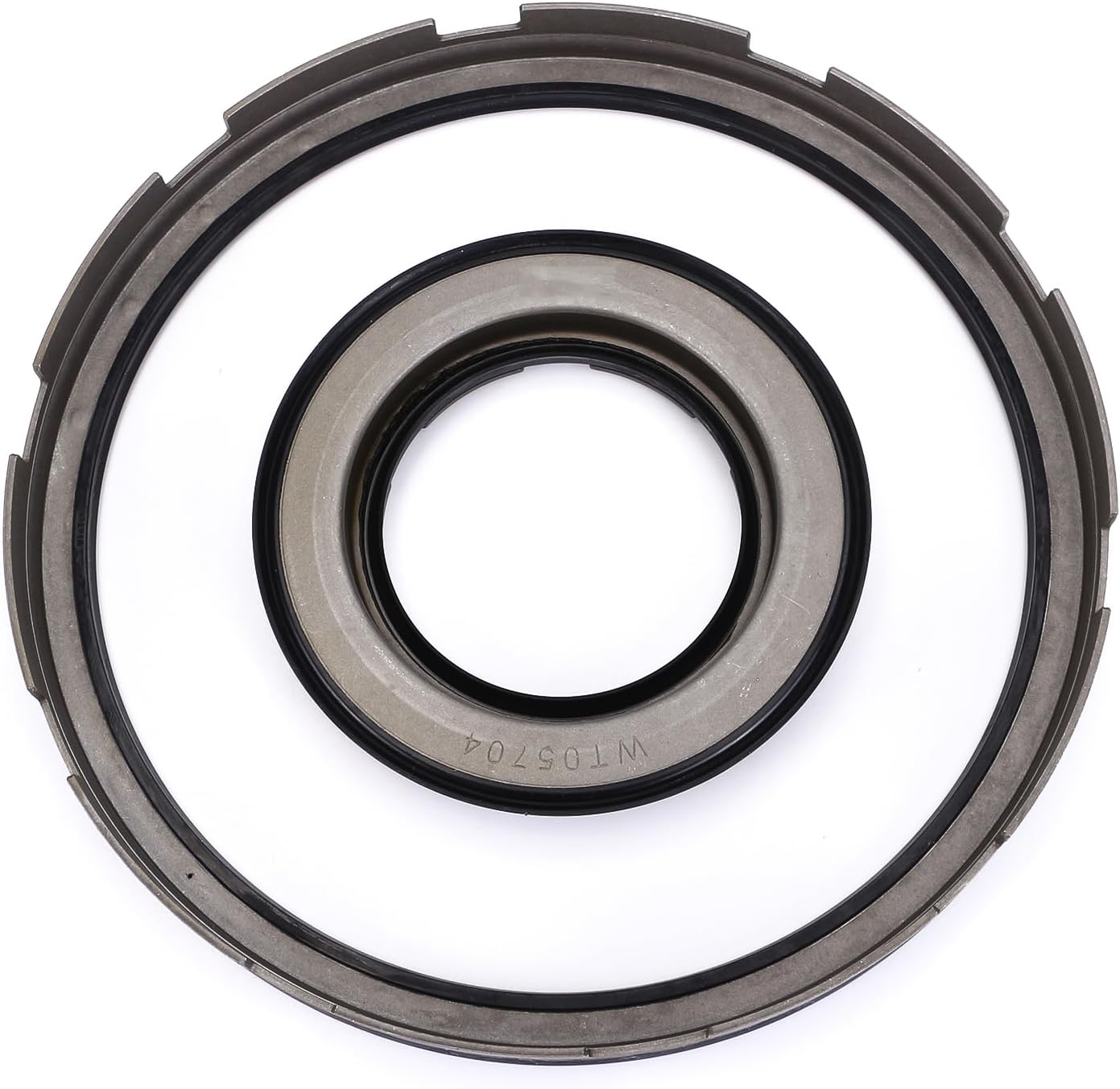
The inspection tip from that article is the useful part. These are bonded rubber-on-steel pistons, and heat can shrink the rubber. A healthy piston has some drag when you slide it in and out of its housing. One that slides in with no resistance has shrunk and will leak under apply even if you cannot see a crack. The GEARS recommendation is to replace the bonded pistons on every rebuild, not just the one that failed.
Cause 3: Gen 1 4-5-6 Drum Problems
Gen 1 units (2008-2011) and Gen 2 units (2012 on) use very different 4-5-6 clutch drums. Per GEARS, the Gen 1 drum has four sealing rings on the ring tower, four frictions, a wave plate, an inner seal on the fluid dam and a regulator valve feeding the compensator. Gen 2 went to three rings, five frictions, no wave plate, no inner seal and a passive dribble feed. The Gen 1 weak spots were the ring tower and the 4-5-6 wave plate, which show up as 4th, 5th and 6th gear complaints.
Do not assume every 4th, 5th and 6th complaint is the drum. GM Preliminary Information PI1131 ties a loss of 4th, 5th and 6th with P0796 on 2011 units built before April 1, 2011 to a non-functioning pressure control solenoid inside the TEHCM, and says only one missing-gear pattern will show up from that cause. Test the solenoid before you pull the unit. Our 6T40 won't shift into overdrive guide walks through sorting the solenoid from the drum, rings and bushings.
The trap is the swap. Dropping a Gen 2 drum into a Gen 1 case loses the inner seal and the fourth sealing ring the Gen 1 compensator feed regulator relies on. GEARS describes the regulator ending up wide open and leaking, with the car falling out of gear at stops, low line pressure complaints and possibly delayed engagement. If you get a Gen 1 car that "has been rebuilt before" and now drops to neutral, check which drum is in it.
Cause 4: A Flare to Neutral That Is Not a Clutch
Transmission Digest ran a case on a 2011 Cruze 1.8L with a Gen 1 6T40. Engagements were good, but it flared to neutral on the 1-2 shift. The obvious call is a 2-6 clutch failure, since that clutch comes on for 2nd. The clutch and piston were fine. A damaged filter plate was letting actuator feed pressure bleed into the pressure switch 2 circuit. That circuit is pressurized in 1st, 3rd, 4th and 5th and exhausts for 2nd, so on the 1-2 shift actuator feed dropped with it and the solenoids could no longer do their job.
The lesson carries past this one car. On the 6T40 the solenoids, TCM and filter plate sit together in the TEHCM stack, and a small leak there can look exactly like a burned clutch. Before you condemn a clutch on a Gen 1 unit, inspect the filter plate for damage around the actuator feed and pressure switch ports.
Cause 5: Software and Adapts, Not Hardware
Not every flare is a mechanical failure. GM's PIP5164 (November 2013) covers 2014 Malibu with the 2.5L (LKW) and 6T40 (MNH) built on or before September 3, 2013. It describes a pulse, fishbite or surge at 30-50 mph in 5th at steady throttle with the transmission above 55°C (131°F), and a harsh or flare-sag feel on 3-4, 4-5 and 5-6 upshifts above 30 mph at 25-40% throttle with ambient temperature above 21°C (70°F). No codes, no MIL. The fix is a TCM reprogram with an updated calibration. Always check for newer calibrations before you pull a unit for a no-code flare.
Adaptive values are the other half. GEARS lists the non-mechanical reasons a 6T40 flares or slips: adapts that have frozen, adapts reset by a power loss or voltage dip, bad powers or grounds, a faulty fluid temperature sensor, a brake switch problem and an internal mode switch fault. It lists the mechanical ones too: clutch clearance, piston problems and internal hydraulic leaks. The adapts can only correct so much, so a unit with worn clutch clearances will run out of adapt range and start flaring.
After any overhaul, valve body or TEHCM work, speed sensor replacement or TCM update, run the Service Fast Learn Adapts. GEARS gives the conditions: drive wheels blocked, parking and service brakes applied, 0% throttle, fluid between 70°C and 115°C (158-239°F), and the selector cycled Park to Reverse three times. Line pressure has to stay within 145 psi (1000 kPa) of commanded, and engine speed must stay under 1500 rpm. Active DTCs can stop it from running, and if it aborts, wait at least 30 seconds before trying again.
Before You Pull It: The Quick Checks
- Check the fluid level correctly. The 6T40 has no dipstick. GEARS says the fluid must be at 85-95°C (185-205°F) before you check at the level plug, because below about 60°C (140°F) a thermostatic element lets fluid drain into the sump and gives a falsely low reading. ATRA Technical Bulletin 1725 covers the same procedure. A low unit slips; an overfilled one by as little as half a quart vents fluid and can set P0218.
- Pull codes and freeze frame. P0776 with reverse and 3rd complaints means 3-5-R until proven otherwise. P2723 with drops to neutral means look at the 1-2-3-4 piston before you buy a solenoid.
- Check for calibration updates and look at battery, grounds and brake switch before trusting any adapt reading.
- Test the solenoids in the car. GEARS describes the Kent-Moore DT47825 kit on 90-100 psi of regulated shop air: command each solenoid on and off with the scan tool and watch the gauge move. A solenoid that passes and a slip that stays tell you the problem is past the solenoid.
- Run a Fast Learn. If the slip is a feel complaint with no code and no speed-sensor evidence of real slip, a learn may be all it needs.
The Fix That Lasts
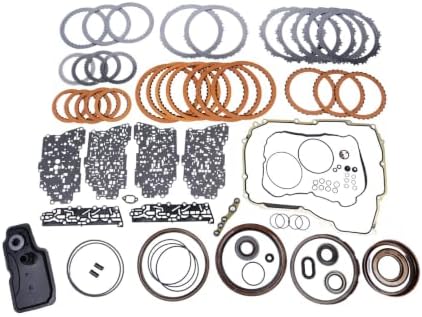
Once the unit is confirmed slipping mechanically, it comes out and comes apart. A partial repair on this transmission is how you see it again in six months. For a lasting fix:
- Replace all the bonded pistons, not just the one that cracked. Per GEARS, they shrink with heat whether or not they have failed yet.
- Install a new 3-5-R piston and apply plate on any Gen 1 unit, per PI0780A, and throw out any notched 3-5-R piston.
- Clean the whole case, both halves, and replace the pump fluid filter and the control solenoid filter plate. Debris from a broken plate travels.
- Keep the 4-5-6 drum matched to the generation. Gen 1 case, Gen 1 drum.
- Inspect the valve body and TEHCM filter plate while it is apart. Worn regulator bores and a damaged filter plate both mimic clutch slip.
- Refill hot and check at the plug, then clear adapts and run the Fast Learn before the road test.
6T40 bonded piston set at Core Transmission Parts
The bonded pistons are the part that shrinks and cracks. If you are replacing them, Core Transmission Parts carries the 2012-up 6T40 bonded piston set, plus filters and rebuild parts for the rest of the job.
View the 6T40 bonded piston set →6T40 and 6T45 bonded piston sets, rebuild kits with frictions, clutch modules and valve bodies — shipped fast from the USA.
Shop 6T40 parts →Related guides
- 6T40 Common Problems and Fixes
- GM 6T40/6T45 Wave Plate Failure
- 6T40 Shift Solenoid Symptoms and Replacement
- 6T40 Fluid Change Cost
- 6T40 Won't Shift Into Overdrive
- 6T70 P0776 Fix
FAQ
Why is my 6T40 transmission slipping?
The most common causes are a broken 3-5-R apply wave plate on 2008-2011 units, which slips reverse, 3rd and 5th and sets P0776, and cracked or heat-shrunk bonded clutch pistons. Low fluid, a damaged TEHCM filter plate and adaptive values that have run out of range can also cause slips and flares. Which gears slip tells you which clutch to look at.
What causes a 6T40 to drop to neutral at a stop?
GEARS magazine traced one case with P2723 to a cracked 1-2-3-4 clutch apply piston, even though the solenoids tested good. On Gen 1 units a Gen 2 4-5-6 drum installed during an earlier rebuild can also leave the compensator feed regulator leaking and cause drops to neutral at stops.
Can a software update fix 6T40 shift flare?
Sometimes. GM PIP5164 fixed a surge at 30-50 mph and flare-sag on 3-4, 4-5 and 5-6 upshifts on early 2014 Malibu 2.5L cars with a TCM reprogram, with no codes set. Check for a newer calibration and run a Service Fast Learn before pulling a unit for a no-code flare.
How do you check the fluid level on a 6T40?
There is no dipstick. Bring the fluid to 85-95 degrees C (185-205 F) and check at the level plug, because below about 60 C a thermostatic element lets fluid drain into the sump and the level reads falsely low. Low fluid causes slips, and overfilling by as little as half a quart can vent fluid and set P0218.
Does a 6T40 need a relearn after repair?
Yes. Run the Service Fast Learn Adapts after an overhaul, valve body or TEHCM work, speed sensor replacement or a TCM update. It needs the wheels blocked, brakes applied, 0% throttle, fluid at 70-115 C, and the selector cycled Park to Reverse three times, and active DTCs can stop it from running.
Sources
- General Motors — Preliminary Information PI0780A, "Slip or No Reverse or 3rd Gear, No Forward, DTC P0776," June 2015 (via NHTSA). Backs the affected 2008-2011 models and the Julian 11-015 build cutoff, the slip/flare in reverse and 3rd complaints with P0776, the broken 3-5-R apply (waved) plate cause, the new piston and plate recommendation, the debris clean-out with pump filter and control solenoid filter plate replacement, and the notched-piston note. static.nhtsa.gov (PDF)
- General Motors — Preliminary Information PIP5164, "Pulse Fishbite Surge Feel at 30 to 50 MPH and/or Harsh Firm or Flare Sag on 3-4 4-5 5-6 Upshifts Above 30 MPH," November 2013 (via NHTSA). Backs the 2014 Malibu 2.5L/6T40 application and build date, the operating conditions for both complaints, the no-DTC note, and the TCM reprogramming fix. static.nhtsa.gov (PDF)
- ATRA / GEARS Magazine — "6T40/45 Diagnosis and Fixes." Backs the P2723 drop-out-of-gear case and cracked 1-2-3-4 piston, the heat-shrunk bonded piston drag check and replace-every-rebuild advice, the 85-95°C level check and 60°C thermostatic element, half-quart overfill and P0218, the ISS/OSS sensing locations, and the DT47825 90-100 psi solenoid test. gearsmagazine.com
- ATRA / GEARS Magazine — "Why Doesn't My 6T40 Shift Right?" Backs the electrical, adaptive and mechanical causes of flares and slips, when a Service Fast Learn is required, its operating conditions, the 145 psi (1000 kPa) line pressure window, the 1500 rpm limit and 30-second retry wait. gearsmagazine.com
- ATRA / GEARS Magazine — "It Worked on the Road Test! The 6T40 4-5-6 Drum Interchange Quandary." Backs the Gen 1 and Gen 2 4-5-6 drum differences, the Gen 1 ring tower and wave plate failures, and the fall-out-of-gear and low line pressure symptoms from a Gen 2 drum in a Gen 1 case. gearsmagazine.com
- Transmission Digest — "Shift Pointers: 6T40 Neutral Drop." Backs the 2011 Cruze 1.8L Gen 1 flare-to-neutral on the 1-2 shift, the damaged filter plate and pressure switch 2 circuit cause, and the gears in which that circuit is pressurized. transmissiondigest.com
- General Motors — Preliminary Information PI1131, "Various Missing Gears, DTC P0776, P0796, P0878, P0873, P2714 or P2723 Set," December 2013 (via NHTSA). Backs the loss of 4th, 5th and 6th with P0796 on 2011 units built before April 1, 2011, the non-functioning pressure control solenoid cause and the one-condition-only rule. static.nhtsa.gov (PDF)
Also referenced: GM PI0670A, "Diagnostic Tips for DTC P0776" (February 2012), for the 2012 slip/flare into 3rd or 5th complaint, the Gen 1 TEHCM performance test limitation and the case air check warning, static.nhtsa.gov (PDF); the Sonnax 6T40-GEN2-ZIP quick guide for the clutch apply chart, sonnax.com (PDF); and ATRA Technical Bulletin 1725 for the fluid level procedure, atracom.blob.core.windows.net (PDF).