Generic code lists print P0716 as "Input/Turbine Speed Sensor A Circuit Range/Performance" and then tell you to check the sensor and the wiring. On a GM 6T70 or 6T75 that advice costs you a sensor, a couple of hours, and the code is still there when you are done.
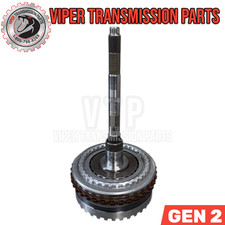
The reason is specific to this transaxle, and it is the one fact that makes the whole diagnosis fall into place: the reluctor the input speed sensor reads is not part of the input shaft. It is a cast iron retainer clipped onto the 3-5-Reverse clutch drum. The ISS on this unit is, in effect, watching a clutch drum assembly that is known to come apart. Once you know that, the odd complaints start making sense.
What P0716 actually means to the TCM
Take the word "performance" seriously. P0716 is not a circuit-open code, it is a rationality code. The module has an input speed number and that number does not agree with the other things it knows: engine speed across the converter, output speed at the far end of the gearset, and the gear it just commanded. P0717 is the sibling code for no signal at all. In practice the same failures set both, and which one you get comes down to how long the dropout lasts and how fast the vehicle is moving.
Sonnax lists P0716 and P0717 first in the block of codes a faulty ISS or OSS can produce on this family, alongside P0722, P0723, P0751, P0756, P0776, P0796, P2714 and P2723. That is why a 6T70 with a speed sensor problem usually walks in as a shift complaint: the module cannot compute a ratio without a trustworthy input number, so it defaults.
Cause 1: the ISS reluctor retainer ring backs out of its groove
This is the one GM put a bulletin on. GM bulletin 16-NA-013, "No Reverse, No Third, DTC P0716, P0717, P0776," covers 2016 Buick Enclave, LaCrosse and Regal, Cadillac SRX and XTS, Chevrolet Equinox, Impala and Traverse, and GMC Acadia and Terrain with RPOs MH2, MHM, M7U, M7V, M7W and M7X. The condition is a customer complaining of no Reverse and sometimes no 3rd, with technicians finding an erratic input speed signal. The cause GM gives is one sentence worth memorizing: the Input Shaft Speed Sensor Reluctor Ring Retainer Ring is out of the groove.
ATRA published a teardown that explains exactly how that produces a code, on a 2013 Ford 6F55N, the Ford twin of this unit and close enough that the failure transfers. The shop had a freshly rebuilt transaxle that kept dropping input speed to zero in 3rd and 5th and setting P0717, and it survived two new factory speed sensors plus a full pinpoint test of the circuit. The circuit was fine. Inside the unit, the snap ring holding the cast retainer to the 3-5-Reverse drum had blown out of its groove.
Here is the mechanism, and it is why the fault is so gear-specific:
- With the snap ring gone, the cast retainer is no longer clamped to the drum. A locator tab keeps it turning with the drum, until the tab breaks.
- Once the tab breaks, the only thing dragging the retainer around is friction from the inner 3-5-R oil seal. That is enough to carry it at drum speed as long as the 3-5-R circuit is exhausted.
- The moment 3-5-R applies, apply oil pushes the loose retainer away from the drum and presses it against the end cover. It stops turning. The ISS sees zero.
- Release the clutch and the retainer picks the drum speed back up, and input speed reappears.
So the signature is a signal that vanishes only in the three gears that use the 3-5-R clutch: 3rd, 5th and Reverse. ATRA notes a second symptom that rides along, and it is a good confirming clue. With input speed wrong during those applies the 3-5-R clutch adapt goes inaccurate, the piston applies with almost no accumulation, and you get a harsh engagement into 3rd, 5th and Reverse on top of the code.
GM's fix list for this is not a sensor. Per 16-NA-013 you replace the retainer ring (415), the input shaft speed sensor reluctor wheel (416), the 3-5-Reverse clutch piston (417) and the 3-5-Reverse and 4-5-6 clutch housing assembly (422), and GM flags all four as mandatory: failure to replace these parts may cause a repeat condition. That is a unit-out, case-cover-off repair, billed under labor operation 8466450.
Cause 2: ferrous debris stuck to a magnetic sensor
The second path is the well-known 6T70 wave plate failure, and it reaches P0716 indirectly. GM bulletin 09-07-30-012F is written around P0776 for a broken 3-5 Reverse clutch plate (waved), P/N 24254103, on 2007-2009 units with RPOs MH2, MH4, MH6 and MY9. Buried in the condition statement is the list of codes that can set independently as a result of that plate breaking: P0777, P2723, P0717, P0716, P2715 and P2714. GM adds that this normally will not occur before approximately 32,000 km (20,000 mi), and that debris generated by the condition can affect the operation of the speed sensors and other clutches.
The cleanup section spells out why, and this is the line that should change how you finish a 6T70 rebuild. The case halves must be separated, internal components removed and all parts thoroughly cleaned, and: "Be sure to clean the speed sensors, both input (ISS) and output (OSS). These sensors are magnetic and will attach and hold any ferrous material. Failure to clean these sensors may result in DTCs."
That is a comeback waiting to happen. A unit gets torn down for a wave plate, everything gets kitted, the sensors get wiped on a shop rag and go back in with a beard of steel on the pole face, and the car returns with a speed sensor code nobody can find a circuit fault for.
The same bulletin gives you a triage rule while you are in there. Pull the filter plate assembly (16) and look at the screens. Clean screens mean the pump fluid filter (201) did its job and the pump, converter and valve body can stay. Debris on the screens means inspecting the pump and converter further. GM also draws the line on what counts: fine particles you cannot feel, or a gray tint to the fluid, are not a reason to condemn a converter. Chips you can feel are.
Cause 3: Gen. 2 and the TEHCM trap
On Gen. 2 units the ISS and OSS live behind the control cover and plug into the TEHCM, so there is very little to test with a meter from outside. That pushes people toward throwing a control solenoid assembly at the problem, and GM says not to.
Bulletin 18-NA-358 covers 2014-2019 Buick, Cadillac, Chevrolet and GMC applications with the 6T70, 6T75 or 6T80 (RPOs M7U, M7V, M7W, M7X and MHM) for shudder and 2-3 or 3-2 shift concerns, and it carries two instructions that matter to anyone chasing a speed sensor code on a Gen. 2. The first is blunt: TEHCM replacement has not been an effective repair for the condition, so do not replace the TEHCM. The second belongs written on the toe board: inspect ISS and/or OSS for debris collecting, as this would be a sign of an internal component failure.
Read that as GM telling you to use the sensors as an inspection tool. A sensor face with fuzz on it is not the fault. It is the evidence.
Diagnosing it on the scan tool before you open anything
You can prove or eliminate the retainer ring failure from the driver seat if you set the test up properly. The catch is that a data list snapshot in Park proves nothing, because the retainer only lets go under 3-5-R apply pressure.
- Graph three PIDs together, not one. Engine speed, input speed and output speed on one screen, plus commanded gear if your tool supports it. A single ISS value scrolling in a list hides a dropout that lasts half a second.
- Baseline in Park at idle. Input speed should track engine RPM. This is where a dead sensor or a real circuit fault shows itself, and where the ATRA car looked completely normal.
- Watch the shift into 3rd and into 5th under light throttle load. If input speed drops to zero at the moment the 3-5-R clutch applies and recovers on the shift out, you have found it. Wiring faults do not care what gear you are in.
- Check Reverse separately. Reverse also applies 3-5-R, but the drum is being brought to a stop, so the dropout is less dramatic. Feel for a harsh Reverse engagement instead, which is the bad adapt riding along.
- Do the ratio math yourself. Divide input speed by output speed and compare that number against the gear the module says it commanded. A ratio that is correct in 1st, 2nd, 4th and 6th but garbage in 3rd and 5th tells you the input number is the thing that is lying, not the gearset.
- Wiggle the harness while the signal is live. If the signal holds steady through a full harness and connector wiggle, as it did in the ATRA case, stop buying sensors.
One more check before the unit comes out: look at fluid condition and the pan magnet. Ferrous fuzz points you at the debris path from cause 2 rather than the retainer, and it changes the scope of the job, because a debris failure means the case halves get separated and the filters get replaced.
The repair, and the details that decide whether it comes back
For the retainer ring failure there is no shortcut. The unit comes out, the case cover comes off, and the 3-5-R/4-5-6 clutch housing assembly comes apart. Replace the four parts 16-NA-013 lists, and while the drum is on the bench:
- Inspect the snap ring for distortion. ATRA is direct about it: if the ring is stretched, replace it. Do not try to close the gap with pliers.
- Inspect the snap ring groove in the drum, especially on a unit that has been built before, and check the drum for contact wear where the retainer tab rubbed the aluminum. If either is compromised, the drum gets replaced.
- Verify the ring is fully seated all the way around before the drum goes back together. This is the entire failure. It deserves a second look even when you are behind.
- Clean both speed sensors, per the GM instruction above, and replace the pump fluid filter and the control solenoid filter plate if there was debris in the unit.
Fill and relearn
DEXRON-VI only. Sonnax's procedure, published with their remanufactured Gen. 2 TEHCM: park level, start it, hold the brake and move the selector through every range pausing about three seconds in each, back to Park, idle at 500-800 RPM for at least a minute, then check level with fluid temperature between 180-200 degrees F off the DIC or a scan tool. Take the lower reading on the dipstick, verify with a second insertion, and add no more than a pint at a time. Solenoid body bolts and main control cover bolts both torque to 106 in-lb in the published sequence.
Relearn matters. Any time a TEHCM is replaced, Service Fast Learn Adapts has to be run so the module relearns individual clutch characteristics, and a replacement module has to be reprogrammed on the vehicle with a J2534 device. After any 3-5-R repair, ATRA's advice is to leave Reverse alone until the unit is warm, around 150 degrees F, and full, then recheck fluid level once you have run all the engagements.
What not to do
- Do not replace the sensor first. Two new factory sensors changed nothing on the ATRA car.
- Do not replace the TEHCM to chase it, per 18-NA-358 and the rule in 09-07-30-012F that the control solenoid assembly should not be replaced for any DTC unless SI diagnostics instruct you to.
- Do not wash the control solenoid (with body and TCM) valve assembly in a parts cleaner. GM states that outright.
- Do not clear the code and road test as the whole diagnosis. The dropout is gear-specific and brief. If you do not graph it, you will miss it.
Get the 6T70 super master rebuild kit → 6T70 bonded piston set →
GM lists the 3-5-Reverse clutch piston as a mandatory replacement in 16-NA-013. If neither kit is right for your year, the full rebuild kit collection covers Gen. 1 and Gen. 2.
FAQ
Does P0716 on a 6T70 mean I need an input speed sensor?
Usually not. P0716 is a performance code: the module got a signal it did not believe, not a dead circuit. The two causes GM publishes for this unit are both mechanical, the reluctor retainer ring coming out of its groove per bulletin 16-NA-013 and ferrous debris on the magnetic sensor face after a 3-5-R wave plate breaks per 09-07-30-012F. A genuinely bad sensor is the least common of the three.
Why does the input speed signal only disappear in 3rd, 5th and Reverse?
Because the reluctor the ISS reads is a cast retainer clipped onto the 3-5-Reverse clutch drum, and those are the three gears that apply that clutch. ATRA documented it on the Ford 6F55N twin: with the snap ring gone, apply oil pushes the loose retainer into the end cover, stopping it and killing the signal. Release the clutch and the signal returns.
What is the difference between P0716 and P0717 on a 6T70?
P0716 means a signal is present but does not agree with engine speed, output speed or the commanded gear. P0717 means no signal at all. The same failures set both, and which one you get depends on how long the dropout lasts and how fast the vehicle is moving. Do not treat P0716 as the milder problem; it points at the same 3-5-R drum area.
Can debris in the pan set P0716 without anything being broken?
Debris always means something is wearing or broken, but the sensor can be the only thing that complains. GM states in 09-07-30-012F that the input and output speed sensors are magnetic, will hold ferrous material, and that failing to clean them may result in DTCs. That is why a rebuilt unit comes back with a fresh P0716 when the sensors went in dirty.
Is the 6T70 wave plate repair covered by GM?
It was, on a specific list of vehicles. GM Special Coverage 14404A extended coverage for a cracked or fractured wave plate to 10 years or 120,000 miles from in-service date on 2007-2009 Buick Enclave, GMC Acadia, Pontiac G6, Saturn AURA and OUTLOOK, 2008-2009 Chevrolet Equinox, Malibu, Pontiac Torrent and Saturn VUE, and 2009 Chevrolet Traverse. Nearly all of those are past both limits now, so treat it as history rather than a live claim.
Need parts for this job?
Clutch and friction module kits, bonded pistons, filter and pan gasket kits, valve bodies, seal kits and DEXRON-VI for the 6T70 and 6T75, all in one place.
Shop 6T70 parts →Sources
- General Motors — Service Bulletin 16-NA-013, "No Reverse, No Third, DTC P0716, P0717, P0776," January 2016 (Version 2, May 2016), hosted by NHTSA. Backs the covered brands, 2016 model year and RPOs MH2, MHM, M7U, M7V, M7W and M7X; the condition statement of no Reverse, no 3rd and an erratic input speed signal with P0716, P0717 and/or P0776 active or history; the stated cause that the Input Shaft Speed Sensor Reluctor Ring Retainer Ring is out of the groove; the mandatory replacement of the retainer ring (415), input shaft speed sensor reluctor wheel (416), 3-5-Reverse clutch piston (417) and 3-5-Reverse and 4-5-6 clutch housing assembly (422); and labor operation 8466450. static.nhtsa.gov
- General Motors — Service Bulletin 09-07-30-012F, "No Reverse, 3rd or 5th, Check Engine Light Illuminated, DTC P0776 (Replace 3-5 Reverse Clutch Plate (Waved))," October 2012, hosted by NHTSA. Backs the 2007-2009 model coverage and RPOs MH2, MH4, MH6 and MY9; the companion code list P0777, P2723, P0717, P0716, P2715 and P2714 setting from a broken wave plate; the approximately 32,000 km (20,000 mi) onset; wave plate P/N 24254103; the statement that debris can affect the operation of the speed sensors; the quoted instruction to clean both ISS and OSS because they are magnetic and hold ferrous material; the filter plate screen decision rule for the pump and converter; the fine-particles versus feelable-chips converter call; the pump fluid filter (201) and control solenoid filter plate (16) replacement requirement; the warning not to wash the control solenoid valve assembly in a parts cleaner; and the rule not to replace it for any DTC unless SI diagnostics instruct you to. static.nhtsa.gov
- General Motors — Special Coverage Adjustment 14404A, "Transmission Clutch Wave Plate," March 2015, hosted by NHTSA. Backs the 10 year / 120,000 mile (193,000 km) special coverage period from in-service date, the covered 2007-2009 Buick Enclave, GMC Acadia, Pontiac G6, Saturn AURA and OUTLOOK, 2008-2009 Chevrolet Equinox, Malibu, Pontiac Torrent and Saturn VUE and 2009 Chevrolet Traverse, RPOs MH2, MH4, MH6 and MY9, and the described condition of a cracked or fractured wave plate resulting in loss of 3rd, 5th and Reverse. static.nhtsa.gov
- General Motors — Service Bulletin 18-NA-358, "Shudder, 2-3 Upshift or 3-2 Downshift Concern," October 2020, hosted by NHTSA. Backs the 2014-2019 Gen. 2 6T70/6T75/6T80 coverage and RPOs M7U, M7V, M7W, M7X and MHM; the statement that TEHCM replacement has not been an effective repair for the condition and the instruction not to replace the TEHCM; and the note to inspect ISS and/or OSS for debris collecting as a sign of internal component failure. static.nhtsa.gov
- ATRA / GEARS Magazine — Keith Clark, "The Disappearing Input Speed Sensor Signal." Backs the full failure mechanism: the cast iron retainer on the 3-5-Reverse drum is the reluctor wheel for the input speed sensor; the snap ring blowing out of its groove; the locator tab carrying the retainer until it breaks; inner 3-5-R oil seal friction driving it afterward; apply oil forcing the retainer against the end cover and stopping its rotation, which drops the input signal to zero; signal return on clutch release; the inaccurate 3-5-R adapt causing minimal accumulation and harsh 3rd, 5th and Reverse engagement; the two replacement sensors and passing circuit pinpoint test that ruled out electrical causes; and the prevention list covering snap ring distortion, groove and drum inspection, full seating, and leaving Reverse alone until the unit is warm at about 150 degrees F and full. gearsmagazine.com
- Sonnax — Remanufactured TEHCM GM6T70-G2-TEHCM product page and installation instructions. Backs the statement that the Gen. 2 TEHCM houses the TCM and solenoids with the ISS and OSS connecting to it; the code list P0716, P0717, P0722, P0723, P0751, P0756, P0776, P0796, P2714 and P2723 attributable to a faulty ISS or OSS; DEXRON-VI as the only specified fluid; the 106 in-lb torque for both the solenoid body bolts and the main control cover bolts; the fill and level-check procedure at 500-800 RPM idle and 180-200 degrees F with no more than a pint added at a time; the requirement to run Service Fast Learn Adapts after TEHCM installation; and the requirement to reprogram a replacement module on the vehicle with a J2534 device. sonnax.com