Every clutch, shift and torque converter apply in a 6T70 or 6T75 runs on the same pressure the pump builds. That is what makes a weak pump one of the most misdiagnosed faults in this transmission — the complaint never points straight at the pump. It shows up as a harsh valve body, a lazy solenoid, a slow TCC apply, or "it just feels tired," and a lot of parts get replaced before anyone puts a gauge on the line pressure test port.
This guide covers how the 6T70/75 pump is actually built (it is not the gear-type pump most people picture), the symptoms a weak one produces, the GM test that proves it, the rebuild gotcha that catches techs off guard, and the look-alike failure that gets blamed on the pump when it is not. Specs and procedures come from GM service information for the 6T70/6T75 and from Transmission Digest's Tech/Talk case files, listed in the Sources at the end.
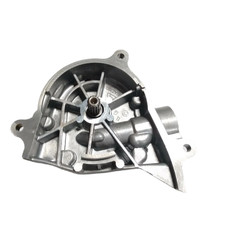
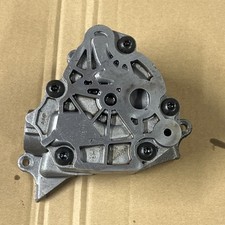

How the 6T70/75 pump is actually built
Picture a gear-type pump and you will be looking in the wrong place on this transmission. GM's service information lists the pump as the Fluid Pump Assembly (203), and it is not bolted directly behind the torque converter in line with the input shaft the way a 4L60E or 4L80E pump is. It is offset, driven by a Drive Sprocket (216) on the input side, a Driven Sprocket (215) on the pump side, and a Drive Link (217/218) — essentially a short chain — connecting the two. That is a deliberate packaging choice for a front-wheel-drive transaxle, where the pump has to sit beside the input shaft rather than behind it.
Around that drive, GM's fault-diagnosis checklists for the 6T70/75 call out the rest of the assembly by part number: the Fluid Outlet Seal Assembly (57) that seals pump output into the case, the Oil Filter Assembly (201) with its own neck seal (202), the five pump housing-to-case bolts (204), and the thrust washers on both sprockets (214, 219, 220) that control end play. Every one of those is a place pressure can leak away before it ever reaches a clutch.
Symptoms of a weak or failing 6T70 pump
1. Delayed engagement into Drive or Reverse
This is the complaint that sends the most 6T70s to a shop. You select a gear, there is a pause longer than normal, then the vehicle takes off. A pump that is not building pressure quickly on startup, or losing volume through a worn sprocket, filter leak or outlet seal, cannot fill the clutch circuits fast enough. The catch: a mismatched clutch apply piston produces the identical complaint with a perfectly good pump, covered below, so do not replace a pump on this symptom alone.
2. Whine or growl that tracks engine RPM
GM's Whine/Growl Noise diagnostic for the 6T70/75 lists the Fluid Pump Assembly alongside the differential and planetary gearsets as a source, specifically pointing techs to a loose or worn Drive Link Assembly, worn thrust washers on either sprocket, and worn or damaged fluid pump shaft splines. A whine that changes pitch with engine speed and does not change with vehicle speed points at the pump drive rather than the differential or axle bearings.
3. Line pressure low across every gear, not just one
A bad shift solenoid or a worn valve body bore usually hurts one gear or one shift. A pump that cannot keep up hurts all of them, because line pressure feeds the whole hydraulic system before it gets split off to individual clutches. If a scan tool pressure test (covered below) comes back low and stays low through the whole RPM and load range, the problem is upstream of the valve body.
4. Soft shifts, flare and slip under load
Low, inconsistent pump output lets clutches slip microscopically before they fully apply. Under light throttle it can feel like nothing more than a soft, mushy shift. Load the engine — a hill, a trailer, a hard merge — and the same marginal pressure turns into flare or an outright slip, because load is exactly when the clutches need the most clamping force and the pump has the least margin to give it.
5. Overheating from reduced flow
The pump does not just feed clutches. It pushes fluid through the cooler and lubricates the planetary gearsets and bushings. A pump running under volume starves both circuits, and the transmission runs hotter than it should even with a clean cooler and correct fluid level.
6. No movement in any gear (worst case)
If the pump loses prime, loses enough volume through internal wear, or the drive link lets go entirely, there is not enough pressure anywhere to apply a clutch. The vehicle sits in Drive or Reverse and does not move. This is the end stage, not the starting point, and by the time you are here the fluid should be checked immediately for metal.
What actually wears or fails inside the pump
- Drive link and sprocket wear. The chain-and-sprocket drive is a wear item like any other chain drive. Stretch or worn sprocket teeth let the pump rotor lag the input shaft under load, which shows up as the whine above and, eventually, reduced output.
- Fluid outlet seal and filter neck seal leaks. GM's Fluid Pressure High or Low checklist lists leaking or damaged fluid pump outlet seals (57) and the oil filter seal (202) as the first things to inspect on a pressure complaint. A leak here lets pump output bleed off before it reaches the valve body.
- Damaged, restricted or mis-installed filter. The same GM checklist flags the filter assembly directly. A collapsed, clogged or improperly seated filter starves the pump inlet, and a pump that cannot draw fluid cannot make pressure no matter how good its internal clearances are.
- Loose pump bolts. Also on GM's list: loose fluid pump bolts (204). A pump housing that is not clamped tight leaks internally across its own mating surfaces.
- Sticking line pressure blow-off valve. This relief valve protects the system from overpressure. If it sticks open, line pressure bleeds off under exactly the conditions — heat, RPM, load — that need it most.
The rebuild trap: the "non-serviceable" pump
GM designed the 6T70/75 fluid pump to be a non-serviceable assembly, and it shows in how it is fastened. The five Torx-head screws that hold the pump cover to the pump body are self-tapping — they cut their own threads into the pump body at the factory. Per Transmission Digest's Wayne Colonna, when a rebuilder removes those screws for inspection, they come out partially stripped and leave metal shavings packed into the threaded holes. Reinstall the screws without clearing that debris and they will not torque down properly, which hands you a low-pump-pressure comeback on a transmission you just rebuilt.
The fix, per the same source: blow all five bolt holes completely clear of metal shavings, chase the threads with an M6x1.0 bottom tap, clean the holes again, then install the five pump assembly bolts and torque to 120 in-lbs. Skip the tap-and-clean step and you are fighting a pressure problem you created, not one the transmission had.
The look-alike: a mismatched 1-2-3-4 clutch apply piston
Delayed engagement and first-gear slip do not always mean the pump. Transmission Digest documented a 2015 Chevrolet Equinox with a 6T75 complaining of exactly that, and the cause was a Generation 1 1-2-3-4 Clutch Apply Piston installed into a Generation 2 transmission. The Gen 2 piston's apply fingers run 0.147 in. taller than the Gen 1 piston (0.785 in. versus 0.638 in.), and Gen 2 also uses thinner frictions (0.058 in. versus 0.061 in.). Mixing generations leaves too much clutch clearance for the pack to hold, which reads exactly like weak pump pressure on a test drive. Generation 2 components started selectively in 2013 and became standard for 2014 and later, so if you are rebuilding a 6T70/75 from that window, confirm which generation of parts you actually have in hand before you condemn the pump.
How to confirm it is the pump: the GM pressure test
GM's Line Pressure Check is the procedure that separates a real pump problem from a look-alike. With a scan tool connected and the fluid level and codes checked first, remove the line pressure test hole plug and install a DT 21867-A gauge (any quality 300 psi gauge works). Using the scan tool's output controls — which only function in Park or Neutral below 1500 RPM, to protect the clutches — step the Line PC solenoid up and down in roughly 200 kPa (29 psi) increments, letting pressure stabilize at each step, and run the full sweep at least three times for consistent readings.
Compare what the gauge shows against GM's solenoid valve pressure chart. If the readings track the chart and the unit still misbehaves, the pump and pressure system are doing their job and you are looking at a valve body, solenoid or clutch issue instead. If the readings run low and stay low through the sweep, GM's own next step is the Fluid Pressure High or Low causes list — which starts with the pump assembly, its bolts, its seals and the filter, before it ever gets to the valve body. Reinstall the test plug and torque it to 12 N·m (106 lb-in) when you are done.
The repair and the fluid behind it
At the dealer level a failed pump means the full Fluid Pump Assembly. On the bench, a worn pump commonly gets replaced outright rather than repaired, given the non-serviceable screws above, and the filter and pan gasket always go in new alongside it — a tired filter undoes a fresh pump fast. Refill with DEXRON-VI only. GM's capacity chart lists 4.0 to 6.0 liters (4.2 to 6.3 quarts) for a drain-plug service, 5.0 to 7.0 liters (5.3 to 7.4 quarts) with the valve body cover removed, and 7.0 to 9.0 liters (7.4 to 9.5 quarts) for a full overhaul refill. As with any internal repair on this transmission, reset the adaptive values afterward and road test so the TCM relearns against the new hardware.
Browse 6T70 parts at Core Transmission Parts →
Need parts for this job?
6T70 pumps, filter and pan gasket kits, valve bodies and solenoid kits, shipped from the USA.
Shop 6T70 parts →FAQ
What kind of pump does the 6T70/6T75 use?
GM's service information lists it as the Fluid Pump Assembly (203), driven off the input shaft through a Drive Sprocket (216), Driven Sprocket (215) and Drive Link (217/218), offset from the input shaft centerline rather than bolted straight to it like a gear-type pump. It is not a serviceable component at the dealer level.
What are the symptoms of a failing 6T70 pump?
Delayed engagement into Drive or Reverse, a whine or growl that rises and falls with engine RPM, line pressure that reads low across every gear instead of one, soft or slipping shifts under load, and in bad cases no movement in any range. A pump problem shows up everywhere at once because every clutch in the unit depends on the same pump.
Can a 6T70 pump be rebuilt instead of replaced?
GM designed the pump as a non-serviceable assembly. Rebuilders do open it on the bench, but the five Torx cover screws are self-tapping and partially strip on removal, leaving metal shavings in the threaded holes. Transmission Digest's fix is to clear the shavings, chase the threads with an M6x1.0 bottom tap, and torque the five bolts to 120 in-lbs on reassembly.
How do you confirm a 6T70 line pressure problem is the pump and not the valve body?
GM's Line Pressure Check uses a DT 21867-A gauge in the test port with the scan tool commanding the Line PC solenoid in 200 kPa steps, Park or Neutral only, below 1500 RPM. If the gauge reading does not match GM's solenoid valve pressure chart at every step, GM's own next step is to work the Fluid Pressure High or Low causes list, which checks the pump assembly, filter and outlet seals before the valve body.
What fluid and capacity does a 6T70 pump job need?
DEXRON-VI only. GM's capacity chart lists 4.0 to 6.0 liters (4.2 to 6.3 quarts) for a drain-plug fluid change, 5.0 to 7.0 liters (5.3 to 7.4 quarts) with the valve body cover off, and 7.0 to 9.0 liters (7.4 to 9.5 quarts) for a full overhaul refill.
Sources
- GM service information (Saab 9-4X, Automatic Transmission 6T70/6T75) — No Drive in All Ranges. Backs the Fluid Pump Assembly (203) component breakdown: Drive Sprocket (216), Driven Sprocket (215), Drive Link (217), Fluid Outlet Seal Assembly (57), Drive/Driven Sprocket Thrust Washers (214, 219, 220), Oil Pump Bolts (204), Oil Filter Assembly (201) and Filter Neck Seal (202). saabwisonline.com
- GM service information (6T70/6T75) — Whine/Growl Noise. Backs the pump-related noise causes: loose or worn Drive Link Assembly (218), worn Driven/Drive Sprocket Thrust Washers, leaking Transfer Drive Gear Support Seal (213)/Fluid Outlet Seal (57)/Filter Seal (202), and worn or damaged fluid pump shaft splines. saabwisonline.com
- GM service information (6T70/6T75) — Fluid Pressure High or Low. Backs the pressure-fault check order: loose fluid pump bolts (204), leaking/damaged fluid pump outlet seals (57) and oil filter seal (202), improperly installed or damaged oil filter, a sticking line pressure blow off valve, and valve body and VBS checks that follow. saabwisonline.com
- GM service information (6T70/6T75) — Line Pressure Check. Backs the DT 21867-A gauge procedure, Park/Neutral below 1500 RPM limit, 200 kPa (29 psi) increments, three repeat sweeps, and the 12 N·m (106 lb-in) test plug torque. saabwisonline.com
- GM service information (6T70/6T75) — Fluid Capacity Specifications. Backs the DEXRON-VI drain-plug (4.0-6.0 L), valve body cover removal (5.0-7.0 L) and overhaul (7.0-9.0 L) capacities. saabwisonline.com
- Transmission Digest — "How to get around non-serviceable GM 6T70/75 self-tapping pump screws" (Wayne Colonna, April 26, 2024). Backs the non-serviceable pump design, the self-tapping Torx screws, the metal-shavings-in-screw-holes failure during rebuild, and the M6x1.0 tap and 120 in-lbs correction. transmissiondigest.com
- Transmission Digest — "GM 6T70/75 slips and delays in first" (Wayne Colonna, November 1, 2023). Backs the 2015 Chevrolet Equinox 6T75 case: a Gen 1 1-2-3-4 Clutch Apply Piston installed in a Gen 2 unit, the 0.638 in. versus 0.785 in. apply finger heights, the 0.061 in. versus 0.058 in. friction thickness, and the 2013-2014 generation changeover. transmissiondigest.com