"It won't go into overdrive" is one of the vaguest complaints that comes across the counter, and on a 6T70 or 6T75 it covers at least four different failures. The customer notices the engine turning too many revs at highway speed, or the gear number on the cluster never climbing past 4 or 5. Some of those vehicles have nothing wrong with them at all. Others have a clutch that has burned, a valve body bore that has worn, or a broken plate throwing steel through the unit. The good news is that this transaxle tells you which one it is, if you know which gear it stops in.
This guide walks through how the 6T70 makes 4th, 5th and 6th, the checks that rule out the no-fault causes, how to use the top gear it reaches to pick the failed clutch, and the parts that fix each case. The specs and clutch charts come from ATRA's 6T70 seminars, Sonnax, Transmission Digest, a GM bulletin filed with NHTSA, and GM's own owner's manual, all listed at the end.
What "overdrive" means on a 6T70
ATRA's 6T70 introduction lists the 6T70/6T75 ratios as 4.48, 2.87, 1.84, 1.41, 1.00 and 0.74, with 2.88 reverse. Strictly, only 6th is an overdrive; 5th is a 1:1 direct gear. In practice the customer means "the top gears," so you need to know how the unit builds 4th, 5th and 6th. It is a clutch-to-clutch design with five clutches and a low one-way clutch, and each forward gear uses exactly two apply elements. From ATRA's range reference chart:
| Gear | Ratio | Applied |
|---|---|---|
| 3rd | 1.84 | 1-2-3-4 + 3-5-Reverse |
| 4th | 1.41 | 1-2-3-4 + 4-5-6 |
| 5th | 1.00 | 3-5-Reverse + 4-5-6 |
| 6th | 0.74 | 2-6 + 4-5-6 |
Two things fall out of that table. First, the 4-5-6 clutch is in every one of the top three gears, so if it is weak, all three suffer. Second, the clutch that joins it changes on each shift: the 4-5 shift swaps the 1-2-3-4 clutch for 3-5-R, and the 5-6 shift swaps 3-5-R for 2-6. So the gear the transmission stops at, and the gears below it that also misbehave, point straight at a clutch. Ford uses the same gearset in the 6F50 and calls the 4-5-6 clutch the "overdrive" clutch, which is a handy way to remember it.
The controls follow the same pattern. ATRA's solenoid function chart assigns pressure control solenoid 2 to the 3-5-R clutch regulator valve, PCS3 to the R1/4-5-6 regulator valve, and PCS4 to the 2-6 regulator valve. PCS2 and PCS3 are normally high (pressure passes to the clutch with the solenoid off); PCS4 is normally low (no pressure with it off).
Check 1: make sure it is not being told to stay down
Before you pull a pan, rule out the driver-selected limit. GM's 2017 Traverse owner's manual describes Electronic Range Select: move the lever to L and use the plus and minus button to set the top gear the transmission is allowed to use. The number shown next to the L in the cluster is the highest gear available, and the manual gives the exact example: with 4 displayed, gears 1 through 4 shift automatically and the transmission will not shift into 5th until the plus button is pressed or the lever goes back to D. A lever left in L after towing, or a sticky plus button, produces a perfect "won't shift into overdrive" complaint on a healthy transmission. Look at the cluster before anything else.
The same manual lists a TRANSMISSION HOT IDLE ENGINE message and tells the driver to stop and idle until the fluid cools. If the customer has seen that message, you have a heat problem to find first: a restricted cooler, low fluid or a slipping clutch making its own heat.
Check 2: fluid level, the right way
A 6T70 that is a quart or more low will slip in the gears that need the most apply volume, and the rotating 3-5-R and 4-5-6 clutches are fed through the drum. ATRA's product-issues seminar gives the procedure: vehicle level, parking brake on, run the selector through the ranges, idle one minute, and read the level with transmission fluid temperature between 180 and 200 degrees F on the scan tool. A cold check on this unit is a guess. Use DEXRON-VI only; it is the fluid GM specifies for this transmission in the owner's manual. While the plug is out, look at what comes out with the fluid. Steel pieces or friction material mean the rest of this article is about a teardown, not an adjustment.
Check 3: find the top gear, and prove it with ratio math
Road test with a scan tool connected and watch commanded gear, input speed and output speed. Do the arithmetic yourself: input speed divided by output speed should land on 1.41 in 4th, 1.00 in 5th and 0.74 in 6th. If the TCM commands 6th and the calculated ratio wanders or climbs, the clutch is slipping. If the TCM never commands 6th, the TCM is protecting something or has been told not to shift. That is the most useful split in the whole diagnosis. Pull stored and history codes too; ratio codes, solenoid performance codes and the P0776 family all narrow it further.
Tops out in 4th: suspect the 3-5-Reverse clutch
5th needs 3-5-R plus 4-5-6. If the unit shifts into 4th but will not take 5th, and it also has no 3rd and no reverse, you are almost certainly looking at the pattern failure of the family. GM bulletin 09-07-30-012F describes it: no reverse, no 3rd or 5th, a check engine light and DTC P0776, caused by a broken 3-5-Reverse wave plate that lets the piston over-travel. The bulletin lists P0777, P2723, P0717, P0716, P2715 and P2714 as codes that can set on their own from the debris, calls for updated plate 24254103, and requires separating the case halves to clean out the metal and replace the pump filter and control solenoid filter plate. ATRA's seminar adds a fast screen: unplug the transmission and check reverse. Our 6T70 P0894 guide covers this failure in depth.
If 3rd and reverse are fine but the 4-5 shift flares, the 3-5-R regulator side is the next stop. Sonnax's Gen. 1 vacuum test guide ties 2-3 flare, 4-5 flare, delayed reverse, reverse slip and a burned 3-5-R clutch to wear at the 3-5-R clutch regulator valve.
Tops out in 5th: suspect the 2-6 clutch
6th is 2-6 plus 4-5-6. If the unit runs a clean 5th but will not hold 6th, check whether 2nd also slips or flares, because the 2-6 clutch is the only thing those two gears share. Sonnax lists 1-2 flare, 5-6 flare, 2nd slip and 6th slip and a burned 2-6 clutch as the symptoms of a worn 2-6 clutch regulator valve bore, repaired with its kit 124740-17K. On the electrical side, PCS4 runs the 2-6 regulator and is normally low, so an open circuit leaves the clutch unapplied in both 2nd and 6th. A no-6th complaint with a matching 1-2 problem is a 2-6 circuit until proven otherwise.
Slips in 4th, 5th and 6th: suspect the 4-5-6 circuit
When the complaint spreads across all three top gears, stop looking at the other clutches. The common factor is 4-5-6, and on this unit the usual root cause is not the frictions themselves but the accumulator that cushions them.
- Gen. 1 (2007 to roughly 2013): Sonnax's vacuum test guide lists 3-4 flare, 3-4 harsh, slipping gears, ratio codes and a burned 4-5-6 clutch as the symptoms of a worn 4-5-6 accumulator piston bore, repaired with kit 124740-04K.
- Gen. 2 (2013 and later): Transmission Digest reports the same failure on the updated valve body. Wear in the 4-5-6 accumulator piston bore bleeds off apply pressure, and TransGo's drop-in piston 6T70-ACCM-G2, with two O-rings to keep the piston off the bore, was released for slips in 4th, 5th or 6th, burnt 4-5-6 clutches, harsh or delayed shifts, flares, and solenoid performance or ratio codes.
Replace burned 4-5-6 frictions without fixing that bore and the new clutches go the same way. Vacuum test the accumulator bore on the bench before the valve body goes back in.
One more leak path belongs here. ATRA's product-issues seminar describes a 3-4 or 4-3 bind, sometimes with P0797, caused by a worn ring groove on the case cover hub sleeve that leaks between the 3-5-R and 4-5-6 clutch circuits. Measure the gap between the ring and the edge of its groove with a feeler gauge; ATRA gives 0.007 inch as the maximum, and past that the case cover gets replaced. A leak there can rob 4-5-6 apply pressure just as badly as a worn accumulator.
After the repair: let it relearn
A 6T70 that was repaired correctly can still refuse to shift well until the TCM relearns the clutches. ATRA says to run Service Fast Learn Adapts with a scan tool after repairs. On Gen. 2 units the TCM also runs clutch pressure learning during steady driving, and ATRA spells out which gear each clutch is learned in: the 4-5-6 clutch in 3rd, the 1-2-3-4 and 2-6 clutches in 5th, and the 3-5-R clutch in 6th. Learning aborts on rough roads. The practical point: a test drive that never holds steady in 3rd, 5th and 6th on smooth pavement never finishes the learn.
The short version
- Check the cluster for an L with a gear number. Electronic Range Select limits top gear by design.
- Set fluid level at 180-200 degrees F and look at what drains out.
- Watch commanded gear against calculated ratio: never commanded is a control issue; commanded but slipping is a clutch.
- Stops in 4th with no 3rd or reverse: the 3-5-R wave plate. Stops in 5th with a 2nd-gear complaint: the 2-6 circuit. Slips in 4th, 5th and 6th: the 4-5-6 accumulator and hub sleeve rings.
- Fix the pressure leak along with the frictions, then run Service Fast Learn Adapts.
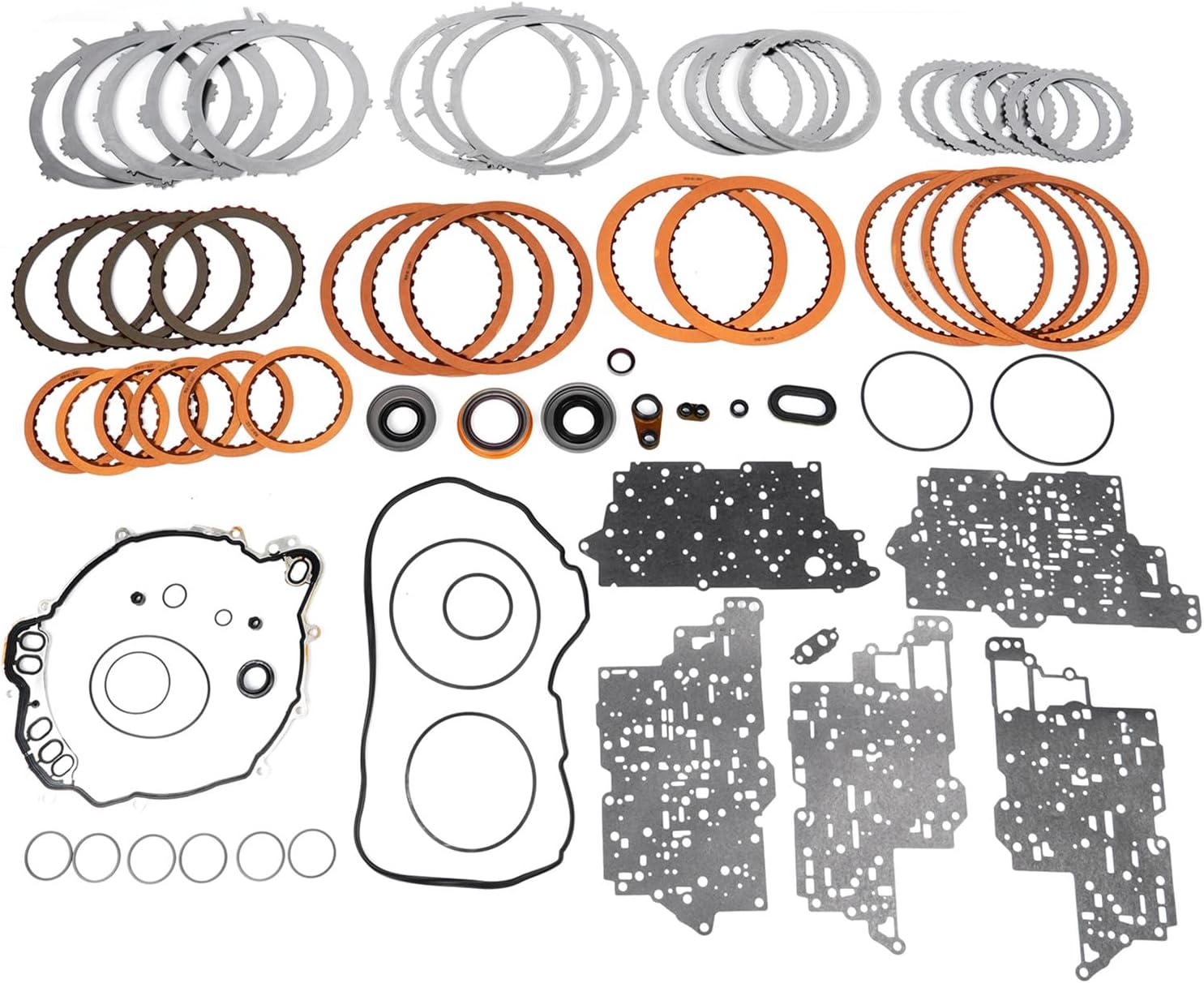
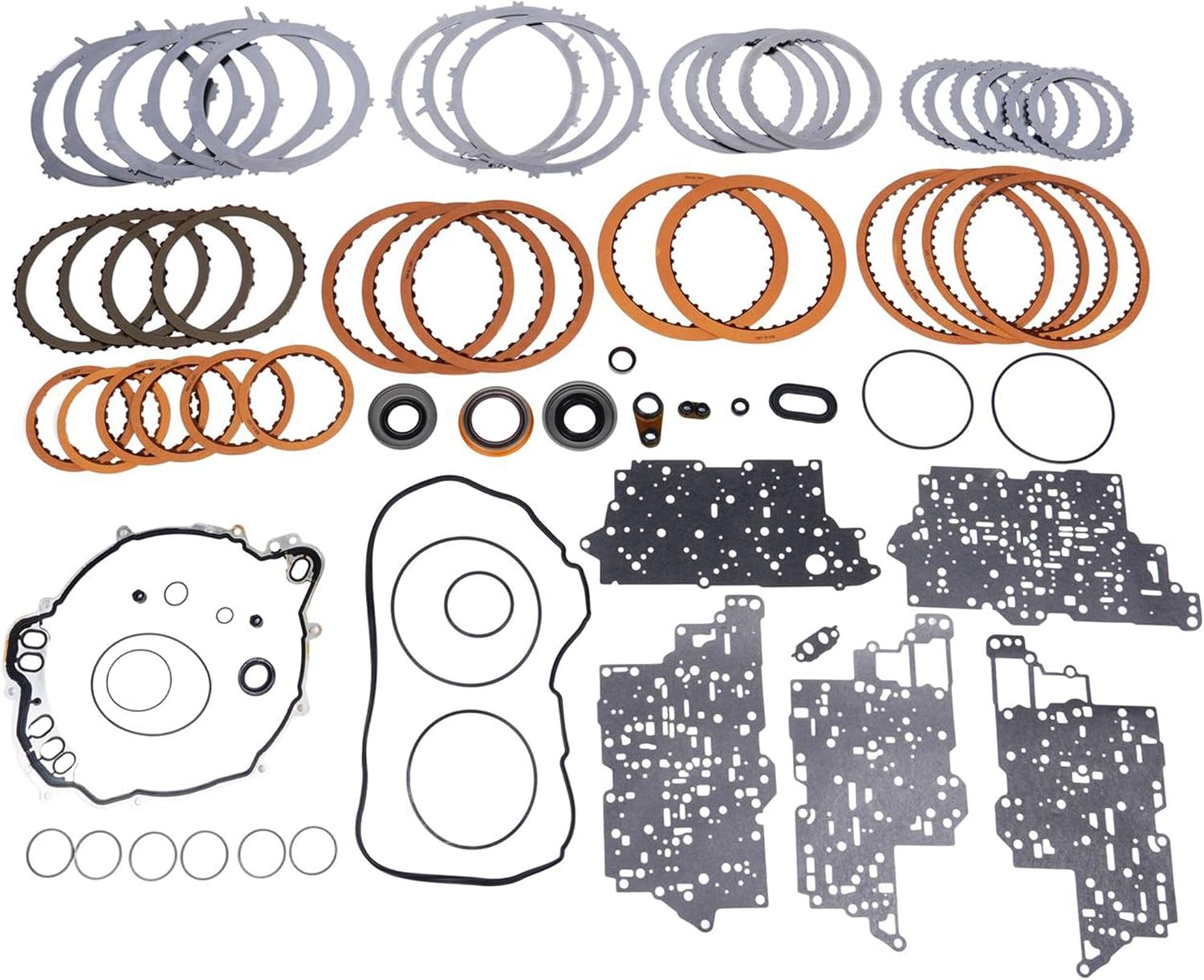
6T70 friction clutch pack, 2007-2012
If the teardown shows burned 4-5-6, 2-6 or 3-5-R frictions, this Raybestos high-energy pack covers the clutches for Gen. 1 units. Fix the accumulator or regulator bore at the same time.
View at Core Transmission Parts →Browse 6T70 parts at Core Transmission Parts →
Need parts for this job?
6T70/6T75 master rebuild kits, valve bodies and hard parts, shipped from the USA. Confirm Gen. 1 or Gen. 2 by VIN and RPO before you order.
Shop 6T70 parts →FAQ
Why won't my 6T70 shift into 6th gear?
First check the cluster: if the shifter is in L with a number beside it, Electronic Range Select is limiting top gear by design. If it is in D, 6th uses the 2-6 and 4-5-6 clutches, so a unit that holds 5th but not 6th usually has a 2-6 clutch or 2-6 regulator valve problem, often with a matching 2nd-gear complaint.
Does the 6T70 have an overdrive gear?
Yes. Per ATRA, 6th gear is 0.74:1, the only true overdrive ratio. 5th is 1.00:1 direct drive. Both 5th and 6th, plus 4th, use the 4-5-6 clutch.
What causes a 6T70 to have no 3rd, 5th or reverse?
GM bulletin 09-07-30-012F ties that combination, usually with P0776, to a broken 3-5-Reverse wave plate. It requires separating the case halves, cleaning out the debris, and installing the updated plate.
Can a worn valve body stop a 6T70 from shifting into 5th and 6th?
Yes. Sonnax and TransGo both document 4-5-6 accumulator piston bore wear that bleeds off 4-5-6 apply pressure, causing slips in 4th, 5th and 6th and burned 4-5-6 clutches. It affects Gen. 1 and Gen. 2 valve bodies and has to be repaired along with the clutches.
Do I need to relearn a 6T70 after a repair?
Yes. ATRA says to run Service Fast Learn Adapts with a scan tool. Gen. 2 units also learn clutch fill during steady driving in 3rd, 5th and 6th, and the learn aborts on rough roads.
Sources
- ATRA — "6T70 Introduction," Steve Garrett. Backs the range reference chart (1-2-3-4 + 3-5-R in 3rd, 1-2-3-4 + 4-5-6 in 4th, 3-5-R + 4-5-6 in 5th, 2-6 + 4-5-6 in 6th), the solenoid function chart (PCS2 to the 3-5-R regulator valve, PCS3 to the R1/4-5-6 regulator valve, PCS4 to the 2-6 regulator valve), the normally high and normally low solenoid assignments, and the Electronic Range Selector top-gear limit. atracom.blob.core.windows.net (PDF)
- ATRA — "6T70 Product Issues and Updates," Steve Garrett. Backs the hot fluid level check at 180-200 degrees F, the 3-4/4-3 bind and P0797 from a worn case cover hub sleeve ring groove leaking between the 3-5-R and 4-5-6 circuits with 0.007 in maximum clearance, the unplug-and-check-reverse screen, Service Fast Learn Adapts, and the clutch pressure learn gear enablement (4-5-6 in 3rd, 1-2-3-4 and 2-6 in 5th, 3-5-R in 6th) with rough road abort. atracom.blob.core.windows.net (PDF)
- General Motors — 2017 Chevrolet Traverse Owner's Manual. Backs the Electronic Range Select description (L position, plus/minus button, the number beside L as the highest gear allowed, and the example that with 4 displayed the transmission will not shift into 5th until plus is pressed or D is selected) the TRANSMISSION HOT IDLE ENGINE message, and DEXRON-VI as the specified automatic transmission fluid. chevrolet.ca (PDF)
- General Motors — Service Bulletin 09-07-30-012F, "No Reverse, 3rd or 5th, Check Engine Light Illuminated, DTC P0776" (via NHTSA). Backs the broken 3-5-Reverse wave plate as the cause of no reverse, 3rd or 5th with P0776, the related P0777, P2723, P0717, P0716, P2715 and P2714 codes, updated plate 24254103, and the case-half separation, debris cleanup and filter replacement requirements. static.nhtsa.gov (PDF)
- Sonnax — "GM 6T70, 6T75 (Gen. 1) Vacuum Test Guide." Backs the 4-5-6 accumulator piston kit 124740-04K and its symptoms (3-4 flare, 3-4 harsh, ratio codes, burned 4-5-6 clutch, slipping), the 2-6 clutch regulator valve kit 124740-17K and its symptoms (1-2 flare, 5-6 flare, 2nd slip, 6th slip, burned 2-6 clutch), and the 3-5-R clutch regulator valve symptoms (2-3 flare, 4-5 flare, delayed reverse, reverse slip, burned 3-5-R clutch). sonnax.com
- Transmission Digest — "TransGo offers drop-in fix for GM 6T series clutch failures." Backs the Gen. 2 (2013 and later) 6T70/6T75/6T80 4-5-6 accumulator piston bore wear causing loss of 4-5-6 apply pressure, the symptom list (slips in 4th, 5th or 6th, burnt 4-5-6 clutches, harsh or delayed shifts, flares, solenoid performance and ratio codes), and the dual O-ring replacement piston 6T70-ACCM-G2. transmissiondigest.com