Ask three shops to quote a 722.6 fluid change and you'll get three different numbers, and it isn't because one of them is ripping you off. "Fluid change" on this transmission means two genuinely different jobs that use different amounts of fluid, and the fluid itself, not the labor, is what actually drives the price. Mercedes also spent the better part of a decade telling owners this transmission was filled for life, which means a lot of 722.6s on the road are seeing their first service well past when they should have, with no baseline invoice to compare a new quote against. Here's what the job actually involves, what Mercedes' own fill specification says it takes, and what you should expect to pay whether you're booking a shop or doing it yourself.

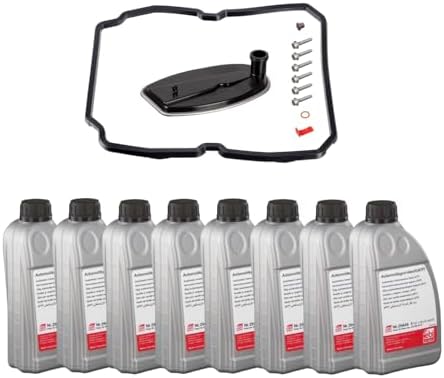

Two Different Jobs Both Get Called "Fluid Change"
A pan-drop service pulls the pan, drops whatever fluid was sitting in it, swaps the filter and gasket, and refills through the dipstick tube. That only moves the fluid that physically drains out through the pan opening, which real-world shop reports put at roughly 4 to 5 quarts (3.8-4.7 liters). The fluid that stays in the torque converter, the cooler, and the lines running to it never gets touched, so you're replacing maybe half of what's actually in the transmission.
A full exchange uses either a power-flush machine or an air-pressure drain and fill tool connected to the cooler lines, and pushes new fluid through the entire circuit, including the torque converter, until what comes out runs clean. Daimler's own version of this job, workshop procedure AR27.55-P-0100A, drains the pan, fits a new filter, then pushes old fluid out through the right-hand cooler line with the engine running in 3-liter batches while fresh oil goes in, and it states the entire flushing procedure requires 14 liters of transmission oil [5]. That is roughly three times what a pan-drop uses. More fluid in means more fluid purchased, which is the single biggest reason two "fluid change" quotes on the same car can be $150 apart with neither shop doing anything wrong.
The Fluid Spec Is Non-Negotiable, and It's the Expensive Line Item
The 722.6 is approved for exactly one fluid family: Mercedes-Benz operating fluid specification 236.14, sold under Mercedes part number A001 989 68 03 10 and commonly branded ATF 134. Mercedes' own star bulletin on fluid specification changes is explicit that 236.14 is the correct fluid for the 722.6, and specifically warns against mixing it with the 236.15 fluid used in later 722.9 seven-speeds or the 236.16 fluid used in the 725.0 nine-speed, because dealer-level filling equipment keeps them in separate dedicated tanks for exactly that reason [1].
Both major third-party fluid makers confirm the same thing from the other direction. Fuchs' TITAN ATF 4134 technical data sheet lists MB-APPROVAL 236.14 and states it's backward compatible with the 722.6's older 236.12 approval, built on Group III+ base oils [3]. Motul's ATF 236.14 product documentation carries the identical 236.14 approval as a standalone spec product, not a universal fluid repackaged with a sticker [4]. Neither of those is a generic "fits most Mercedes" ATF you grab off a shelf, which is exactly why this fluid costs more than a jug of Dexron and why it's the part of the invoice that doesn't shrink no matter who does the labor.
How Much Fluid It Actually Takes
Daimler's own workshop fill procedure, AR27.00-P-0100AC, lists the initial fill capacity by transmission variant, and it's a wider range than most owners expect. The most common 5-speed family fitted to W203 C-Class and W211 E-Class cars (722.600 through 722.699) takes 7.5 liters plus a half-liter margin. Other variants in the same 722.6 family run from 7.3 liters up to 9.3 liters depending on the exact transmission number and chassis, and a handful of variants have a separate published "during oil change" quantity of 5 to 6.5 liters for a disassembled service, distinct from the initial factory fill [2].
Part of what you are paying a shop for is the level check, because the 722.6 is not a pour-and-look transmission. Febi, an OE-supplier parts maker, notes that no transmission dipstick is supplied from the factory; the filler tube in the engine compartment is sealed with a cap and a locking pin that has to be broken off and replaced after every check [6]. The level is read with a separate measuring dipstick pushed all the way to its end stop, with the car standing level on its wheels and the fluid cold at 25 °C, where it must sit between the minimum and maximum marks of the 25 °C range [6]. On an oil change, febi's sequence is to pour in about 5 liters first, start the engine, run it briefly in P, shift through the gears several times at idle, return to P, then top up and re-measure [6]. A quote that does not include a new locking pin and a measured level check is a quote for half the job.
The practical upshot: before you compare two quotes, confirm they're quoting the same job on the same transmission variant. A pan-drop quote using 4-5 quarts and a full-exchange quote using 8-9 liters on a car that actually needs the larger fill are not comparable numbers, and neither is wrong, they're just different services.
| Service type | Fluid replaced | What's included |
|---|---|---|
| Pan-drop and filter | ~4-5 quarts (3.8-4.7 L) | Filter, pan gasket, fluid that drains through the pan |
| Full exchange / power-flush | Factory cooler-line flush: 14 L total (per AR27.55-P-0100A); unit holds ~7.3-9.3 L | Filter, pan gasket, fluid through torque converter and cooler lines |
Parts Cost Breakdown
A filter and gasket kit for the pan-drop job runs in the $29-95 range depending on whether it's a bare filter or a kit that bundles the filter with the conductor plate assembly (common on this family since the filter often mounts through it). The fluid itself is the bigger number: at roughly 4-5 quarts for a pan-drop or the 14 liters Daimler specifies for a full cooler-line exchange, correctly-spec'd 236.14 fluid is what separates a $150 DIY job from a $300+ one, regardless of labor. A bundled kit that includes both the filter and enough 236.14 fluid for a full exchange removes the guesswork on quantity, since buying fluid a liter short mid-job on a Saturday is its own kind of expensive.
If you're doing a full exchange yourself, budget for the tool too. A drain-and-fill adapter that connects to the cooler lines is a one-time cost that pays for itself after a couple of services, versus renting or improvising a power-flush setup each time.
Labor and Shop Pricing
Shop invoices that owners have posted for this exact service land in a wide band: roughly $230 at the low end for a straightforward pan-drop at a dealer or independent shop using correct fluid, up toward $450-plus for a full exchange that includes more fluid and more labor time pulling the pan, cleaning the magnet, and verifying the fill level with the car at operating temperature (the 722.6's fill procedure specifically calls for checking level both cold and, if shift complaints are present, with the transmission over 80°C [2] [6]). A quote well under that range is worth a direct question about which fluid they're using and whether it's a pan-drop or a full exchange, since neither corner is cheap to cut correctly on this unit.
Is DIY Actually Cheaper?
For a basic pan-drop, yes, by a meaningful margin, since you're paying parts cost (filter, gasket, 4-5 quarts of fluid) plus your own time instead of shop labor. For a full exchange, the gap narrows because you also need the drain-and-fill hardware and roughly double the fluid, and that fluid cost doesn't change whether you or a tech is doing the pouring. Where DIY wins beyond the invoice is catching problems early: pulling the pan yourself means you see metal in the fluid, a worn filter, or fluid that's darker or burnt-smelling before it turns into a bigger bill, which is harder to get from a shop that just hands you an invoice.
Frequently Asked Questions
Why do fluid change quotes for a 722.6 vary so much?
Because two different jobs both get called a "fluid change." A pan-drop service only replaces the fluid that drains out through the pan, roughly 4-5 quarts (3.8-4.7 liters), and leaves the fluid trapped in the torque converter, cooler and lines untouched. A full exchange, done with a power-flush machine or an air-pressure drain tool, pushes new fluid through the whole system and replaces closer to the transmission's full capacity, which per Daimler's own fill specification runs 7.3 to 9.3 liters depending on the exact 722.6 variant. Daimler's factory flush procedure (AR27.55-P-0100A) uses 14 liters in total to get there, about three times a pan-drop, so it costs more, and a shop that doesn't say which method they're quoting is a shop you should ask directly.
Can I use any red ATF to save money on a 722.6 fluid change?
No. The 722.6 is only approved for Mercedes-Benz specification 236.14, sold as ATF 134 under part number A001 989 68 03 10. Mercedes' own bulletin on fluid specification changes warns that 236.14 and the newer 236.15/236.16 fluids used in later transmissions must never be mixed, since they're chemically different products kept in separate filling equipment at the dealer level. A generic Dexron or Mercon fluid, or an off-spec "universal" ATF, will change shift feel and can accelerate wear in a transmission this electronically sensitive, even though it won't throw an immediate code.
How much fluid does a 722.6 actually hold?
It depends on the exact variant. Daimler's workshop fill procedure (AR27.00-P-0100AC) lists initial charge capacities ranging from 7.3 liters up to 9.3 liters across the 722.6 family depending on the specific transmission number and chassis, with most common C-Class and E-Class 5-speed applications (722.600-699) at 7.5 liters plus a half-liter margin. That range is also why dealer and shop quotes differ car to car, not just shop to shop.
Is a DIY 722.6 fluid change actually cheaper than a shop?
For a basic pan-drop and filter service, yes, usually by $50-150, since you're only paying for the filter and gasket kit plus 4-5 quarts of 236.14-spec fluid and your own time. For a full exchange, the gap closes fast, because you also need a drain and fill tool or power-flush adapter and up to 14 liters of fluid, which is the expensive part regardless of who does the labor. The real savings in doing it yourself is catching problems early, not just the invoice total.
What parts get replaced in a normal 722.6 fluid change?
At minimum the filter and the pan gasket, since the pan has to come off to access either one. Most service kits bundle those two together, and some 722.6 applications also route the filter through a conductor plate assembly, which is why conductor-plate-and-filter kits are common for this family even on a routine service. The fluid itself, in the correct 236.14 spec, is the largest cost in the job on nearly every 722.6.
722.6 Transmission Filter, OEM A1402720095
CoreTransmissionParts carries the direct-fit filter for the 722.6 pan-drop service, the part that's being replaced regardless of which fluid method you use.
View the filter →Shop 722.6 parts →
Sources
- Mercedes-Benz USA Star Bulletin S-B-00.40/89d, "Operating Fluid Specification Changes for Automatic Transmission," November 6, 2013, hosted via NHTSA. Backs the 236.14 fluid spec, ATF 134 branding, part number A001 989 68 03 10, and the warning against mixing 236.14/236.15/236.16 oils. static.nhtsa.gov (PDF)
- Daimler AG Workshop Information System, AR27.00-P-0100AC, "Check oil level in automatic transmission and correct if necessary," transmission 722.6. Backs the per-variant initial fill capacities (7.3-9.3 liters across the 722.6 family), the "during oil change" quantities published for specific variants, the fill procedure, and the special tool part numbers for the dipstick and filling pipe. mbclub.ru (PDF)
- Fuchs Lubricants, TITAN ATF 4134 technical product page. Backs the MB-APPROVAL 236.14 certification, backward compatibility with the 722.6's 236.12 approval, and the Group III+ base oil formulation. fuchs.com
- Motul, ATF 236.14 product page. Corroborates the 236.14 approval as a standalone fluid specification independent of the Fuchs formulation. motul.com; the ATF 236.14 technical data sheet (09/2024) lists MB-Approval 236.14 and Mercedes references A 001 989 45 03 and A 001 989 68 03. motul.com (PDF)
- Daimler AG Workshop Information System, AR27.55-P-0100A, "Flush out automatic transmission and torque converter," transmission 722.6. Backs the factory full-exchange method (pan drain at 80 C, new filter, cooler-line exchange in 3-liter batches with the engine running) and the 14-liter total fluid requirement used in the fluid-quantity and cost figures. w124performance.com (PDF)
- febi bilstein, "Tips for Checking the Oil Level in 5-Speed Automatic Transmissions (722.6) from Mercedes-Benz." Backs the absence of a factory transmission dipstick, the filler-tube cap and locking pin that must be replaced after each check, the cold 25 °C measuring range with the car level on its wheels, and the oil-change sequence of about 5 liters first, a brief run in P and shifting through the gears before topping up. blog.febi.com
Shop filter and gasket kits, full fluid service kits, and conductor plates for the 722.6, shipped fast from the USA.
Shop 722.6 parts →