An ML320 that "slips" comes in three ways. Some trucks do have burnt clutch packs. A lot more have a valve body that lets a shift flare, or a converter clutch that will not hold. And a fair number are not slipping at all: the truck is in limp mode, in Winter mode, or fighting its own four-wheel-drive system. On a W163 the fix depends on telling those apart, and a scan tool plus a road test will usually do it before the pan comes off.
Every first-generation ML from 1998 through 2005, the ML320, ML350, ML430, ML500 and ML55 AMG, uses the 722.6 five-speed. This is the order we work a slip complaint on these trucks, with the factory and ATSG numbers behind each step.
Why the ML Is Hard on This Transmission
The 2001 M-Class operator's manual rates the truck at 6,005 lb gross vehicle weight and 5,000 lb of braked trailer. That is a lot of load on a five-speed that also went into C-Class sedans. The same manual tells the owner the transmission "has a permanent fill" and that regular level checks and fluid changes "are not required," which is why it has no dipstick. Plenty of these trucks are on their original fluid at 150,000 miles, and many of those towed something.
Sonnax notes that the last three digits of the W5A designation give maximum input torque in Newton meters (W5A330, W5A580 and so on). The V8 and AMG trucks use the heavier build, and clutch counts differ between builds. ATSG's B2 section, for example, says the pack may have 4 or 5 double-sided frictions depending on the model. Read the ID plate on the left side of the case before you order frictions.
Step 1: Rule Out the Fake Slips
Work through these before you condemn a clutch pack. Each one feels like slipping to the owner.
- Limp mode. The operator's manual says that in limp-home mode "only the 2nd gear or reverse gear can be activated." A truck pulling away from a light in 2nd feels gutless and soft, and owners call that slipping. ATSG adds that the transmission holds the gear it was in when the fault happened until the truck is stopped, shut off, left off for 10 seconds and restarted, and then gives 2nd. If the same permanent limp code shows up on three key cycles in a row, the TCM stops recovering on its own and the code has to be cleared with a scanner.
- Winter mode. ATSG explains that the W position on the S/W switch starts the truck in 2nd and uses a 1.93:1 reverse ratio, against 3.16:1 in S. A truck left in W pulls away slowly in both directions. Check the switch before anything else.
- Mismatched tires. The W163 is full-time four-wheel drive. The operator's manual says tires of different sizes make the wheels turn at different speeds so the ESP may step in, and that all wheels, spare included, "must have the same tire outside diameter." When the ESP light flickers and the engine bogs on hard acceleration, that is traction control pulling torque, not a clutch letting go. Measure all four tires.
- LOW RANGE changeover. The manual says the range can only be switched at a standstill in N with the engine under 1,500 rpm, and that a fast-blinking LOW RANGE lamp means the conditions were not met or the system is faulty. If the transfer case did not finish its shift, check it before you blame the transmission.
Step 2: Read the Codes the Way the TCM Sees Them
The 722.6 has no pressure sensors. It judges a slip by comparing speeds. The N2 and N3 Hall-effect sensors on the conductor plate read input speed, the TCM compares that with output speed, and when the ratio does not match the commanded gear it sets a ratio code. ATSG's code list includes P0730 (incorrect gear ratio), P0731 through P0735 (ratio error in 1st through 5th), and Mercedes code 53, converter clutch slipping, reported as P0740.
One ATSG detail that catches people on these trucks: the N3 sensor is not reported in 1st and 5th, and N2 is not reported in reverse. An input-speed fault that only appears in some gears does not mean those gears are slipping. ATSG also lists "Input Speed Sensor Overspeed" as a rationality check that drops the transmission to neutral, so a bad sensor signal can look like the truck lost drive. febi's bulletin ties P0715 to the speed sensors and gives the 13-pin connector values to check: the speed sensor supply at pin 7 should be 4 to 8 volts.
On the W163, ATSG puts the TCM on the floor in the center of the console. If you see ratio codes alongside communication faults, check that module and its connectors before you pull the transmission.
Step 3: Set the Level Hot, the Factory Way
On a heavy truck, being a liter low is the cheapest slip there is. Daimler's WIS procedure AR27.00-P-0100AC has you break the plate off the locking pin, push the pin out of the filler cap, and use the long service dipstick (tool 140 589 15 21 00) with the truck level on its wheels. Range A on the stick is the cold mark at about 25 C. Range B is hot, and the procedure states a precise check is only possible above 80 C (180 F). Read fluid temperature on the scan tool with the selector in D or R and your foot on the brake. febi explains why: the temperature sensor is wired in series with the Park/Neutral reed switch, so in P or N the reading falls back to coolant temperature.
WIS lists dry-fill capacities for the two model 163 variants: 7.6 to 8.0 liters for the 722.673 and 8.8 to 9.2 liters for the 722.674. It warns that both under-fill and over-fill can cause malfunctions and damage. Fluid is MB 236.14, per fluid sheet BB00.40-P-0236-14A in the same procedure. Smell and wipe the stick while you are there. Dark, burnt fluid with friction material in it means a pack has already slipped. Pink or frothy fluid points to the radiator heat exchanger leaking coolant into the ATF, which febi's bulletin warns about. On a glycol-contaminated unit, replace the radiator before you rebuild the transmission.
Step 4: Find the Element With a Road Test
Log engine speed, turbine (input) speed and output speed together, and do a full-throttle pull through every gear when the fluid is hot. If a gear holds, the ratio stays flat. If a pack is slipping, the ratio climbs above target as load comes in, and it gets worse with heat. If engine and turbine speed separate while the ratio stays flat, the slip is in the converter clutch.
From ATSG's application chart, these are the elements that hold under power in each range (S mode):
| Range | Holding elements |
|---|---|
| 1st | B2, F1, F2 |
| 2nd | K1, B2, F2 |
| 3rd | K1, K2, B2 |
| 4th | K1, K2, K3 |
| 5th | B1, K2, K3 |
| Reverse (S) | B1, B3, F1 |
| Reverse (W) | K1, K3, B3 |
Find the element that every slipping range uses and every good range does not. If it slips in 1st through 3rd but holds 4th and 5th, suspect B2. Slips in 2nd through 4th, suspect K1. Slips in 4th, 5th and W reverse, suspect K3. If reverse slips in S but not in W, that splits B1 from K1 and K3 without dropping the pan, because the two reverse ratios use different elements and the only one they share is B3.
If 1st and 2nd slip under power and 3rd up are solid, check the F2 freewheel before you buy frictions. ATSG says the original 14-element F2 sprag "is known to slip," setting ratio codes, and was upgraded to a 20-element part (220 270 01 31). Do not reuse a 14-element sprag in a rebuild.
Step 5: The Flare That Is Not a Clutch
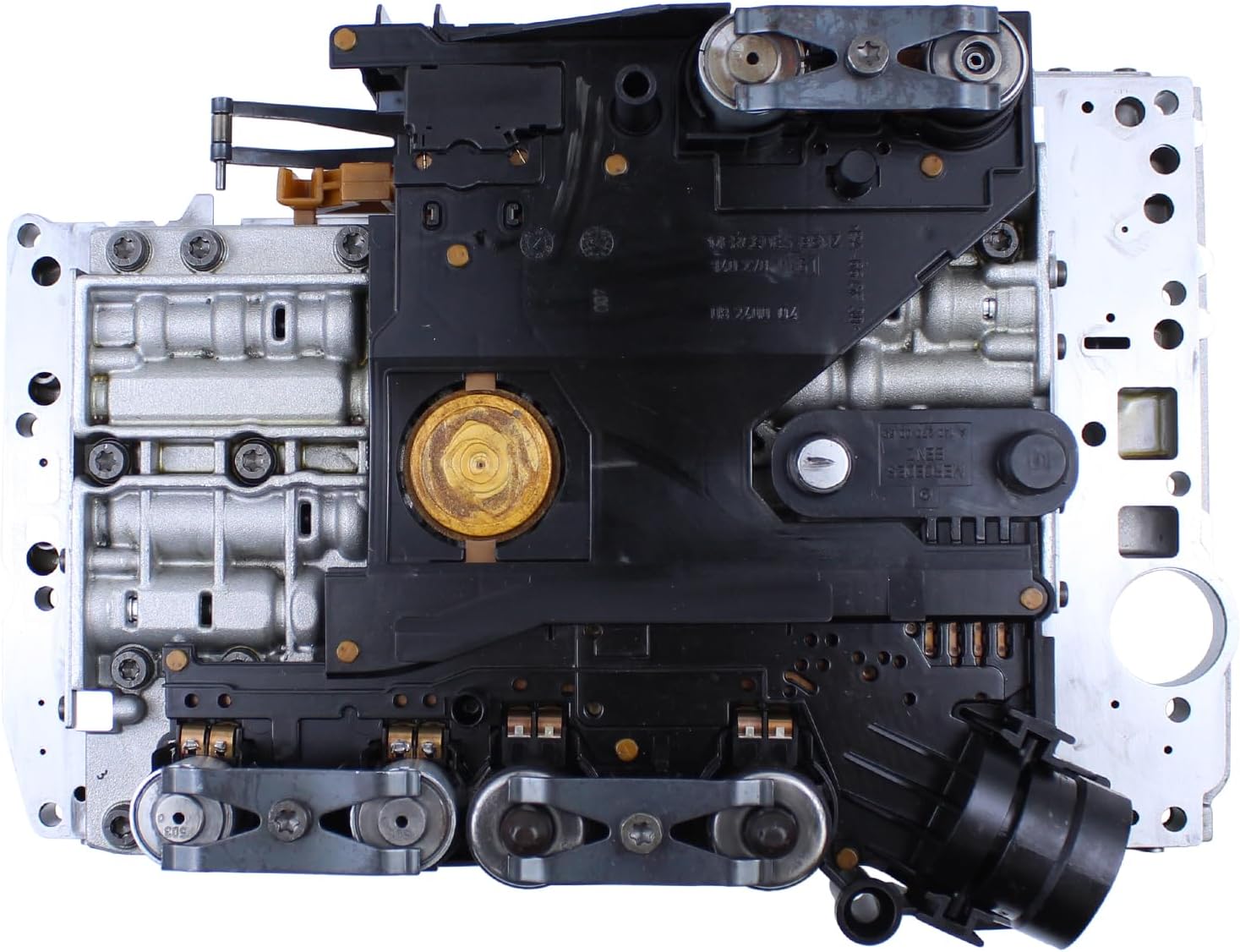
An ML that flares on the 2-3 or 4-5 upshift, or seems to drop into neutral on a 5-4 or 3-2 downshift while pulling a grade, often has good clutches and a worn valve body. Sonnax's technical resource explains how it happens. The working pressure regulator valve bore wears, pMod signal oil leaks past the boost end of the valve, and working pressure stops rising with load. The 1-2/4-5, 2-3 and 3-4 overlap sleeves on the same circuit wear and leak too. Sonnax traces 2-3 flare bad enough to set limp mode on warranty vehicles back to 1998, which takes in the first ML320s, and blames valve body material that was not hard enough.
On a truck that tows, the low pressure under load lets the clutch slip on every shift, and that is what burns the packs. Confirm it with the Sonnax 722.6/NAG1 vacuum test before you condemn the valve body. Fix the bore with a hardened bushing and new or tested overlap sleeves, or replace the valve body if the casting is too worn.
Step 6: Converter Clutch Slip and Cooler Flow
If the rpm hunts at steady highway speed while road speed holds, look at the converter. In Transmission Digest, retired Sonnax specialist Ed Lee describes the 722.6's three-path converter. TCC apply oil is sealed only by an interference fit between the input shaft and an aluminum sleeve in the converter cover. When that fit wears, apply oil leaks, clamping force drops and the clutch slips or shudders. Charge oil escapes past the same fit, so cooler flow drops too. He reports some converters flowing close to zero to the cooler, against a 2.5 to 3.5 GPM window on the Sprinter version. A towing ML with low cooler flow overheats its fluid and the clutch packs follow. When you rebuild, send the converter to a shop that adds a positive seal to that sleeve, and measure cooler flow before the truck goes back to the customer.
Step 7: When It Is the Packs, Set the Clearances
If the road test points at a burnt element and the fluid confirms it, rebuild the transmission. On these units, clutch clearance is what decides how long the rebuild lasts, and ATSG lists it by friction count and selective snap ring. A few of the figures from ATSG's manual:
| Element | Frictions | Clearance |
|---|---|---|
| B1 (single-sided) | 4 / 6 / 8 | 0.5-0.8 / 0.8-1.0 / 1.0-1.3 mm |
| K1 (single-sided) | 6 / 8 | 0.8-1.0 / 1.0-1.3 mm |
| K3 (single-sided) | 6 / 8 / 10 | 0.7-0.9 / 1.0-1.3 / 1.3-1.5 mm |
| B2 (double-sided) | 4 / 5 | 0.2-1.3 / 0.2-1.4 mm |
Set them with a feeler gauge against the selective snap ring, as ATSG does. ATSG also notes its clearances differ from factory figures in places, so stay with one source through the whole build. Soak every friction in the correct fluid for 30 minutes before you install it. Count the original frictions in each drum as it comes apart, because the V6 and V8 builds are not interchangeable. After the rebuild, reset the adaptations and road test with the same logging you did before. A pack that is set correctly holds a flat ratio under full throttle.
W163 Slip Checklist
- Check the S/W switch, tire diameters and LOW RANGE status.
- Scan codes. Ratio codes point one way, and sensor or limp codes point another.
- Inspect the 13-pin plug and measure the speed sensor supply at pin 7.
- Set the level above 80 C, with temperature read in D or R and 236.14 fluid only.
- Road test and log speeds to tell a gear slip from a TCC slip.
- Use the application chart to isolate the element, and check F2 for 1st and 2nd slips.
- Vacuum test the valve body for 2-3 and 4-5 flare.
- Rebuild only when the evidence points at friction material, with clearances set to spec.
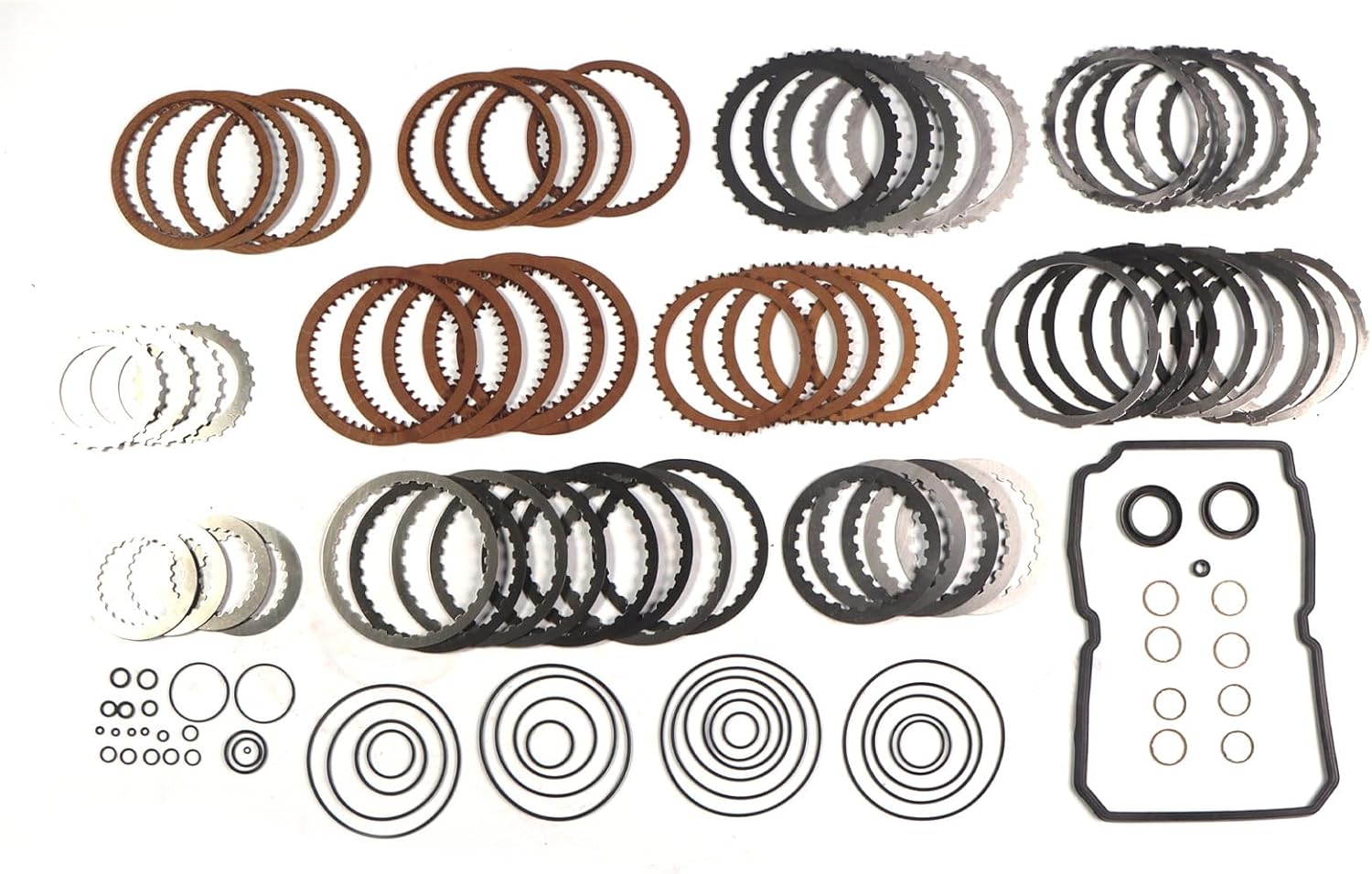
722.6 Master Transmission Rebuild Kit (1996-up)
When the road test and the fluid both point at burnt packs: CoreTransmissionParts carries a 722.6 master rebuild kit for the 1996-up five-speed, so the frictions, seals and gaskets for an ML rebuild come in one box.
View the 722.6 rebuild kit →Shop 722.6 parts →
Frequently Asked Questions
Why does my Mercedes ML feel like it is slipping?
On a W163 the most common causes are low or burnt fluid, a worn valve body that lets the 2-3 or 4-5 shift flare, a converter clutch that will not hold, or worn clutch packs. Before you blame the transmission, rule out limp mode (2nd gear only), Winter mode on the S/W switch and mismatched tire diameters, because each one feels like a slip.
How do I check the transmission fluid on a W163 ML?
There is no dipstick. Daimler's procedure has you remove the locking pin from the filler cap and use the long service dipstick, tool 140 589 15 21 00, with the truck level. A precise check is only possible above 80 C, and fluid temperature must be read on the scan tool in D or R because in P or N it reads coolant temperature.
Can a slipping ML 722.6 be fixed without a rebuild?
Often, yes. If the fluid is not burnt, setting the level hot with MB 236.14 fluid, repairing the 13-pin plug or conductor plate, or reworking a worn valve body can cure a flare or slip. If a road test shows the ratio drifting in specific gears and the fluid is full of friction material, the clutch pack needs a rebuild.
Which clutch is slipping if my ML slips in 1st, 2nd and 3rd?
From ATSG's application chart, B2 is the element shared by 1st, 2nd and 3rd that is not used in 4th or 5th, so it is the prime suspect. If only 1st and 2nd slip, check the F2 freewheel first, because ATSG says the original 14-element F2 sprag is known to slip and was upgraded to a 20-element part.
Sources
- ATSG (Automatic Transmission Service Group), Mercedes 722.6 Technical Service Information manual (2009). Backs the W163 model listings, the TCM location in the center console, limp-mode behavior and the three-key-cycle rule, N2/N3 reporting gaps, the input speed overspeed neutral default, S/W mode reverse ratios (3.16:1 and 1.93:1), ratio and TCC slip codes, the clutch application chart, the 14- to 20-element F2 sprag upgrade (220 270 01 31), B2 friction counts, the B1/K1/K3/B2 clutch clearances and the 30-minute friction soak. w124performance.com (PDF)
- Mercedes-Benz, M-Class Operator's Manual, ML 320 / ML 430 / ML 55 AMG (USA Edition B 2001). Backs the 6,005 lb GVWR and 5,000 lb trailer rating, the "permanent fill" and no-dipstick statements, the limp-home procedure (2nd and reverse only), the same-outside-diameter tire requirement for ESP, and the LOW RANGE switching conditions. archive.org (PDF)
- Daimler AG WIS AR27.00-P-0100AC, "Check oil level in automatic transmission and correct if necessary," Transmission 722.6. Backs the locking pin and dipstick tool 140 589 15 21 00, ranges A and B, the above-80 C check with temperature read in R or D, the model 163 capacities (722.673 and 722.674), the under/over-fill warning and fluid sheet BB00.40-P-0236-14A. mbclub.ru (PDF)
- Sonnax Technical Resource 129, "Mercedes 722.6, Daimler W5, Porsche W5, Jaguar 722.6." Backs the W5A torque designations, regulator valve bore wear and pMod leakage, overlap sleeve wear, the 2-3/4-5 and 5-4/3-2 flare symptoms and the 1998 warranty-vehicle history. sonnax.com
- Transmission Digest, Ed Lee, "The importance of a positive seal: 722.6 issues" (July 1, 2018). Backs the three-path converter interference-fit leak behind TCC slip and low cooler flow, and the 2.5-3.5 GPM Sprinter cooler flow window. transmissiondigest.com
- febi bilstein / Blue Print Technical Bulletin, "Mercedes Benz Conductor Plate" (July 2013). Backs P0715 and the speed sensors, the 4-8 V supply at pin 7, the reed switch temperature behavior in P/N, and the radiator heat exchanger coolant warning. techtips.ie (PDF)
The valve body vacuum test in Step 5 is Sonnax's "Mercedes 722.6/Chrysler NAG1 Vacuum Test Guide" (sonnax.com).
Shop rebuild kits, valve bodies and shift kits for the W163 ML 722.6, on our own secure checkout.
Shop 722.6 parts →Related 722.6 guides
- 722.6 Mercedes ML Common Problems and Fixes
- 722.6 Mercedes E Class Slipping: Causes and Fix
- 722.x Mercedes Slipping Under Load: Root Causes and Fixes
- 722.6 Valve Body Symptoms and Testing
- 722.6 Torque Converter Lockup Shudder Fix
- 722.6 Fluid Type and Capacity: MB 236.14 Spec, Fill Amounts and the Factory Level Check