The W163 M-Class was Mercedes' first SUV built in Alabama, sold here from the 1998 model year through 2005 as the ML320, ML350, ML430, ML500 and ML55 AMG. Every one of them uses the 722.6 five-speed automatic. The seven-speed 722.9 did not show up until the W164 replaced it for 2006, so if you are working on a first-generation ML, you are working on a 722.6.
The ML gets the same 722.6 failures as the sedans, but it gets them harder. It is a heavy, full-time four-wheel-drive truck, a lot of them towed a boat or a camper, and the transmission lives next to a radiator that carries its fluid cooler. Below are the six problems we see on these trucks, how each one shows up on an ML, how to prove it before you buy parts, and what fixes it.

Step Zero: Read the ID Plate and Get the Capacity Right
febi's technical bulletin on the 722.6 says the unit is identified by the middle row of numbers on the small plate on the left-hand side of the case. Read it before you order anything or pour any fluid, because capacity changes by variant. Daimler's WIS procedure AR27.00-P-0100AC lists initial-charge quantities for dozens of 722.6 variants, and it calls out two of them specifically for model 163, the W163 chassis:
| 722.6 variant (from ID plate) | Initial charge (dry) |
|---|---|
| 722.673 in model 163 | 7.6 to 8.0 L |
| 722.674 in model 163 | 8.8 to 9.2 L |
| 722.600-699 general group (incl. 722.660/661/662/664/665) | 8.0 L |
| 722.622-636/663/666/669 group | 8.6 L (+0.5) |
That is better than a liter of spread between the two ML-specific variants, which is why forum answers for "how much ATF does an ML take" are all over the place. Those are dry-fill figures for a rebuilt unit with an empty converter and cooler. The WIS procedure says to pour in about 5 liters before the first start after a refill, start it and idle in P, add the remainder, then hold the brake and run through the ranges several times before checking. If the plate shows a number not listed above, find it in the full WIS table rather than guessing.
Sonnax also notes that the W5A designations used on this family (W5A330, W5A380, W5A580) carry the maximum input torque in Newton meters in their last three digits. That matters on an ML because the V8 and AMG trucks run the heavier-duty build, and internal parts like clutch packs and drums are not always shared with the V6 trucks. Match parts to the plate, not to the badge on the liftgate.
Problem 1: The Level Was Never Set Hot
The ML has no dipstick. The filler tube is sealed with a cap and a locking pin; Daimler's procedure has you break off the pin's plate, push the rest out, and fit a new pin when you are done. The check uses the Mercedes dipstick, tool 140 589 15 21 00. febi sells an equivalent as part 38023, about a meter long, and it goes all the way down until it touches the pan.
There are two ranges on the stick because, as febi puts it, this fluid has a very high rate of thermal expansion. Range A is the cold reading at about 25 C (77 F). Range B is above 80 C (180 F), and Daimler says plainly that a precise check is only possible above 80 C. The truck must be level on its wheels or the reading is wrong.
The trap is the temperature reading. The ATF temperature sensor is wired in series with the Park/Neutral reed switch on the conductor plate, so the transmission reports its own fluid temperature only in D or R. In P or N the scan tool value defaults to coolant temperature, per febi. Check fluid temperature on the scan tool in D or R with your foot on the brake, then read the stick at idle. Daimler lists both under-fill and over-fill as causes of malfunctions and transmission damage.
Problem 2: The 13-Pin Plug and Guide Sleeve Leak
The round 13-pin harness plug on the side of the case plugs into a guide sleeve that passes through the case to the conductor plate, sealed by O-rings. febi calls the guide sleeve seals a common source of transmission oil leaks, and goes further: when those rings fail, oil can get into the harness plug itself, and metal particles suspended in the ATF can short the circuits. That is how a simple seep turns into intermittent limp mode.
W163 owners report a second wrinkle. Fluid that gets into the plug can wick up the inside of the harness by capillary action and travel toward the transmission control module, and ML owners on the Mercedes forums describe finding ATF dripping under the driver's side of the dash. That is owner-reported, not a factory statement, but if you find oil in the plug, pull the harness at the TCM end and look before you call the job done.
The repair is quick. Turn the tan collar on the plug counterclockwise until it clicks and jacks the plug out. Remove the 7 mm bolt in the center of the sleeve and pry the sleeve out with a drain pan under it. Lube the new O-rings, line up the sleeve holes with the conductor plate pins, push it home, and torque the bolt to 2.5 Nm per febi. Refit the plug by turning the collar clockwise to resistance, then about another 30 degrees until it clicks locked. Clean wet or green pins on the harness side with electrical contact cleaner and let them dry. A contaminated plug sets the same codes as a dead conductor plate.
Problem 3: Limp Mode From the Conductor Plate
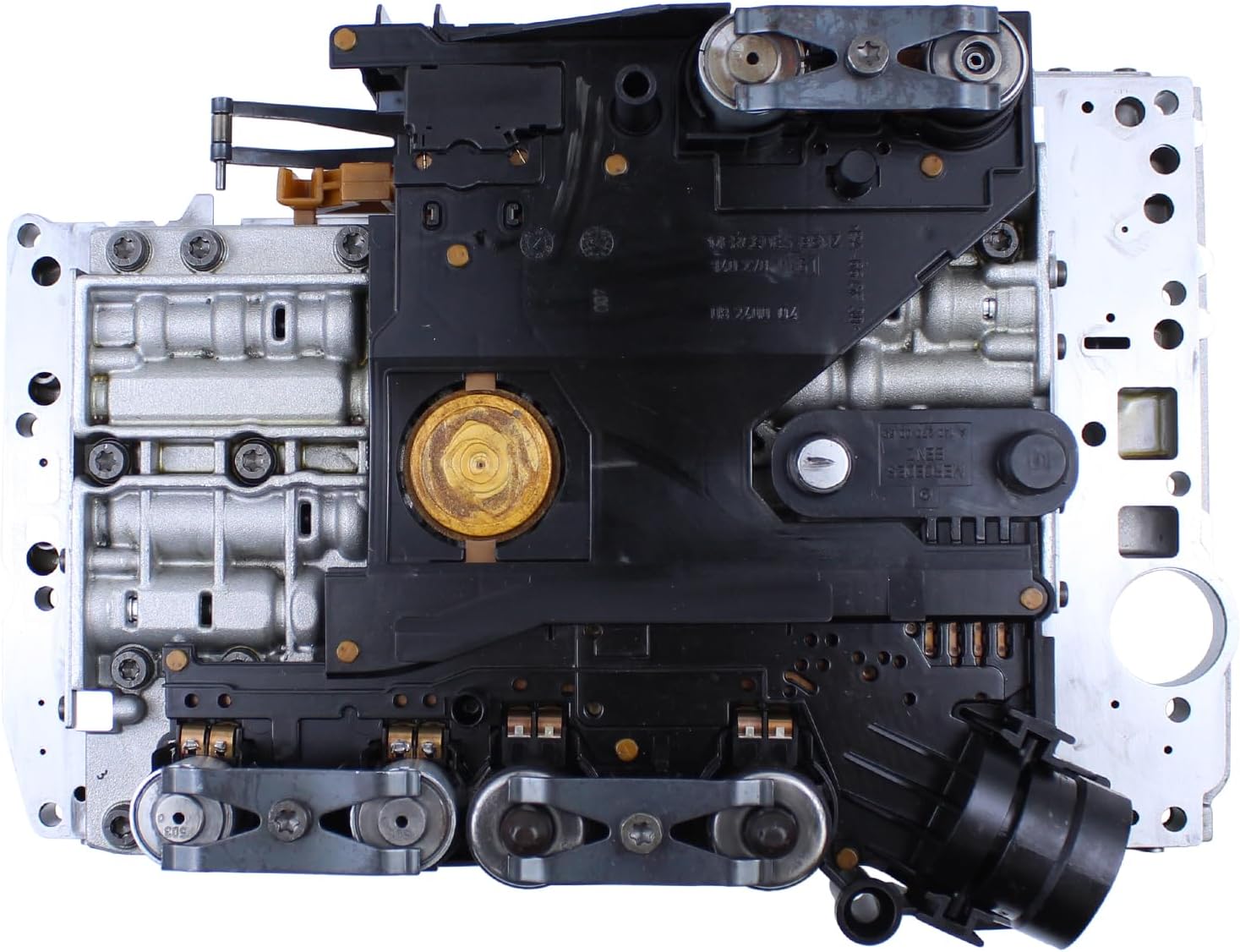
The conductor plate bolted to the top of the valve body carries the six solenoids, the N2 and N3 Hall-effect speed sensors, the PTC temperature thermistor and the starter-interlock reed switch. When a contact or sensor lead fails, the TCM loses a signal and drops to limp-home. On an ML that usually means a check-engine light and a truck that pulls away in 2nd and stays there until it is shut off and restarted. febi ties P0715 to the speed sensors and P0748 through P0753 to the solenoid circuits.
Two things to know before you diagnose. First, there are no pressure taps on this case and no pressure transducers inside it. febi is explicit that any pressure value on your scan tool is calculated from the PWM duty cycle sent to the three modulating solenoids, so a "low pressure" number on the screen is not a pressure test. Second, you can test nearly everything from the 13-pin connector without dropping the pan.
Using febi's pinout: the line pressure modulating solenoid (pins 2 and 6) and the shift pressure modulating solenoid (10 and 6) should read about 5.5 ohms. The lock-up clutch modulating solenoid (11 and 6) reads about 2.7 ohms. The 1-2/4-5, 2-3 and 3-4 shift solenoids (pins 13, 8 and 9 against 6) read about 4.5 ohms each. The temperature sensor at pins 4 and 12 should read 800 to 1200 ohms at 20 C, but only with the selector in D or R, because of that reed switch. The speed sensor supply at pin 7 should be 4 to 8 volts. A circuit that is open or out of range at the plug, with a solenoid that checks good on the bench, condemns the plate.
To replace it, drain the fluid warm and let the case cool. Pull the six pan bolts and spacers, the strainer and the valve body bolts, and watch the selector plunger as the body comes away; febi warns the valve body is heavy. Fit the new plate on its locating tabs, move the solenoids over, and torque the solenoid retaining springs, valve body bolts and pan bolts to 8 Nm.
Problem 4: 2-3 or 4-5 Flare With No Codes
An ML that flares the engine on the 2-3 or 4-5 upshift, or feels like it drops into neutral on a 5-4 or 3-2 downshift when you are climbing a grade, usually has a hydraulic leak, not an electrical one. Sonnax's technical write-up lays out the mechanism. The outer bore of the working pressure regulator valve wears, pMod solenoid signal oil leaks past the boost end of the valve, and working pressure does not rise with engine load. The 1-2/4-5, 2-3 and 3-4 overlap sleeves sit in the same pMod circuit, wear on their inside diameter and leak on the outside, pulling pressure down further.
Sonnax notes that high-mileage Mercedes warranty vehicles were showing a 2-3 flare bad enough to cause limp mode as early as 1998, and attributes the bore wear to valve body material that is not hard enough. That puts the earliest ML320s squarely in the at-risk group. A flare left alone eventually sets a gear ratio fault and limps the truck, which looks electrical until you vacuum test the valve body. Sonnax's 722.6/NAG1 vacuum test guide shows the test points. The fix is a hardened bushing in the regulator bore and tested or new overlap sleeves, or a replacement valve body if the casting is too far gone.
Problem 5: Shudder on Lock-Up and Low Cooler Flow
The 722.6 uses a three-path converter, and the TCC apply oil is sealed from the converter charge oil only by an interference fit between the input shaft and an aluminum sleeve in the converter cover. Ed Lee, a retired Sonnax technical specialist, explains in Transmission Digest that as that fit wears, two different complaints show up. Apply oil leaks away, clamping force drops, and the converter clutch shudders on apply. And because charge oil can escape past the same worn fit when the clutch is released, cooler flow falls off. He reports some converters on the dyno flowing close to zero to the cooler, against a 2.5 to 3.5 GPM pass/fail window on the Sprinter version.
On a heavy ML that tows, that combination is how a transmission cooks itself: a shudder the owner learns to live with, plus a cooler that is barely being fed. If you are rebuilding an ML that came in with a burnt-fluid smell or a lock-up shudder complaint, have the converter rebuilt by a shop that adds a positive seal to that sleeve, and verify cooler flow before the truck leaves.
Problem 6: Coolant in the ATF, or the Wrong Fluid
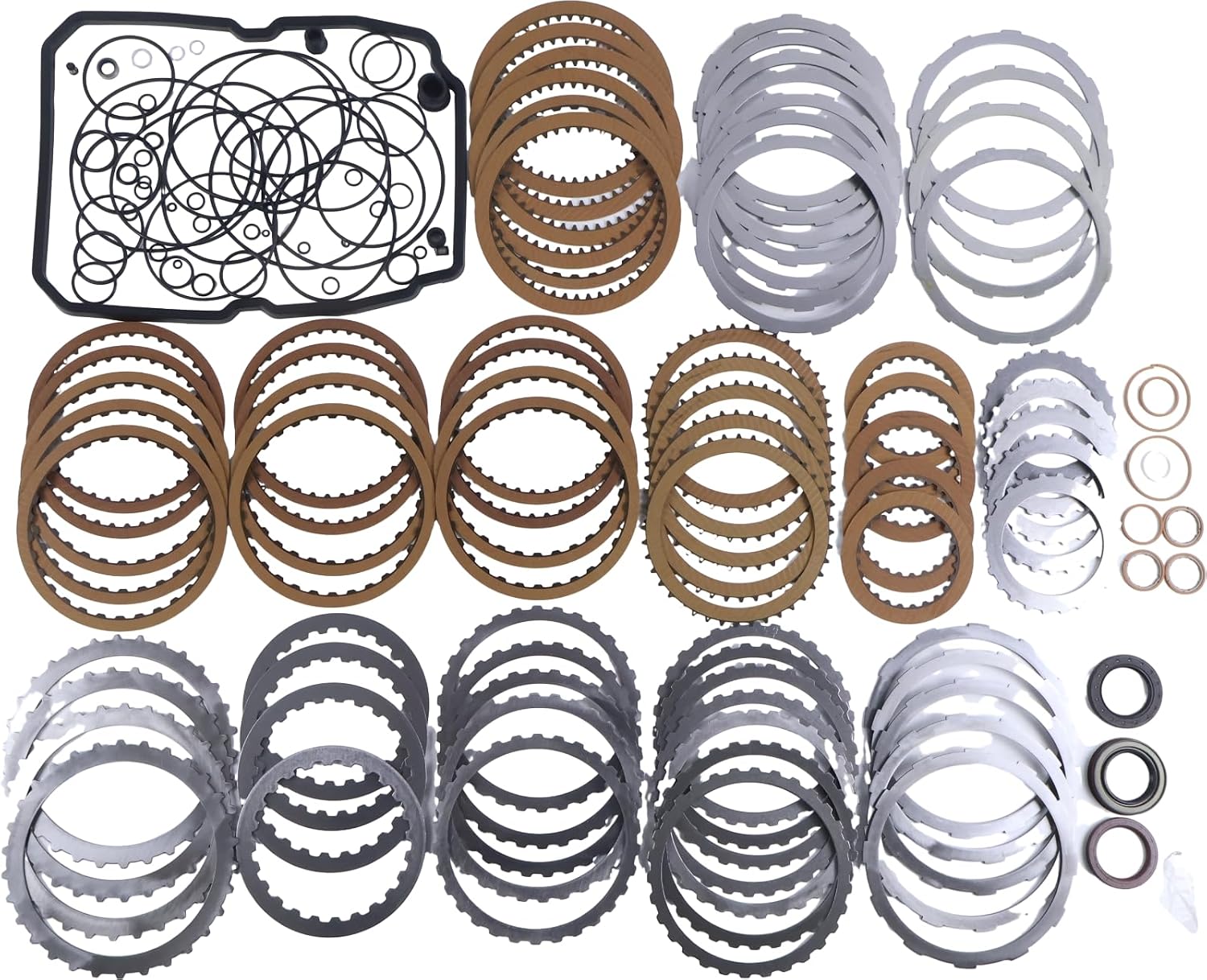
The ML cools its ATF through a heat exchanger in the radiator. febi's bulletin warns of known cases where coolant enters the transmission through small perforations in that heat exchanger, and says pink or frothy ATF can indicate it. Run a glycol test on any ML whose drained fluid looks like a strawberry milkshake. Glycol attacks friction material and bonded seals, so a contaminated unit often needs a full rebuild, and the radiator has to be replaced first or the new parts get the same treatment.
The other fluid problem is the wrong fluid. Daimler's procedure points every 722.6 variant, including both model 163 variants, to fluid sheet BB00.40-P-0236-14A, which is the MB 236.14 specification. Fuchs lists its TITAN ATF 4134 with the MB 236.14 approval, recommends it for 722.6 five-speeds, and describes it as backward compatible with 236.12 fluids, which is what many of these trucks were originally filled with. A generic multi-vehicle red ATF from a quick-lube top-off is not a 236.14 fluid.
Diagnostic Order on a W163 ML
- Read the ID plate. Confirm 722.6, note the variant for capacity and parts, and note V6 or V8 build.
- Scan codes. P0715 or P0748-P0753 point to the plug, sleeve or conductor plate; ratio codes with clean circuits point to the valve body.
- Inspect the 13-pin plug and harness for oil, including at the TCM end, then measure the circuits at the connector.
- Pull a fluid sample. Pink or frothy means test for glycol and fix the radiator first.
- Set the level hot, above 80 C, temperature read in D or R, truck level.
- Road test for flare on the 2-3 and 4-5 and for lock-up shudder at light throttle.
- Only then choose between a sleeve, a conductor plate, a valve body, a converter or a rebuild.
722.6 Conductor Plate, Filter and Gasket Kit (1402701161)
For the limp-mode and connector-sleeve repairs on an ML: CoreTransmissionParts carries the 722.6 conductor plate kit with filter and pan gasket, so the plate, strainer and gasket go in on one pan drop.
View the conductor plate kit →Shop 722.6 parts →
Frequently Asked Questions
Which Mercedes ML models have the 722.6 transmission?
Every first-generation W163 M-Class sold from the 1998 through 2005 model years uses the 722.6 five-speed, including the ML320, ML350, ML430, ML500 and ML55 AMG. The seven-speed 722.9 arrived with the W164 for 2006. Read the middle row of numbers on the ID plate on the left side of the case to confirm the exact variant.
How much transmission fluid does a W163 ML 722.6 take?
Daimler's WIS table lists 7.6 to 8.0 liters for the 722.673 and 8.8 to 9.2 liters for the 722.674 in model 163, both dry-fill figures. A pan and filter service takes much less. After a drain, pour in about 5 liters before the first start, then set the final level hot above 80 C.
What ATF does a Mercedes ML 722.6 use?
Daimler's procedure points the 722.6, including the model 163 variants, to fluid sheet BB00.40-P-0236-14A, the MB 236.14 specification. Fuchs TITAN ATF 4134 is one aftermarket fluid that lists the 236.14 approval and is backward compatible with older 236.12 fluids. Do not top off with a generic multi-vehicle red ATF.
Why is my ML stuck in 2nd gear?
That is limp-home mode. On a W163 the usual causes are a leaking 13-pin plug or guide sleeve, a failed conductor plate speed sensor or solenoid circuit (P0715 or P0748-P0753), or a valve body flare bad enough to set a ratio fault. Measure the circuits at the 13-pin connector before replacing anything.
Sources
- Daimler AG WIS AR27.00-P-0100AC, "Check oil level in automatic transmission and correct if necessary," Transmission 722.6. Backs the model 163 capacities for 722.673 (7.6-8.0 L) and 722.674 (8.8-9.2 L), the variant capacity table, the approx. 5 L pre-start fill, the cap and locking pin, dipstick tool 140 589 15 21 00, ranges A (25 C) and B (above 80 C), the scan-tool temperature check in R or D, the level-vehicle requirement, the under/over-fill warning, and fluid sheet BB00.40-P-0236-14A. mbclub.ru (PDF)
- febi bilstein / Blue Print Technical Bulletin, "Mercedes Benz Conductor Plate" (July 2013). Backs the ID plate location, conductor plate components, P0715 and P0748-P0753, the 13-pin resistance and voltage values, the no-pressure-taps note, the reed switch temperature behavior, the guide sleeve leak and metal-particle short, the 2.5 Nm sleeve bolt and 30-degree collar lock, 8 Nm valve body and pan torque, dipstick 38023, and the heat exchanger coolant warning. techtips.ie (PDF)
- Sonnax Technical Resource 129, "Mercedes 722.6, Daimler W5, Porsche W5, Jaguar 722.6." Backs the W5A torque designations, regulator valve bore wear and pMod leakage, overlap sleeve wear, the 2-3/4-5 and 5-4/3-2 flare symptoms, and the 1998 warranty-vehicle limp mode history. sonnax.com
- Sonnax, "Mercedes 722.6/Chrysler NAG1 Vacuum Test Guide." Backs the valve body vacuum test used to confirm regulator bore and overlap sleeve wear. sonnax.com
- Transmission Digest, Ed Lee, "The importance of a positive seal: 722.6 issues" (July 1, 2018). Backs the three-path converter design, the interference-fit leak behind TCC apply shudder and low cooler flow, and the 2.5-3.5 GPM Sprinter cooler flow window. transmissiondigest.com
- Fuchs Lubricants, TITAN ATF 4134 product page. Backs the MB 236.14 approval, the 722.6 recommendation and backward compatibility with 236.12 fluids. fuchs.com
The report of ATF wicking up the harness toward the TCM comes from W163 owner threads on Mercedes enthusiast forums and is not counted as a source.
Shop conductor plates, valve bodies and rebuild kits for the W163 ML 722.6, on our own secure checkout.
Shop 722.6 parts →