The Mercedes 722.6 does not usually overheat because it is weak. It overheats because one small valve in the cooler circuit is known to stick, and because the car will run the wrong fluid for years without complaint until the day it cannot shed heat fast enough. This 5-speed sits under Mercedes, Porsche, Jaguar and Chrysler/Jeep/Dodge badges (where it is called NAG1), and the overheating story is mostly the same across all of them because they share the same hydraulic architecture.
This guide covers the two real mechanical causes of 722.6 overheating, why the fluid spec is not optional, how Mercedes itself checks transmission temperature in the shop, and what towing data from the shared Chrysler platform tells us about when this unit runs hottest. Sources are Mercedes-Benz USA's own fluid bulletin, the factory WIS service procedure, an FCA service bulletin for the shared W5A580 platform, and Sonnax's technical documentation on the known thermal valve failure. All are listed at the end.
The short version: the OE thermal bypass valve in the 722.6's cooler circuit is known to stick in the recirculation position, per Sonnax, which keeps hot fluid inside the transmission instead of routing it to the cooler. Running anything other than MB spec sheet 236.14 (ATF 134, red) compounds the problem, and towing in high heat is a documented trigger on this platform's shared hardware. Diagnose with Star Diagnosis reading fluid temperature in gear, not a guess from the dipstick.

One Transmission, Four Badges, the Same Cooler Circuit
Per Sonnax's technical writeup on the family, the 722.6 went into production for 1996 model year vehicles and was still being built decades later. Mercedes uses it, but so do Porsche and Jaguar, and Chrysler licensed the same hardware as the NAG1 (New Automatic Gearbox, first version). In the US, NAG1 variants are badged W5A580, W5A380, W5A330 and W5J400, where the last three digits are the maximum input torque in Newton-meters and the J400 marks a Jeep application. You can tell country of manufacture by the tag: a pin stamp alone, or a pin stamp plus barcode, means it was built in Germany; a barcode tag alone means it was built by Chrysler.
That shared hardware matters for this topic specifically because the cooler circuit, the thermal bypass valve and the torque converter clutch design are the same across badges. A known failure on a Jeep Grand Cherokee's W5A580 is mechanically the same failure waiting to happen on a Mercedes E-Class or ML-Class 722.6, even though the two use different fluid.
The Thermal Bypass Valve: the Number One Cause
Sonnax's own technical page for its 72760-02K Thermal Bypass Eliminator Kit names the failure directly. The symptom is listed as overheating and overheated fluid. The cause: the OE thermal bypass valve can become stuck in the cooler-bypass position, which keeps hot fluid circulating inside the transmission instead of routing it out to the cooler. Sonnax lists the 722.6 alongside the 42RLE, 45RFE, 68RFE, 545RFE and Jatco/Nissan JF011E as sharing this same valve design and the same failure mode, under OE part numbers 55111005AC and 68192000AA.
This is a mechanical, not electronic, failure. There is no check-engine light that says "thermal valve stuck." The transmission simply runs hotter than it should under conditions that used to be fine, because the valve meant to send fluid to the cooler is parked in the wrong position. Sonnax's fix removes the OE thermal valve and replaces it with a drop-in eliminator that permanently routes flow through the cooler, while keeping the factory pressure-bypass feature that protects the transmission if the cooler itself ever gets blocked.
If your shop is chasing an overheating 722.6 and the fluid level, cooler and lines all check out externally, this valve is the next place to look before you condemn the torque converter or the unit itself.
The Fluid Spec Is Not a Suggestion
Mercedes-Benz USA's own Star Bulletin S-B-00.40/89d (most recent revision dated November 6, 2013) is unambiguous: the 722.6 runs on operating fluid sheet 236.14 only, which is ATF 134, red in color, under MB part number A001 989 68 03 10. The bulletin's own compatibility table shows 722.6 taking only the 236.14 fluid, not the blue FE-ATF 134 (236.15) used on later 722.9 units, and it states plainly that these oils must never be mixed and require separate filling equipment.
The bulletin also carries a specific warning that matters for any 722.6 that has been serviced by someone unfamiliar with the unit: 722.6 and early 722.9 transmissions (built before component serial number 2834526) may not be filled with FE-ATF 134, the newer blue fluid. Putting the wrong-spec fluid in an older 722.6 changes its friction and viscosity behavior, which works against the transmission's ability to manage heat even if the cooler circuit itself is fine. Sonnax's own 722.6 family writeup adds a related wrinkle: Sprinter, Crossfire and Mercedes-badged units require this specific fluid due to calibration, while other Chrysler applications of the same hardware run ATF+4 instead.
If your 722.6 has an unknown fluid-change history, do not assume the last shop used the right bottle. Verify it, and if there is any doubt, a full drain, flush and refill with the correct 236.14 spec is cheap insurance against a heat-related failure down the road.
How Mercedes Itself Checks the Temperature
The factory WIS procedure AR27.00-P-0100AC lays out exactly how a dealer technician verifies the 722.6's fluid level and temperature, and it is worth knowing because it tells you how little margin there is for guessing. There are two check points on the dipstick: range A at approximately 25C (77F) for a cold check, and range B at 80C (180F) for the hot check.
The cold check is done first: engine idling in Park, service brake applied, shifted through all gear ranges and back to Park, dipstick read against range A. The procedure is explicit that steps 10 through 14, the hot check, are only required if shifting problems occur, and it states plainly: "Precise checking is only possible at a transmission oil temperature greater than 80C." To get there, the technician connects Star Diagnosis, the factory scan tool, and reads transmission oil temperature with the vehicle in gear range R or D, brake applied, and matches the dipstick to range B once the fluid has actually reached operating temperature.
Two things fall out of this procedure directly. First, there is no accurate way to confirm a 722.6 is overheating by feel or by a quick dipstick check alone; you need a scan tool reading actual fluid temperature in gear. Second, both overfilling and underfilling are called out repeatedly in the same document as causing "malfunctions and transmission damage," the same aeration-and-heat relationship that shows up on nearly every modern automatic: wrong level, more air in the fluid, less effective cooling.
What Towing Data From the Shared Platform Shows
Mercedes does not publish towing-specific heat data for the 722.6 the way Chrysler has had to for its badge-shared W5A580. FCA Service Bulletin 21-035-15 (May 27, 2015, superseding 21-014-14) reprogrammed the transmission control module on 2013 Jeep Grand Cherokee, Jeep Wrangler, Dodge Durango and Dodge Challenger models equipped with the WA580 transmission specifically to address erratic shifting and gear hunting while climbing steep hills or towing a loaded trailer in high ambient temperatures, defined in the bulletin as above 32C (90F). The Wrangler's symptom list even includes the transmission hanging in second gear while towing or climbing on Rubicon models.
This is not a Mercedes bulletin and it should not be read as proof your 722.6 will do the same thing. What it does confirm is that the shared hydraulic and electronic architecture under this family of transmissions is sensitive to heat and load together, enough that Chrysler's own engineers had to recalibrate shift behavior around it. A Mercedes-badged 722.6 towing or climbing in hot weather is working the same hardware, so if your transmission runs hot specifically under those conditions, that pattern lines up with how this platform is known to behave, not a coincidence specific to your car. For band settings and cooling upgrades aimed at towing specifically, see our 722.6 towing upgrades guide.
Diagnosing a Hot 722.6
1. Confirm it with a scan tool, not a guess
Connect Star Diagnosis or an equivalent capable scan tool and read fluid temperature with the engine running in gear range R or D, brake applied, per the factory procedure. Anything that only estimates temperature from engine coolant or ambient sensors is not reading the transmission.
2. Check fluid level at both ranges
Do the cold check at approximately 25C against range A first. If shifting complaints are present, do the hot check once the fluid is confirmed above 80C against range B. The vehicle must be level on all four wheels or the reading is unreliable.
3. Verify the fluid itself
Confirm the fluid is 236.14 (ATF 134, red), not a mismatched or mixed fluid. If the service history is unknown, do not trust the color on the dipstick alone; a full service with the correct spec is the safer move.
4. Check actual flow through the cooler
With the engine running and the transmission at operating temperature, feel or measure temperature rise across the cooler lines and cooler itself. A cooler and lines that stay cool while the transmission runs hot point straight at a thermal bypass valve stuck in recirculation.
5. Inspect or eliminate the thermal bypass valve
If flow testing points to the valve, it can be replaced with an eliminator kit such as Sonnax's 72760-02K, which removes the failure-prone OE valve and permanently routes flow through the cooler while preserving the pressure-bypass safety feature.
Preventing It Going Forward
- Verify the fluid spec at every service. 236.14 (ATF 134, red) for the 722.6, never mixed with the newer blue FE-ATF 134, per Mercedes-Benz's own bulletin.
- Get the level checked the factory way. A cold check alone does not confirm anything if the transmission is already running hot; insist on the hot check above 80C with a scan tool reading actual temperature.
- Treat towing and steep grades as a heat event. This platform's shared hardware is documented as heat- and load-sensitive; see our towing upgrades guide for cooling and band recommendations.
- Flow test the cooler circuit if the transmission runs hot for no obvious reason. A stuck thermal bypass valve is a known, documented failure on this exact family, not a rare edge case.
- Do not ignore shift quality changes. Hesitation, gear hunting or harsh engagement under load can be an early heat symptom before a temperature warning ever shows.
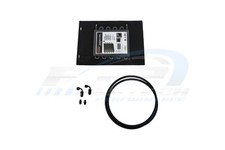
722.6 Conductor Plate, Filter & Gasket Kit
The conductor plate carries the 722.6's internal connections and sits right above the filter and pan gasket, so a fluid service is the natural time to inspect it. Pairing a new filter and gasket with the conductor plate kit avoids a second teardown later. Sold by CoreTransmissionParts.
View the conductor plate, filter & gasket kit →Shop the 722.6 conductor plate kit →
Frequently Asked Questions
What causes a 722.6 transmission to overheat?
The most common cause is the factory thermal bypass valve sticking in the cooler-bypass position, per Sonnax, so hot fluid keeps recirculating inside the transmission instead of routing through the cooler. Running the wrong fluid spec, a low or overfilled pan, and towing in high ambient heat on this platform's shared hardware all add to it.
How do I know if the 722.6 thermal bypass valve is stuck?
Sonnax lists overheating and overheated fluid as the direct symptoms of a thermal bypass valve stuck in the cooler-bypass position. A shop can confirm it by checking cooler line flow and temperature rise under load; if the transmission runs hot regardless of driving conditions and the cooler lines stay cool to the touch, the valve is a prime suspect.
What transmission fluid does the 722.6 require?
Mercedes-Benz specifies operating fluid sheet 236.14 (ATF 134, red, part number A001 989 68 03 10) for the 722.6, per Mercedes-Benz USA Star Bulletin S-B-00.40/89d. The bulletin is explicit that 722.6 units built before component serial number 2834526 must not be filled with the newer FE-ATF 134 (blue, spec 236.15), and the two fluids cannot be mixed.
How is transmission temperature checked on a 722.6?
Per the Mercedes-Benz WIS procedure AR27.00-P-0100AC, a cold check is done at approximately 25C (77F) against the dipstick's A range, and a precise check requires connecting Star Diagnosis and reading fluid temperature in gear range R or D with the brake applied, which is only accurate above 80C (180F), checked against the dipstick's B range.
Does towing make a 722.6 overheat?
Towing in high ambient heat is a documented trigger on this shared transmission architecture. FCA Service Bulletin 21-035-15 reprogrammed the transmission control module on WA580-equipped Jeep and Dodge models specifically for erratic shifting and gear hunting while towing a loaded trailer above 32C (90F), confirming the platform is heat- and load-sensitive even outside Mercedes-badged applications.
Sources
- Mercedes-Benz USA, LLC — Star Bulletin S-B-00.40/89d, "Operating Fluid Specification Changes for Automatic Transmission," November 6, 2013 (supersedes S-B-00.40/89c). Backs the 722.6's required operating fluid sheet 236.14 (ATF 134, red, MB part number A001 989 68 03 10), the compatibility table showing 722.6 takes only 236.14, the rule that 236.14/236.15/236.16 oils must never be mixed and need separate filling equipment, and the exception that 722.6 and early 722.9 units (before component serial number 2834526) must not be filled with FE-ATF 134. static.nhtsa.gov
- Daimler AG / Mercedes-Benz — WIS document AR27.00-P-0100AC, "Check oil level in automatic transmission and correct if necessary," Transmission 722.6 (revised 3/30/13). Backs the two-stage dipstick check (range A at 25C/77F cold, range B at 80C/180F hot), the requirement that precise checking is only possible above 80C, the Star Diagnosis procedure reading fluid temperature in gear range R or D with the brake applied, the requirement that the vehicle be level, the warning that incorrect fluid level causes malfunctions and transmission damage, and the fill capacities (7.0 to 9.2 liters depending on variant) referencing operating fluid sheet BB00.40-P-0236-14A. Accessed via mbclub.ru's hosted copy of the factory WIS page. mbclub.ru
- Sonnax — Thermal Bypass Eliminator Kit 72760-02K product and technical page. Backs the thermal bypass valve as the direct, named cause of overheating and overheated fluid on the 722.6 and related units (42RLE, 45RFE, 68RFE, 545RFE, JF011E/RE0F10A), the valve's failure mode (stuck in the cooler-bypass/recirculation position), OE part numbers 55111005AC and 68192000AA, and the eliminator kit's pressure-bypass safety feature. sonnax.com
- Sonnax — Mio Cundl, "Mercedes 722.6, Daimler W5, Porsche W5, Jaguar 722.6," June 30, 2009. Backs the 722.6's production history from 1996, its use across Mercedes, Porsche, Jaguar and Chrysler (as NAG1), the W5A580/W5A380/W5A330/W5J400 naming convention, the Germany-vs-Chrysler manufacturing identification method, and the fluid note that Sprinter, Crossfire and Mercedes units require specific fluid while other Chrysler applications use ATF+4. sonnax.com
- FCA US LLC — Service Bulletin 21-035-15, "Flash: Transmission Shift Enhancements," May 27, 2015 (supersedes 21-014-14). Backs the WA580-equipped 2013 Jeep Grand Cherokee, Jeep Wrangler, Dodge Durango and Dodge Challenger TCM reprogram addressing erratic shifting and gear hunting while towing or climbing steep hills in high ambient temperature, defined as above 32C/90F, including the Wrangler Rubicon's reported hanging-in-second-gear symptom while towing. static.nhtsa.gov
Shop 722.6 coolers, conductor plates, filters, solenoid kits and master rebuild kits, shipped fast from the USA.
Shop 722.6 parts →