The 722.6 is Mercedes-Benz's five-speed automatic, built in close to twenty sub-variants that show up behind everything from a W202 C-Class to a W463 G-Wagen to the diesel V6 in a Dodge Sprinter, where Chrysler badges the same unit as the NAG1. It is a felt-filtered, conductor-plate-controlled transmission, and unlike a cable-shift domestic automatic, there is no dipstick hanging out of the pan for a quick look. Checking or filling it wrong is one of the easiest ways to put a healthy 722.6 into a shift complaint that looks like a hard-parts failure.
This page gives the factory fluid type, the initial-charge capacity by sub-variant, and the exact cold and hot level-check procedure, pulled from Daimler AG's own workshop document AR27.00-P-0100AC for transmission 722.6. It also covers why a Sprinter's "NAG1" badge does not mean Chrysler ATF+4, and what the "lifetime fluid" claim actually looks like in the factory paperwork. Sources are listed at the end.


722.6 Fluid Type: MB 236.14 (Supersedes 236.12 and 236.10)
Daimler's AR27.00-P-0100AC level-check procedure carries a fluid-specification column for every 722.6 variant it covers, and every single one of them points to the same operating-fluids sheet: BB00.40-P-0236-14A, which is Mercedes Material Standard MB 236.14. That is the current factory spec across the whole 722.6 family, from the early 722.602/603/615 units through the later 722.671/675/677 variants (Daimler AG, AR27.00-P-0100AC, operating fluids column).
Mercedes-Benz USA put the same rule in writing for dealers. Star bulletin S-B-00.40/89d (November 2013) says the 722.6 may only be filled with oils listed on specification sheet 236.14, sold as the red ATF under part number A001 989 68 03 10. It requires separate filling equipment for 236.14, 236.15 and 236.16 fluids because they must never be mixed, and it states outright that a 722.6 may not be filled with FE-ATF 134, the blue fluid used in later 722.9 units. If you find blue fluid in a 722.6 pan, someone grabbed the wrong bottle.
Sonnax, writing about this same transmission family, ties the fluid requirement to calibration: the Sprinter, Crossfire and Mercedes applications need the specific Mercedes fluid, while the other Chrysler NAG1 applications (W5A580, W5A380, W5A330 and W5J400) were calibrated for ATF+4.
Earlier 722.6 production (roughly 1996 through the early 2000s) left the factory on 236.12, and some parts counters still list 236.10 for the oldest units. 236.14 was formulated to supersede both and is backward compatible, which is why a Fuchs Titan ATF 3353 or Q8 Auto 25 bottle on the shelf today is labeled as meeting MB 236.12 and MB 236.14 at once; the fluid maker is telling you it is safe across the whole range (Q8 Oils, Auto 25 product data sheet). Do not go the other direction and run an old 236.10/236.12-only fluid in a transmission whose plate now calls for 236.14 unless the bottle explicitly lists 236.14 compatibility too.
Why Chrysler ATF+4 Is the Wrong Bottle for a Sprinter or Crossfire 722.6
Chrysler sells two completely different automatic transmission families under its own badge, and this is where owners get burned. Most Chrysler-built automatics run ATF+4. The Dodge Sprinter's NAG1 and the Chrysler Crossfire's transmission are not Chrysler-built; they are Mercedes 722.6 units wearing a different badge, and trade reporting on this exact transmission family is explicit that the Sprinter, Crossfire and Mercedes-branded units "require specific fluid because of calibration issues," while other Chrysler applications use ATF+4 (Transmission Digest, "Mercedes 722.6, Daimler W5, Porsche W5, Jaguar 722.6"). Mopar's own parts catalog backs this up: the correct fluid for a Sprinter NAG1 is part number 05127382AB, which is Pentosin ATF134 built to MB 236.14 and backward compatible with 236.12, not ATF+4. Pour ATF+4 into a 722.6 and you are running a fluid with the wrong friction modifiers for that conductor plate's shift calibration.
722.6 Fluid Capacity by Sub-Variant
There is no single "722.6 holds X liters" answer, because the fill table in AR27.00-P-0100AC lists a different initial-charge figure for nearly every casting. The full three-digit suffix stamped on the transmission's ID tag (the numbers after "722.6") is what determines your number. A representative slice of the factory table:
| 722.6 sub-variant | Common application | Initial charge |
|---|---|---|
| 610/638 | Early W210/W202 inline-6 | 7.0 L (+0.5) |
| 602/603/615 | W210/W220 V8 | 7.5 L |
| 600/601/604-699 family | Broadest passenger/Sprinter group | 8.0 L |
| 620/621 (W220) | S-Class, CL-Class | 8.2 - 8.6 L (+0.5) |
| 637 (461/463) | G-Class (Wolf/G-Wagen) | 7.9 L |
| 612/697/698 (W202) | C-Class | 7.3 - 7.7 L |
| 673/674 (W163) | ML-Class | 7.6 - 9.2 L |
| 667/668/672/676/690 | Later V8/AMG applications | 9.0 L |
Across the roughly twenty variants the document lists, the initial charge runs from 7.0 L on the smallest early units up to 9.2 L on a couple of the larger ML and G-Class castings (Daimler AG, AR27.00-P-0100AC, Filling Capacity table, BF27.00-P-1001-01C). If you do not know your exact suffix, buy 9 to 10 liters so you are not short mid-fill, and keep whatever does not go in for the top-off.
What "Initial Charge" Actually Means
That capacity column is the complete dry-to-full fill, the amount Daimler specifies when the transmission has been fully drained, such as after an overhaul or a converter replacement. A routine pan-drop fluid and filter service recovers far less than that, usually in the 4 to 5 liter range, because the torque converter, cooler and lines stay full. Only two of the roughly twenty variants in the table even get a separate "during oil change" figure published at all: 722.648 at 5.0 L and 722.649 at 6.5 L. Every other variant's in-service column is simply blank. That gap in the paperwork is exactly where the "lifetime fluid" myth comes from, and it is worth its own section below.
How to Check and Fill 722.6 Fluid (Factory Procedure)
The 722.6 has no permanent dipstick. Mercedes checks it with a dedicated tool through the filler pipe, and the procedure only works if the car is level (Daimler AG, AR27.00-P-0100AC):
- Secure the vehicle on level ground; measurements taken on a slope will be wrong.
- Break off the locking pin's plate with a suitable tool, remove the pin, and pull the cap off the filler pipe.
- After a complete refill or a fluid change, pour in approximately 5 liters before starting the engine.
- Start the engine and let it idle briefly in gear range "P."
- On a complete refill only, add the remaining quantity for your sub-variant.
- Hold the service brake, shift through every gear range with the vehicle stationary and the engine at idle, then return to "P."
- Insert special dipstick tool 140 589 15 21 00 all the way into the filler pipe, pull it, and read the level. Cold (about 25 C / 77 F), it must sit between the min and max marks in range A on the stick.
- Correct the level if needed, then recheck after adding fluid. Mount the cap and press in a new locking pin.
Both over- and under-filling are called out directly in the procedure as causing malfunctions and transmission damage, which is the same failure pattern a 46RE or 4L60E shows from bad fluid level, just reached through a different filler design.
The Hot Check at 80 C (Only If Shifting Feels Off)
If the cold check reads correct but the shift quality is still off, Daimler's next step is a hot recheck, and it requires a scan tool: connect Mercedes Star Diagnosis, verify transmission fluid temperature while in gear range "R" or "D," then return to "P" with the engine idling. Insert the same 140 589 15 21 00 dipstick and read range B, which only applies above 80 C (180 F). Precise checking below that temperature is not possible, which is why a "fluid level" diagnosis done cold, in a parking lot, with a shift complaint already present, is not reliable by Mercedes' own procedure.
Is the 722.6 Really "Fluid for Life"?
Mercedes marketed the 722.6 as sealed and maintenance-free for years, and the factory paperwork half-supports that: as covered above, eighteen of the roughly twenty sub-variants in the fill table simply have no published in-service fluid quantity. But "no published number" is not the same as "never needs it." The 722.6 uses a felt-type filter inside the pan rather than a disposable paper element, and felt loads up with friction material over tens of thousands of miles rather than failing outright, so a transmission can be running on a progressively more restricted filter with no warning light. Independent shops that live on this transmission settle on 40,000 to 60,000 mile fluid, filter and conductor-plate-seal service regardless of what the window sticker said when the car was new, specifically because old fluid accelerates corrosion at the conductor plate's connector, and conductor plate failure is the single most common hard shift-quality complaint on this transmission family. Our 722.6 conductor plate failure guide covers that part in depth.
What a 722.6 Fluid Service Costs
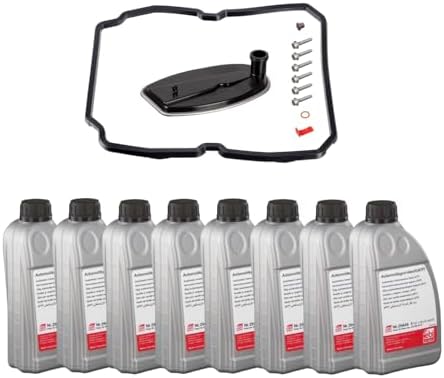
Parts for a proper service are the fluid (buy enough MB 236.14-rated ATF for your sub-variant's pan-drop volume, typically 4 to 5 liters), a filter and pan gasket, and, if the car has any shift hesitation at all, the conductor plate while the pan is already down. A combined conductor plate, filter and gasket kit runs $84.99 to $95.99 depending on the specific application, and an 8-liter Sprinter-spec service kit with the correct ATF included is $334.99 on our store. We break the full parts-versus-shop-labor math down in our 722.6 fluid change cost guide.
Need parts for this job?
MB-spec ATF, conductor plates, filters, gaskets and drain tools for the 722.6, all on our own secure checkout.
Shop 722.6 parts →Frequently Asked Questions
What transmission fluid does a 722.6 take?
Daimler's workshop data lists Operating Fluids Sheet BB00.40-P-0236-14A, meaning MB 236.14, as the current factory spec for every 722.6 sub-variant in the official fill table. MB 236.14 supersedes the older 236.12 and 236.10 fluids and is backward compatible with them, so a 722.6 that originally called for 236.12 can run 236.14 safely. Do not use Chrysler ATF+4, Dexron or Mercon in a 722.6, including the Dodge Sprinter NAG1 version.
How many liters of fluid does a 722.6 hold?
It depends on the exact sub-variant stamped on the transmission's ID tag. Daimler's fill table lists initial-charge capacities from 7.0 liters up to 9.2 liters across the roughly twenty 722.6 variants, with most common passenger-car versions falling between 7.5 and 8.6 liters. This is the complete dry-to-full charge, not a routine pan-drop top-off.
Is the 722.6 really a lifetime-fluid transmission?
Mostly not in practice. Daimler's own fill procedure only lists a separate in-service oil-change quantity for two of the roughly twenty 722.6 variants; the rest show a blank field rather than a published top-off number, which is where the lifetime-fluid idea comes from. Independent shops and most 722.6 owners service the fluid, filter and conductor plate seal every 40,000 to 60,000 miles because the felt-type filter clogs and old fluid accelerates conductor plate connector corrosion.
Can I use Chrysler ATF+4 in a Dodge Sprinter 722.6?
No. Even though Dodge badges the Sprinter's transmission as the NAG1, it is a Mercedes-built 722.6 and needs the Mercedes-spec fluid, not ATF+4. Mopar sells the correct fluid as part number 05127382AB, which is Pentosin ATF134 built to MB 236.14 and backward compatible with 236.12. Trade reporting on this transmission family notes specifically that Sprinter, Crossfire and other Mercedes-sourced units need this fluid because of shift calibration, unlike other Chrysler-built transmissions that run ATF+4.
How do I check the fluid level on a 722.6?
With the vehicle level, remove the filler-pipe cap and locking pin, insert Mercedes special tool 140 589 15 21 00 dipstick, pull it and read the level. Checked cold at about 25 C (77 F), the level must sit between the min and max marks in range A on the stick. If shift quality is off, Daimler's procedure calls for a second check with a scan tool confirming fluid temperature above 80 C (180 F), reading range B on the same dipstick.
Sources
- Daimler AG — AR27.00-P-0100AC, "Check oil level in automatic transmission and correct if necessary," Transmission 722.6. Backs the fluid specification sheet reference (BB00.40-P-0236-14A / MB 236.14) across all listed sub-variants, the full initial-charge capacity table, the special tool numbers, and the complete cold/hot level-check procedure. mbclub.ru (PDF)
- Mercedes-Benz USA — Star Bulletin S-B-00.40/89d, "Operating Fluid Specification Changes for Automatic Transmission" (Nov. 6, 2013), via NHTSA. Backs the 236.14-only rule for the 722.6, part number A001 989 68 03 10, separate filling units because 236.14/236.15/236.16 oils must never be mixed, and the prohibition on FE-ATF 134 in a 722.6. static.nhtsa.gov (PDF)
- Sonnax — Mio Cundl, "Mercedes 722.6, Daimler W5, Porsche W5, Jaguar 722.6." Backs the W5A580/W5A380/W5A330/W5J400 naming and that Sprinter, Crossfire and Mercedes units require the specific Mercedes fluid for calibration reasons while other Chrysler applications use ATF+4. sonnax.com
- Q8 Oils — Auto 25 automatic transmission fluid product data sheet. Backs MB 236.12 and MB 236.14 dual approval on a current fluid, confirming 236.14's backward compatibility with 236.12. q8oils.com (PDF)
- Transmission Digest — "Mercedes 722.6, Daimler W5, Porsche W5, Jaguar 722.6." Backs the point that Sprinter, Crossfire and Mercedes-branded 722.6 units require Mercedes-spec fluid due to shift calibration, while other Chrysler-built transmissions use ATF+4. transmissiondigest.com
- ATRA, Gears Magazine — "NAG 1/722.6 P0741 TCC Slip" (December 2020). Backs that a 722.6 shift/converter-clutch complaint can present with clean, odor-free fluid and no pan debris, confirming fluid condition is not always the cause once level and type are confirmed correct. gearsmagazine.com
- febi Bilstein — "Tips for Checking the Oil Level in 5-Speed Automatic Transmissions (722.6)." Supplementary parts-manufacturer bulletin corroborating the filler-pipe locking pin removal and dipstick insertion steps for technicians using an aftermarket dipstick. blog.febi.com