The E-Class is where the 722.6 five-speed spent most of its working life in Mercedes sedans and wagons. It arrived with the 1996 model year, when Sonnax notes the unit went into production, so it covers most of the W210 run (1996-2002) and the early W211 cars (2003 on) until the seven-speed 722.9 took over engine by engine. That makes the E-Class 722.6 population old, heavy, and in a lot of cases on its second or third owner, with a "lifetime fill" that was never changed. The failures we see on these cars are the same handful every time: a leaking 13-pin connector sleeve, a conductor plate that sends the car into limp mode, valve body bore wear that shows up as a flare, wrong fluid or a level nobody set hot, and on W210 cars especially, coolant getting into the ATF through the radiator. Here is how each one shows up on an E-Class, how to prove it, and what fixes it.


Step Zero: Is It Really a 722.6?
On a W211 this is not a formality. The 7G-Tronic 722.9 replaced the five-speed partway through the W211 run, and which car got which depends on engine, drivetrain and model year. The high-torque V8 cars, including the supercharged E55 AMG, stayed on the five-speed longer than the V6 cars. The two transmissions share almost nothing internally, so a conductor plate or valve body for one will not fit the other.
febi's technical bulletin on the 722.6 says the unit is identified by the middle row of numbers on the small plate on the left-hand side of the case. Get that number before you order anything. Sonnax adds a second clue: the W5A designations (W5A330, W5A380, W5A580) carry the maximum input torque in Newton meters in their last three digits, which is why the bigger-engine E-Class cars run the heavier-duty W5A580 build.
One trap that is specific to the W211: the fluid is not a reliable tell. Mercedes-Benz USA Star Bulletin S-B-00.40/89d specifies MB 236.14 (red ATF 134) for every 722.6, and also for the 722.9 up to transmission production date June 21, 2010. The W211 gave way to the W212 in 2009, so a W211 722.9 is a pre-cutoff unit, and a W211 with red fluid in it can be either transmission. Read the plate.
How Much Fluid Your E-Class Actually Takes
There is no single capacity for "the E-Class 722.6." Daimler's WIS procedure AR27.00-P-0100AC lists initial-charge quantities by variant number, and they range by almost two liters. A sample of the table:
| 722.6 variant (from ID plate) | Initial charge |
|---|---|
| 722.600/601/604-609/611/613/614/616-619/629/634/639/660-662/664/665/689/695/696/699 | 8.0 L |
| 722.602/603/615 | 7.5 L (+0.5) |
| 722.610/638 | 7.0 L (+0.5) |
| 722.622-628/630-633/635/636/663/666/669 and 722.620/621 in model 140 | 8.6 L (+0.5) |
| 722.640/644 | 7.5 L |
| 722.642 | 7.3 L (+0.5) |
| 722.643 | 8.7 L |
| 722.648 | 8.0 L initial, 5.0 L at oil change |
| 722.649 | 8.0 L initial, 6.5 L at oil change |
Those are dry-fill numbers. A pan drop and filter change only takes a fraction of that, because the converter and cooler circuit hold fluid. The same WIS procedure says to pour in about 5 liters before the first start after a refill or oil change, start it and idle in P, add the remainder, then hold the brake and run through the ranges several times before checking.
Problem 1: The Level Was Never Set Hot
Most E-Class 722.6 cars have no dipstick. The filler tube is sealed with cap 93 and a locking pin, 93a, which the WIS procedure says you break off and push out to open, and replace with a new pin when you are done. The check needs the Mercedes dipstick, tool 140 589 15 21 00 (febi sells an equivalent as part 38023, about a meter long). It goes all the way down until it touches the pan.
The dipstick has two ranges because, as febi points out, this fluid expands a lot with heat. Range A is the cold reading at about 25 C (77 F). Range B is the reading above 80 C (180 F), and Daimler states plainly that a precise check is only possible above 80 C. The car has to be level on its wheels or the reading is wrong.
Here is the part people get wrong. The ATF temperature sensor is wired in series with the Park/Neutral reed switch on the conductor plate, so the transmission only reports its own temperature in D or R. In P or N the value you see defaults to coolant temperature. Daimler's procedure tells you to check transmission temperature on Star Diagnosis in R or D with the brake applied. If you read "fluid temp" in Park, you are reading the engine, and you can set the level a liter off. Both under-fill and over-fill are listed in the WIS document as causes of malfunctions and transmission damage.
Problem 2: The 13-Pin Connector Sleeve Leaks (W211 Campaigns)
The 13-pin harness plug on the side of the case plugs into a guide sleeve that passes through the case and seals with O-rings. febi calls those seals a common source of leaks, and warns that a failed seal lets ATF into the plug, where metal particles in the fluid can short the pins.
Mercedes addressed this on the W211 twice. Campaign 2006020008 (NHTSA ID 10019822) had dealers inspect the pilot bushing for a color marking, because some had been fitted with non-tempered sealing rings that could leak. Bulletin SB-2008120008 (NHTSA ID 10030904) called for replacing the pilot bushing at the electrohydraulic unit on models 203, 209, 211, 219, 230 and 463 for model years 2005-2007. If you have a 2005-2007 E-Class 722.6 with oil around the plug, ask a dealer to run the VIN for open campaign work.
The fix itself is short. Turn the tan collar on the plug counterclockwise until it clicks and jacks the plug out. Remove the 7 mm bolt in the center of the sleeve and pry the sleeve out, with a pan under it. Lube the new O-rings, line the sleeve up with the conductor plate pins, push it home, and torque the bolt to 2.5 Nm per febi. If the pins on the harness side are green or wet, clean them now. A contaminated plug throws the same codes as a dead conductor plate.
Problem 3: Limp Mode From the Conductor Plate
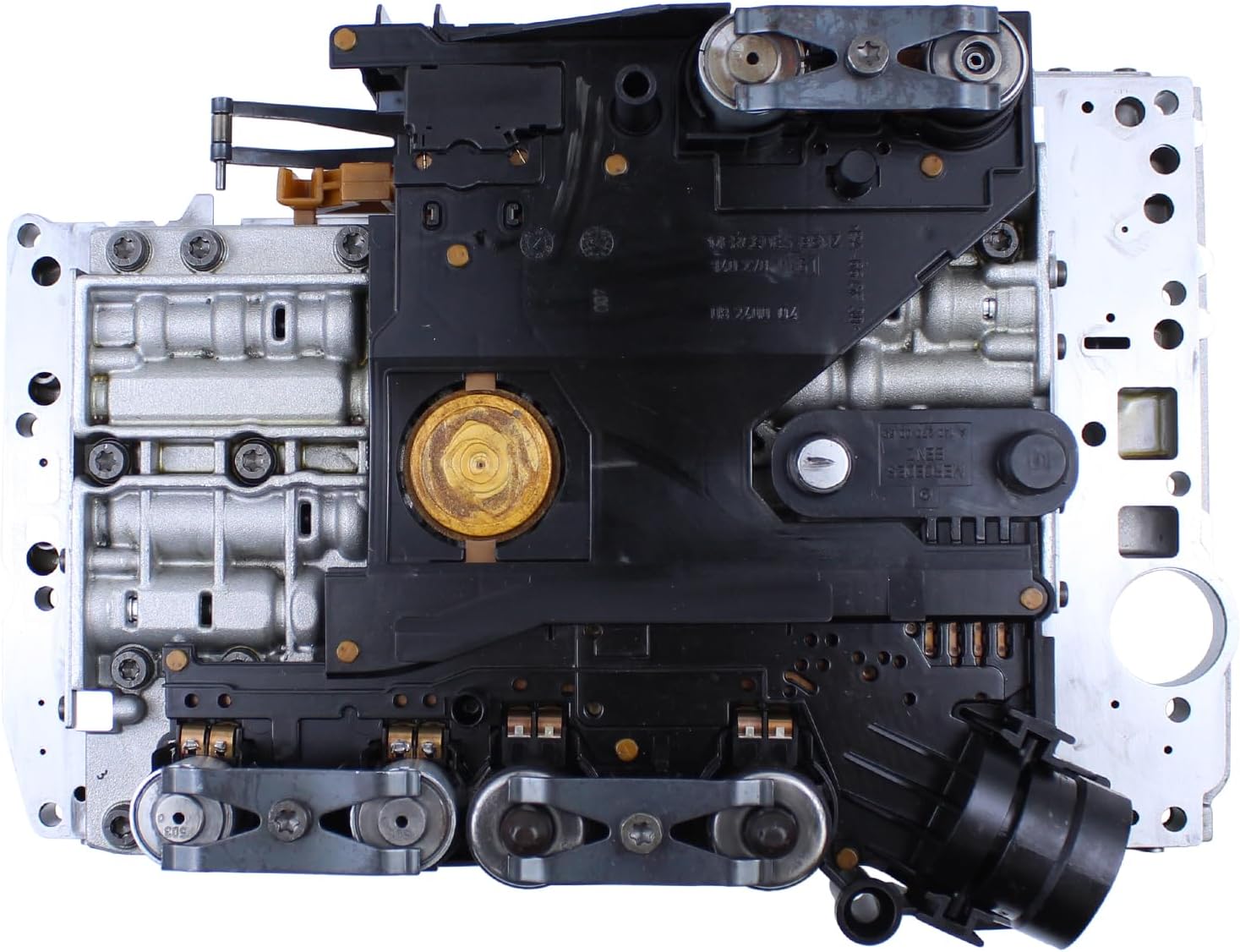
The conductor plate on top of the valve body carries the six solenoids, the N2 and N3 Hall-effect speed sensors, the temperature thermistor and the reed switch. When its contacts or sensor leads fail, the TCM loses a signal it trusts and drops into limp-home. On an E-Class that usually means a check-engine light and a car that pulls away in 2nd and will not upshift. febi ties P0715 to the speed sensors and P0748 through P0753 to the solenoid circuits.
There are no pressure taps on this case and no pressure transducers inside it. febi is explicit that any "pressure" on your scan tool is estimated from the PWM duty cycle sent to the three modulating solenoids, so do not condemn hydraulics off a scan-tool pressure number.
Test from the 13-pin connector before you drop the pan. Using febi's pinout, the line pressure modulating solenoid (pins 2 and 6) and shift pressure modulating solenoid (10 and 6) should read about 5.5 ohms, the lock-up modulating solenoid (11 and 6) about 2.7 ohms, and the three shift solenoids (pins 13, 8 and 9 to 6) about 4.5 ohms each. The temperature sensor at pins 4 and 12 should read 800-1200 ohms at 20 C, but only with the selector in D or R. A circuit that is open or out of range at the connector, with a solenoid that measures fine on the bench, means the plate is the problem.
To replace it: drain warm, then let it cool. Pull the six pan bolts and their spacers, the strainer, and the valve body bolts, watching the selector plunger as the body comes away. Note where each solenoid goes. Fit the new plate on its locating tabs, refit the solenoids, and torque the solenoid springs, valve body and pan bolts to 8 Nm, per febi. Do the connector sleeve on the same job.
Problem 4: 2-3 or 4-5 Flare With No Codes
An E-Class that flares the engine on the 2-3 or 4-5 upshift, or feels like it falls into neutral on a 5-4 or 3-2 downshift under load, usually has a hydraulic problem, not an electrical one. Sonnax's write-up by Mio Cundl lays out the mechanism. The outer bore of the working pressure regulator valve wears, pMod solenoid signal oil leaks past the boost end, and working pressure does not rise with load. The 1-2/4-5, 2-3 and 3-4 overlap sleeves sit in the same pMod circuit and wear on their inside diameter, leaking at the outside and pulling pressure down further.
The same article notes that by 1998 many high-mileage Mercedes warranty cars were showing a 2-3 flare bad enough to put them into limp mode, which the author traced to valve body material that was too soft. That is early W210 territory. A flare left long enough will set a ratio fault and limp the car, which looks electrical until you vacuum test the valve body. Sonnax's 722.6/NAG1 vacuum test guide shows where to test. The repair is a hardened bushing in the regulator bore plus tested or new overlap sleeves, or a replacement valve body if the casting is too worn.
Problem 5: Coolant in the ATF (Mostly W210)
The 722.6 cools its fluid through a heat exchanger in the radiator. febi's bulletin warns that coolant can enter the transmission through small perforations in that heat exchanger. On W210 cars this is a well-known failure: owners on the Mercedes forums widely report original radiators failing internally and contaminating the transmission, sometimes with no overheating warning first. That is anecdotal, but it matches what we see on the bench.
If drained fluid is pink, milky or frothy, run a glycol test before anything else. Glycol attacks the friction material and the bonded seals, so a contaminated unit often needs a full rebuild, not a flush. Replace the radiator first. Putting a conductor plate or valve body into a transmission that is still taking on coolant wastes the part.
Problem 6: The Wrong Red Fluid
Star Bulletin S-B-00.40/89d allows only 236.14 fluid in the 722.6 (Mercedes part number A001 989 68 03 10), and says 236.14, 236.15 and 236.16 oils must never be mixed, to the point of calling for separate filling units. Fuchs Titan ATF 4134 is one aftermarket fluid that lists the 236.14 approval. A generic "multi-vehicle" red ATF from a quick-lube top-off is not a 236.14 fluid, and a shop that services a lot of later Mercedes may reach for blue 236.15 out of habit. If you do not know what is in it, a full drain and refill to the correct spec is cheap insurance.
Diagnostic Order on an E-Class
- Read the ID plate. Confirm 722.6 and note the variant for capacity and parts.
- Scan codes. Speed sensor and solenoid codes point to the plug, sleeve or plate; ratio codes with clean circuits point to the valve body.
- Inspect the 13-pin plug for oil, then measure the circuits at the connector.
- Pull a fluid sample. Pink froth means glycol: fix the radiator before anything else.
- Set the level hot, above 80 C, read in D or R on the scan tool, car level.
- Only then choose between a sleeve, a conductor plate, a valve body or a rebuild.
722.6 Conductor Plate, Filter and Gasket Kit (1402701161)
For the limp-mode and connector-leak repairs above: CoreTransmissionParts carries the conductor plate kit with filter and pan gasket that fits the E-Class 722.6.
View the conductor plate kit →Shop 722.6 parts →
Frequently Asked Questions
Which Mercedes E-Class models have the 722.6 transmission?
Most W210 E-Class cars from 1996 on and the early W211 cars use the 722.6 five-speed. The seven-speed 722.9 replaced it partway through the W211 run depending on engine, and the high-torque V8 cars stayed on the five-speed longer. Read the middle row of numbers on the ID plate on the left side of the case to confirm.
How much transmission fluid does an E-Class 722.6 take?
It depends on the variant number on the ID plate. Daimler's WIS table lists initial charges from 7.0 liters (722.610/638) to 8.7 liters (722.643), with many variants at 8.0 liters. After a drain, pour in about 5 liters before the first start, then set the final level hot above 80 C.
Why does my E-Class transmission fluid temperature read wrong in Park?
The ATF temperature sensor is wired in series with the Park/Neutral reed switch, so the transmission only reports its own temperature in D or R. In P or N the scan tool value defaults to coolant temperature. Check the temperature in D or R with the brake applied before reading the dipstick.
Can a bad radiator ruin an E-Class 722.6?
Yes. The ATF cooler is a heat exchanger inside the radiator, and febi warns coolant can leak into the transmission through small perforations in it. Glycol attacks clutch friction material and seals, so pink or milky fluid usually means a new radiator and often a rebuild, not just a flush.
Sources
- Mercedes-Benz USA Star Bulletin S-B-00.40/89d, "Operating Fluid Specification Changes for Automatic Transmission," November 6, 2013 (NHTSA-hosted). Backs the 236.14 requirement for the 722.6 and for the 722.9 before the June 21, 2010 production date, part number A001 989 68 03 10, the red ATF 134 color, and the never-mix rule for 236.14/15/16. static.nhtsa.gov (PDF)
- Daimler AG WIS AR27.00-P-0100AC, "Check oil level in automatic transmission and correct if necessary," Transmission 722.6. Backs the variant capacity table, the approx. 5 L pre-start fill, the cap and locking pin, dipstick tool 140 589 15 21 00, ranges A (25 C) and B (80 C), the scan-tool temperature check in R or D, the level-vehicle requirement and the under/over-fill warning. mbclub.ru (PDF)
- febi bilstein Technical Bulletin, "Mercedes Benz Conductor Plate." Backs the ID plate location, conductor plate components, P0715 and P0748-P0753 codes, the 13-pin resistance values, the no-pressure-taps note, the reed switch/temperature behavior, the guide sleeve leak and 2.5 Nm bolt, the 8 Nm valve body and pan torque, dipstick 38023, and the heat exchanger coolant warning. techtips.ie (PDF)
- Sonnax Technical Resource 129, "Mercedes 722.6, Daimler W5, Porsche W5, Jaguar 722.6" (Mio Cundl). Backs the 1996 production start, the W5A torque designations, regulator valve bore wear and pMod leakage, overlap sleeve wear, the 2-3/4-5 and 5-4/3-2 flare symptoms, and the 1998 warranty-car limp mode history. sonnax.com
- Sonnax, "Mercedes 722.6/Chrysler NAG1 Vacuum Test Guide." Backs the valve body vacuum test used to confirm regulator bore and overlap sleeve wear. sonnax.com
- Fuchs Lubricants, TITAN ATF 4134 product specification page. Backs the MB 236.14 approval of an aftermarket ATF for the 722.6. fuchs.com
Mercedes-Benz campaign 2006020008 (NHTSA ID 10019822) and bulletin SB-2008120008 (NHTSA ID 10030904) are cited by number; the documents are distributed through Mercedes-Benz dealer service information. The W210 radiator observation is drawn from owner reports on Mercedes enthusiast forums and is not counted as a source.
Shop conductor plates, valve bodies and rebuild kits for the E-Class 722.6, on our own secure checkout.
Shop 722.6 parts →