The C-Class is one of the most common places to find a Mercedes 722.6 five-speed on the road today. The late W202 cars and most of the 2001-2007 W203 C230, C240, C280 and C320 sedans, wagons and coupes left the factory with one, and a lot of them are now cheap, high-mileage daily drivers whose owners have never had the pan off. That is exactly the population where this transmission's known weak spots show up. None of them are mysterious. They come down to a leaking connector sleeve, an aging conductor plate, a valve body bore that wears, and fluid that was either the wrong spec or never checked properly because the car has no dipstick. Here is how each one presents on a C-Class, how to prove it before you buy parts, and what fixes it.

First, Confirm the C-Class Actually Has a 722.6
Do not assume. Depending on model year, engine and drivetrain, some later W203 V6 cars came with the seven-speed 722.9 instead, and the two share almost no internal parts and use different fluid. febi's technical bulletin on the 722.6 notes the unit is identified by the middle row of numbers on the small ID plate on the left-hand side of the case. Read that plate before you order anything.
The factory fill table backs up how many variants there are. Daimler's WIS procedure AR27.00-P-0100AC lists transmissions 722.612/697/698 "in model 202" with an initial charge of 7.3 to 7.7 liters, and 722.645 in model 202 at 8.8 to 9.2 liters. The most common 722.6xx variants elsewhere in the table sit at 7.5 liters (+0.5) or 8.0 liters. The point is that the variant number on the plate, not the badge on the trunk lid, tells you the fill quantity and which valve body and conductor plate fit.
| Item | 722.6 spec (C-Class) |
|---|---|
| Fluid | MB 236.14 (ATF 134, red), MB part A001 989 68 03 10 |
| Initial charge, 722.612/697/698 in W202 | 7.3-7.7 L |
| Initial charge, 722.645 in W202 | 8.8-9.2 L |
| Fill before first start after a drain | approx. 5 L |
| Level check ranges | Range A at 25 C (77 F), range B above 80 C (180 F) |
| Valve body, solenoid spring and pan bolts | 8 Nm (febi procedure) |
| Connector guide sleeve bolt | 2.5 Nm (febi); 3 Nm in the Daimler campaign procedure |
Problem 1: The 13-Pin Connector Sleeve Leaks
This is the one that is most specific to the W203. The 13-pin harness plug on the side of the case does not plug directly into the conductor plate. It plugs into a guide sleeve (Mercedes calls it the pilot bushing) that passes through the case wall and is sealed by O-rings both at the case and inside the conductor plate. When those O-rings harden, ATF weeps out around the plug. Worse, as febi's bulletin points out, a failed sleeve seal can let oil into the harness plug itself, and metal particles suspended in the fluid can cause short circuits across the pins.
Mercedes knew about it. Campaign 2006020008 (NHTSA ID 10019822, January 2007) had dealers inspect the pilot bushing at the electrohydraulic unit for a color marking because some had been built with non-tempered sealing rings that could leak. A follow-up bulletin, SB-2008120008 (NHTSA ID 10030904, December 2008), called for replacing the pilot bushing on models 203, 209, 211, 219, 230 and 463 from model years 2005-2007. If you have a 2005-2007 C-Class with a 722.6 and an oily connector, check whether that work was ever done.
How to fix it
- Pop the cover off the harness plug and turn the lug on the tan collar counterclockwise. It clicks and jacks the 13-pin plug out of the sleeve.
- Remove the 7 mm bolt in the center of the sleeve and pry the sleeve out. Expect fluid to run out, so have a pan under it.
- Lubricate the new sleeve's O-rings, line its holes up with the pins on the conductor plate, push it home and torque the bolt to 2.5 Nm. Daimler's campaign procedure calls for 3 Nm. Either way this is a tiny fastener into a plastic part, so use an inch-pound wrench.
- Refit the plug and turn the collar clockwise until you feel resistance, then about 30 degrees more until it clicks into its locked position.
If the plug pins are green or wet, clean them before you reconnect. A contaminated plug will throw the same solenoid and speed sensor codes as a bad conductor plate, which is how people end up replacing a good plate.
Problem 2: Conductor Plate Failure and Limp Mode
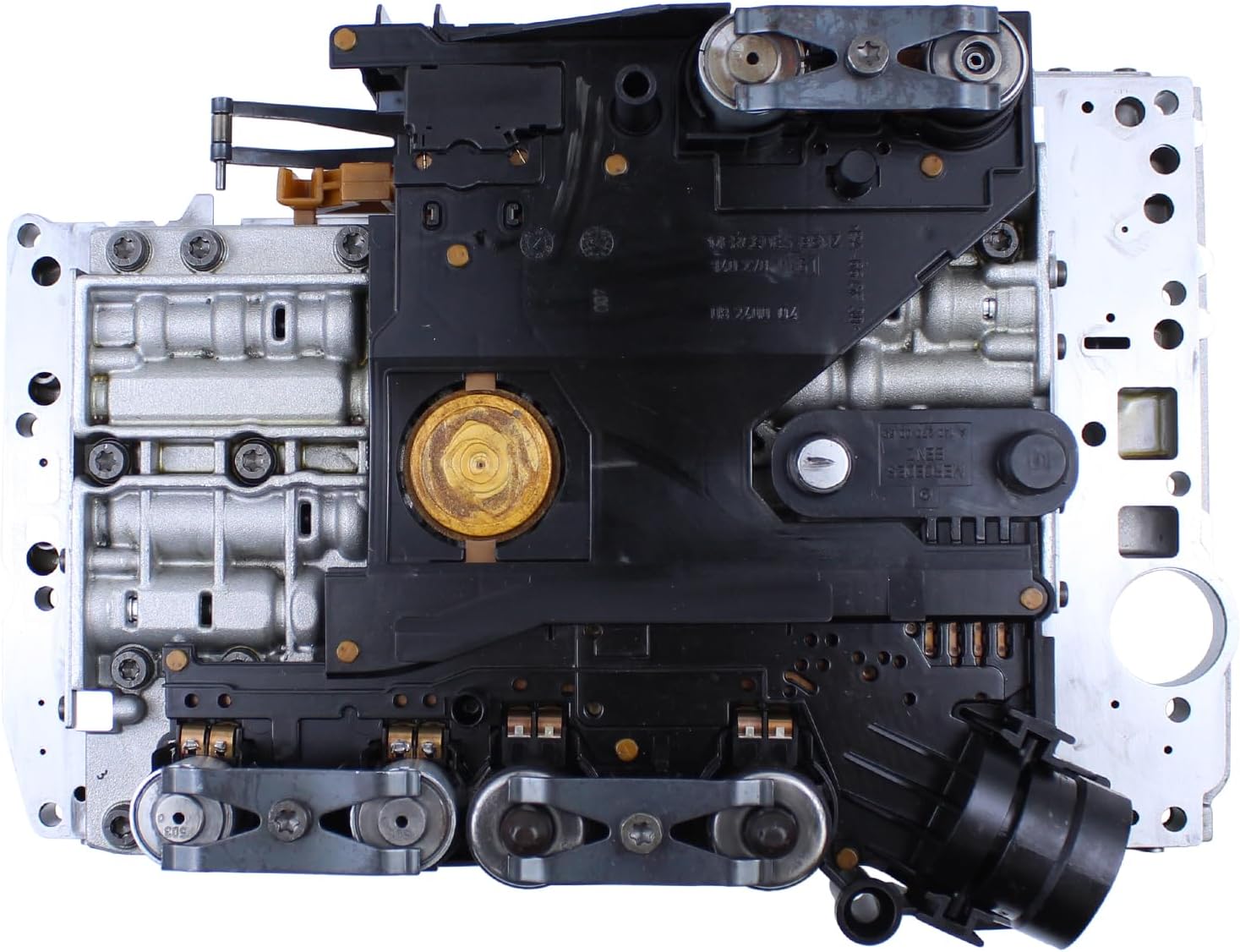
The conductor plate sits on top of the valve body and carries the electrical paths for the six solenoids, plus the N2 and N3 Hall-effect speed sensors, the ATF temperature thermistor and the Park/Neutral reed switch. When its contacts or sensor leads fail, the TCM sees a signal it cannot trust, lights the check-engine light and drops into limp-home mode. On a C-Class that usually feels like the car starts in 2nd and will not shift.
febi's bulletin ties OBD codes P0748 through P0753 to the solenoid circuits and P0715 to the speed sensors. One thing to understand before you start chasing pressure: there are no pressure taps on this transmission and no pressure transducers inside it. Whatever "pressure" your scan tool shows is calculated from the PWM duty cycle the TCM is sending the three modulating solenoids. It is a command, not a measurement.
Bench-check the plate at the 13-pin connector
You can test most of the plate without dropping the pan by measuring at the connector, disconnected, or back-probed with it plugged in. Values from febi's pinout:
| Pins | Circuit | Expected |
|---|---|---|
| 2 and 6 | Line pressure modulating solenoid | about 5.5 ohms |
| 10 and 6 | Shift pressure modulating solenoid | about 5.5 ohms |
| 11 and 6 | Lock-up clutch modulating solenoid | about 2.7 ohms |
| 13, 8, 9 (with 6) | 1-2/4-5, 2-3, 3-4 shift solenoids | about 4.5 ohms each |
| 4 and 12 | ATF temp sensor through reed switch | 800-1200 ohms at 20 C, in D or R only |
| 7 | Speed sensor supply | 4-8 volts |
| 6 | Solenoid supply | battery voltage |
The temperature sensor is wired in series with the reed switch, so it only reads in D or R. In other selector positions the reading defaults to coolant temperature. That trips people up during a level check, which we get to below. If a solenoid circuit is open or way out of range at the connector but the solenoid itself measures fine on the bench, the plate is your problem.
Replacing the plate
Drain warm, then let the car cool before you go further. Pull the pan (six Torx bolts with spacers), the strainer, and the ten Torx bolts that hold the valve body. The valve body is heavy, and you need to watch the selector plunger as it comes off the selector sector. On the bench, note each solenoid's position before you remove it. The shift solenoids have no O-rings; the pressure modulating solenoids have two each. Snap the new plate onto its two locating tabs, refit the solenoids, and torque the solenoid retaining springs, valve body bolts and pan bolts to 8 Nm. Replace the connector sleeve while you are in there; it is the same job.
Problem 3: Flare on the 2-3 and 4-5 Upshifts
If the codes are clean but the engine flares on the 2-3 or 4-5 upshift, or the car feels like it drops into neutral on a 5-4 or 3-2 downshift, you are looking at a hydraulic problem, not electrical. Sonnax's technical write-up on the 722.6, by Mio Cundl of D.B. Automobile in Berlin, explains the mechanism: the outer bore of the working pressure regulator valve wears and lets pMod solenoid signal oil leak past the boost end of the valve, so working pressure (the 722.6's line pressure) does not rise with engine load. The overlap sleeves in the 1-2/4-5, 2-3 and 3-4 circuits also wear on their inside diameter and leak at the outside diameter, which pulls working pressure down further.
The same article notes that by 1998 many high-mileage cars under Mercedes warranty were showing a 2-3 flare that put them into limp mode, which the author put down to valve body material that was not hard enough. That matters for the C-Class because a car that has been flaring for a while may set a gear-ratio code and go into limp mode on its own, which looks like an electrical failure until you vacuum test the valve body. Sonnax's 722.6/NAG1 vacuum test guide shows the exact test locations. The fix is a hardened bushing in the worn regulator bore and new or tested overlap sleeves, done as a valve body rebuild, or a replacement valve body if the casting is too far gone.
Problem 4: Wrong Fluid, Wrong Level
Mercedes-Benz USA Star Bulletin S-B-00.40/89d is blunt: the 722.6 takes only fluid that meets operating fluid specification sheet 236.14, part number A001 989 68 03 10, which is the red ATF 134. The same bulletin says 236.14, 236.15 and 236.16 oils must never be mixed and calls for separate filling units for each. Fuchs Titan ATF 4134 is one aftermarket fluid that carries the 236.14 approval. A C-Class that was "topped off" with whatever red ATF was on the shelf at a quick-lube is a real risk, and so is a 722.9 shop habit of filling with blue 236.15.
Level is the other half. Most C-Class cars have no dipstick, just a filler tube sealed with a cap and a locking pin you break to remove. Daimler's WIS procedure calls for the car level on its wheels, about 5 liters poured in before the first start after a drain, then a cycle through the gear ranges with the brake on before checking. Cold, the level must read in range A at about 25 C. The precise check happens above 80 C in range B, and the factory says to use a scan tool to confirm fluid temperature in R or D, which lines up with the reed switch behavior above. Both under-fill and over-fill can cause malfunctions and transmission damage, per the same document.
Problem 5: Coolant in the ATF
febi's bulletin flags a failure many people miss: coolant getting into the transmission through small perforations in the heat exchanger. If the fluid you drain is pink, milky or frothy, run a glycol test before you do anything else. Glycol attacks clutch friction material, so a C-Class with coolant contamination usually needs more than a fluid change, and putting a new conductor plate into contaminated fluid is wasted money. Fix the cooler first.
A Sensible Diagnostic Order
- Read the ID plate and confirm it is a 722.6, and note the variant number.
- Scan for codes. Speed sensor and solenoid codes point at the connector, sleeve or plate. Gear-ratio codes with clean electricals point at the hydraulics.
- Inspect the 13-pin plug for oil and corrosion, then measure the circuits at the connector against the table above.
- Check level and condition properly, hot, in D or R, on a scan tool. Look for burnt smell, metal on the magnet, or pink froth.
- Only then decide between a sleeve, a conductor plate, a valve body, or a rebuild.
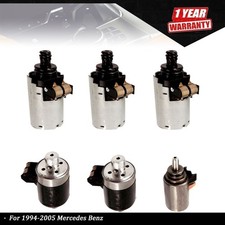
722.6 Shift Solenoid Kit, 1994-2005
If a solenoid measures out of range at the connector and on the bench, CoreTransmissionParts carries the solenoid set that mounts to the conductor plate on these 722.6 units.
View the solenoid kit →Shop 722.6 parts →
Frequently Asked Questions
Which Mercedes C-Class models have the 722.6 transmission?
Late W202 C-Class cars and most 2001-2007 W203 C230, C240, C280 and C320 models use the 722.6 five-speed, but some later W203 V6 cars came with the seven-speed 722.9 instead. Read the middle row of numbers on the ID plate on the left side of the case to confirm before ordering parts or fluid.
Why is my C-Class stuck in 2nd gear?
That is the 722.6 limp-home mode. The TCM drops into it when it sees a solenoid or speed sensor signal it cannot trust, usually from a failing conductor plate or an oil-contaminated 13-pin connector. Scan for P0715 and P0748-P0753 range codes and inspect the connector before replacing the plate.
Why is transmission fluid leaking from the connector on my W203?
The 13-pin plug seats in a guide sleeve, called the pilot bushing, that is sealed with O-rings. Mercedes ran campaign 2006020008 and bulletin SB-2008120008 because some sleeves leaked, covering model 203 among others for 2005-2007. Replacing the sleeve with new seals and torquing its small bolt to about 2.5-3 Nm stops the leak.
What transmission fluid does a C-Class 722.6 take and how much?
Only fluid approved to MB 236.14, the red ATF 134 sold under Mercedes part number A001 989 68 03 10. Daimler lists 7.3 to 7.7 liters initial charge for the 722.612/697/698 variants in the W202, and about 5 liters goes in before the first start after a drain, with the final level set hot in range B above 80 C.
Sources
- Mercedes-Benz USA Star Bulletin S-B-00.40/89d, "Operating Fluid Specification Changes for Automatic Transmission," November 6, 2013 (NHTSA-hosted). Backs the 236.14-only fluid requirement for the 722.6, part number A001 989 68 03 10, the red ATF 134 color, and the rule that 236.14, 236.15 and 236.16 oils must never be mixed. static.nhtsa.gov (PDF)
- Daimler AG WIS AR27.00-P-0100AC, "Check oil level in automatic transmission and correct if necessary," Transmission 722.6. Backs the W202 variant capacities (722.612/697/698 at 7.3-7.7 L, 722.645 at 8.8-9.2 L), the approx. 5 L pre-start fill, the level-on-wheels requirement, the 25 C and 80 C check ranges, the scan-tool temperature check in R or D, and the under/over-fill warning. mbclub.ru (PDF)
- febi bilstein Technical Bulletin, "Mercedes Benz Conductor Plate" (July 2013). Backs the ID plate location, the conductor plate component list, P0715 and P0748-P0753 code ranges, the 13-pin connector pin values, the no-pressure-taps note, the removal and 8 Nm torque procedure, the 2.5 Nm guide sleeve bolt and 30-degree collar lock, the sleeve O-ring short-circuit failure, and the coolant-through-heat-exchanger warning. techtips.ie (PDF)
- Sonnax Technical Resource 129, "Mercedes 722.6, Daimler W5, Porsche W5, Jaguar 722.6" (Mio Cundl). Backs the working pressure regulator valve bore wear, pMod signal leakage, overlap sleeve wear, the 2-3/4-5 upshift and 5-4/3-2 downshift flare, the 1998 warranty-car limp mode history and the hardened bushing repair. sonnax.com
- Sonnax, "Mercedes 722.6/Chrysler NAG1 Vacuum Test Guide." Backs the valve body vacuum test locations used to confirm regulator bore and overlap sleeve wear. sonnax.com
- Fuchs Lubricants, TITAN ATF 4134 product specification page. Backs the MB 236.14 approval of an aftermarket ATF suitable for the 722.6. fuchs.com
Mercedes-Benz campaign 2006020008 (NHTSA ID 10019822) and bulletin SB-2008120008 (NHTSA ID 10030904) are cited by number above; the documents are distributed through Mercedes-Benz dealer service information.
Shop conductor plates, solenoid kits, valve bodies and rebuild kits for the C-Class 722.6, on our own secure checkout.
Shop 722.6 parts →