A Mercedes-Benz 722.9 (the seven-speed 7G-Tronic, NAG2 platform) that shifts through all seven forward gears fine but gives you nothing, or almost nothing, in Reverse is one of the more misleading complaints on this transmission. The instinct is to order a conductor plate or a valve body, because that is what gets blamed for most 722.9 weirdness online. But reverse has a structural weakness built into every planetary automatic: it is the one range that asks the hydraulic system to clamp two holding elements at once instead of one, which means it is usually the first thing to go soft when line pressure, valve body condition, or fluid condition is marginal rather than catastrophic. This guide walks through the causes that actually show up in documented field cases, in the order a tech should check them.
722.9 No Reverse: Diagnosis and Fix


Why Reverse Fails Before the Forward Gears Do
Every one of the 722.9's seven forward ratios is built by applying one or two shift elements, usually a single clutch pack or a single clutch-and-brake combination. Reverse is different: it requires clamping two of the transmission's holding brakes simultaneously while a clutch pack carries drive backward through the planetary gearset. Transmission Digest's rebuild comparison of the 722.9 against its five-speed predecessor, the 722.6, lays out the internal layout this creates: starting from the pump, the stack runs B1 brake, K1 clutch, the 722.9-specific B3 brake (a pack the 722.6 does not have in this position), K2 clutch, K3 clutch, and finally the B2 brake at the rear of the case. With that many separate clutch and brake packs needing calibrated pressure at the right moment, reverse's requirement for two of them to clamp at once makes it the range most sensitive to any across-the-board drop in line pressure or valve body accuracy, even when every forward gear still shifts and holds normally.
That is the pattern to listen for before you touch anything: good forward gears, including acceptable engine braking in manual low ranges, but reverse that is weak, slips under throttle, or is simply not there. It points at the hydraulic supply feeding the whole valve body, not a single burned clutch pack.
Cause 1: Pump Bushing-to-Converter-Hub Wear Killing Line Pressure
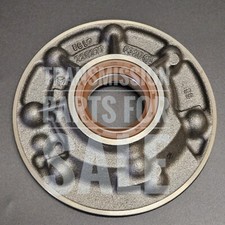
The 722.9's oil pump originally rode against the torque converter hub on a plain bushing, the same basic arrangement used in the 722.6. Transmission Digest's November 2014 Tech/Talk column documents a 2006 Mercedes-Benz CLK500 with only 85,000 miles that lost all movement on the highway; teardown found the pump bushing had literally welded itself to the converter hub and spun, trashing the pump. The article notes this was common enough on the 722.9 specifically, unlike the 722.6, that Mercedes-Benz switched to a caged bearing design for the pump, the only bearing-style pump available from the factory, under part number 722 270 0197.
A pump that has lost its seal at the hub, or whose bushing is worn enough to let fluid bypass internally, does not usually fail instantly. It typically shows up first as weak, slow, or absent reverse engagement, since reverse's two-brake clamping requirement eats into the pressure margin fastest, before forward gears start slipping too as wear progresses. Transmission Digest's June 2013 rebuild-comparison article adds a second wrinkle specific to the 722.9: certain models also use an external auxiliary pump to hold line pressure during stop-start idle shutdown, so a start-stop-equipped car with a weak or dead auxiliary pump can show the same symptom pattern at a stop light specifically. A line-pressure test in Reverse at the transmission's test port, checked against the spec in the service documentation, confirms or rules this out before the pan ever comes off.
Cause 2: Valve Body Wear at the Pressure Regulator Bore and Solenoids
Gears Magazine's field-documented rundown of common 722.9 problems points to the valve body itself as a frequent, separate cause of pressure-related complaints on this transmission. The most common failure noted is O-rings on the tips of the solenoids deteriorating and leaking fluid, which stops the solenoid from properly stroking its valve and shows up as burnt clutches from incomplete or inconsistent apply. The same source documents wear at the working pressure regulator bore specifically, which the article ties to burnt clutches and overheating, along with broken valve body springs that can still stroke a valve intermittently rather than failing outright, making the fault hard to catch without a full teardown and a vacuum test of every bore.
None of that wear is unique to reverse, but reverse is where it shows up first for the same clamping-margin reason covered above. A valve body with a worn regulator bore or a leaking solenoid O-ring is delivering less consistent pressure across the board; the two-brake-plus-clutch demand of reverse is the first place that shortfall becomes a complaint instead of a number on a pressure gauge. Gears Magazine's recommendation applies directly here: disassemble the valve body completely on any 722.9 rebuild rather than reusing it on inspection alone, check every bore for wear with a vacuum tester, and replace rather than reuse any spring you cannot positively confirm is still at factory tension.
Cause 3: Wrong, Low, or Degraded ATF
Fluid condition and spec matter more on a transmission that is already running on a thin pressure margin. Mercedes-Benz's own Star Bulletin S-B-00.40/89d sets a hard production break for 722.9 fluid specification at transmission component serial number 23834526, built June 21, 2010. Transmissions built before that date, and most transmissions built after it when paired with engines 113, 152, 156, 157, 275, or 279, require red ATF134 fluid meeting the 236.14 specification (part number A001 989 68 03 10). Most other transmissions built after that break require blue FE-ATF134 meeting the 236.15 specification (part number A001 989 78 03 09). The bulletin is explicit that these two fluids are not interchangeable, must never be mixed, and require separate filling equipment, because their additive packages behave differently against the clutch packs. Motul's own technical data sheet for its 236.15-approved fluid confirms the fluid is a synthetic, friction-modified formulation engineered specifically around that approval, which underscores why a generic or mismatched ATF changes clutch-pack friction behavior rather than just topping off volume.
Fluid that is simply low, old, or oxidized compounds the same problem without needing a wrong-spec fill: a transmission already dealing with pump wear or valve body wear has less margin to absorb a second, fluid-side pressure loss, and reverse is where that combination typically surfaces first. Checking fluid level and condition, and confirming the spec matches the production date using the bulletin's fluid color and part-number guidance, costs a few minutes and should happen before any parts are ordered.
The Rebuild Trap: A Piston Installed Backward
One more documented failure mode belongs in this guide, even though the specific case on record is a forward-movement complaint rather than a reverse one, because it is exactly the kind of mistake that produces a comeback on any 722.9 that has recently been apart. Transmission Digest's Tech/Talk series documents a 2007 Mercedes-Benz CLS550 722.9 that came out of an overhaul with a complaint of no forward movement. The cause was the B2 Brake Housing's inner apply piston having been installed upside down; the B2 Brake is applied in first through fourth gear and holds the rear sun gear that connects the output shaft to the rest of the gear train, so a piston seated backward in that pack kept it from doing its job at all. Reinstalling the piston correctly restored forward movement immediately.
If your 722.9 just had a valve body replacement, a clutch-pack overhaul, or a full rebuild and it has gone from working reverse to no reverse, or from no reverse to still no reverse after the first repair attempt, a misseated or backward piston in whichever pack contributes to reverse's clamping is a fast, inexpensive thing to rule out before assuming the replacement part itself is defective.
How to Work This Diagnosis in Order
- Check fluid first. Confirm level, look for oxidation or a burnt smell, and verify the color and part number against production date per S-B-00.40/89d before anything else.
- Pull stored fault codes. Speed-sensor or solenoid-circuit codes point toward the conductor plate or valve body electrically; no codes at all, with good forward gears and weak or absent reverse, points at a straight hydraulic/mechanical cause.
- Line-pressure test in Reverse at the transmission's test port, compared against the service spec, to separate a pump problem from a valve body problem before disassembly.
- If pressure is low across the board, inspect the pump bushing-to-hub fit for wear or spin damage per the documented 722.9 failure pattern, and consider the bearing-style pump upgrade.
- If pressure is inconsistent or borderline, pull the valve body and inspect the working pressure regulator bore, solenoid tip O-rings, and every spring per Gears Magazine's documented failure points, rather than reusing it on a visual check alone.
- On any unit recently apart, verify piston orientation and seating in the clutch and brake packs before ordering a second part.
FAQ
Why does a 722.9 lose reverse before it loses any forward gears?
Reverse is built by clamping two of the transmission's holding elements at once while a clutch pack transmits drive backward through the gearset, which takes more clamping pressure than most forward ratios need. On a 722.9 running on marginal line pressure, whether from a worn pump, a worn valve body regulator bore, or fluid that is low or the wrong spec, reverse is usually the first range to slip or drop out completely, with the forward gears still shifting normally for a while longer. That pattern, good forward gears but nothing in reverse, points straight at the hydraulic supply side rather than a single broken part.
Can a worn pump really cause no reverse on a 722.9?
Yes, and Transmission Digest has documented it directly. The 722.9 pump originally used a bushing where it rides against the torque converter hub, and Mercedes-Benz later switched to a caged bearing (part number 722 270 0197) after enough bushing spin-out and seizure cases on the 722.9 specifically. A spun or worn bushing lets the pump lose its seal against the converter hub, line pressure drops, and the vehicle can go from normal operation to no movement, forward or reverse, quickly. A pressure test at the line-pressure tap in Reverse, compared to the spec in the service documentation, is the fastest way to confirm or rule this out before anything is disassembled.
Is the valve body or the conductor plate more likely to cause no reverse?
On most 722.9 no-reverse complaints, the valve body's hydraulic wear is the more common culprit. Gears Magazine documents that the working pressure regulator bore wears on high-mileage 722.9 valve bodies, along with solenoid O-ring deterioration and broken valve body springs, any of which can rob the clutch and brake packs of the pressure they need to hold. The conductor plate and its speed sensors are a real and separate failure path on this transmission, but that failure pattern more commonly shows up as limp mode or erratic shifting across multiple gears, not a clean loss of reverse with normal forward operation.
Could the wrong transmission fluid cause no reverse in a 722.9?
It can contribute, and it is worth ruling out before any parts are ordered. Mercedes-Benz bulletin S-B-00.40/89d sets a hard break for 722.9 fluid specification at transmission production date June 21, 2010: red ATF134 (236.14 spec) before that date, and blue FE-ATF134 (236.15 spec) after it for most applications, with the bulletin explicit that the two must never be mixed. Fluid that is low, badly degraded, or the wrong spec changes the friction behavior and effective clamping force in the clutch packs, which can tip a transmission that is already on the edge, from a worn pump or valve body, into losing reverse specifically.
If a 722.9 just had a rebuild or valve body swap and still has no reverse, what should get checked first?
Piston orientation and seating inside the unit, before assuming a part is defective. Transmission Digest documented a 2007 Mercedes-Benz CLS550 722.9 that came out of an overhaul with a complaint of no forward movement, traced to the B2 Brake Housing inner apply piston having been installed upside down; reinstalling it correctly restored movement immediately. That case was forward, not reverse, but it is the same class of mistake, a single piston installed backward or misseated during reassembly, and it is a fast, inexpensive thing to rule out on a comeback before resorting to a second parts order.
Found the real cause of your 722.9 no-reverse complaint?
Pumps, valve bodies, and complete master rebuild kits, shipped fast from the USA.
Shop 722.9 parts →Need the exact valve body for this fix?
CoreTransmissionParts stocks the 722.9 7G-Tronic valve body (A2302700160) that matches the regulator-bore and solenoid wear covered above.
Shop the 722.9 valve body at CTP →Sources
- Mercedes-Benz USA, LLC — Star Bulletin S-B-00.40/89d, "Operating Fluid Specification Changes for Automatic Transmission," November 6, 2013 (revision d), for all models with Transmission 722.6, 722.9, 724.2, or 725.0 (archived via NHTSA). Backs the June 21, 2010 production break at component serial number 23834526, the red 236.14 vs. blue 236.15 fluid specifications and part numbers, and the never-mix requirement. static.nhtsa.gov
- Motul — Technical Data Sheet, "ATF 236.15 DE," Automatic Transmission Fluid for Mercedes-Benz 7-speed automatic transmissions, approved to MB-Approval 236.15. Backs the blue 236.15 fluid's synthetic, friction-modified formulation referenced in the fluid-cause section. motul.com
- Transmission Digest — "7G-Tronic vs. 7G-Tronic Plus" rebuild comparison, June 2013 issue. Backs the internal clutch/brake stack order (B1, K1, B3, K2, K3, B2), the original pump bushing design, and the start-stop auxiliary pump detail. transmissiondigest.com
- Transmission Digest — Tech/Talk, "Mercedes 722.9 failure," November 2014 issue. Backs the documented CLK500 pump bushing spin-out case and the bearing-style pump upgrade under Mercedes-Benz part number 722 270 0197. transmissiondigest.com
- Transmission Digest — "Mercedes-Benz 722.9: No Forward Movement After Overhaul," Tech/Talk, August 2023. Backs the B2 Brake function description and the documented piston-installed-upside-down case used in the rebuild-trap section. transmissiondigest.com
- Gears Magazine (ATRA) — "Common Mercedes 722.9 Problems." Backs the solenoid O-ring deterioration, working pressure regulator bore wear, and broken valve body spring failure points covered in the valve body section. gearsmagazine.com
Shop 722.9 pumps, valve bodies, and master rebuild kits — shipped fast from the USA.
Shop 722.9 parts →