A 722.9 filter and pan service looks routine right up until you're standing at the parts counter not sure whether your car takes red fluid or blue, and whether the six bolts you're about to pull back in are supposed to be reused at all. Unlike most domestic transmissions, the 722.9 (Mercedes' 7G-Tronic, also called NAG2) doesn't have one fluid spec and one pan design across its whole production run — it has at least two of each, split by the transmission's own production number rather than the car's model year, and getting that identification wrong before you drop the pan is how a routine service turns into a harsh-shifting comeback. This page walks the actual service straight from Mercedes-Benz's own factory bulletins: how to identify which fluid and pan generation you're working on, what the filter is actually catching, the torque numbers, and the mistakes that cause problems weeks later on a transmission that was fine before the service.

Start Here: Confirm Which Fluid Generation You're Working On
Before you buy a drop of fluid, identify which 722.9 you actually have. Mercedes-Benz's factory bulletin S-B-00.40/89d, "Operating Fluid Specification Changes for Automatic Transmission," states the split in plain terms: a 7-speed 722.9 built up to transmission production date June 21, 2010 runs spec sheet 236.14, red fluid, OEM part number A001 989 68 03. A 722.9 built after that date and paired with engines 113, 152, 156, 157, 275 or 279 (the M113 V8 and the AMG-coded engines) runs spec sheet 236.15, blue fluid, OEM part number A001 989 78 03. Other post-cutover units are approved for 236.15 or a third sheet, gold-colored 236.16, part number A001 989 92 03. The bulletin is explicit that these oils "must never be mixed with other oils," and requires separate dedicated filling equipment for each one — not a suggestion, a hard requirement, specifically to prevent cross-contamination in a shop servicing multiple Mercedes transmissions.
You can confirm the generation two ways: the transmission's own production/serial number stamped on its ID tag (the cutover point is documented at production number 2834526), or the physical pan itself. The early pan has round dimple-style indentations and a black or white overflow pipe visible once the drain plug comes out. The later pan, used from the June 2010 change onward, has oval-shaped indentations, sits 5mm deeper than the earlier pan, and uses a green overflow pipe. None of this is cosmetic — a transmission that was swapped in as a replacement unit can run a different spec than the car originally shipped with, so the physical ID on the unit in front of you beats a VIN lookup every time. We cover the full capacity numbers and fill procedure for both generations in our 722.9 fluid type and capacity guide; this page focuses on the service itself.
What the Filter Is Actually Catching
The 722.9's filter sits integrated with the oil pan assembly rather than as a separate in-line cartridge, similar in concept to the felt-element design on the related 722.6. Parts suppliers servicing the later 7G-Tronic Plus generation identify a larger, Filtran-made "SmartMedia" triple-element filter used from that production change onward — which lines up with why the pan itself grew 5mm deeper at the same point in the production run, to physically fit the bigger filter alongside the extra fluid volume. Whichever generation you're working on, the job of the filter is the same: catching the friction material and fine metal the clutch packs and bands shed in normal operation before it recirculates through the valve body's small hydraulic passages. A filter that's choked with debris doesn't usually fail outright; it starves specific passages first, which is why a neglected filter tends to show up as a harsh or delayed shift into one particular gear rather than a total loss of drive.
Draining: Why the Pan Alone Isn't the Whole Story
Pulling the pan and draining through the drain plug only touches part of the transmission's total fluid. The torque converter holds a substantial separate volume — reference documentation on these transmissions puts it at roughly 4 liters, nearly half the unit's total fluid capacity on units where the converter isn't drained in the same service — and our fluid type and capacity guide covers the roughly 6-liter baseline that a pan-drop service alone actually circulates versus the 8 to 10 liters a full service with the converter drained moves. If your 722.9 has a torque converter drain plug, use it; if it doesn't, understand going in that a pan-and-filter service is a partial fluid change, not a full one, and set the customer's expectations accordingly.
This isn't a theoretical concern Mercedes invented after the fact. In 2005, Mercedes-Benz issued a factory circular (PW Circular No. 44/05, NFZ No. 20/05) calling for a one-time-only transmission fluid change on 722.6 and 722.9 units at 64,000 km (40,000 miles), specifically to remove metal and friction particles that accumulate during normal break-in. That bulletin is the clearest factory acknowledgment that even a transmission with no complaint can be carrying contamination a pan-only drain won't fully clear — which is exactly why matching the service to what the customer actually needs (a filter refresh versus a full converter-inclusive fluid change) matters more than defaulting to whichever one is quicker.
Removing the Pan and Filter
With the drain plug fluid collected, remove the pan bolts and lower the pan carefully — there is still fluid sitting in the pan itself even after the drain plug stops flowing, so have a catch pan ready rather than a rag. The filter comes out as part of this same step rather than as its own separate removal. While the pan is off, wipe down and inspect the magnet in the pan base: a light coating of fine metallic fuzz is normal wear, but larger metal flakes or chunks point to a mechanical problem well beyond what a filter service addresses. Clean both the pan and case mating surfaces completely free of old gasket material, oil and grease before the new gasket goes on; a sealing surface that isn't fully clean is a documented path to a weep leak within the first few hundred miles, even with a brand-new gasket installed correctly.
Installing the New Filter, Gasket and Pan
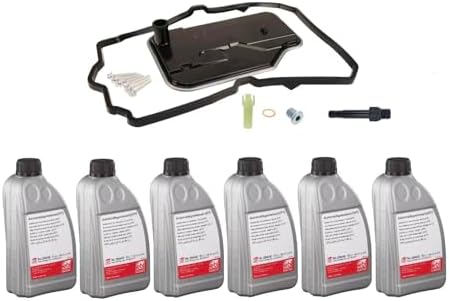
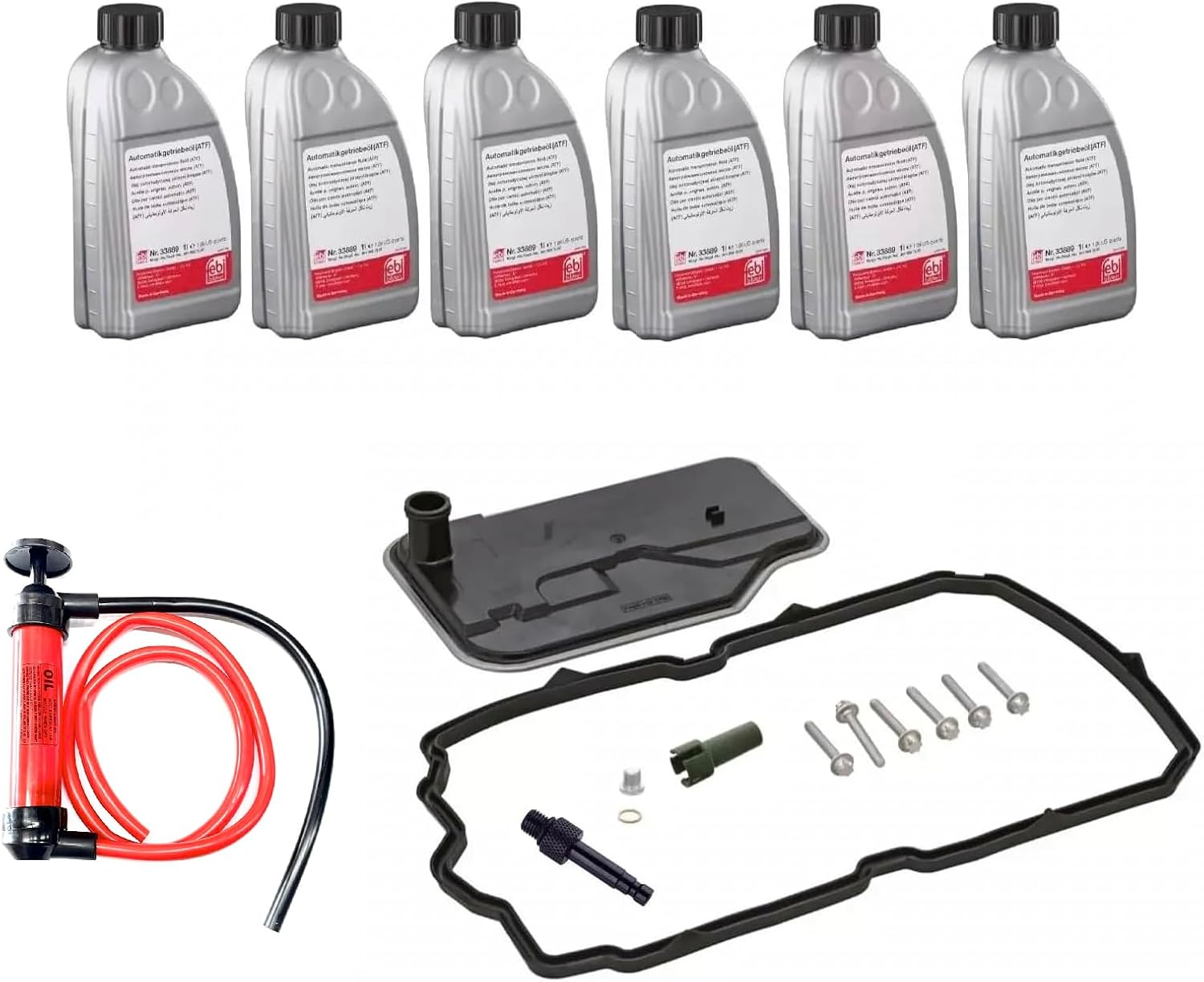
Set the new filter in place, then the new seal on the clean pan surface. The Mercedes WIS pan procedure (reproduced in Weistec's 722.9 service data) says to always replace the seal and not to apply any sealant to the pan or the housing, because leaks can result. The pan bolts are a two-stage spec: Stage 1 at 4 Nm (about 35 in-lb), then Stage 2 a further 180 degrees, with new bolts every time. The reason is the case. Per ATSG's Wayne Colonna, the 722.9 main case is magnesium and the bolts threaded into it are aluminum, and "all aluminum bolts must be replaced if removed as they can stretch and when reused, could snap." Mercedes' StarTuned training material calls the pan bolts aluminum stretch bolts and says replacing them is "absolutely mandatory." Run the bolts to 4 Nm in a crisscross pattern with an inch-pound wrench, then turn each one 180 degrees using an angle gauge or paint marks. Don't re-torque them after the angle stage, and never put an impact gun on them. Replace the overflow pipe with one of the same color and press it fully onto its base, because WIS states its height sets the fill capacity. The drain screw goes in last, after the level is set, at 22 Nm with a new sealing ring. We cover every 722.9 pan fastener in our 722.9 pan bolt torque spec guide.
Shop the part for this fix
We stock a 722.9-specific filter and ATF fill adapter kit, plus a drain and flush tool built for this transmission's fill procedure. Both ship same day from the USA.
Shop the 722.9 drain and fill tool kit →Refilling Is Not Optional Guesswork
Fill with exactly the fluid spec your pan generation calls for, not whatever ATF is on the shelf. For a red-pan, 236.14-spec 722.9, Shell's own technical data sheet for Shell ATF 134 — a product carrying MB-Approval 236.14 and built specifically as an initial-fill and service-fill fluid for Mercedes-Benz 7-speed automatics — lists kinematic viscosity of 29 mm²/s at 40°C and 6.2 mm²/s at 100°C, a viscosity index of 180, a pour point of -51°C and a flash point of 202°C. That's a real synthetic ATF spec, not an interchangeable generic fluid, and it is only approved for the 236.14 (red) side of the split; it is not the fluid for a blue-pan, 236.15 unit. The 722.9 has no conventional dipstick, so the fill-and-check procedure runs through the overflow pipe at a controlled fluid temperature rather than a stick-and-mark check — we walk the complete step-by-step for both generations in our fluid type and capacity guide. If you're using Mercedes' own Xentry or Star Diagnosis software, Mercedes' bulletin notes that the software (from the 05/2010 version with add-on 1476 onward) displays the correct specified gear oil for the unit before it will even read out transmission oil temperature — a built-in cross-check worth using if you have the tool.
After the Service: Adaptation Values and the Valve Body
A basic filter and pan service doesn't require touching the transmission control unit or the conductor plate, and there's no manual "reset" step needed for the transmission to keep running normally. What's worth knowing if a car comes back with a complaint afterward: Mercedes-Benz's own Star Diagnosis software, as of DVD version 09/12, tracks a gear-adaptation counter broken out by cold, warm and hot operating temperature, shown both acoustically and as a frequency count, specifically so a technician can verify the transmission's shift adaptations are progressing normally rather than guessing. That's a genuinely useful diagnostic entry point if a customer reports a shift quality complaint in the weeks after a service, rather than assuming the service itself caused a new mechanical problem.
Since the pan is off and the valve body is exposed, it's tempting to go further and swap the conductor plate or valve body assembly in the same visit. Be aware that Transmission Digest's own trade reporting on this family notes the 722.9's valve body and TCU are purchased and programmed as a matched assembly, and that Mercedes requires the TRP (theft relevant parts) process to be followed for that work. That's a distinct job from a routine filter and pan drop, with its own parts-ordering and programming requirements — plan for it separately rather than assuming it tacks on to a standard service.
Mistakes That Turn a Routine Service Into a Comeback
- Guessing the fluid color from the car's model year instead of the transmission's own production number — a replacement unit installed later in the car's life can run a different spec than the vehicle originally shipped with.
- Topping off a 236.14 (red) unit with 236.15 or 236.16 fluid, or vice versa — Mercedes' bulletin states these oils must never be mixed, and using shared fill equipment across fluid types defeats the entire point of the separate-equipment requirement.
- Skipping the angle stage or overtightening the pan bolts — the spec is 4 Nm plus 180 degrees into a magnesium case. A torque-only install leaves uneven clamp load, and an impact gun will strip the case threads or snap a bolt.
- Reusing pan bolts — Mercedes and ATSG both call for new aluminum bolts. A bolt that has already been through the 180-degree stage won't reach the same clamp load and can snap off in the case.
- Treating a pan-drop as a full fluid change — on units where the torque converter isn't also drained, roughly half the system's total fluid, and whatever contamination is in it, stays in the car.
- Setting the fill level cold, or at the wrong temperature for your pan generation — this transmission has no dipstick, and the overflow-pipe fill level is only correct at a specific controlled fluid temperature.
Frequently Asked Questions
How do I know which transmission fluid my 722.9 needs for a filter and pan service?
Mercedes-Benz factory bulletin S-B-00.40/89d ties the fluid to the transmission's own production number, not the car's model year. A 722.9 built before June 21, 2010 (roughly, before production/serial number 2834526) takes red spec 236.14 fluid, OEM part number A001 989 68 03. A 722.9 built after that date, paired with engines 113, 152, 156, 157, 275 or 279, takes blue spec 236.15, OEM part number A001 989 78 03. Other post-cutoff units are approved for 236.15 or gold spec 236.16, part number A001 989 92 03. You can also read it off the pan itself: the early pan has round dimples and a black or white overflow pipe, while the later pan has oval dimples, sits 5mm deeper, and uses a green overflow pipe. A transmission swapped in as a replacement can carry a different spec than the car originally shipped with, so the physical ID beats guessing from the VIN.
Is a pan-and-filter service the same as a full fluid change on a 722.9?
No. A pan-drop service only circulates the fluid that passes through the pan and lower case, which our 722.9 fluid type and capacity guide puts at roughly 6 liters. On units where the torque converter isn't drained in the same service, the converter itself holds a large separate volume that stays in the system; reference material on these transmissions puts that figure at around 4 liters, close to half the transmission's total fluid volume. That's exactly why Mercedes issued a one-time factory bulletin calling for an early fluid change on new 722.6 and 722.9 units at 64,000 km (40,000 miles) specifically to flush out metal and friction particles left over from break-in that a pan-only service wouldn't fully clear.
What torque should I use on the 722.9 oil pan bolts?
The Mercedes WIS spec for the 722.9 oil pan to transmission housing bolts is two-stage: 4 Nm (about 35 in-lb), then a further 180 degrees. The drain screw is 22 Nm with a new sealing ring, and the torque converter drain bolt is 10 Nm (M8) or 15 Nm (M10). The pan bolts are aluminum threading into a magnesium case, so use an inch-pound wrench and an angle gauge, never an impact gun.
Can I reuse the old pan bolts on a 722.9?
No. Mercedes StarTuned training material calls the 722.9 pan bolts aluminum stretch bolts and says replacing them is absolutely mandatory, and ATSG warns that aluminum bolts in this transmission can stretch and snap if reused. Buy new pan bolts with the filter kit and throw the old ones away.
Do I need to do anything to the transmission control unit after a 722.9 filter and pan service?
A basic filter and pan drop doesn't require touching the TCU or conductor plate, and you don't need to manually reset anything for the transmission to keep working. What's worth knowing is that Mercedes-Benz's own Star Diagnosis software tracks a gear-adaptation counter, broken out by cold, warm and hot operating temperature, that shows how many times the transmission has relearned its shift adaptations; a tech chasing a comeback complaint after a service can use that counter to see whether the adaptations are progressing normally. If the job does expand into valve body or conductor plate work, be aware that Mercedes treats that assembly as a theft-relevant part requiring its own purchase and programming process, which is a separate job from a routine filter and pan service.
Mercedes 722.9 7G-Tronic Trans Filter Kit with ATF Fill Adapter
Matched filter and fill adapter for the drain-plug filling procedure this transmission requires.
View the 722.9 filter kit →Sources
- Mercedes-Benz USA / Daimler AG, Star Bulletin S-B-00.40/89d, "Operating Fluid Specification Changes for Automatic Transmission," November 6, 2013 (supersedes S-B-00.40/89c). Backs the fluid specification split by production number and cutover date (June 21, 2010 / production number 2834526), the OEM part numbers for 236.14 (red), 236.15 (blue) and 236.16 (gold) fluid, the engine-specific application table, the no-mixing / separate-equipment requirement, and the pan dimple shape, 5mm depth change and overflow pipe color identification. static.nhtsa.gov (PDF)
- Mercedes-Benz USA, Star Bulletin S-B-27.00/124, "Transmission 722.9, Additional Adaptation Counter Indicator," October 3, 2012. Backs the gear-adaptation counter tracked by cold/warm/hot temperature via Star Diagnosis DVD 09/12 and Xentry Diagnostics. static.nhtsa.gov (PDF)
- Shell, Technical Data Sheet, "Shell ATF 134," v1.1, September 2014. Backs the MB-Approval 236.14 rating and the kinematic viscosity, viscosity index, density, flash point and pour point figures for the red-generation fluid. shop.sclubricants.com (PDF)
- Transmission Digest, "Mercedes 722.9 VB/TCU," January 20, 2021. Backs the 722.9's shared architecture and rebuild-procedure lineage with the 722.6, and the TRP (theft relevant parts) process required for valve body/TCU assembly work. transmissiondigest.com
- W220 S-Class Encyclopedia, "WIS 27.00 Transmission - General." Backs the approximate torque converter fluid volume (roughly 4 liters, nearly half of total capacity on units where it isn't drained with the pan) and the 2005 Mercedes-Benz factory circular (PW 44/05, NFZ 20/05) calling for a one-time 722.6/722.9 fluid change at 64,000 km (40,000 miles) to remove break-in particles. w220.wiki
- Weistec Engineering, "722.9 Transmission Service Data" (reproduces Mercedes-Benz WIS procedures). Backs the oil pan bolt spec (Stage 1 4 Nm, Stage 2 180 degrees, replace bolts), the 22 Nm drain screw, the 10/15 Nm converter drain bolt, the no-sealant rule and the overflow pipe height setting fill capacity. weistec.com (PDF)
- Mercedes-Benz USA, StarTuned technician magazine, "Transmission Maintenance," March 2017. Backs the aluminum stretch-bolt replacement requirement and the same-color overflow pipe replacement. automotivetechinfo.com (PDF)
- Wayne Colonna (ATSG), "Mercedes torqued transmissions," Vehicle Service Pros, October 29, 2014. Backs the magnesium main case, the aluminum-bolt requirement and the rule that aluminum bolts must be replaced if removed. vehicleservicepros.com
Filter kits, fill adapters and fluid matched to both 722.9 pan generations, shipped fast from the USA.
Shop 722.9 parts →