The 722.9 oil pan is the only transmission pan most shops touch where the torque spec has an angle in it. Mercedes' service data calls for the six pan bolts at 4 Nm, then a further 180 degrees, and it calls for new bolts every time they come out. Techs who come off GM and Ford pans see "4 Nm" and either run them in by feel or reuse the old ones. Both are how a clean 7G-Tronic service turns into a weep at the pan rail a month later, or a snapped bolt stuck in a magnesium case. This page covers every fastener you'll torque on a 722.9 pan and fluid service, the reason the spec looks the way it does, and the order to do it in so the fill level comes out right.

The 722.9 Pan and Service Torque Specs
These numbers come from the Mercedes-Benz WIS procedures for removing and installing the 722.9 oil pan and setting the fluid level. Weistec Engineering's 722.9 service data packet reproduces those procedures, and the converter-housing figure comes from ATSG's published 722.9 case notes. The inch-pound and foot-pound figures are our conversions. Mercedes publishes the specs in Nm.
| Fastener | Spec | Notes |
|---|---|---|
| Oil pan to transmission housing bolts | Stage 1: 4 Nm (35 in-lb) Stage 2: +180° | Replace bolts every time they come out |
| Oil drain screw to oil pan | 22 Nm (16 ft-lb) | New sealing ring every time |
| Torque converter drain bolt, M8 | 10 Nm (89 in-lb) | New sealing ring |
| Torque converter drain bolt, M10 | 15 Nm (133 in-lb) | New sealing ring |
| Transfer case oil filler screw (722.96 4Matic) | 20 Nm (15 ft-lb) | New screw after the 700 ml prefill |
| Solenoid valve to shift plate (valve body) | 8 Nm (71 in-lb) | Only if the solenoids come out |
| Converter housing to main case | Stage 1: 10 Nm (89 in-lb) Stage 2: +90° | Aluminum bolts, replace (case split only) |
The pan itself needs only the first three rows. The converter drain is part of any honest fluid service, because the converter holds a big share of the fluid. The 4Matic prefill matters if you dropped the transmission or transfer case. The last two rows are there for when the job grows.
Why a Pan Bolt Gets a Torque-Plus-Angle Spec
The 722.9 main case is magnesium. ATSG's Wayne Colonna laid this out in his 722.9 write-up: the converter housing is aluminum, the main case is magnesium, and the switch saves about 2.5 kg (5.5 lb) against an aluminum case. Magnesium solves a weight problem but creates a fastener problem. You can't thread steel bolts into it, because steel expands at a different rate and corrodes the case where the two metals touch. So the bolts that thread into the main case are aluminum, and per ATSG, "all aluminum bolts must be replaced if removed as they can stretch and when reused, could snap."
Mercedes' own StarTuned technician magazine says the same thing about the pan: the bolts holding it are aluminum stretch bolts, and replacing them is "absolutely mandatory." An aluminum bolt doesn't take a torque reading the way a steel bolt does. Friction under the head and in the threads varies a lot from bolt to bolt, so a torque-only spec would leave clamp load all over the place. The 4 Nm first stage only seats the bolt and pulls the pan flat onto the gasket. The 180-degree second stage is what loads the joint. It stretches each bolt by a set amount, which gives a consistent clamp load no matter how much drag the threads have.
That stretch is permanent. A bolt that has already been through its angle stage is longer and thinner at the neck than a new one. Run it through a second angle stage and it either won't reach the same clamp load or it necks down and breaks. If it breaks flush in a magnesium boss, a pan service turns into an extraction job on a case that does not forgive a drill wandering off center.
The Pan Retainers Are Transmission-Specific Too
The WIS pan procedure includes a note that's easy to skip. The small pan retainers under the bolt heads (WIS calls them "sprags") "are only permitted for transmission 722.9 and they may not be mixed up with sprags for other transmissions. Contact corrosion can occur otherwise." It's the same galvanic logic as the bolts. If a retainer made for a steel-bolted, aluminum-cased transmission ends up on a magnesium case, the dissimilar metals start corroding at the joint. If you service 722.6, 722.9 and NAG3 units in the same bay, keep each unit's hardware in its own tray.
Step by Step: Pan Off, Pan On
- Get the car level, side to side and front to back. The WIS fill procedure requires it, because the overflow pipe sets the level and a tilted car gives a false reading.
- Clean the pan and the area around it before anything comes loose. WIS warns that the smallest foreign particle in the hydraulic components can cause malfunctions or a total failure, and calls for lint-free cloths.
- Drain. Pull the drain screw, then pry the overflow pipe off its base inside the pan. Mercedes lists drift W722 589 03 15 00 for this. Most of the remaining fluid comes out as soon as the pipe pops off. Measure what came out if you need it for the refill.
- Drain the converter. Remove the bell housing cover, rotate the engine in its normal direction until the converter drain screw lines up, and drain it. Refit it with a new sealing ring at 10 Nm (M8) or 15 Nm (M10).
- Drop the pan. Remove the six bolts and throw them away. Lower the pan level, because there's still fluid in it.
- Clean the magnet and read it. Fine gray paste is normal wear. Flakes, chunks or brass-colored glitter point to a mechanical problem that a pan service won't fix. WIS says to replace the magnet if it's damaged.
- Replace the overflow pipe and press it firmly onto its base. WIS states that the distance from the top of the overflow pipe to the floor of the pan sets the transmission's fill capacity. A pipe that isn't fully seated, or one from a different pan revision, gives you the wrong fluid level no matter how carefully you set the temperature.
- Install the new filter and a new seal. WIS says to always replace the seal and not to put any sealant on the pan or the housing, because leaks can result. Both sealing surfaces have to be completely free of oil and grease. If you used brake-clean, let it evaporate completely before the seal goes on.
- Install the pan with new bolts and the 722.9 retainers. Run all six in by hand. Take them to 4 Nm in a crisscross pattern with a calibrated inch-pound wrench, then make a second pass to turn each one 180 degrees.
Getting the 180 Degrees Right
Half a turn sounds easy to eyeball, but it isn't when you're on your back under a W211 with a 1/4-inch ratchet. Use an angle gauge, or paint-mark each bolt head and the pan flange after the 4 Nm stage so you can see when the mark has gone exactly halfway around. Turn each bolt in one smooth pull. If you stop halfway and restart, static friction makes it hard to tell where you are. Don't go back over the bolts with the torque wrench after the angle stage. A torque reading on a stretched aluminum bolt means nothing, and "just snugging them up" is how they break. If you over-rotate one, take it out and start over with a new bolt.
Shop the part for this fix
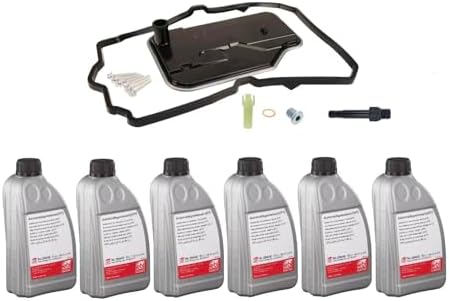
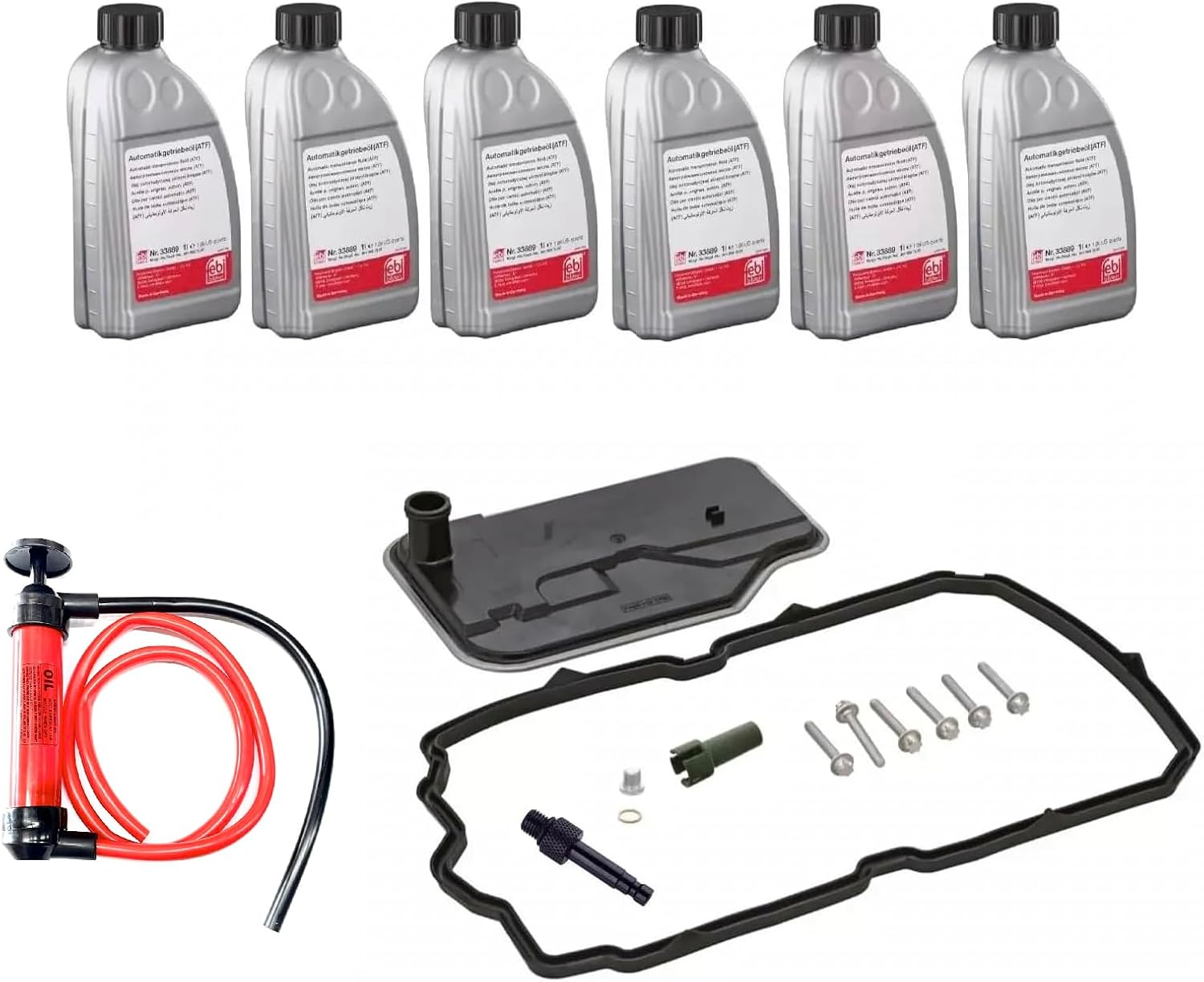
CoreTransmissionParts carries a 722.9 filter with gaskets kit for exactly this service: the filter plus a pan gasket. Pair it with a fresh set of pan bolts and a drain-screw sealing ring from your Mercedes parts counter.
Shop the 722.9 filter and gasket kit →The Drain Screw Goes On Last, at 22 Nm
On a 722.9, the drain screw is also the fill port, so it's the last fastener you torque. The fill sequence in the WIS procedure, also laid out in Mercedes' StarTuned training material, goes like this:
- Mount the fill adapter in the drain opening and pump in 6 liters of the correct-spec fluid before you start the engine. If the transmission was repaired, WIS says to put in the amount you drained plus 0.5 liter instead.
- Start the engine and read transmission oil temperature on Xentry or STAR Diagnosis. Bring it to 45°C (113°F) at about 2500 rpm in Park. On cars with an auxiliary transmission cooler, bring it to 90°C (194°F) so the cooler thermostat opens, then shut down and let it cool back to 45°C. StarTuned notes that never means power-braking the car.
- With the engine idling in Park, pump in another 4 liters if the converter was drained, or 2 liters if it wasn't. Shift through P-R-N-D several times with the car stationary.
- Confirm 45°C again, pull the adapter, and let the excess run out of the overflow pipe until it only drips. WIS warns that draining hotter than spec lets too much fluid out.
- Fit a new sealing ring and torque the drain screw to 22 Nm.
StarTuned points out that the temperature target can vary by pan version and vehicle. They saw 95°F on a non-chamfered pan in one model they checked, so confirm against WIS for the car in front of you. For reference, WIS lists total initial-fill capacity at 9 liters for most 722.9 variants and 9.7 liters for the 722.960 through 722.966 4Matic family. A pan service moves far less than that. Our 722.9 fluid type and capacity guide breaks down how much each service actually replaces.
Fluid, Pan Revisions and Overflow Pipe Color
None of the torque work matters if the fluid is wrong. Mercedes bulletin S-B-00.40/89d splits the 722.9 at transmission serial number 2834526. Units up to that number take red 236.14 fluid (A001 989 68 03). Later units with engines 113, 152, 156, 157, 275 or 279 take blue 236.15 (A001 989 78 03), and later units with other engines are approved for 236.15 or gold 236.16. The bulletin says these oils "must never be mixed" and calls for a separate fill unit for each one. Shell's data sheet for its 236.14-approved ATF 134 lists 29 mm²/s at 40°C and 6.2 mm²/s at 100°C. That's a low-viscosity synthetic, and it's one reason the fill level is so sensitive to temperature.
Mercedes also revised the pan and overflow pipe more than once. The black, white and green pipes differ in height, and WIS calls for swapping some early pans for the revised design. StarTuned's advice is to look up the overflow pipe part number in the EPC by VIN and replace it with the same color, because "using the wrong one will under- or over-fill the transmission." Order the pipe with the bolts so the car isn't sitting on the lift waiting for one.
Why 722.9 Pans Leak After a Service
- Reused pan bolts. They stretched on the first install and won't reach clamp load again. The pan weeps at the bolt holes or along one rail.
- Torque-only install. Someone ran the bolts to 4 Nm and skipped the angle stage, or "converted" the spec to a higher torque value. Either way the clamp load is uneven and the seal won't stay put.
- Sealant on the seal. WIS specifically prohibits it. The seal is designed to go on dry against clean, oil-free metal.
- Reused drain screw ring. A flattened ring at 22 Nm seeps, and it shows up right where you'd blame the pan.
- Wrong-transmission retainers. They don't leak on day one. They corrode against the magnesium over the following months.
- Impact gun on the pan bolts. At 4 Nm, an impact strips the case threads or snaps a bolt before the first stage is even done.
Mercedes 722.9 7G-Tronic Trans Filter Kit with ATF Fill Adapter
The filter plus the fill adapter the drain-port fill procedure needs, on our own checkout.
View the 722.9 filter kit →Frequently Asked Questions
What is the torque spec for the 722.9 transmission pan bolts?
Mercedes-Benz WIS lists the 722.9 oil pan to transmission housing bolts in two stages: 4 Nm (about 35 in-lb) first, then a further 180 degrees. The first stage seats the pan on the seal and the angle stage stretches each aluminum bolt to a consistent clamp load. Use new bolts every time.
Can you reuse 722.9 oil pan bolts?
No. Mercedes StarTuned training material calls the pan bolts aluminum stretch bolts and says replacing them is absolutely mandatory, and ATSG warns that aluminum bolts in the 722.9 can stretch and snap if reused. A reused bolt will not reach the same clamp load and can break off in the magnesium case.
What is the 722.9 drain plug torque?
The oil drain screw to the oil pan is 22 Nm (about 16 ft-lb) with a new sealing ring. On the 722.9 the drain screw is also the fill port, so it is torqued last, after the level has been set by draining excess fluid through the overflow pipe at 45 C (113 F) with the engine idling in Park.
Should I use sealant on the 722.9 pan gasket?
No. The WIS procedure says to always replace the seal and not to apply any sealant to the transmission oil pan or housing, because leaks can occur otherwise. Both sealing surfaces must be completely free of oil and grease before the new seal goes on.
Sources
- Weistec Engineering, "722.9 Transmission Service Data" (reproduces Mercedes-Benz WIS procedures for transmissions 722.9 / 722.950-966). Backs the oil pan bolt spec (Stage 1 4 Nm, Stage 2 180 degrees, replace bolts), drain screw 22 Nm, converter drain bolt 10 Nm (M8) / 15 Nm (M10), transfer case filler screw 20 Nm and 700 ml prefill, solenoid bolt 8 Nm, 9 / 9.7 liter initial fill, the 722.9-only pan retainer ("sprag") corrosion warning, the no-sealant rule, the overflow pipe height setting fill capacity, and the 45 C / 90 C fill sequence. weistec.com (PDF)
- Mercedes-Benz USA, StarTuned technician magazine, "Transmission Maintenance," March 2017. Backs the aluminum stretch-bolt replacement requirement, overflow pipe removal with drift W722 589 03 15 00, same-color overflow pipe replacement by VIN, new drain seal washer, the 6 L + 4 L / 2 L fill quantities, and the 113 F / 95 F / 194 F temperature targets. automotivetechinfo.com (PDF)
- Wayne Colonna (ATSG), "Mercedes torqued transmissions," Vehicle Service Pros, October 29, 2014. Backs the magnesium main case / aluminum converter housing construction, the 2.5 kg weight saving, the aluminum-bolt requirement and "must be replaced if removed" rule, and the 10 Nm + 90 degree converter housing bolt spec. vehicleservicepros.com
- Mercedes-Benz USA, Star Bulletin S-B-00.40/89d, "Operating Fluid Specification Changes for Automatic Transmission," November 6, 2013. Backs the 236.14 / 236.15 / 236.16 fluid split at serial number 2834526, the engine application list, OEM fluid part numbers and the no-mixing / separate fill unit requirement. static.nhtsa.gov (PDF)
- Shell, Technical Data Sheet, "Shell ATF 134," v1.1, September 2014. Backs the MB-Approval 236.14 rating and the 29 mm2/s at 40 C and 6.2 mm2/s at 100 C viscosity figures. shop.sclubricants.com (PDF)
Filter kits, fill adapters and correct-spec fluid kits for both 722.9 fluid generations, on our own checkout.
Shop 722.9 parts →