Ask three shops how to change fluid in a 722.9 and you will get three answers: drain the pan and refill, drop the pan and change the filter, or hook up a machine and flush it. On a domestic unit with a dipstick, the difference is mostly how much old fluid you leave behind. On the 7G-Tronic it matters more, because there is no dipstick, the level is set by an overflow pipe at a specific fluid temperature, roughly half the fluid can sit in the torque converter where a pan drain never touches it, and the valve body carries nine small control solenoid valves that do not like loose debris. This page walks through what Mercedes' own service procedure actually does, what each method really replaces, and how to pick the right one for the car on your lift.


What Mercedes' Procedure Actually Calls For
Start with the factory process, because it answers half the flush-versus-drain argument by itself. The Mercedes-Benz WIS service data for the 722.950 through 722.966 family lays out the fluid change as a pan service plus a converter drain: remove the drain screw, pry the overflow pipe off its base with a drift so the rest of the pan drains, drop the pan, clean and check the magnet, check the filter and replace it if necessary, install a new pan seal and new pan bolts, then drain the converter separately through its own drain screw behind a cover in the bell housing. The w220 community reproduction of WIS 27.00 notes the same thing from the other direction: the later procedure (AP27.00-P-2702W) makes draining the converter part of the service rather than an option.
There is no step in that procedure that hooks an external pump to the cooler lines. That is the first thing to understand about "flushing" a 722.9: the factory method is a thorough drain-and-fill, not a pressure flush. Anything else is a shop choice, and you should be able to explain why you made it.
The Numbers That Matter
Everything below comes from the Mercedes WIS service data unless noted.
| Item | Spec |
|---|---|
| Initial fill capacity, 722.9 (except 722.96x) | 9.0 L |
| Initial fill capacity, 722.960-966 (4MATIC) | 9.7 L |
| Oil drain screw to oil pan | 22 Nm |
| Oil pan bolts to case (new bolts) | Stage 1: 4 Nm, Stage 2: +180 degrees |
| Torque converter drain screw | M8: 10 Nm, M10: 15 Nm |
| Transfer case prefill (4MATIC, when lowered) | 700 ml |
| Level check fluid temperature | 45°C / 113°F |
Two notes on the table. The pan bolts are aluminum, one-time-use fasteners, and the WIS sheet says to replace them, not reuse them. And the 9.0 L figure is a dry, initial fill; no service method gets all nine liters out of a transmission that is still in the car.
Method 1: Drain-and-Fill (Pan Only)
This is the quickest version: pull the 22 Nm drain screw, pry the overflow pipe off so the pan empties, reinstall with a new sealing ring, and refill. No pan drop, no filter. What it does not touch is the converter. On a 2003 S500 722.9 with no converter drain plug, the w220 reference measured about 4 liters left in the converter, close to half the total capacity, and warned that leaving it in place will contaminate the new fluid badly.
Run the math honestly. If roughly 5 of about 9 liters come out each time, one drain-and-fill gets you to a bit over half new fluid. A second one a few hundred miles later gets you near 80 percent, and a third gets you around 90 percent. That is an estimate, not a spec, but it shows why one pan drain on a neglected unit only dilutes the problem. It also shows why a series of drain-and-fills is the gentlest way to bring a high-mileage, never-serviced 722.9 back to fresh fluid: the change happens gradually, with the transmission's own pump and filter doing the work.
Method 2: Pan Drop, Filter and Converter Drain (the Factory Service)
This is the WIS job and the one we default to. You get a new filter, you get eyes on the magnet, and if the converter has a drain screw you get almost all the old fluid out. Bump the engine over in the direction of rotation until the converter drain screw lines up with the opening behind the bell housing cover, drain it, replace the sealing ring, and torque it to 10 Nm (M8) or 15 Nm (M10).
Early 722.9 converters did not have a drain screw at all. Per the w220 reference, Mercedes removed the converter drain from the 722.6 in mid-1999, the first 722.9 units never had one, and it was reintroduced later. If you are working on one of the no-plug units, the factory service becomes a partial change no matter how carefully you do it, and that is where the cooler-line question comes up.
Read the magnet before you decide anything else. Fine gray paste is normal clutch and gear wear. Flakes, slivers, or chunks of friction material mean the transmission has a mechanical problem that no fluid service will fix, and you should be talking about a rebuild, not a flush.
Method 3: Cooler-Line Exchange vs. a Pressure Flush
The word "flush" covers two very different things, and the difference is the pump.
Cooler-line exchange (transmission's own pump)
Here you open the cooler supply line, let the transmission's own pump push old fluid out into a container while you feed new fluid in at the same rate, and stop when the fluid coming out runs clean or the new supply runs out. The w220 write-up calls this, combined with a pan drop, filter and refill through the overflow, the best way to get a thorough change on a no-plug converter. The key point is that the vehicle pump drives the flow, so the system never sees more pressure or volume than it is designed for. The same author notes some fluid bypasses through one of the solenoids during the exchange, so even this method is not 100 percent.
Pressure flush (external pump)
A pressure flush uses the machine's pump to force fluid through the unit. Mercedes publishes no procedure for it on the 722.9, and the reason to be careful is mechanical, not superstition. The electrohydraulic control unit carries nine control solenoid valves: working pressure, clutches K1, K2 and K3, brakes B1, B2 and B3, the converter lockup clutch, and the wet clutch. The WIS data even includes a three-step visual chart for inspecting those solenoid valves after cleaning: one condition that requires replacement, one that requires cleaning, and one that is good to reinstall. Mercedes would not publish that chart if debris on those valves were rare. Push loosened varnish and wear material through that circuit faster than the filter can catch it, and a sticking pressure-control or clutch valve shows up as a harsh shift, a flare, or a limp-mode fault a week after the "service."
That is the pattern behind most "the flush killed it" stories: a worn unit whose old fluid was hiding the wear. On a high-mileage 722.9 with unknown history, we use drain-and-fills or a cooler-line exchange on the transmission's own pump, never an external pressure flush.
Shop the part for this fix
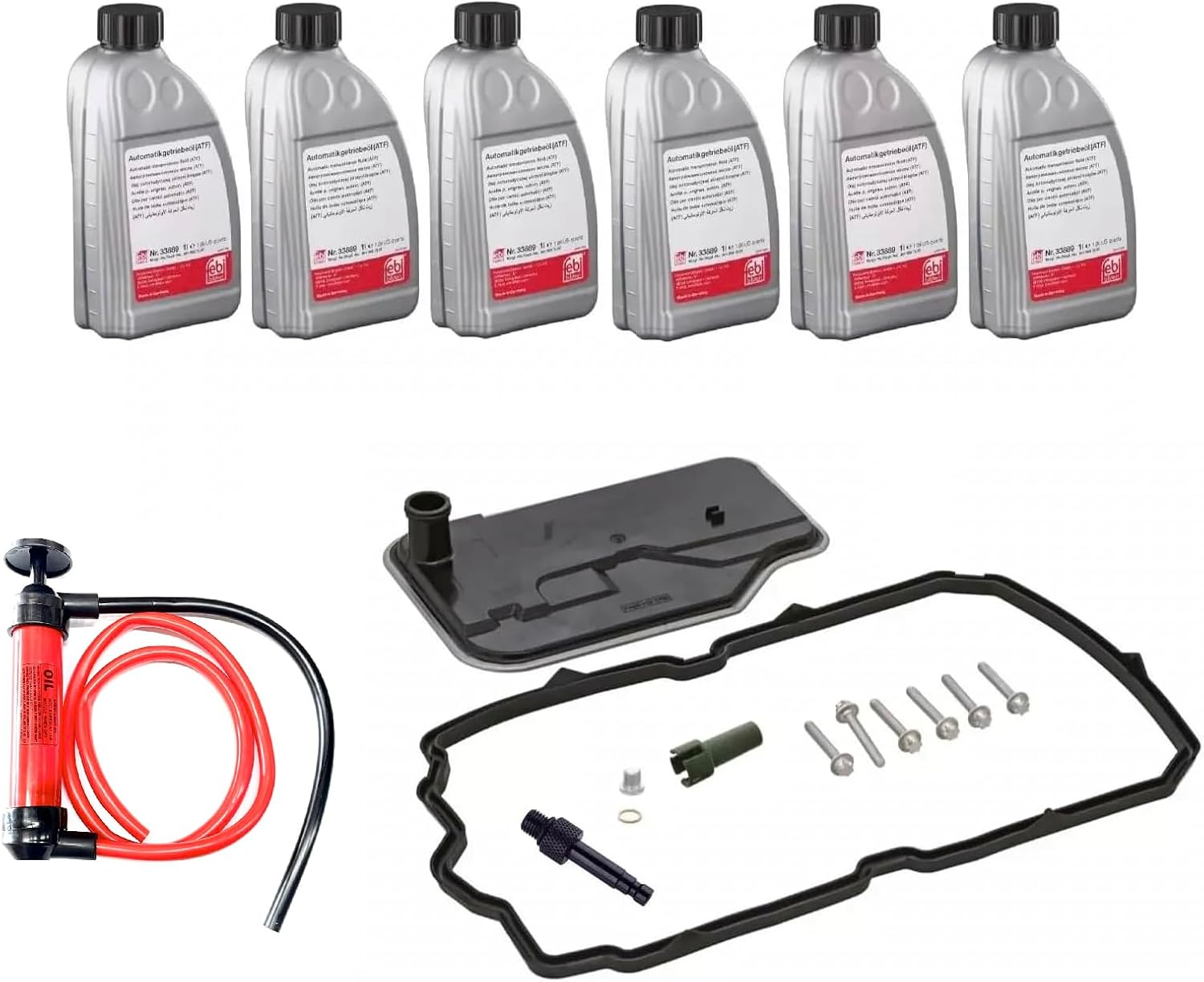
Doing the factory pan service? This 722.9 filter (2212770100) comes with the gaskets the job calls for.
See the 722.9 filter with gaskets →The Fluid Has to Match, Whatever Method You Use
An exchange or flush with the wrong fluid is worse than no service. Mercedes bulletin S-B-00.40/89d splits the 722.9 by transmission production date: units built up to June 21, 2010 take red spec 236.14 (A001 989 68 03), and later units take blue 236.15 (A001 989 78 03) or, on some, gold 236.16, depending on engine application. The bulletin says these fluids must never be mixed and requires separate filling equipment for each one. For an exchange machine, that means one machine or reservoir per fluid, cleaned between jobs, not one tank of whatever is on hand.
The fluids are not cosmetically different. Shell's data sheet for ATF 134, an MB 236.14 fluid, lists 29 mm²/s at 40°C and 6.2 mm²/s at 100°C. Motul's data sheet for its MB-Approval 236.15 fluid lists 17.4 mm²/s at 40°C and 4.3 mm²/s at 100°C. That is a thinner fuel-economy fluid, and the shift calibration on the later units expects it. Identify the generation from the transmission's production number or the pan and overflow pipe before you choose a fluid, not from the car's model year. Our 722.9 fluid type and capacity guide covers the identification in detail.
Refill and Level Set: Where Most Comebacks Start
Every method ends with the same overflow level set, and this is where a good fluid change goes wrong. The WIS procedure, in short:
- Car level front-to-back and side-to-side on the lift.
- Fill adapter in the drain hole, pump in 6 liters before starting the engine.
- Start the engine and read transmission oil temperature on STAR/Xentry or a scan tool that reads the actual TCU value.
- With the engine running in Park, add 4 more liters if the converter was emptied, or 2 liters if it was not.
- Shift P-R-N-D several times with the car stationary, then return to Park at idle.
- At 45°C (113°F), remove the adapter and let the steady stream drain off until only drops come out. Install a new sealing ring on the drain screw and torque to 22 Nm.
The WIS sheet is blunt about temperature: the overflow pipe is designed for that fluid temperature, and if the fluid is hotter, too much drains out. If you open the drain and get no steady stream at all, the level is low; go back to the fill step and do it again. Don't trust an infrared gun pointed at the pan for this either. The w220 author found a laser reading off by as much as 10°C compared with the TCU value. If the car has had an additional transmission cooler replaced, WIS adds a step: bring the fluid to 90°C at 2,500 rpm in Park so the cooler thermostat opens and the cooler fills, shut down and let it cool, then set the level at 45°C.
After the level is set, a road test should show normal shift quality within a few drive cycles. If a customer comes back with a shift complaint, Mercedes bulletin S-B-27.00/124 describes the adaptation counter in STAR Diagnosis and Xentry, broken out by cold, warm and hot temperature, so you can see whether the adaptations are actually progressing instead of guessing.
Which One Should You Do?
- Known history, normal mileage, converter has a drain screw: the factory pan, filter and converter drain service. It gets nearly all the fluid out and gives you a look at the magnet.
- Known history, converter has no drain screw: pan and filter service, then either a second drain-and-fill within a few hundred miles or a cooler-line exchange on the transmission's own pump.
- High mileage, never serviced, shifts fine: a series of two or three drain-and-fills, with one filter change in the series. Gentle beats thorough here.
- Debris on the magnet, burnt smell, or existing shift faults: stop. Fluid will not fix a mechanical failure, and an aggressive flush can turn a soft complaint into a hard one. Diagnose first.
- External pressure flush: no factory procedure supports it on this unit, and it puts the most loose debris at the solenoid valves. We skip it.
Frequently Asked Questions
Is it safe to flush a Mercedes 722.9 transmission?
It depends on what you mean by flush. A cooler-line exchange that uses the transmission's own pump, done with the correct MB-approved fluid, is a gentle way to get old fluid out of the converter and cooler. An external pressure flush has no Mercedes procedure behind it and can push loosened debris into the nine control solenoid valves on the valve body, so on a high-mileage unit with unknown history we stick to drain-and-fills or the factory pan and converter service.
How much fluid does a 722.9 drain-and-fill replace?
The 722.9 holds about 9 liters on a dry initial fill per Mercedes service data, or 9.7 liters on 4MATIC 722.96x units. A pan-only drain leaves the converter full, and on a no-plug unit the converter can hold around 4 liters, close to half the total. Expect one drain-and-fill to replace a little over half the fluid, so two or three spaced a few hundred miles apart are needed to get to roughly 80 to 90 percent new fluid.
Does the 722.9 have a torque converter drain plug?
Some do and some do not. The first 722.9 units were built without a converter drain screw and it was reintroduced later. If yours has one, it sits behind a cover in the bell housing; bump the engine over until it lines up, drain it, fit a new sealing ring and torque it to 10 Nm for an M8 screw or 15 Nm for an M10.
What temperature do you check 722.9 fluid level at?
Mercedes service data sets the level at 45 degrees C (113 degrees F) with the engine idling in Park, read from the transmission control unit with STAR, Xentry or a capable scan tool. The overflow pipe is designed for that temperature, so checking hotter drains off too much fluid and leaves the unit low. An infrared reading of the pan can be off by as much as 10 degrees C, so use the TCU value.
Mercedes 722.6/722.9 ATF Drain and Fill Kit
A pump and adapter setup for the drain-hole fill and overflow level set this transmission requires.
View the 722.9 drain and fill kit →Sources
- Mercedes-Benz WIS service data, Transmission 722.950-966: fill procedure, oil pan removal/installation, torque converter drain and solenoid valve inspection (reproduced by Weistec Engineering). Backs the 6 L prefill, the +4 L / +2 L converter refill, the 45°C level set and 90°C cooler step, the 9.0 L / 9.7 L initial fill capacities, the 22 Nm drain screw, the 4 Nm + 180 degree pan bolts, the 10 Nm / 15 Nm converter drain screws, the 700 ml transfer case prefill, and the nine control solenoid valves with their inspection chart. weistec.com (PDF)
- Mercedes-Benz USA, Star Bulletin S-B-00.40/89d, "Operating Fluid Specification Changes for Automatic Transmission," November 6, 2013. Backs the June 21, 2010 production-date split between 236.14 (red) and 236.15/236.16 fluids, the OEM part numbers, and the never-mix / separate filling equipment requirement. static.nhtsa.gov (PDF)
- Mercedes-Benz USA, Star Bulletin S-B-27.00/124, "Transmission 722.9, Additional Adaptation Counter Indicator," October 3, 2012. Backs the cold/warm/hot adaptation counter in STAR Diagnosis and Xentry used to check post-service shift adaptation. static.nhtsa.gov (PDF)
- Shell, Technical Data Sheet, "Shell ATF 134." Backs the MB 236.14 approval and the 29 mm²/s (40°C) and 6.2 mm²/s (100°C) viscosity figures for the red-generation fluid. shop.sclubricants.com (PDF)
- Motul, Technical Data Sheet, "ATF 236.15," 08/2021. Backs the MB-Approval 236.15 rating and the 17.4 mm²/s (40°C) and 4.3 mm²/s (100°C) viscosity figures for the blue-generation fluid. motul.incony.de (PDF)
- W220 S-Class Encyclopedia, "WIS 27.00 Transmission - General" (community reproduction of Mercedes WIS notes). Backs the roughly 4 L converter volume on a no-plug 722.9, the converter drain plug history, AP27.00-P-2702W requiring converter draining, the cooler-line exchange method on the vehicle's own pump, and the infrared temperature error. w220.wiki
Service kits with the correct 236.14 or 236.15 fluid, filters, fill adapters and drain kits for the 722.9.
Shop 722.9 parts →