Ask ten people whether a 722.6 should be flushed or just drained and refilled and you will get ten answers, most of them built on what happened to somebody's brother-in-law's car. The useful thing about this transmission is that Mercedes settled the question in writing. Daimler's workshop procedure for the 722.6 is literally titled "Flush out automatic transmission and torque converter" (AR27.55-P-0100A), and it is not a machine flush. It is a pan service followed by a cooler-line fluid exchange that uses the transmission's own pump and 14 liters of oil.
This page lays out what each service actually replaces, the factory exchange procedure step by step with its torque values and tool numbers, where a shop flush machine goes wrong on this unit, and how I decide which one a given car gets. Sources, including the Daimler documents and the Mercedes fluid bulletin, are listed at the end.


What a Drain-and-Fill Actually Replaces
A drain-and-fill on a 722.6 is the drain screw, the pan, a new filter and a gasket. Daimler has you drain hot, at about 80 C, through the pan drain screw (20 Nm on reinstall, 22 Nm on the 722.649), and then warns that roughly 2.5 liters are still sitting in the pan when you unbolt it (AR27.55-P-0100A, steps 2 and 3). Add those together and a pan-drop service recovers about 4 to 5 liters.
Now compare that to what the transmission holds. Daimler's level-check document, AR27.00-P-0100AC, lists the initial (dry) fill by sub-variant: 7.0 liters on the 722.610/638, 7.5 on the 722.602/603/615, 8.0 on the common 722.600-series passenger car units, 8.6 on the 722.622 through 722.636 group, and 8.7 on the 722.643, with others in the same band. Call it 7 to 9 liters. The difference between what comes out of the pan and that number is fluid living in the torque converter, the cooler and the lines. A single drain-and-fill on this transmission replaces roughly half the oil, sometimes a bit more.
Some early 722.6 converters were built with a drain plug you could reach through the inspection opening, which pulls a few more liters on its own. Field reports from owners and independent shops put the end of that plug at around the 2000 model year, but I have not seen a Daimler document that gives a clean cutoff, so look before you assume. If the converter has no plug, the only way to get the converter's oil out without pulling the transmission is the cooler-line exchange below.
None of that makes a drain-and-fill wrong. It means a drain-and-fill dilutes the old oil instead of replacing it. Two of them a few hundred miles apart gets you to roughly three quarters fresh fluid; three gets you most of the way there. That is a valid strategy, it just costs more trips and more gaskets.
What Mercedes Calls a Flush (and What It Is Not)
When a parts counter says "flush" they usually mean a powered exchange machine hooked into the cooler circuit. The Daimler procedure is different in an important way: there is no external pump and no cleaning solvent. The transmission's own pump moves the old oil out through the cooler line while you add new oil through the fill tube. Here is the sequence from AR27.55-P-0100A, condensed:
- Drain the pan at about 80 C, remove the pan, fit a new filter, and refit the pan with a new gasket. Pan bolts are 8 Nm on every listed 722.6 variant. Make sure both sealing faces are oil-free.
- Unclip the right-hand cooler line from the engine oil pan and remove the banjo bolt at the cooler line connection.
- Fit the connection fitting from the Mercedes hand pump (tool 210 589 00 71 00) to an approximately 1.5 meter hose with a hose clamp, then bolt the banjo and cooler line onto that fitting.
- Run the hose into a bucket of at least 10 liters capacity that has a scale on it, so you can measure what comes out.
- Break off the locking-pin plate, remove the fill tube cap, fit the funnel (126 589 12 63 00) and pour in 5 liters.
- With an assistant, start the engine. When 3 liters have collected in the bucket, stop the engine immediately and pour 3 liters back in.
- Repeat that 3-out, 3-in cycle twice more, then check and correct the level per AR27.00-P-0100AC and reassemble.
The math is the whole procedure: 5 liters after the pan service, plus three 3-liter replacements, is the 14 liters Daimler says the entire flush requires. Stopping at exactly 3 liters is the safety margin. The engine is pumping oil out of a transmission that only holds 7 to 9 liters, and you never want the pump pulling air through the filter. That is why the procedure calls for an assistant: one person watches the scale and kills the engine, the other is under the car.
On reassembly, the cooler banjo or union nut torque depends on the chassis. Daimler lists 20 Nm on the Typ 163 ML, Typ 199 and the 461/463 G-Class, and a two-stage spec of 5 Nm plus 90 degrees on the 170, 171, 203, 204, 209, 210, 211, 215, 216, 219, 220, 221, 230 and 240 platforms. The bolt holding the cooler line to the engine oil pan is 11 Nm, and the retaining clamp bolt is 8 Nm. Mixing those up is how a fresh service turns into a cooler-line weep.
Shop the part for this fix
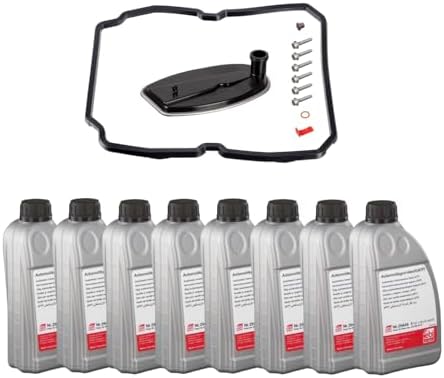
Either service starts with a new filter and pan gasket. CoreTransmissionParts carries the 722.6 filter and pan gasket kit for 2004-2019 units, Mercedes and Chrysler-built.
Shop the 722.6 filter and pan gasket kit on CoreTransmissionParts →Rebuilding instead? See the CoreTransmissionParts rebuild kit collection.
Where a Shop Flush Machine Goes Wrong on a 722.6
The machine itself is not the problem. What is in it usually is. Mercedes star bulletin S-B-00.40/89d is blunt: the 722.6 gets oil to sheet 236.14 only (ATF 134, red, part number A001 989 68 03), the 236.14, 236.15 and 236.16 oils "must never be mixed," and separate filling units have to be used for each. The same bulletin adds that the 722.6 may not be filled with FE-ATF 134, the blue 236.15 fluid used in later 7G-Tronic units.
A general-purpose exchange machine that last ran a later Mercedes, a Dexron VI GM unit or a Mercon LV Ford is carrying a few liters of the wrong oil in its tank and lines. On a 722.6, where the shift calibration was built around the 236-series friction characteristics, that shows up as harsh engagements or flare that nobody can explain. Sonnax notes the Mercedes-sourced units, Sprinter and Crossfire included, "require specific fluid due to calibration issues," while the Chrysler-built NAG1 applications run ATF+4. If a shop insists on a machine, ask what was in it last and whether it was purged with 236.14 fluid. If they cannot answer, do the factory cooler-line method with a bucket.
That Mercedes-versus-Chrysler split matters for the fluid you buy, too. Transmission Digest's field-ID note is the quickest check: a German-built 722.6 carries a pin stamp, or a pin stamp plus a bar-code tag, on the driver's side of the case, while a Chrysler-built unit carries only a bar-code tag. Chrysler builds take ATF+4; German builds take 236.14.
The Fluid: What 236.14 Actually Means
236.14 is an approval, not a brand. Any fluid you put in a German-built 722.6 should show "MB-Approval 236.14" on its technical data sheet, not "suitable for" or "meets the performance of." As one example of what a real approval sheet looks like, Motul's ATF 236.14 data sheet lists MB-Approval 236.14 and the Mercedes part references A 001 989 45 03 and A 001 989 68 03, with a kinematic viscosity of 6.6 mm2/s at 100 C, 29.6 mm2/s at 40 C, a viscosity index of 192 and a pour point of minus 54 C. Those numbers are a useful sanity check against an unbranded jug: a heavy universal ATF will be well above that 100 C figure.
How much to buy: 5 to 6 liters for a pan-drop drain-and-fill (what came out, plus a margin for the level check), and the full 14 liters for the factory flush. Running out halfway through an exchange is the one way the cooler-line method can actually hurt a transmission, so buy the full amount before you crack the banjo bolt.
Which One, When: How I Decide
Here is how I sort the cars that come in for "a fluid service" on this transmission:
- Known service history, fluid red or light brown, shifts clean: full factory flush. There is no reason to leave half the old oil in the converter of a healthy unit.
- Unknown history, high miles, fluid dark but no burnt smell, shifts clean: drain-and-fill with a new filter now, a second drain-and-fill a few thousand miles later, then the full flush once you have seen the pan and magnet twice and know what you are dealing with.
- Any flare, slip, harsh engagement or stored transmission codes: diagnose first. No fluid service fixes a worn part, and doing one right before a failure guarantees the service gets blamed.
- Heavy friction material or metal on the magnet, or a burnt smell: stop. That transmission needs a teardown estimate, not fluid.
That third bullet is where the "flush killed my transmission" story usually comes from. Sonnax documents a specific 722.6 wear point: the outer bore of the working pressure regulator valve wears, signal oil from the modulating pressure solenoid leaks past the boost end, and working pressure stops rising with engine load. The 1-2/4-5, 2-3 and 3-4 overlap sleeves sit in the same circuit and commonly wear on the inside diameter. The symptom is RPM flare on the 2-3 and 4-5 upshifts under load and neutral flare on the 5-4 and 3-2 downshifts. A unit with that wear was already flaring, or about to. Fresh fluid did not cause it, but it often gets the blame because it was the last thing touched.
So before choosing, take the car for a loaded drive and watch the tach on the 2-3 and 4-5 shifts, and scan the transmission control module for stored faults. If it flares, you are looking at a valve body, a conductor plate or a rebuild, and our 722.6 delayed engagement guide and conductor plate failure guide are the next stops.
The Level Check After Either Service
Both services end at the same place, and it is the step people get wrong most often because the 722.6 has no conventional dipstick. Per AR27.00-P-0100AC, the car must be level on its wheels. Cold, at roughly 25 C, put in about 5 liters before starting the engine after a complete drain, start it and let it idle in P, add the rest, then hold the brake and shift slowly through every range a few times, return to P and read the level with the Mercedes dipstick tool (140 589 15 21 00) in the cold range on the stick.
Daimler is explicit that a precise check is only possible above 80 C. If there is any shift complaint, connect a scan tool, confirm fluid temperature in R or D, and read the level again in the hot range. Over-filling foams the oil and under-filling starves the pump, and Daimler calls out both as causes of malfunction and transmission damage. Then fit a new locking pin in the fill cap; the old one is destroyed when you remove it. Full capacity tables and the cold-versus-hot ranges are in our 722.6 fluid type and capacity guide, and the pan and filter steps in detail are in the 722.6 filter and pan service guide.
Bottom Line
A drain-and-fill on a 722.6 is a partial change that dilutes old oil about 50 percent per round. The Mercedes "flush" is a controlled 14-liter exchange through the right cooler line using the transmission's own pump, and it is what Daimler specifies when you want the converter oil changed too. Use the factory exchange on healthy units, step up with repeated drain-and-fills on unknown-history units, and diagnose anything that flares before you touch the fluid at all. Use only 236.14-approved oil on a German-built unit, ATF+4 on a Chrysler-built one, and never let a machine full of someone else's fluid near it.
Need parts for this job?
722.6 service kits with ATF, filter and gasket kits, conductor plates and drain-and-fill tools, all on our own secure checkout.
Shop 722.6 parts →Frequently Asked Questions
Is a flush or a drain-and-fill better for a 722.6?
Mercedes' own workshop procedure for the 722.6 is a cooler-line flush, not a pressure-machine flush: drain the pan, fit a new filter, then use the transmission's own pump to push old fluid out the right cooler line in 3-liter batches while you replace it with fresh 236.14 fluid. It uses about 14 liters and replaces most of the fluid in the converter and cooler. A plain drain-and-fill is gentler on the wallet but only swaps roughly half the fluid, so it is the right first step on a high-mileage unit with unknown history, not a substitute for the full exchange.
How much fluid does a 722.6 drain-and-fill replace?
Usually 4 to 5 liters. Daimler notes about 2.5 liters are still in the pan after the drain screw stops, and together with the drain screw that is what a pan-drop service recovers. Initial-fill capacity on the 722.6 runs roughly 7 to 9 liters depending on sub-variant, so the torque converter and cooler circuit keep the rest.
How much ATF do I need to flush a 722.6?
Daimler's flush procedure, AR27.55-P-0100A, states the entire flushing procedure requires 14 liters of transmission oil: 5 liters in after the pan service, then three cycles of draining 3 liters out the cooler line and pouring 3 liters back in. Buy 14 liters of MB 236.14 fluid for a flush, or 5 to 6 liters for a pan-drop drain-and-fill.
Can a shop flush machine be used on a 722.6?
Only if it has been purged and is filled with 236.14-approved fluid. Mercedes star bulletin S-B-00.40/89d says the 236.14, 236.15 and 236.16 oils must never be mixed and calls for separate filling units for each, and it specifically says the 722.6 may not be filled with the blue FE-ATF 134 (236.15). A shared exchange machine that last serviced a later 7G-Tronic is a contamination risk.
Will flushing a high-mileage 722.6 make it slip?
Fresh fluid does not wear clutches, but it also cannot fix hardware that is already worn. Sonnax documents wear in the 722.6 working pressure regulator valve bore that stops line pressure from rising with engine load, which shows up as 2-3 and 4-5 flare. If a unit flares after a fluid service, that wear was usually there before the service. Check for flare and codes before you choose the service, not after.
Sources
- Daimler AG — AR27.55-P-0100A, "Flush out automatic transmission and torque converter," Transmission 722.6. Backs the 80 C drain, the approximately 2.5 liters remaining in the pan, the 20/22 Nm drain screw and 8 Nm pan bolt torques, the cooler-line exchange sequence (hand pump fitting 210 589 00 71 00, 1.5 m hose, 10-liter bucket, 5 liters in, 3 liters out and in, repeated twice), the 14-liter total, and the cooler banjo, line and clamp torque tables by chassis. w124performance.com (PDF)
- Daimler AG — AR27.00-P-0100AC, "Check oil level in automatic transmission and correct if necessary," Transmission 722.6. Backs the initial-fill capacities by sub-variant, the 5-liter pre-start fill, the cold (25 C) and hot (above 80 C) check procedure, the dipstick tool number and the warning that over- and under-filling cause transmission damage. mbclub.ru (PDF)
- Mercedes-Benz USA / Mercedes-Benz Canada — Star Bulletin S-B-00.40/89d, "Operating Fluid Specification Changes for Automatic Transmission" (November 6, 2013). Backs the 236.14-only rule for the 722.6, part number A001 989 68 03, the never-mix rule and separate filling units for 236.14/236.15/236.16, and the note that the 722.6 may not be filled with FE-ATF 134. static.nhtsa.gov (PDF)
- Sonnax — "Mercedes 722.6, Daimler W5, Porsche W5, Jaguar 722.6" technical resource. Backs the fluid-calibration split between Mercedes-sourced and Chrysler-built units, the working pressure regulator valve bore wear, the overlap sleeve wear and the 2-3/4-5 and downshift flare symptoms. sonnax.com
- Motul — ATF 236.14 Technical Data Sheet (09/2024). Backs the example of an MB-Approval 236.14 listing, the Mercedes part references, and the viscosity (6.6 mm2/s at 100 C, 29.6 at 40 C), viscosity index (192) and pour point (minus 54 C) figures. motul.com (PDF)
- Transmission Digest, "Mercedes 722.6, Daimler W5, Porsche W5, Jaguar 722.6," by Mio Cundl, June 1, 2009. Backs the field identification of German-built (pin stamp, or pin stamp plus bar-code tag) versus Chrysler-built (bar-code tag only) units. transmissiondigest.com