A 722.9 that leaves spots on the shop floor is a different problem from a domestic unit doing the same thing, for two reasons. First, there is no dipstick, so the customer usually has no idea how much fluid is gone until the car starts flaring a shift or throwing a fault. Second, the 7G-Tronic is a mechatronic transmission: the control unit is bolted to the valve body inside the case, so a leak at the electrical plug is not just a mess, it is a path for ATF to work its way into the wiring. Here are the spots Mercedes tells dealers to check, the fix for each, and how to set the level once the leak is sealed.


Start With What Mercedes Says Leaks
Mercedes put out a dealer Technical Information document for exactly this complaint: LI27.55-P-058976, "Procedure in case of slight oil traces on TRANSMISSION 722.9," which went through at least five versions in 2014 and was later followed by LI27.55-P-060088 for the C, GL, M and R models. Copies are on file at NHTSA. The list of locations is short and specific:
- The connections of the transmission oil (cooler) lines
- The transmission oil pan
- The joint between the torque converter housing and the transmission housing
- The interior of the torque converter housing
- The auxiliary oil pump, on cars with code B03 (ECO start/stop)
Two details in that document are worth taking to heart. The stated cause is "possible minor leakage" or "oil transfer" from the assembly plant, meaning some wet spots on low-mileage cars were never leaks at all, just residue from the factory fill. And the work units attached to the document include op. 27102 04, "radial shaft sealing ring of primary pump leaking." That is the front pump seal, and it is the one leak on this list that means the transmission has to come out.
Versions 4 and 5 tell the technician to work the attached diagnosis tree and, if the leak is still present, "repair as necessary." AMG units were routed straight to a factory technical case. There was no magic part number: you find the source and fix that source.
Step Zero: Prove It Is a Leak, and Prove It Is ATF
Before you order anything, do three things.
- Clean it and drive it. Degrease the pan, case, bell housing seam and line fittings, then put real miles and heat on it. "Oil transfer" residue does not come back. A real leak does, and the fresh wet line points uphill to the source.
- Make sure it is transmission fluid. Oil inside the bell housing can be ATF from the front pump seal or engine oil from the crankshaft rear seal. The two drip from the same low point. A fluorescent dye added to one fluid at a time answers the question in a day; guessing costs a transmission R&R.
- Check the level the right way. On a 722.9 that means the WIS overflow procedure at 45°C (113°F) fluid temperature, read from the transmission control unit on STAR/Xentry or a scan tool that shows the TCU's oil temperature value. An underfilled unit tells you how big the leak really is.
Spot 1: The Oil Pan and Drain Screw
This is the most common real leak we see, and most of the time it traces back to the last person who serviced it. The WIS removal and installation steps for the 722.9 pan are unusually strict, and every one of them is a leak waiting to happen if you skip it:
- The seal is replaced every time. WIS says to always replace the pan seal. The w220 reference lists the gasket as 220 271 03 80.
- No sealant. WIS says not to apply any sealant or sealing compound to the pan or the case, and warns leaks can occur otherwise. RTV squeezed into the joint lifts the gasket off the rail.
- Dry, clean sealing surfaces. Both surfaces must be completely free of oil and grease, and WIS wants the cleaning spray fully evaporated before the pan goes on.
- New pan bolts, torqued by angle. The bolts are aluminum, one-time-use fasteners: 4 Nm, then an additional 180 degrees. A reused bolt that has already been stretched will not hold clamp load, and the pan weeps at the corners.
- The right clamps. The pan hold-down clamps are specific to the 722.9 and WIS says they must not be mixed up with clamps from other transmissions, or contact corrosion can occur. Corrosion at the clamp is a slow leak a year later.
- Drain screw. New sealing ring every time (12 x 16 x 1.5 mm per the w220 reference), 22 Nm. A leak that drips from the center of the pan and nowhere else is usually this ring.
While the pan is down, WIS calls for a new overflow pipe pressed firmly onto its base, because the pipe's height sets the fill level. A loose pipe will not leak, but it leaves the level wrong.
Spot 2: The Cooler Line Connections
Mercedes lists the oil line connections first, and in our experience they are the most common source that is not service-related. The steel lines plug into the case and the cooler with O-ring seals. After a decade of heat cycles those O-rings flatten and harden, and the fitting starts to weep, usually worse when the fluid is hot and thin.
The fix: new O-rings on both ends of the line. Hold the disconnected line up high to limit the loss, inspect the case-side bore for scoring, lube the new rings with clean ATF, and seat the line fully before the retainer goes on. Any time a line is pulled for a fluid exchange or an R&R, replace the rings rather than reusing them, and set the level afterward with the overflow procedure, not a guess.
Spot 3: The Torque Converter Housing (Front Pump Seal)
Mercedes lists two separate entries here: the joint between the converter housing and the transmission housing, and the interior of the converter housing. If the dye confirms ATF is coming from inside the bell, the front pump radial shaft seal (op. 27102 04) is the usual suspect, and the transmission has to come out to replace it.
Do not just replace the seal and send it. A front seal that leaks on a 722.9 is often telling you something about the pump and the converter hub. Transmission Digest documented a 2006 CLK500 at 85,000 miles whose pump bushing seized to the converter hub and spun, taking out the pump. The article notes that the 722.9 started with a bushing-type pump and that Mercedes switched to a caged-bearing design after enough failures (Mercedes part 722 270 0197). A worn bushing lets the hub move, and a hub that moves will wear the seal lip no matter how new the seal is.
When the unit is out:
- Inspect the converter hub where the seal rides. A groove or pitting means the converter needs work, not just a seal.
- If the pump is the bearing type or is being upgraded to it, tell the converter rebuilder. Transmission Digest warns that a standard hub may not be hard enough to act as a bearing journal, so the hub has to be correct for the pump.
- Look at the pump gear face. On the 722.9 the gears run against the bell housing directly, with no steel plate, so a failed pump can score the bell itself.
- On reassembly, check converter-to-crankshaft pilot clearance and the engine-to-bell housing dowels. A converter that is not centered loads the seal on one side.
A wet seam between the bell housing and main case is a case joint, not a shaft seal, but it is still a transmission-out job. Confirm with dye first.
Shop the part for this fix
Pulling the unit for a front seal or a case joint? The 722.9 overhaul gasket and seal kit puts every gasket and seal for the job in one box.
See the 722.9 gasket and seal kit →Spot 4: The Electrical Plug
The round electrical connector on the side of the case seals with O-rings, and when those O-rings let go, ATF does two things. It drips, and it travels. Fluid under pressure finds its way into the plug, and capillary action can carry it up the wire strands of the harness. On a 722.9 that matters, because the control unit lives inside the transmission on the valve body and the harness carries its power, ground and network signals to the rest of the car.
Mercedes' published procedure for this leak, as distributed through ALLDATA, covers the earlier 722.6, but we handle the 722.9 plug the same way:
- Clean the area and replace the connector and its O-rings.
- Only connect or disconnect the plug with the transmission fluid below 50°C. The 722.6 procedure warns that working it hot can damage the conductor plate.
- If there is fluid in the harness, wipe it dry, blow out the plug at both the transmission and control-module ends, and clean the contacts with contact cleaner.
- Route the harness so there is no tension on the connector. A harness pulling sideways on the plug distorts the O-ring and starts the leak over again.
If you find ATF well up the harness, or communication or circuit faults alongside the leak, the harness section itself may need replacing. Cleaning the plug alone does not get fluid out of the strands.
Spot 5: The Auxiliary Oil Pump (Start/Stop Cars)
Cars with code B03, Mercedes' ECO start/stop system, have an electric auxiliary oil pump that keeps pressure up while the engine is off at a stop. Mercedes added it to the leak document by name, and there was even a separate version of LI27.55-P-058976 just for B03 cars. If the car has start/stop and the wet spot is near the auxiliary pump, check its seals and connections before you blame the pan.
After the Repair: Use the Right Fluid and Set the Level
Every leak repair ends with topping off or refilling, and the fluid matters. Mercedes Star Bulletin S-B-00.40/89d splits the 722.9 by production date: units built through June 21, 2010 take 236.14 fluid, and later units take 236.15 (or 236.16 on some applications). The bulletin says these fluids must never be mixed. Identify the transmission generation before you add a drop. Our 722.9 fluid type and capacity guide covers how.
Then set the level per WIS. After a pan job, pump 6 liters in through the drain hole with a fill adapter before starting, then add 2 more liters with the engine idling in Park (4 if the converter was drained). Shift through P-R-N-D a few times, return to Park, and at 45°C (113°F) on the scan tool remove the adapter and let the excess run out until it only drips. If no steady stream comes out, the unit is still low. If the fluid is hotter than 45°C, too much drains out and you have made it low yourself. Our 722.9 flush vs drain-and-fill guide has the full step list, including the 90°C step for cars with an additional cooler.
Frequently Asked Questions
Where does a Mercedes 722.9 transmission usually leak?
Mercedes' own leak bulletin for the 722.9 lists five places: the cooler line connections, the oil pan, the joint between the torque converter housing and the main case, the inside of the converter housing, and the auxiliary oil pump on start/stop cars. In practice the pan and the cooler line O-rings account for most real leaks, and the electrical plug O-rings are the next thing to check.
Can I use RTV sealant on a 722.9 transmission pan?
No. Mercedes service data says not to apply any sealant to the pan or the case because leaks can occur. Use a new one-piece pan seal on clean, oil-free surfaces, new aluminum pan bolts torqued to 4 Nm plus 180 degrees, and the 722.9-specific pan clamps.
Is ATF dripping from the bell housing a front seal leak?
It can be, but prove it first. Fluid in the bell housing can be ATF from the front pump radial shaft seal or engine oil from the crankshaft rear seal, and both drip from the same spot. Add fluorescent dye to one fluid at a time; if it is ATF, the transmission has to come out, and the pump and converter hub should be inspected along with the seal.
Why does ATF get into the wiring on a 722.9?
The 722.9 control unit is mounted on the valve body inside the transmission, and the round electrical plug on the case seals with O-rings. When those O-rings fail, fluid enters the plug and can wick up the wire strands. Replace the connector O-rings, clean and blow out both ends of the harness, and route it with no tension on the plug.
How much fluid does a leaking 722.9 need?
There is no dipstick, so you cannot judge it by eye. Set the level by the Mercedes overflow procedure: engine idling in Park, fluid at 45 degrees C read from the transmission control unit, and add fluid until a steady stream runs out of the overflow at that temperature. Use 236.14 fluid on units built through June 21, 2010 and 236.15 or 236.16 on later units, and never mix them.
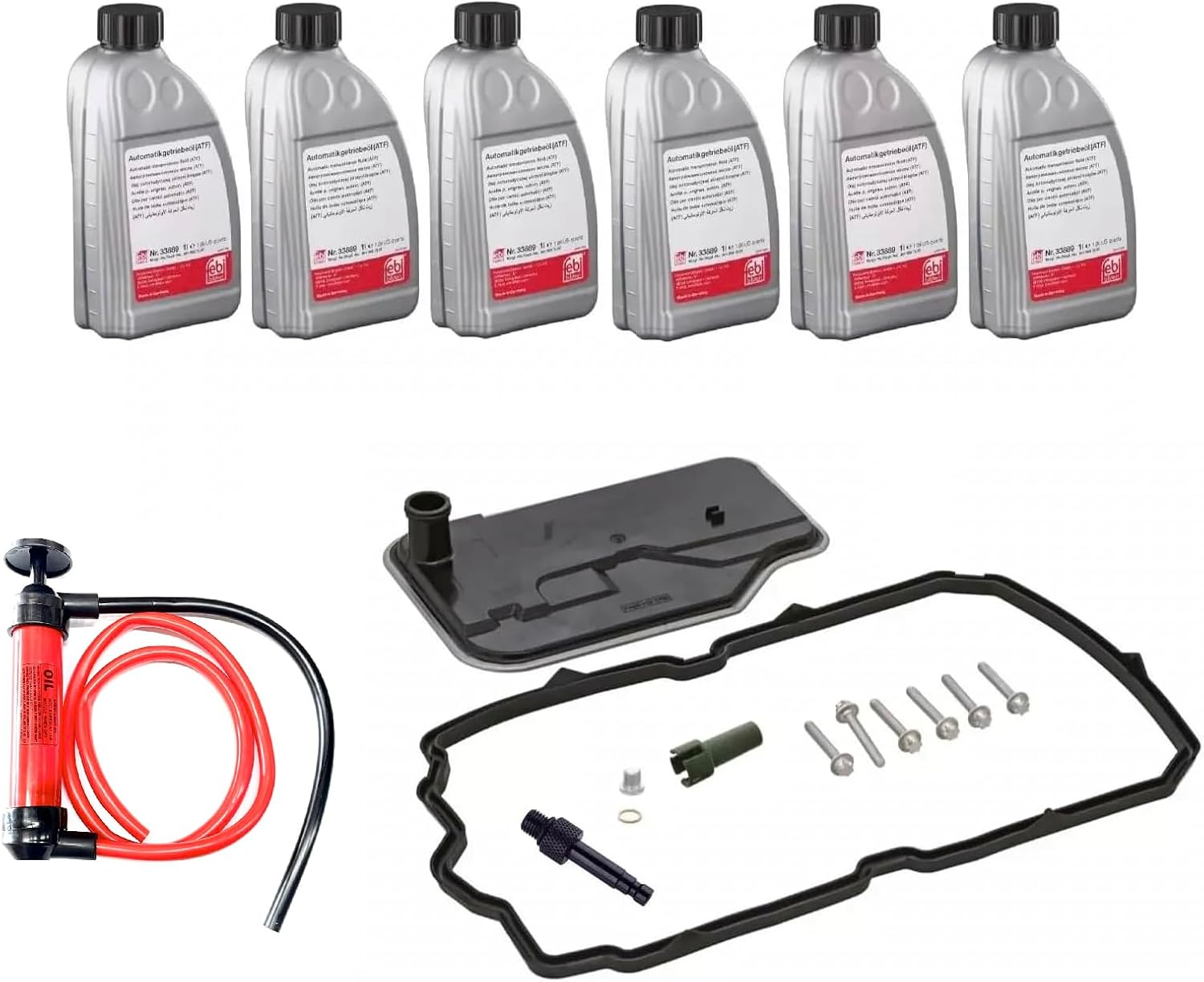
Mercedes 722.9 Filter Kit with Pan Gasket and Fill Adapter
The filter, one-piece pan gasket and threaded fill adapter for a pan reseal and the overflow level set that follows it.
View the 722.9 filter and gasket kit →Sources
- Daimler AG / Mercedes-Benz, Technical Information LI27.55-P-058976, "Procedure in case of slight oil traces on TRANSMISSION 722.9," versions 2 (B03 / ECO start-stop) and 5, 2014, on file at NHTSA. Backs the five listed leak locations, the "oil transfer from assembly plant" cause, op. 27102 04 (primary pump radial shaft seal), the B03 auxiliary oil pump, the diagnosis-tree remedy and the AMG exclusions. Version 5 (static.nhtsa.gov PDF); B03 version (static.nhtsa.gov PDF)
- Mercedes-Benz WIS service data, Transmission 722.950-966: oil pan removal/installation and fill procedure (reproduced by Weistec Engineering). Backs always replacing the pan seal, no sealant, oil-free sealing surfaces, the 722.9-only pan clamps and contact corrosion warning, the 4 Nm + 180 degree pan bolts, the 22 Nm drain screw, the overflow pipe, and the 6 L / +4 L / +2 L fill with the 45°C and 90°C steps. weistec.com (PDF)
- Transmission Digest, "Transmission TECH/TALK," November 2014 issue: Mercedes 722.9 failure. Backs the 2006 CLK500 pump bushing seizure, the switch from bushing to caged-bearing pump (722 270 0197), converter hub hardness, pump gears running on the bell housing, and the pilot clearance and dowel checks. transmissiondigest.com
- Underhood Service, "Tech Tip: Mercedes-Benz A/T Fluid Leaks at the Electrical Connector," courtesy of ALLDATA, October 29, 2008. Backs the connector and O-ring replacement, the under-50°C rule to protect the conductor plate, cleaning oil out of the harness and plugs, and tension-free harness routing (published for the 722.6). underhoodservice.com
- Mercedes-Benz USA, Star Bulletin S-B-00.40/89d, "Operating Fluid Specification Changes for Automatic Transmission," November 6, 2013. Backs the June 21, 2010 production-date split between 236.14 and 236.15/236.16 fluid and the never-mix requirement. static.nhtsa.gov (PDF)
- W220 S-Class Encyclopedia, "WIS 27.00 Transmission - General" (community reproduction of Mercedes WIS notes). Backs the pan gasket part number 220 271 03 80, the aluminum one-time pan bolts, and the 12 x 16 x 1.5 mm drain screw sealing ring. w220.wiki
Pan gaskets and filter kits, correct-spec 236.14 and 236.15 fluid, fill adapters and full gasket-and-seal rebuild kits for the 722.9.
Shop 722.9 parts →