Somebody sold a lot of people a part that does not exist. Search for a 727 shift solenoid and you will find listings, cross-reference charts and forum threads, and none of it changes the fact that a Chrysler A727 TorqueFlite has zero shift solenoids in it. It never had one. The unit decides when to shift using oil pressure and nothing else, so if yours shifts late, early, erratically or not at all, the fault is in that hydraulic circuit, a linkage adjustment, or a band that is out of spec.
The short version: the A727 schedules its shifts by balancing governor pressure (a mechanical device on the output shaft that makes pressure proportional to road speed) against throttle pressure (a valve driven by linkage from the carburetor or throttle body that makes pressure proportional to engine load). Those two pressures push on opposite ends of the 1-2 and 2-3 shift valves. Whichever one wins decides when the shift happens. Every "shift solenoid symptom" on a 727 is really a governor fault, a throttle linkage or throttle valve fault, a band adjustment, or a pressure problem. The one genuinely electrical device on the case is the three-terminal neutral safety and back-up light switch, and it cannot affect shifting at all.

Proof, Not Opinion: What the Factory Manual Actually Lists
The Chrysler TorqueFlite service manual covering the A727 and A904 is the settling argument here. Search the entire transmission section for the word "solenoid" and you get exactly one context: the starter solenoid, referenced in the description of the neutral starting switch, which provides ground for the starter solenoid circuit through the selector lever cam in Park and Neutral only. That is it. No shift solenoid, no lockup solenoid, no pressure control solenoid.
Better still, look at what the factory lists as the causes of a no-upshift complaint. The manual gives eleven: low fluid level, throttle linkage adjustment, kickdown band adjustment, hydraulic pressures too high or low, governor sticking or leaking, valve body malfunction or leakage, sticking clutches or servos, faulty oil pump, kickdown servo or band malfunction, worn front clutch, and worn input shaft or reaction shaft support seal rings. Not one is electrical. That list is your diagnostic tree.
What the electrical connector on the case really is
The three-terminal switch screwed into the case does two jobs, neither involving shifting. The center terminal is the neutral starting switch: continuity between the center pin and the case should exist only in Park and Neutral. The two outside terminals are the back-up light circuit, showing continuity only in Reverse and none to the case. A replacement torques in at 24 ft-lb, and the manual says check gearshift linkage adjustment before condemning a switch that tests bad.
Where the Solenoid Confusion Comes From
The confusion is not stupid — it comes from the family tree. Chrysler bolted an overdrive section onto the back of the 727 and released it as the A518, later renamed the 46RH, with stablemates 42RH, 44RH, 46RE, 47RH and 47RE. On the RH units the three forward gears still shift on governor and throttle pressure exactly like a 727, but overdrive and the converter clutch are each switched by a solenoid, sold as one assembly on a three-pin connector. Those are the solenoids people try to backfit onto a 727.
The RE units went further and put governor pressure itself under electronic control, using a governor pressure solenoid and a transducer in place of the mechanical flyweight governor. Sonnax describes that circuit plainly in its governor bore plug documentation: governor oil leaving the solenoid reacts on the 1-2 and 2-3 bore plugs, which sequentially stroke the shift valves. Same valve body architecture the 727 uses, different source of pressure.
Tell them apart in ten seconds: count the forward gears and look for the connector. Three speeds, no multi-pin connector, no overdrive housing means A727 — fully hydraulic, and no shift solenoid exists for it at any price. Four speeds with a three-pin connector puts you in the A518/46RH family, where the solenoid you can buy operates overdrive and lockup only, never the 1-2 or 2-3 shift. Four speeds with a full harness and a scan tool that talks to it means 46RE, 47RE or 48RE, where a governor pressure solenoid genuinely can cause shift timing complaints.
The Test That Replaces the Solenoid You Cannot Buy
Pressure testing is the 727 equivalent of watching solenoid commands on a scan tool, and the factory numbers are tight enough to be genuinely diagnostic. Get the fluid to operating temperature, 150 to 200 degrees F, and put the vehicle on a hoist with the rear wheels free to turn. The manual calls for gauge tool C-3292 (0 to 100 psi) for line, lube and governor pressure, and C-3293 (0 to 300 psi) for the rear servo.
| Test | Condition | Specification |
|---|---|---|
| Line pressure | D, in direct, 1,000 rpm | 54–60 psi |
| Line pressure | Throttle lever swept to full throttle, at kickdown | Rises to 90–96 psi max |
| Front servo release | Same test, read alongside line pressure | No more than 3 psi below line |
| Lubrication pressure | 1,000 rpm, closed throttle, in direct | 5–15 psi |
| Rear servo apply | Reverse, 1,600 rpm | 230–300 psi |
| Governor pressure | Vehicle stopped | Must return to 0–1.5 psi |
| Line pressure (Sonnax quick reference) | Reverse idle / Reverse stall | 145–175 psi / 230–280 psi |
Read those together rather than one at a time. If line pressure is in spec at 1,000 rpm but front servo release sits more than 3 psi below it, the manual points at leakage in the front clutch or front servo circuits, not the pump. If line pressure never climbs toward 90–96 psi as you sweep the throttle lever by hand, your throttle pressure circuit is dead and every shift point is now wrong — the single most common reason a 727 gets accused of a bad shift solenoid.
The governor test, and the two-psi rule worth memorizing
The governor pressure port is on the lower left side of the extension housing near the mounting flange. Drive the vehicle on the hoist and compare readings to the factory chart, which is indexed by engine and axle ratio. For a 340, 383 or 440 with a 3.23 axle, 15 psi should appear at 15–17 mph, 50 psi at 38–44 mph and 75 psi at 60–66 mph. A numerically higher axle makes those pressures at lower road speeds, which is why comparing your shift points to somebody else’s car teaches you nothing.
Two behaviors matter more than the exact numbers. Pressure must respond smoothly to changes in mph; steps and hangs mean a sticking governor valve or weights. And governor pressure must bleed down to 0–1.5 psi when the vehicle stops. The manual is blunt: above 2 psi at standstill will prevent the transmission from downshifting. A 727 that pulls away from a dead stop in second or third is almost always a governor that will not bleed off.
When the governor is clean and it still shifts wrong
Governor pressure does not just get made, it has to survive the trip to the shift valves. Sonnax attributes 1-2 shuttle shifts, oversensitive 2-3 and 3-2 shifts, early upshifts and difficulty adjusting shift timing with the TV linkage to wear in the valve body casting at the large diameter of the 1-2 or 2-3 governor plugs, which lets governor oil leak past them. The correction is drop-in governor bore plug kit 22771-14K with PTFE seals. The tell is temperature sensitivity: bore wear makes shift timing drift with operating temperature, so a unit that shifts acceptably cold and badly hot is describing a leak, not a schedule.
Throttle Pressure: The Half Nobody Adjusts
Governor pressure gets the attention because you can put a gauge on it. Throttle pressure gets ignored because you cannot. The manual states flatly that no provisions are made to test it, and that incorrect throttle pressure should only be suspected when part-throttle shift speeds are very delayed or very early relative to vehicle speed. Adjust the linkage first, and only then touch the setting inside the valve body.
Sonnax publishes the linkage procedure in a form you can follow on a lift. Put the throttle body or carburetor at its lowest idle position, using a wire tie to hold it there if it will not return on its own. Raise the vehicle, loosen the lock screw on the linkage swivel and disconnect it from the throttle lever. Hold the transmission throttle lever as far toward the front of the transmission as it will go, adjust the swivel so it just slips onto the lever, and tighten the lock screw. On a 727 that has had a carburetor swap, that is frequently the entire repair.
While the lever is in your hand, try to wiggle it on the valve body shaft — the manual has you inspect it for looseness during pressure testing. A lever that has worn its square onto the shaft delivers less throttle pressure than the pedal asks for, so the unit upshifts early and slips on the 1-2.
Line pressure adjustment, and the two measurements that come first
An incorrect throttle pressure setting produces incorrect line pressure readings even when the line pressure adjustment is correct, so the manual orders the work: throttle first. Then check two dimensions with the valve body out. Manual valve (in 1-low) to line pressure adjusting screw must be 1-7/8 inches, corrected by repositioning the spring retainer — out of position, the regulator valve can cock and hang in its bore. The line pressure adjustment itself is roughly 1-5/16 inches from the valve body to the inner edge of the adjusting nut.
From there it is arithmetic: one full turn of the adjusting screw moves closed-throttle line pressure about 1-2/3 psi, counterclockwise to increase. That increment is small enough that chasing a 20 psi deficit with the screw means the problem is elsewhere. Sonnax lists reverse slip, poor line pressure control, poor forward and reverse engagement, soft reverse and poor cooler charge at idle for a worn line pressure plug and sleeve, repaired with kit 22229-01K (.200-inch plug) or 22229-04K (.264-inch).
Bands, Because Two of Them Are Shift Quality
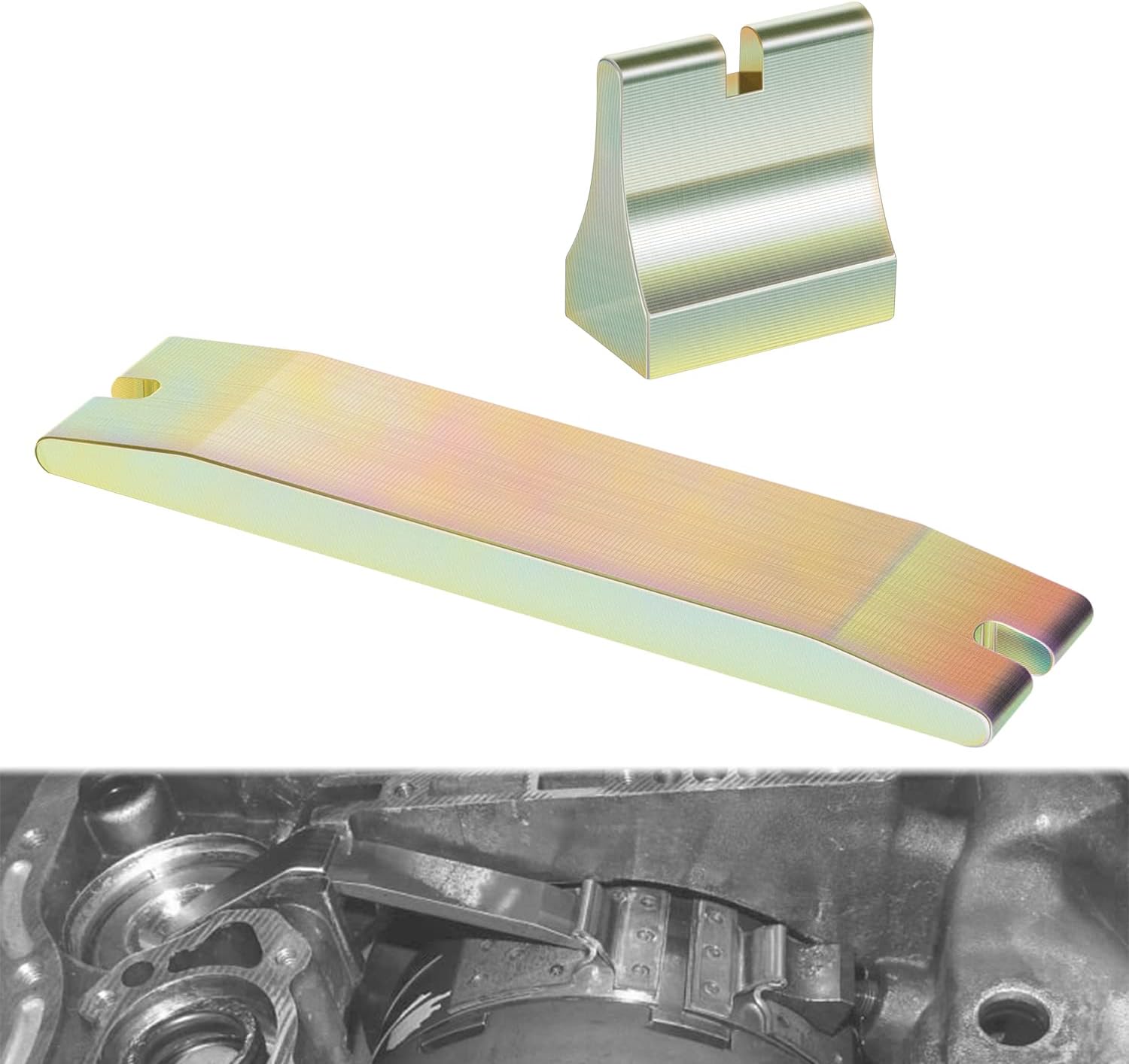
A 727 applies the kickdown band for second gear. Loose, the 1-2 is soft and the 2-3 late; tight, you get a harsh 1-2 and a bind. It is out of spec on most units that have never been touched.
| Adjustment | Kickdown band (front) | Low and reverse band (rear) |
|---|---|---|
| Access | Adjusting screw on left side of case | Inside the pan — drain and remove pan |
| Snug torque | 47–50 in-lb with C-3380 plus adapter C-3705 | 47–50 in-lb with C-3380 plus adapter C-3705 |
| Snug torque without adapter | 72 in-lb (the true torque) | 72 in-lb (the true torque) |
| A-727 back-off | 2 turns (1-1/2 turns for 426 cu. in.) | 2 turns |
| Lock nut | 29 ft-lb | 35 ft-lb |
| Pan bolts on reassembly | — | 150 in-lb |
The adapter detail gets skipped constantly. C-3380 with adapter C-3705 reads 47–50 in-lb because the adapter changes the wrench’s effective length; without it you tighten the same screw to 72 in-lb. Mix the two and the band ends up meaningfully wrong. Back the lock nut off five turns first and confirm the screw turns freely, because a seized screw reads as torque that never reached the band.
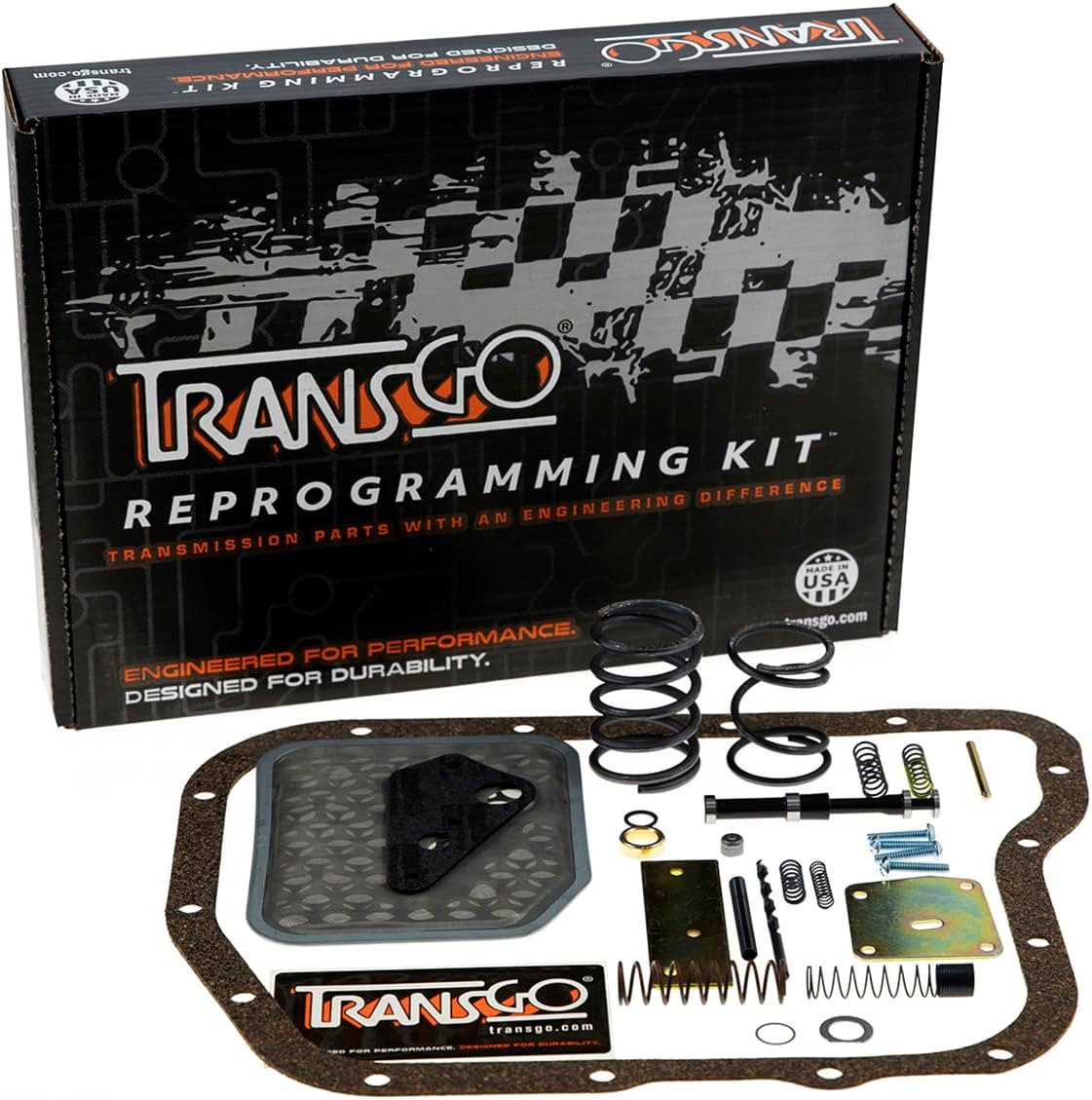
TransGo TF-2 Gear Command shift kit for the Chrysler A727
The standard reprogramming package for a 727 once the governor, throttle linkage and bands check out and you want firmer, better-timed shifts with more holding capacity. Install it in a valve body you have already inspected — a kit corrects calibration, it will not seal a worn governor plug bore.
View the TransGo TF-2 kit →Fluid and Capacity, Since Low Fluid Heads the Fault List
Low fluid level heads the factory cause list for no upshift and erratic shifts. Aerated fluid does the same by another route: air in the pump suction passages makes pressure that will not hold a shift valve where it belongs, which is why the manual makes inspecting for those leaks its own step.
An A727 holds 18-1/2 US pints, about 9.25 quarts, counting transmission and torque converter behind the standard 11-3/4 inch converter. An A904 holds 15-1/2 US pints, which is why capacity charts that lump all TorqueFlites together get you into trouble. A pan drop and filter service takes a fraction of that, so measure what comes out rather than dumping in a case of fluid.
The original specification was AQ-ATF Suffix A or Dexron. That is a period spec; Chrysler long since moved the TorqueFlite family to ATF+4, defined by material standard MS-9602. Mobil states on its ATF+4 data sheet that the fluid covers services specifying ATF+, ATF+2 and ATF+3 type fluids. ATF+4 is a very different friction package from Dexron, so on a fresh rebuild follow the rebuilder recommendation for the material actually installed.
The Order of Operations
Work it in this sequence and you will not waste a Saturday:
- Confirm you actually have a 727 — three speeds, no overdrive housing, no multi-pin connector. A three-pin connector means A518/46RH, where the overdrive and lockup solenoids are legitimately on the table.
- Inspect and adjust the throttle linkage, and check the throttle lever for looseness on the shaft.
- Inspect and adjust the throttle linkage, and check the external throttle lever for looseness on the valve body shaft.
- Adjust the kickdown band, and the low-reverse band if the pan is coming off anyway.
- Run the pressure tests at operating temperature: line and front servo release together, lube, rear servo, then governor.
- Only then pull the valve body, and inspect the governor plug bores, throttle valve bore and line pressure plug and sleeve bore rather than just cleaning the valves.
- Only then pull the valve body, and when you do, inspect the governor plug bores, throttle valve bore and line pressure plug and sleeve bore rather than just cleaning the valves and calling them good.
The 727 earned its reputation by being simple enough to diagnose with a gauge and a wrench. That only holds if you diagnose the transmission in front of you instead of the one the parts catalog wants to sell you.
Master rebuild kits, valve body and shift kits, governors, bands, filter and gasket kits, torque converters and bench tools for the Chrysler A727 TorqueFlite — shipped fast from the USA.
Shop 727 TorqueFlite parts →Related reading: 46RE shift solenoid symptoms covers the descendant unit where the solenoids are real and testable, and 46RE rebuild wear points goes into the overdrive section Chrysler grafted onto this case.
Sources
- Chrysler Corporation — TorqueFlite A727 and A904 Automatic Transmission Service Manual (Group 21, 1966–1977 coverage). The primary source for this article. Backs the absence of any transmission solenoid in the unit and the single starter-solenoid reference in the neutral starting switch description; the eleven-item no-upshift cause list; the three-terminal neutral safety and back-up light switch continuity tests and the 24 ft-lb switch torque; the hydraulic control pressure test procedure at 150–200 degrees F with gauge tools C-3292 and C-3293; line pressure of 54–60 psi at 1,000 rpm rising to 90–96 psi at kickdown with front servo release within 3 psi; lubrication pressure of 5–15 psi; rear servo apply pressure of 230–300 psi in Reverse at 1,600 rpm; the governor pressure charts by engine and axle ratio and the 0–1.5 psi standstill bleed-down with the above-2-psi no-downshift warning; the statement that no provisions are made to test throttle pressure; the 1-7/8 inch spring retainer and 1-5/16 inch line pressure adjustment dimensions and the 1-2/3 psi per turn adjustment rate; kickdown and low-reverse band adjustment specifications including tools C-3380 and C-3705 and the 29 and 35 ft-lb lock nut torques; the 150 in-lb pan bolt torque; and the A727 capacity of 18-1/2 US pints with the 11-3/4 inch converter. 1966–1977 TorqueFlite 727/904 Service Manual (PDF)
- Sonnax — "Chrysler A727, A904 Pressure Ports." Backs the quick-reference line pressure values used in the test table: Reverse idle 145–175 psi and Reverse stall 230–280 psi, D2 idle 54–60 psi and stall 90–96 psi, and the rule that governor pressure should be equal to road speed. sonnax.com/tech_resources/250-chrysler-a727-a904-pressure-ports
- Sonnax — Governor Bore Plug Kit 22771-14K product and application page. Backs the cause statement that wear in the valve body casting at the large diameter of the 1-2 or 2-3 governor plugs lets governor oil leak past the shift valve governor plugs; the symptom list of 1-2 shuttle, oversensitive 2-3 and 3-2, difficulty adjusting shift timing with TV linkage and early upshifts; the note that bore wear makes shift timing change with operating temperature; and the description of the RE-family circuit in which governor oil leaving the solenoid reacts on the 1-2 and 2-3 bore plugs. sonnax.com/parts/1837-governor-bore-plug-kit
- Sonnax — "Chrysler A727, A904 Throttle Link Adjustment." Backs the step-by-step throttle linkage adjustment procedure: holding the throttle body or carburetor at lowest idle with a wire tie, loosening the swivel lock screw, holding the transmission throttle lever fully forward, and adjusting the swivel so it just slips onto the throttle valve lever. sonnax.com/tech_resources/277-chrysler-a727-a904-throttle-link-adjustment
- Sonnax — Chrysler A727 transmission unit page and symptom index. Backs the line pressure plug and sleeve symptom set (reverse slip, poor line pressure control, poor forward and reverse engagement, soft reverse, poor cooler charge at idle) and the.200-inch and.264-inch plug diameter split between kits 22229-01K and 22229-04K, plus the throttle valve kit applications (22771-03K and oversized 22771-04K) for shift timing concerns, throttle buzz, poor kickdown and late 2-3. sonnax.com/units/90-a727
- Sonnax — "Chrysler 46RE, 46RH, 47RE, 47RH Vacuum Test Guide." Backs the statement that the 727 valve body architecture carried into the overdrive units, showing the same 1-2 and 2-3 shift valves, 1-2 and 2-3 governor plugs, throttle valve, kickdown valve, manual valve, pressure regulator valve and line pressure plug and sleeve in the descendant castings, alongside the overdrive-era additions (3-4 shift, TCC apply and TCC timing valves, lockup boost valve). sonnax.com/tech_resources/529-chrysler-46re-46rh-47re-47rh-vacuum-test-guide
- ExxonMobil — Mobil ATF+4 product data sheet. Backs the Chrysler MS-9602 specification reference and the statement that the fluid covers services specifying ATF+, ATF+2 and ATF+3 type fluids in Chrysler, Dodge, Plymouth, Eagle and certain Jeep applications. Always confirm the fluid specification called out for your specific vehicle, model year and rebuild. mobil.com/en-bq/passenger-vehicle-lube/pds/gl-xx-mobil-atf4