The pan-and-filter service on a GM 8L90 is not a hard job. Fifteen bolts, a filter, a gasket, and you are done in an hour. What makes it a job people get wrong is that the 8L90 has no dipstick and no fill tube. There is a plug in the bottom of the pan and a temperature window, and if you miss that window the unit leaves your bay either starved or foaming. GM spells out both failure modes in writing, and neither one is subtle.
The short version: DEXRON HP only, 7.0 L / 7.4 qt fluid-change capacity. Fifteen pan bolts at 10 N·m (89 lb-in). The pan gasket is reusable and GM says to inspect it rather than automatically replace it. Set the level with the engine running and fluid temperature between 35–45°C (95–113°F), and the level-set plug goes back in at 9 N·m (80 lb-in). On trucks with a thermal bypass valve, heat the fluid past 90°C (194°F) first, then let it cool into the window.
Does GM Actually Call For This Service?
Yes, but only on one of the two schedules, and that distinction is worth understanding before you sell the job. Pull up the maintenance schedule in a 2017 Silverado 1500 owner manual. On page 456, Additional Required Services — Normal, there is no transmission fluid line at all. Turn the page to 457, Additional Required Services — Severe, and "Change automatic transmission fluid and filter" is checked at three intervals: 72 000 km/45,000 mi, 144 000 km/90,000 mi, and 216 000 km/135,000 mi.
So the honest answer to a customer asking whether GM requires it is: it depends on how they drive. GM defines severe service in that same manual as vehicles mainly driven in heavy city traffic in hot weather, mainly driven in hilly or mountainous terrain, frequently towing a trailer, used for high-speed or competitive driving, or used for taxi, police or delivery service.
That describes a half-ton that tows a boat on weekends and sits in traffic the rest of the week, and it describes almost every work truck. The 45,000-mile number is not aggressive upselling. It is the schedule GM published for the way these vehicles actually get used.
Fluid: DEXRON HP, and Why the Wrong Bottle Causes Problems
The 8L90 takes DEXRON HP. Not DEXRON VI, which is what the 6L80 next to it on the shelf uses, and not DEXRON ULV, which is what the 10L80 that replaced it uses. GM's 2025 TechLink transmission capacities chart lists the 8L90 under RPO N8X at 7.0 liters / 7.4 quarts fluid-change capacity, fluid DEXRON HP. The 8L80 in the same chart is identical on both counts.
Three different low-viscosity GM fluids with three different friction packages, all sold in similar-looking bottles, all fitting the same funnel. Label the jugs on your bench.
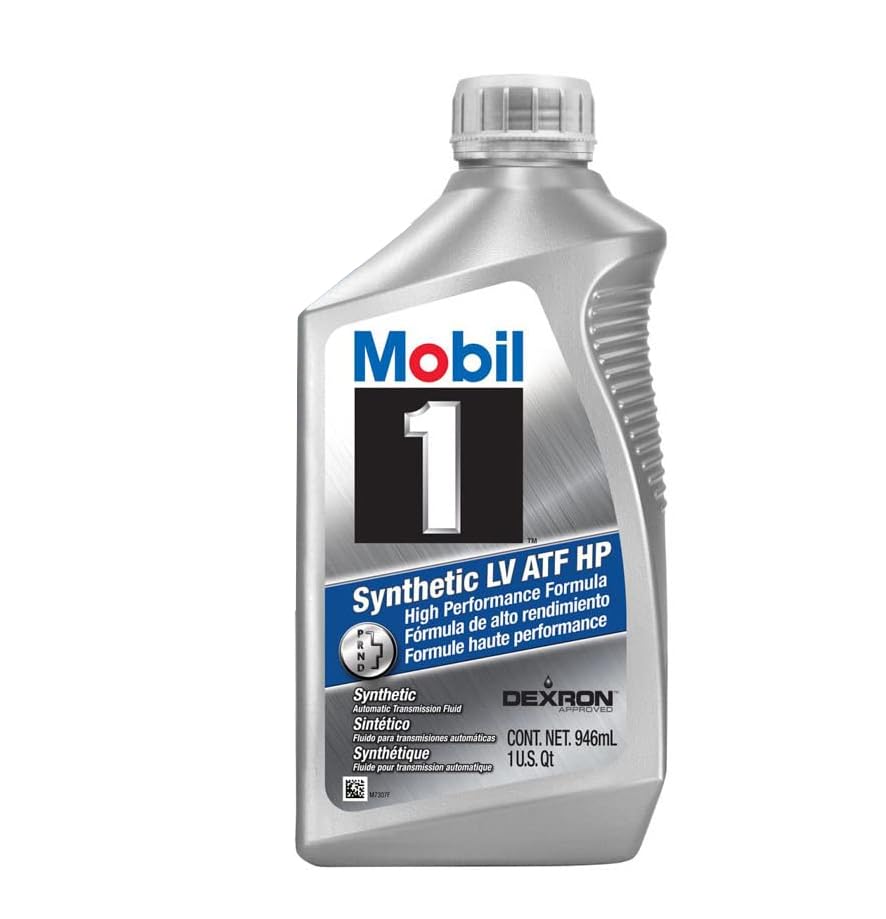
The current service fill is the blue-label Mobil 1 Synthetic LV ATF HP, GM part number 19417577 in the US and 19418066 in Canada. Mobil's own product data sheet confirms it is licensed against DEXRON HP under license code J-62120, with a kinematic viscosity of 5.7 mm²/s at 100°C, a viscosity index of 152, and a pour point of −54°C.
The blue label matters. GM bulletin 18-NA-355 documents why: the base stock in the earlier HP fluid, part 19355656, attracts low levels of moisture, and that absorbed moisture degrades the coefficient of friction of the fluid. The replacement uses a gas-to-liquid base stock that tolerates more moisture, and that change is the entire fix for the light-throttle shudder complaint between 25 and 80 mph that plagued these units. The bulletin is also explicit that intermixing other fluids or aftermarket additive packages leaves you with a low concentration of the new fluid and will not produce satisfactory results.
So if you are in the pan on a unit with any shudder history, put the correct blue-label HP fluid in it and do not add a friction modifier on top. The additive is the problem you are trying to remove.
What Actually Comes Out When You Drop the Pan
The 7.4 quart figure is the fluid-change capacity, and a pan drop does not get all of it. The converter and the cooler circuit hold fluid that never reaches the pan, so a drop-and-refill exchanges roughly half the unit's total charge. That is normal and still worth doing, but it is not a flush and you should not quote it as one.
It also explains why GM's shudder correction in 18-NA-355 is not a pan service: that procedure loads a TransFlow machine with 20 quarts and pushes fluid through the cooler lines, precisely because a pan drop cannot displace what is trapped in the converter. If the complaint is shudder, a pan and filter alone will disappoint everyone.
Pan Off: Bolts, Gasket and Reading the Magnet
The 8L90 pan is held on by fifteen bolts, per GM bulletin 16-NA-014. There are more holes than that in the casting because a couple of them locate the gasket rather than clamp it, so count fasteners, not holes.
Crack the bolts at one corner and let the pan tip and drain into a clean catch pan rather than pulling it flat and wearing seven quarts. Keep that fluid. You are going to read it.
Here is the detail most aftermarket write-ups get backwards. GM's instruction in 16-NA-014 is that the fluid pan gasket is reusable, and the technician is told to inspect it and determine whether it can be reused. The bulletin specifies replacing it if it is stuck to the case or to the pan. Add the obvious: replace it if it is torn, nicked, hardened or distorted. The part number is 24260071 and it covers both the 8L45 and the 8L90.
Still have one on the shelf before you start. Discovering yours is stuck to the case at 4:30 on a Friday is how a one-hour job becomes an overnight.
Now read what came out:
- Fine gray haze on the magnet. Normal. Every automatic makes some steel dust.
- Coarse metallic flakes or chunks. Stop selling a fluid service. Something is coming apart.
- Black friction dust, brown tint, burnt smell. Clutch material. The unit has already lost capacity somewhere, and fresh fluid can make a marginally slipping clutch let go entirely.
- Aluminum glitter. Bore wear or a hard-part problem. These valve bodies are aluminum and they do wear.
- Milky or hazy fluid. Coolant intrusion from the cooler in the radiator. Stop and test the cooler.
Wipe the magnet clean, wipe the pan out with a lint-free rag rather than a shop towel that sheds, and do not hose it with brake cleaner and bolt it back up wet.
Filter and Reassembly
The service filter is commonly cataloged under GM number 24274402 — confirm the exact number against the VIN, because these vehicles span a decade of running changes. Seat the new filter fully. A filter that is not pushed home leaves a gap at the pump suction, and that is a slow-to-diagnose air leak that shows up as low pressure and a whine once the fluid warms. Note that GM's front-cover procedure in 16-NA-014 leaves the filter in place entirely, which is a hint at how little holds it captive.
Hang the pan with the gasket located, start all fifteen bolts by hand, then torque them to 10 N·m (89 lb-in) in the sequence shown in service information. That is inch-pounds. A 3/8 ratchet and a firm wrist is roughly double that figure, and overtightening distorts a stamped pan flange into a leak you will be chasing next week. Use an inch-pound torque wrench.
The Refill and Level Set: The Part That Decides Everything
This is where 8L90s get killed. GM's procedure, as published in 18-NA-355, is nothing like how you check a 4L60E.
| Item | Spec | Why it matters |
|---|---|---|
| Fluid | DEXRON HP (blue label Mobil 1 Synthetic LV ATF HP) | DEXRON VI or ULV gives wrong friction behavior |
| Fluid-change capacity | 7.0 L / 7.4 qt | GM 2025 TechLink capacities chart, RPO N8X |
| Level-check fluid temp (TFT) | 35–45°C (95–113°F) | Outside it, the level is wrong by definition |
| TFT above 45°C at check | Result: under-filled | Premature component wear or damage |
| TFT below 35°C at check | Result: over-filled | Fluid out the vent tube, fire risk, foaming, pump cavitation |
| Thermal bypass trucks | Heat to 90°C (194°F), then cool to 35–45°C | Opens the bypass so the cooler fills first |
| Engine state during check | Running, in Park, vehicle level | Engine off dumps excess fluid and under-fills |
| Pan bolts | 10 N·m (89 lb-in), 15 of them | GM 16-NA-014 |
| Level-set plug | 9 N·m (80 lb-in) | GM 18-NA-355 |
The sequence GM publishes runs like this. Observe transmission fluid temperature on a scan tool or the driver information center. Start the engine and let it idle. With your foot on the brake, move the shift lever through each gear range, pausing at least three seconds in every range, then return to Park. Confirm engine speed is down at a normal 500–800 rpm idle. Let it idle at least one full minute. Raise the vehicle on a hoist, keeping it level, engine still running, lever still in Park.
Then pull the level-set plug and read what happens:
- Fluid comes out as a steady stream. Wait. When it slows to a drip, the level is correct.
- Nothing comes out. It is low. Add fluid until it drips out of the plug hole.
GM's caution, in capitals in the bulletin, is that the engine must be running when the level check plug is removed, or you get excessive fluid loss and an under-filled transmission. Reinstall the plug at 9 N·m (80 lb-in). If the fluid temperature drifts out of the window while you work, put the plug back in, drop the vehicle, and get the temperature back where it belongs before trying again.
Thermal bypass trucks are a different procedure
Silverado, Sierra, Yukon and Escalade models fitted with a thermal bypass valve need an extra step, and skipping it is the most common way to end up with a truck that is low on fluid but reads full. The bypass valve stays closed when the fluid is cool, so the cooler and its lines are still empty when you check. You set the level against a system that has not filled yet, the customer drives it, the valve opens, the cooler takes its share, and now the transmission is genuinely low.
GM's fix: get the fluid to or past 90°C (194°F) so the bypass opens and the cooler fills, then shut the vehicle off and let it cool back to 35–45°C before checking. It costs you a heat cycle. It is the difference between a correct level and a slow clutch death.
Mistakes That Turn a Service Into a Rebuild
- Checking level cold. Below 35°C you will overfill it. Aerated fluid does not hold pressure, and GM specifically warns about foaming, pump cavitation, and fluid discharged out the vent tube.
- Checking level hot off a road test. Above 45°C you will under-fill it. Let it cool into the window rather than guessing at a correction.
- Engine off with the plug out. Guarantees an under-fill.
- Torquing pan bolts by feel. 89 lb-in is light, and feel will distort the flange.
- Selling a pan service as a shudder fix. It is not. The GM correction is a full fluid exchange, and improvement can take up to 320 km (200 mi) of driving even when done correctly.
- Letting it run dry after deeper work. If the job went past the pan and the valve body or pump came off, note that Sonnax documents the 8L90 off-axis chain-driven pump frequently failing to self-prime on installation, and recommends priming it on the bench before the unit goes back in.
One last thing worth doing while the pan is off: write the actual condition of the fluid on the ticket. If the magnet had coarse debris or the fluid smelled burnt, tell the customer now that they are looking at a unit with a finite remaining life rather than a maintenance item. That conversation goes far better before the fresh fluid than after the comeback.
FAQ
Does the 8L90 need a transmission fluid and filter change?
GM lists it, but only on the severe schedule. In the 2017 Silverado 1500 owner manual, "Change automatic transmission fluid and filter" is checked at 72 000 km/45,000 mi, 144 000 km/90,000 mi and 216 000 km/135,000 mi under Additional Required Services - Severe. The same line does not appear on the normal schedule at all. Severe covers heavy city traffic in hot weather, mountainous terrain, frequent towing, high-speed driving, and taxi, police or delivery use.
What fluid does an 8L90 take and how much?
DEXRON HP, not DEXRON VI and not DEXRON ULV. GM's 2025 TechLink transmission capacities chart lists the 8L90 (RPO N8X) at 7.0 L / 7.4 qt fluid-change capacity. The current fill is blue-label Mobil 1 Synthetic LV ATF HP, GM part 19417577 in the US and 19418066 in Canada, which Mobil's data sheet shows carries DEXRON HP license J-62120.
Do you have to replace the 8L90 pan gasket?
Not automatically. GM bulletin 16-NA-014 states the fluid pan gasket is reusable and tells the technician to inspect it and decide. Replace it if it is stuck to the case or the pan, or if it is torn, distorted or hardened. The part number is 24260071 for both 8L45 and 8L90. Buy one before you start so a bad gasket does not end the job.
How do you check the fluid level on an 8L90 with no dipstick?
Through the level-set plug in the pan, with the engine running and fluid temperature between 35-45 C (95-113 F). Shift through every range pausing three seconds each, return to Park, idle at least a minute, then pull the plug. A steady stream means wait until it drips; nothing at all means add until it drips. On trucks with a thermal bypass valve, first get the fluid to 90 C (194 F), then shut it off and let it cool back into the window.
What happens if an 8L90 is overfilled?
GM's warning in bulletin 18-NA-355 is specific: an overfilled transmission pushes fluid out the vent tube, which can cause a fire, and it also causes foaming and pump cavitation. Aerated fluid will not hold pressure, so clutches slip and burn. Checking the level below 35 C is what produces the overfill, because cold fluid has not yet expanded into the cooler and lines.
Related guides
- 8L90 Fluid Type and Capacity — the spec and the numbers on one page.
- 8L90 Fluid Change Cost — what the job should run and what drives the price.
- GM 8L90 and 8L45 Shudder and Harsh Shift Fix — the full 18-NA-355 story.
- 8L90 Common Problems and Fixes — what these units actually break.
- 8L90 Line Pressure Testing — when the complaint is bigger than fluid.
8L90 Transmission Filter 24274402 with Gaskets
The filter and gaskets for exactly this job in one box, from our sister store CoreTransmissionParts. If you would rather see the whole 8L90 parts shelf first, the full 8L90 collection is here.
Get the filter and gasket set →Sources
- GM Service Bulletin 16-NA-014, July 2016 (hosted by NHTSA). Backs the 15 fluid pan bolts and the 10 N·m (89 lb-in) pan bolt torque, the statement that the fluid pan gasket is reusable and should be inspected and only replaced if stuck to the case or pan, pan gasket part number 24260071 for 8L45/8L90, the note that the fluid filter does not need to be removed for front cover service, and DEXRON HP as the specified fluid. static.nhtsa.gov/odi/tsbs/2016/SB-10097193-2280.pdf
- GM Service Bulletin 18-NA-355, August 2019 (hosted by NHTSA). Backs the transmission fluid level and condition check procedure in full: the 35–45°C (95–113°F) TFT window, the warning that TFT above 45°C yields an under-filled unit and TFT below 35°C an over-filled one, the over-fill consequences (fluid out the vent tube with fire risk, foaming, pump cavitation), the 90°C (194°F) heat-then-cool step for thermal bypass valve models, the caution that the engine must be running when the level check plug is removed, the shift-through-ranges and 500–800 rpm idle steps, the 9 N·m (80 lb-in) level set plug torque, blue-label Mobil 1 Synthetic LV ATF HP part numbers 19417577 (US) and 19418066 (Canada), the moisture-attracting base stock of the earlier 19355656 fluid and the GTL base stock of its replacement, the 20 quarts loaded into the DT-45096 TransFlow machine, the intermixing warning, and the 320 km (200 mi) improvement window. static.nhtsa.gov/odi/tsbs/2019/MC-10163890-9999.pdf
- GM TechLink — 2025 Transmission Capacities & Fluids chart. Backs the 8L90 (RPO N8X) fluid-change capacity of 7.0 liters / 7.4 quarts and DEXRON HP as its specified fluid, the identical figures for the 8L80, and the contrast with DEXRON ULV used by the 10L80 and DEXRON VI used elsewhere in the lineup. gm-techlink.com — TechLink transmission fluid capacities 2025
- 2017 Chevrolet Silverado 1500 Owner Manual (chevrolet.com), Service and Maintenance, pages 452, 456 and 457. Backs the absence of any transmission fluid line on the Additional Required Services — Normal schedule, the presence of "Change automatic transmission fluid and filter" on the Additional Required Services — Severe schedule at 72 000 km/45,000 mi, 144 000 km/90,000 mi and 216 000 km/135,000 mi, and GM's definition of severe service (heavy city traffic in hot weather, hilly or mountainous terrain, frequent trailer towing, high-speed or competitive driving, taxi/police/delivery use). chevrolet.com — 2017 Silverado 1500 Owner Manual (PDF)
- ExxonMobil — Mobil 1 Synthetic LV ATF HP product data sheet. Backs the DEXRON HP approval and license code J-62120, kinematic viscosity of 5.7 mm²/s at 100°C and 27 mm²/s at 40°C, viscosity index 152, pour point −54°C, flash point 233°C, and density 835 kg/m³ at 15°C. mobil.com — Mobil 1 Synthetic LV ATF HP PDS
- Sonnax — "Troubleshooting GM 8L45, 8L90 No Move & No Pressure Conditions." Backs the off-axis chain-driven pump frequently failing to self-prime on installation and the recommendation to prime it on the bench before the unit goes back in, along with the other assembly-side no-pressure causes worth ruling out after deeper work. sonnax.com — Troubleshooting GM 8L45, 8L90 No Move & No Pressure