A light shudder in a GM 8L90 at a steady 40 to 60 mph, throttle held constant, feels like driving over rumble strips. It is one of the most common complaints on this transmission, and it is also one of the most misdiagnosed, because the first instinct is to blame a worn clutch pack or a tired torque converter. Most of the time that instinct is wrong. GM has two documented bulletins that cover this exact complaint on the 8L90 and its FWD-based sibling the 8L45, and both point to causes that do not require a teardown. Here is how to confirm it is torque converter clutch (TCC) shudder, the exact fix GM publishes, and what to check if the fluid procedure does not resolve it.
What TCC shudder actually feels like, and what it isn't
GM's own bulletin language describes the complaint precisely: a shake or shudder during light-throttle acceleration or steady-state cruise, in a specific speed window, that feels like driving over rumble strips or rough pavement. It happens only when the transmission is not actively shifting gears, and it shows up in both Drive and the manual shift range. That is the signature of a torque converter clutch that is slipping in a narrow, uncontrolled band instead of holding a clean lockup or staying fully open.
It is easy to confuse with tire vibration, a bad engine mount, a driveline angle problem, or a wheel balance issue, because all of those also show up as a steady-speed vibration. The difference is that TCC shudder is tied to torque converter clutch slip, not vehicle speed or engine speed directly, and GM publishes an exact test to tell the two apart before anyone touches a wrench.
The factory diagnostic test: three modes, one road
Per GM Bulletin 16-NA-175, the test has to be run on a smooth road with the transmission sump between 122°F and 158°F (50°C to 70°C). On trucks and SUVs, hold the tow-haul button for five seconds first to disable grade braking, which would otherwise force an unwanted downshift mid-test. Using GDS2, drive the vehicle in 8th gear and run three modes:
- Mode A — Normal operation. GDS2 for viewing only. This is where you confirm the shudder is actually present.
- Mode B — TCC commanded disabled (open). If the shudder disappears here, the torque converter clutch is implicated.
- Mode C — TCC commanded enabled (locked). If the shudder also disappears here, the clutch is confirmed as the root cause rather than a coincidental vibration.
If the vibration is present in Mode A and gone in both Mode B and Mode C, GM calls this confirmed TCC shudder, and the fluid exchange below is the corrective action. If the vibration is still there with the clutch forced open, or still there with it forced locked at zero slip, the cause is not TCC shudder and belongs in general vehicle vibration diagnosis instead — tires, driveline, mounts.
The February 2017 revision of the bulletin adds exact test parameters by application, because the shudder frequency and the speed window both change with vehicle and engine combination. A Corvette or Z06 with the LT1/LT4 and M5U transmission is tested at 1,000 to 1,800 rpm transmission input speed, 40 to 80 mph, 125 to 250 Nm of engine torque, with a measured vibration frequency around 28 Hz. A Camaro with the same M5U drivetrain runs a tighter 1,000 to 1,500 rpm, 40 to 55 mph window. Half-ton trucks and SUVs with the L83 or L86 and M5U run 1,050 to 1,500 rpm, 45 to 55 mph, 200 to 375 Nm, with a measured frequency closer to 26 Hz. A PicoScope and NVH software can confirm the vibration peak lands within 2 Hz of the listed frequency and stays constant in 8th gear regardless of vehicle speed — if the frequency follows road speed instead of staying fixed, it is not TCC shudder.
Two different root causes behind the same complaint
The 2015 calibration issue (Bulletin 15389)
The earliest documented 8L90 shudder cause was a calibration problem, not a hardware or fluid problem. GM Service Update 15389, released in May 2015, covers 2015 Cadillac Escalade and Escalade ESV, Chevrolet Silverado, and GMC Sierra, Yukon Denali and Yukon Denali XL models equipped with the 8L90 (RPO M5U) and the 6.2L V8 (RPO L86). GM's own description is that the transmission calibration allowed a higher-than-target energy input to the torque converter clutch under certain conditions, which wore the clutch friction material faster than expected and produced a shudder when the TCC applied. The fix was a straightforward TCM reprogram with no parts involved, applied to roughly 54,037 U.S. vehicles under the New Vehicle Limited Warranty. If you are working on an early 2015 truck or Escalade that has never had this reflash, check calibration history before assuming the problem is fluid or hardware.
The fluid-condition issue (Bulletin 16-NA-175)
The much larger and longer-running cause is tied to the transmission fluid itself. GM's technical explanation is that the original DEXRON HP fluid's base stock had a tendency to attract low levels of moisture over time, which degraded the fluid's coefficient of friction and allowed the torque converter clutch to slip intermittently instead of holding a clean lockup. That is what produces the rumble-strip shudder. Bulletin 16-NA-175 covers 2015 through 2017 (and later revisions extend the range through 2019) Cadillac, Chevrolet and GMC vehicles with the 8L90 (M5U, M5X) and 8L45 (M5T, M5N) across the full range of GM passenger cars and trucks that use these units, including Camaro, Corvette, CTS, ATS, Colorado/Canyon and the full-size trucks and SUVs. This is not a vehicle-specific recall; it is a fluid-chemistry issue that shows up across the whole 8L90/8L45 population as fluid ages.
The fix: a triple fluid exchange, not a single drain-and-fill
A normal fluid change will not fix TCC shudder, because a single pass does not get the contaminated fluid concentration low enough. GM's published service procedure is a three-cycle flush:
- Step 1. Flush the cooler lines and cooler. Drop the pan, drain all fluid, clean the pan and magnet, replace the filter if debris is present, then refill and run the vehicle on a hoist for 10 minutes cycling through every forward range, Reverse and Neutral.
- Step 2. Drop the pan again, drain again, refill again, and repeat the 10-minute cycle-through on the hoist.
- Step 3. Drop the pan a third time, drain, then refill to the correct level using the fluid-fill procedure in GM's service information.
The original 2016 version of the bulletin specifies new DEXRON HP fluid, GM part number 19331925 (19331926 in Canada). The February 2017 revision tightens that to a specific formulation: Mobil 1 Synthetic LV ATF DEXRON HP, GM part number 19353429 (19353430 in Canada), ordered through a GM oil distributor rather than the general parts catalog. That fluid uses a base stock engineered to tolerate more moisture without losing its friction coefficient, which is the actual fix for the hygroscopic problem described above. A later bulletin, 18-NA-355, refines the procedure further for the broader 2015–2019 population and calls for a dedicated cooler flush machine and exchange tool kit to guarantee at least 93% new-fluid concentration, since GM found that some aftermarket flush machines don't fully displace the old fluid.
Don't expect an instant fix. GM's own bulletin notes the shudder should improve directionally right away but may need up to 200 miles and at least two full cold-to-hot drive cycles before you can judge whether the triple flush actually resolved the complaint. Re-evaluating too early is the most common reason techs think the fix didn't work when it was still settling in.
Fluid type and capacity
The 8L90 runs DEXRON HP across every GM-documented application, never DEXRON VI or DEXRON ULV. GM's 2026 transmission capacities chart lists a fluid-change capacity of 7.0 liters (7.4 quarts) of DEXRON HP for 8L90 (code N8X) applications in vans like the Express and Savana, while the same transmission in a Low Cab Forward chassis takes 11.8 to 12.0 liters (12.5 to 12.7 quarts) due to a different pan and cooler circuit. Those figures are for a single pan drop and refill. Since the shudder procedure is a triple flush with a full drain and refill at each of the three steps, budget roughly three times the single-change volume for the whole job, not one pan's worth.
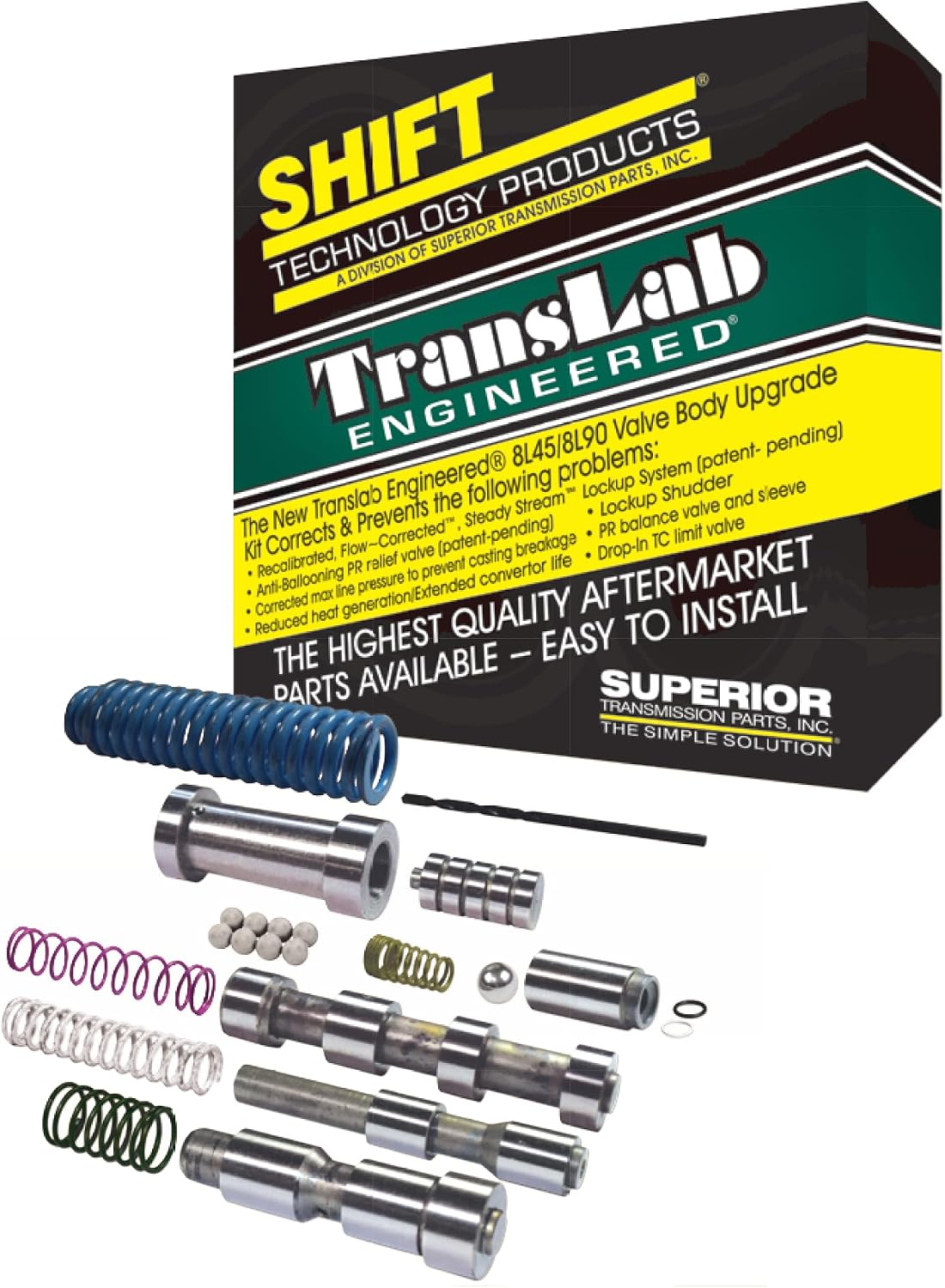
8L90 Transmission Valve Body Shudder Fix Kit STL-8L90
The honest pitch: if the three-mode test confirms TCC shudder and a proper triple fluid exchange still hasn't fully cleared it, this kit replaces the regulator valve and springs inside the valve body that cause converter shudder and the related 1-2 clunk on 8L45 and 8L90 units. It's a valve body service, not a teardown.
Shop the part for this fix →Need the converter feed limit valve or clutch control valve kits instead? The full 8L90 parts collection carries the Sonnax valve kits, solenoids, filters and fluid.
When fluid and calibration don't fix it: mechanical causes
If the three-mode test confirms TCC shudder and a correctly performed triple flush with the right fluid still doesn't clear it, the next suspects are inside the valve body, not the clutch pack:
- Converter feed limit (CFL) valve bore wear. This valve regulates line pressure to the converter circuit. Sonnax documents that bore wear here lets the valve lose its regulating function, producing low or incorrect TCC apply and release pressure, an overheated converter, inadequate lubrication, and a high TCC slip RPM. The typical codes are P0218 (transmission fluid overtemperature) and P0741 (TCC performance, stuck off). Sonnax's drop-in Converter Feed Limit Valve Kit (154740-19K) restores proper valve function without reaming; an oversized version (154740-22K) is available for bores already worn past the standard kit's tolerance.
- Clutch control valve bore wear. The S2/S3/S4/TCC clutch control valve kit addresses worn bores that let apply pressure leak internally, which is linked to burnt clutches and inconsistent TCC apply and release separate from the CFL valve's circuit.
- The converter itself, as a last resort. If the clutch friction material inside the torque converter has already glazed or burnished from running in the degraded condition over an extended period, no fluid or valve body fix will restore it. At that point the torque converter needs to come out and be replaced or rebuilt. This is the reason to run the fluid procedure early rather than letting a known shudder complaint ride for months.
Work the diagnosis in order: confirm with the three-mode test first, do the triple fluid exchange with the correct DEXRON HP formulation, give it the full 200-mile break-in before judging the result, then move to the CFL and clutch control valves if the complaint persists. Chasing a converter replacement before ruling out the cheaper fluid and valve body causes is the most expensive way to get the same result.
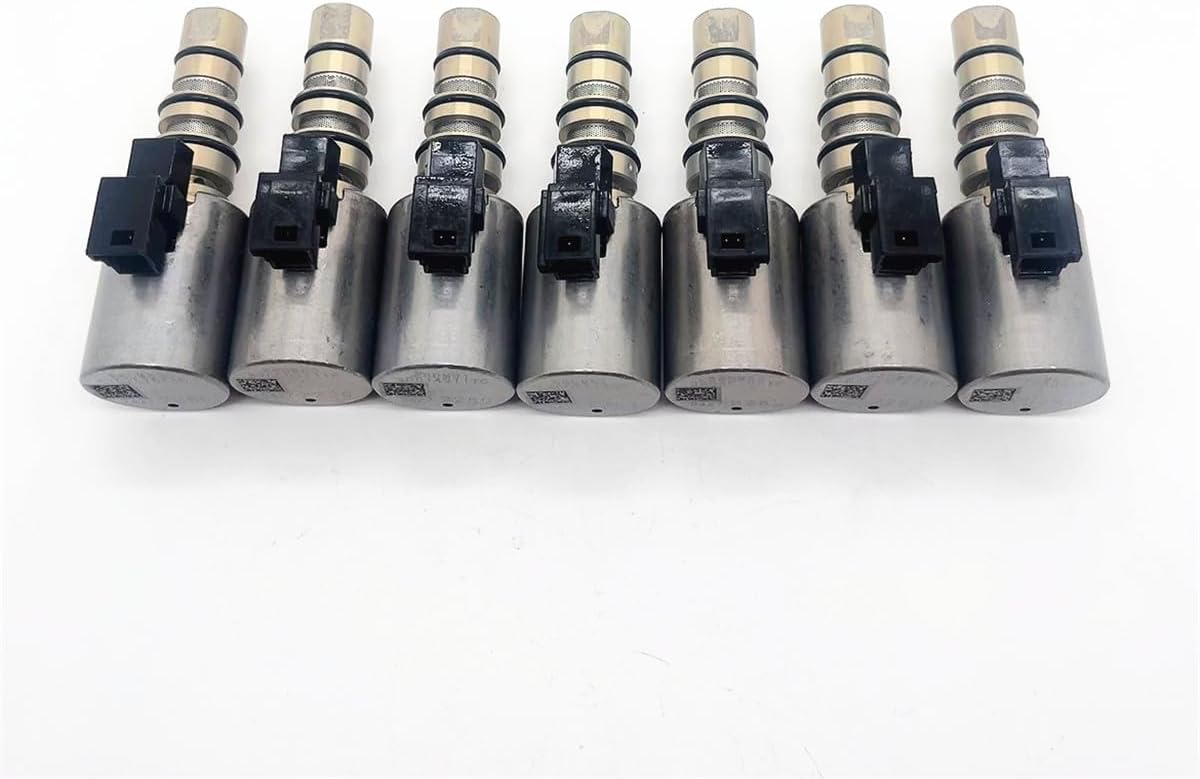
Solenoid kits, valve body shudder kits, and the fluid and filter to do a proper triple flush — shipped fast from the USA.
Shop 8L90 parts →FAQ
What does TCC shudder feel like on an 8L90?
A light vibration at a steady speed between roughly 25 and 80 mph, with the throttle held constant and the transmission not actively shifting. Drivers usually describe it as similar to driving over rumble strips or rough pavement. It shows up in both Drive and the manual shift mode, and it is most noticeable on light, steady throttle, not under hard acceleration.
How do I tell GM TCC shudder apart from other vibrations?
Run GM's three-mode test with a scan tool: Mode A is normal driving, Mode B commands the torque converter clutch open (disabled), and Mode C commands it locked (enabled). If the shudder shows up in Mode A but disappears in both Mode B and Mode C, it is confirmed TCC shudder and the fluid procedure is the corrective action. If the vibration is still present with the clutch forced open or forced locked, the cause is something else, tires, driveline, or engine mounts, and chasing the transmission will not fix it.
What fluid fixes 8L90 shudder and how much does it cost?
GM's corrective action is a triple drain-and-refill using the DEXRON HP fluid specified in Bulletin 16-NA-175, with later revisions calling for Mobil 1 Synthetic LV ATF DEXRON HP, GM part number 19353429. A fluid-change capacity is around 7.0 to 7.4 quarts on most 8L90 applications, but the triple-flush procedure needs roughly three times that volume since the pan is dropped and refilled three separate times. Expect to need up to 200 miles and at least two full hot-to-cold drive cycles before the shudder is fully gone.
Will a torque converter replacement be needed to fix 8L90 shudder?
Only if the clutch friction material inside the converter has already been glazed or burnished by running in the degraded condition for an extended period. The fluid and valve body fixes address the cause, but they can't restore friction material that has already cooked. If a proper fluid exchange and a converter feed limit valve check do not resolve the shudder, the torque converter itself is the next and final suspect.
Related guides
- 8L90 TCC Lockup Explained
- 8L90 Slipping Causes and Fix
- 8L90 Valve Body Symptoms
- 8L90 P0741 Fix
- 8L90 Fluid Type and Capacity
Shop 8L90 parts →
Sources
- General Motors — Service Update Bulletin 15389, "Torque Converter Clutch (TCC) Shudder" (May 2015), via NHTSA. Backs the affected population of 2015 Cadillac Escalade/Escalade ESV, Chevrolet Silverado and GMC Sierra, Yukon Denali and Yukon Denali XL with the 8L90 (RPO M5U) and 6.2L L86 engine; the root cause of transmission calibration allowing higher-than-target energy input to the TCC, wearing clutch material faster and producing shudder; the TCM-reprogram-only correction with no parts; and the approximately 54,037 U.S. vehicles involved. static.nhtsa.gov (PDF)
- General Motors — Service Bulletin 16-NA-175, "Shake and/or Shudder During Light Throttle Acceleration" (June 2016), via NHTSA. Backs the three-mode diagnostic test (Mode A normal, Mode B TCC disabled, Mode C TCC enabled), the 122°F–158°F sump temperature test window, the tow-haul-button grade-braking disable step, the original DEXRON HP fluid spec (GM part 19331925/19331926), and the three-step drain-refill-drive service procedure. static.nhtsa.gov (PDF)
- General Motors — Service Bulletin 16-NA-175, February 2017 revision, via NHTSA. Backs the expanded 2015–2017 application table across Cadillac, Chevrolet and GMC passenger cars and trucks with the 8L90 (M5U, M5X) and 8L45 (M5T, M5N); the exact per-vehicle test parameters (transmission input speed, vehicle speed, engine torque and measured PicoScope vibration frequency) for Corvette/Z06, Camaro and full-size trucks; and the updated fluid requirement of Mobil 1 Synthetic LV ATF DEXRON HP, GM part number 19353429/19353430. static.nhtsa.gov (PDF)
- General Motors / GM TechLink — "2026 Transmission Capacities & Fluids" (U.S. and Canada). Backs the DEXRON HP fluid specification and the 7.0 liter / 7.4 quart fluid-change capacity for 8L90 (code N8X) van applications, versus 11.8–12.0 liters / 12.5–12.7 quarts for the same transmission in a Low Cab Forward chassis. gm-techlink.com (PDF)
- Sonnax — Converter Feed Limit Valve Kit (154740-19K) product and application data. Backs the converter feed limit valve's regulating function, the bore-wear failure mode causing low or incorrect TCC apply/release pressure, an overheated converter, inadequate lubrication and high TCC slip RPM, the associated P0218 and P0741 codes, and the drop-in repair kit versus the oversized 154740-22K kit for bores worn past standard tolerance. sonnax.com
- General Motors — GM Powered Solutions, 8L90 8-Speed Automatic Transmission product page. Backs the 8L90's OEM identification and its use of DEXRON High Performance ATF as the specified fluid type. poweredsolutions.gm.com