P0730 on a scan tool means the TCM measured a gear ratio that doesn't match the one it commanded. That's it — it's a comparison failure, not a part number. On a ZF 9HP48 or its Chrysler-built twin, the 948TE, the generic P0730 almost never shows up by itself. Stellantis's own TCM software is more specific than the generic OBD-II standard requires, and it sets a per-gear code instead: P0733 for Gear 3, P0734 for Gear 4, P072F for stuck-in-Gear-4, P076F for a Gear 7 ratio fault. That specificity actually works in a technician's favor, because Stellantis has published real service bulletins tied to several of these exact codes — and the fix for some of them is a ten-minute software flash, while the fix for a very similar-looking symptom on the same platform is a full transmission teardown. Telling those two apart before pulling a transmission is the entire point of this guide.
The short version: A 948TE almost always sets a manufacturer-specific per-gear code instead of the generic P0730 — P0733 (Gear 3), P0734 (Gear 4), P072F (stuck in Gear 4) or P076F (Gear 7) are the documented ones. Two Stellantis TCM reflash bulletins, TSB 21-027-14 and TSB 21-043-15, fix those with software alone. But TSB 21-008-15 REV A documents a separate, confirmed mechanical C-Clutch snap ring defect on this same transmission that causes a weak 5-4 downshift and sets DTC U0402 — and that one requires pulling and disassembling the transmission. A VIN check for an open reflash campaign comes before any parts order or teardown.

What the TCM Is Actually Comparing
The 948TE's TCM divides input (turbine) speed by output speed to get a real-time measured ratio, then checks that number against the known ratio for whatever gear it just commanded. The nine forward ratios on this transmission run from a numerically low First down to an overdrive Ninth, so a wrong ratio reading in any one gear produces a mismatch the TCM can catch almost instantly. P0730 is the generic version of that fault — "a gear ratio is wrong, somewhere" — and any scan tool will show it if the vehicle's software doesn't have a more specific definition loaded.
The 948TE's own calibration does have more specific definitions, and that's the more useful data to work from. Stellantis assigns individual codes per gear: P0731 through P0739 cover gears 1 through 9 individually, and on top of those, this platform adds its own failure-mode codes like P072F (the transmission is stuck in Gear 4 and won't shift out) and P076F (Gear 7's measured ratio doesn't match commanded). When one of those shows up instead of a bare P0730, it's telling a technician exactly which gear element — which clutch, which planetary set — failed to deliver its commanded ratio, which narrows the diagnosis before a single bolt comes off.
Two Real TCM Reflash Bulletins Fix This in Software
Stellantis has published more than one bulletin where the entire fix for a 948TE gear-ratio code is a Transmission Control Module reflash — no parts, no teardown.
TSB 21-027-14: P0733 (Gear 3 Incorrect Ratio)
TSB 21-027-14, dated September 12, 2014, is titled "Flash: MIL Illumination For P0733, P0618, P1088" and applies to 2014–2015 (KL) Jeep Cherokees built for international markets with the 2.0L turbo diesel (sales code EBT) and either the 948TE 4WD transmission (DFJ) or the FWD/AWD version (DFH). The bulletin lists P0733 — Gear 3 Shift Incorrect Ratio as one of the calibration issues the new software corrects, along with P0618 (internal torque calculation performance) and a P1088 erroneous-DTC condition. The repair procedure is a straight TCM reprogram with wiTECH, 0.2 hours of labor under operation 18-19-05-G9. The bulletin is explicit that the flash clears the transmission's adaptive values, which means the separate Transmission Adaptation Learn procedure is required afterward — the bulletin points to Service Bulletin 21-013-13 for those steps.
TSB 21-043-15: P0734, P072F, and P076F
TSB 21-043-15, dated June 19, 2015, covers 2014 (KL) Jeep Cherokees with the 3.2L engine (sales code EHB) and the 948TE (DFJ or DFH). Its DTC list is more specific and directly useful for ratio diagnosis: P072F-00 — Stuck in Gear 4, P076F-00 — Gear 7 shift incorrect ratio, and P0734-00 — Gear 4 shift incorrect ratio, alongside P0810 (clutch position control error), P1CC9 (unable to engage gear) and P061B (internal torque calculation performance). Like the 2014 bulletin, the fix is a TCM reflash, but this procedure adds a verification step worth knowing: before flashing, the technician records the Clutch Fill and Fast Fill counter values in wiTECH. After the flash, those counters are checked again — if they reset to zero, the 9 Speed Adaptation Drive Learn procedure is required before the repair is considered complete. Skipping that step is a documented way to trade one shift-quality complaint for another.
When It Isn't Software: TSB 21-008-15 and the C-Clutch Snap Ring
Not every 948TE shift-quality complaint traces back to calibration. TSB 21-008-15 REV A, dated February 7, 2015, documents a confirmed mechanical defect on the same transmission platform: a C-Clutch snap ring that Stellantis found causes less than desired shift quality during a 5-4 downshift and can set DTC U0402 in the PCM. It applies to 2014–2015 (KL) Jeep Cherokee and 2015 (UF) Chrysler 200 vehicles with the 948TE (DFH or DFJ) — and critically, the bulletin restricts the repair to VINs listed in Stellantis's VIP system or on the RRT recall list; it explicitly instructs that any other vehicle with a matching symptom gets diagnosed through normal published service procedures instead, not this specific snap ring swap.
The repair itself is not a quick one. It requires pulling the transmission, removing the valve body (with a caution to protect the Transmission Range Sensor and speed sensor wiring harness in the process), removing the bellhousing, and disassembling down through the differential, transfer gear, Gear 4 planetary carrier, and Gear 3 annulus assembly to reach the C-Clutch and D-Clutch packs. The new C-Clutch snap ring (Mopar part 04736949AB) installs with its opening rotated 90 degrees counterclockwise from the original ring's position — a detail the bulletin calls out specifically, since getting that wrong on reassembly reintroduces the same problem. Reassembly torques are documented precisely: bellhousing-to-case bolts at 29 Nm (21 ft-lbs), valve body retaining bolts at 11 Nm (8 ft-lbs), and the TRS/speed sensor bolts at 6.5 Nm (5 ft-lbs), with a final input shaft end-play spec of 0.07–0.32 in. Labor time for the job runs 6.0 to 6.5 hours depending on engine and chassis code, before any 9-Spd 948TE Quick Learn procedure (listed separately in the bulletin at 0.4 hours) is added on top.
The reason this bulletin matters for a ratio-code diagnosis, even though U0402 isn't itself a P073x code, is what it proves: this platform has a documented history of both software-side and hardware-side root causes for shift-quality and ratio-adjacent complaints in the same model years. A reflash that doesn't resolve the symptom isn't a dead end — it's evidence the fault is more likely mechanical, and a worn or damaged C-Clutch snap ring is a confirmed, factory-documented reason why.
How to Diagnose a 948TE P0730-Family Complaint
- Read every code stored, not just the active one. A bare P0730 is less useful than P0733, P0734, P072F or P076F — the specific code tells you which gear and narrows which bulletin, if any, applies.
- Check the VIN against VIP/RRT before ordering parts or scheduling a teardown. TSB 21-027-14, TSB 21-043-15 and TSB 21-008-15 all gate their repair on VIN eligibility; TSB 21-008-15 is explicit that the snap ring procedure is not the correct repair for a vehicle outside its VIN list even with a matching symptom.
- Check fluid level and condition before anything else. ZF specifies LifeguardFluid 9 as the only approved fluid for the 9HP48 family, and the 948TE's fill check is a temperature-indexed dipstick reading at the differential fill plug, not a fixed quart number — low or degraded fluid changes clutch fill timing enough to throw a ratio reading off on its own.
- If a reflash is available for the stored code, perform it first. It's the lowest-cost, least invasive step, and two separate bulletins show it's a legitimate full fix for P0733, P0734, P072F and P076F on applicable VINs.
- After any reflash, confirm whether the Adaptation Drive Learn is required. TSB 21-043-15's Clutch Fill/Fast Fill counter check is the documented way to know — don't skip it on the assumption the flash alone is sufficient.
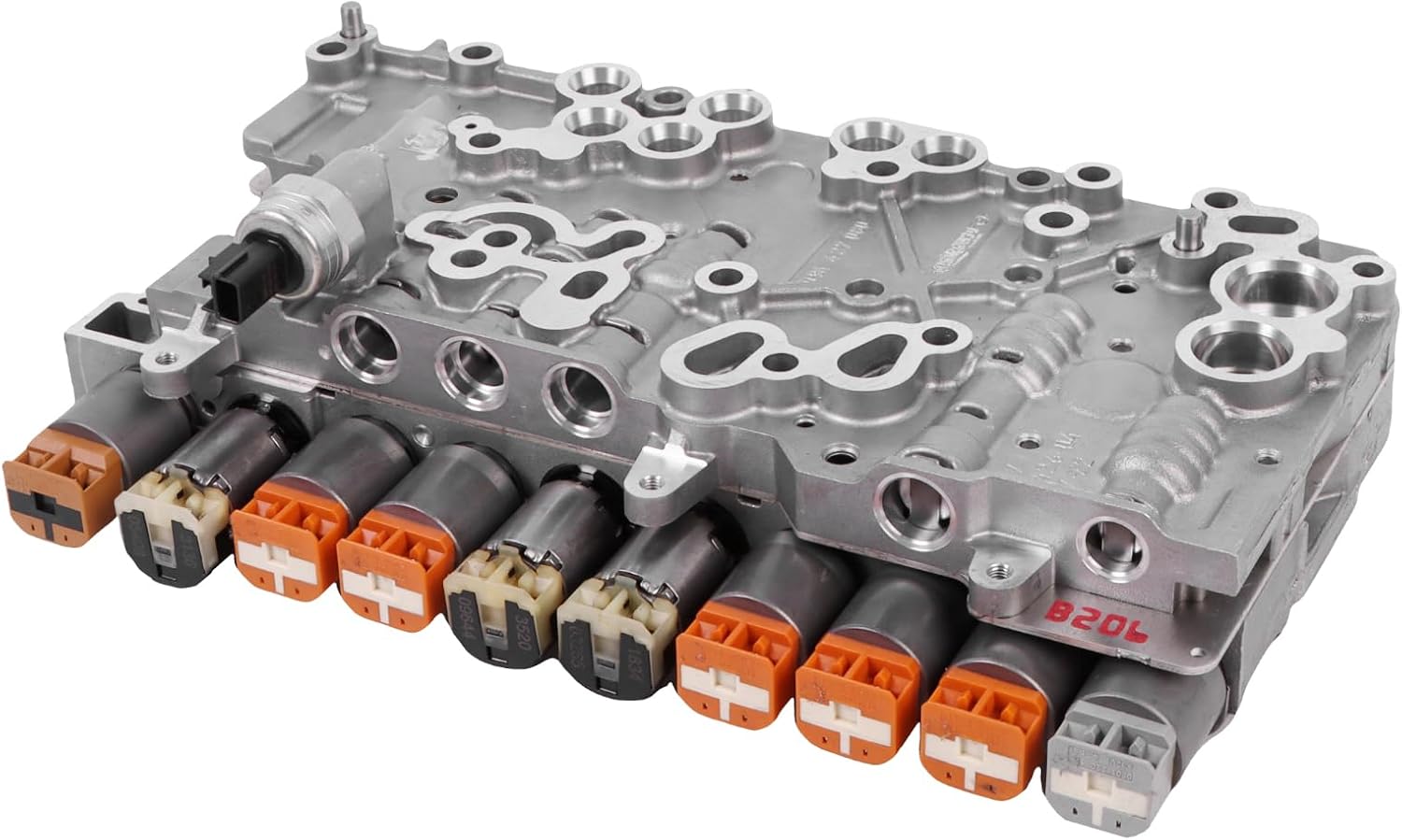
- If the reflash doesn't clear the code or the VIN isn't covered, treat the complaint as mechanical. A worn C-Clutch snap ring, valve body wear, or solenoid degradation inside the valve body are the next real candidates, not another round of software.
948TE Valve Bodies, Harness Assemblies, and Filter Kits
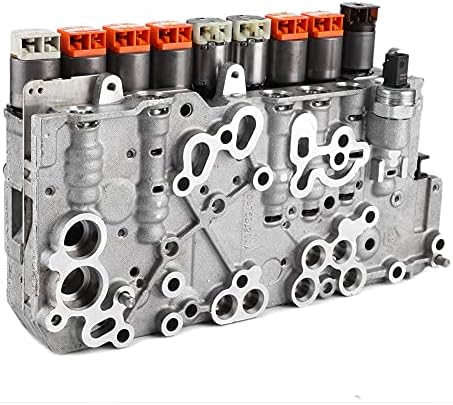
When a ratio code isn't fixed by a reflash, the valve body and its solenoids are the next real candidate. We stock a 948TE valve body with its wire harness, a fully remanufactured 9HP48 valve body with all 10 solenoids installed, and the correct filter and pan gasket kit for the fluid service every internal repair should include — shipped fast from the USA.
Shop 9HP48 parts →FAQ
What does P0730 mean on a 9HP48/948TE?
P0730 is the generic OBD-II code for Incorrect Gear Ratio. The TCM calculates the actual ratio from input (turbine) speed divided by output speed and compares it against the expected ratio for whatever gear it commanded. On the 948TE, the TCM rarely sets the generic P0730 itself; it almost always sets a manufacturer-specific per-gear code instead, such as P0733 (Gear 3), P0734 (Gear 4), P072F (stuck in Gear 4) or P076F (Gear 7 incorrect ratio), which is more specific and tells a technician which gear actually failed to make its commanded ratio.
Is a 948TE gear ratio code fixed with a software update or a repair?
It depends on the code and the build date, and Stellantis has issued bulletins for both. TSB 21-027-14 (P0733) and TSB 21-043-15 (P0734, P072F, P076F) are both pure TCM reflashes with no hardware involved. But TSB 21-008-15 REV A documents a separate, mechanical root cause on the same 948TE platform: a C-Clutch snap ring defect that sets DTC U0402 and causes weak 5-4 downshift quality, and its fix is a full transmission removal and teardown to replace the snap ring, not a flash. Checking for an open reflash campaign on the VIN before assuming a rebuild is needed is the correct first step.
Why does a 948TE gear ratio TSB also require a Quick Learn or Adaptation Drive Learn?
Any TCM reflash on this transmission clears the stored clutch adaptive values, which is the data the TCM uses to fine-tune clutch fill times for smooth shifts. TSB 21-043-15 has technicians record the Clutch Fill and Fast Fill counters with wiTECH before the flash, then check after the flash whether the counters reset to zero; if they did, the 9 Speed Adaptation Drive Learn procedure is required before the repair is complete. Skipping that step after any flash or mechanical repair is a documented cause of comeback shift-quality complaints on this platform.
Can low or worn fluid cause a false P0730 on a 9HP48?
Yes, and it is the fastest thing to rule out before chasing a TCM flash or a teardown. The TCM's ratio calculation depends on clean clutch apply and release, and low or degraded ZF LifeguardFluid 9 changes clutch fill timing enough to throw off the measured ratio during the fill transition. ZF's own fluid data sheet specifies LifeguardFluid 9 as the only approved fluid for the 9HP48 family, and Gears Magazine's documented 948TE fluid-level procedure uses a temperature-indexed dipstick check at the differential fill plug rather than a fixed quart number, since level varies with fluid temperature.
Sources
- Chrysler Group LLC — Technical Service Bulletin 21-027-14, “Flash: MIL Illumination For P0733, P0618, P1088” (September 12, 2014): the 2014-2015 (KL) Jeep Cherokee, international markets, 2.0L turbo diesel (EBT), 948TE 4WD (DFJ)/FWD-AWD (DFH) application; the DTC list including P0733 Gear 3 Shift Incorrect Ratio; and the TCM reflash repair procedure, labor operation 18-19-05-G9, and the required Transmission Adaptation Learn procedure. static.nhtsa.gov (NHTSA TSB archive, PDF)
- Chrysler Group LLC / FCA US LLC — Technical Service Bulletin 21-043-15, “Flash: Transmission Shift and Diagnostic Enhancements” (June 19, 2015): the 2014 (KL) Jeep Cherokee, 3.2L (EHB), 948TE (DFJ/DFH) application; the DTC list including P072F (Stuck in Gear 4), P076F (Gear 7 shift incorrect ratio) and P0734 (Gear 4 shift incorrect ratio); the Clutch Fill/Fast Fill counter verification step; and the TCM reflash procedure with the 9 Speed Adaptation Drive Learn requirement. static.nhtsa.gov (NHTSA TSB archive, PDF)
- FCA US LLC — Technical Service Bulletin 21-008-15 REV. A, “Transmission Shift Quality C-Clutch Snap Ring” (February 7, 2015): the 2014-2015 (KL) Jeep Cherokee and 2015 (UF) Chrysler 200, 948TE (DFH/DFJ) application restricted to VIP/RRT-listed VINs; the symptom of weak 5-4 downshift quality and DTC U0402; the full transmission removal/disassembly procedure to replace the C-Clutch snap ring (part 04736949AB); and the documented torque specs, special tools and 6.0-6.5 hour labor times. static.nhtsa.gov (NHTSA TSB archive, PDF)
- ZF Friedrichshafen AG — Product Data Sheet, ZF LifeguardFluid 9 (for 8HP and 9HP automatic transmissions): confirms ZF LifeguardFluid 9 as the only approved fluid for the 9HP48 family, referenced here as the baseline fluid check before chasing a ratio code in software or hardware. aftermarket.zf.com (PDF)
- Gears Magazine (ATRA) — “948TE: Checking Fluid Levels” (April 2017): the documented 948TE fill-check procedure at the differential fill plug, the temperature-indexed level chart, and the Mopar ZF 8 & 9 Speed ATF part number (68157995AB) used for the fluid check referenced in the diagnostic order above. gearsmagazine.com
- Gears Magazine (ATRA), Sean Boyle — “ZF 9HP48 — A Mechanical Marvel!” (December 2019): background on the 948TE's four multiple-disc clutch assemblies (B, C, D, E) and two dog clutches (A, F), confirming the C-Clutch and D-Clutch identities referenced in the TSB 21-008-15 teardown procedure above. gearsmagazine.com