Most 9HP48 converter complaints that land on the bench are not really converter complaints. A Cherokee that "feels like it is driving over rumble strips" at 40 mph, a Pilot that flares a few hundred rpm on the highway, a Renegade with a stored converter clutch code and a perfectly good converter: all three come back to the same small system. A single friction disc inside the converter, a lockup clutch valve in the valve body, one solenoid that drives it, and the fluid that ties them together.
This guide explains how lockup actually works on the ZF 9HP48 (Chrysler builds its own version as the 948TE, and Honda/Acura use the ZF-built unit in V6 models such as the Pilot, MDX and TLX), how to read it on a scan tool, how to test the TCC solenoid at the case connector, and how to decide between a fluid service, a valve body, and a converter.
The short version: The 9HP48 converter uses a single-disc friction clutch splined to the damper spring assembly. Apply is controlled by the TCC solenoid feeding the Lockup Clutch Valve (LC-V), with a separate Converter Switch Valve in the upper valve body. The TCC solenoid reads 5–6 ohms between case connector terminals 1 and 10. Healthy lockup slip on most units sits under about 60 rpm; compare commanded slip to actual slip on the scan tool before you condemn anything. Check fluid only at 37–45°C (99–113°F), and run the adaptation drive learn after any valve body or TCM work.

What Is Inside the 9HP48 Converter
ATRA's 948TE introduction describes the converter as conventional: impeller (pump), stator and turbine, plus a single disc friction clutch splined to the dampening spring assembly (ATRA, 948TE Introduction). When the clutch applies, engine torque goes through the cover, the friction ring, the damper springs and into the turbine hub, bypassing the fluid coupling. The damper springs exist because a nine-speed spends a lot of time locked at low engine speeds, where firing pulses would otherwise go straight into the driveline.
Sonnax's ZF9HP48/948TE converter parts listing shows what wears. The lockup friction ring is listed as B45285HTE (0.045 in. thick, 8.870 in. ID, 10.236 in. OD) and an alternate B45120HTS (0.045 in., 8.125 in. ID, 9.250 in. OD). The piston seals with fluorocarbon O-rings, and the turbine side runs on an enclosed thrust bearing (ZF-N-2). Two of the bearings on that page, ZF-N-7 (impeller side) and ZF-N-6 (cover side), along with O-ring GM-O-11V, are flagged as fitting only the Honda/Acura and Land Rover ZF9HP48 units, not the Chrysler-built 948TE. That is the first sign the two families are close cousins, not twins. ATRA says the same thing about the whole transmission: the units look nearly identical, but parts are not necessarily interchangeable.
That single, thin friction ring matters for diagnosis. There is not a lot of material to glaze, and once it develops hard spots or uneven surfaces it does not recover with a fluid change. Gears Magazine lists uneven converter clutch surfaces as one of the three root causes of converter shudder, alongside degraded fluid and poor module command (Gears, "Shudder Diagnosis").
How the Valve Body Controls Lockup
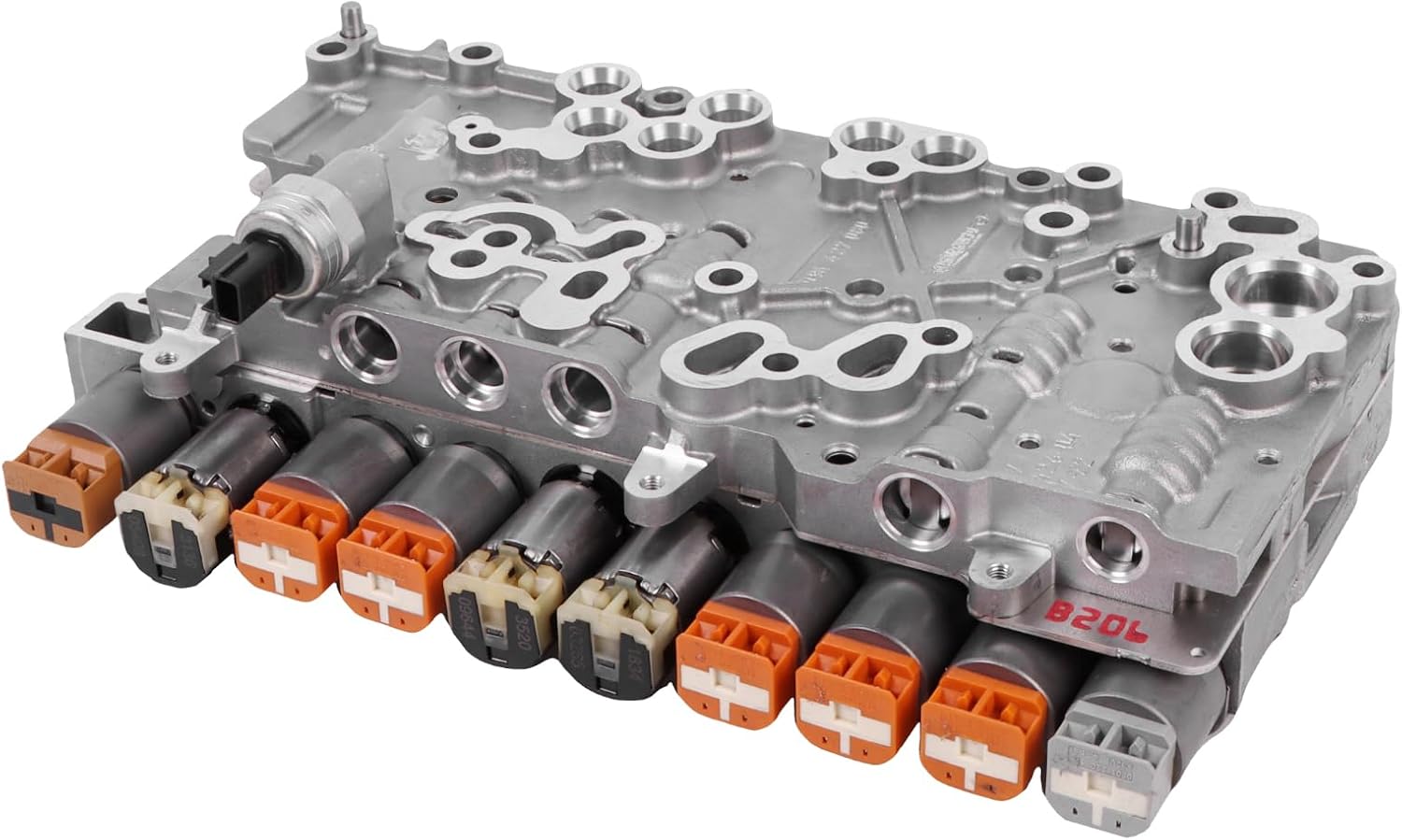
The 948TE valve body comes in two versions. Park By Wire (PBW) units have 10 solenoids; Park By Cable (PBC) units have 9. All Honda applications use the ZF9HP48 PBW design, and the two valve bodies are not interchangeable (Sonnax, 948TE-ZF9-HONDA-ZIP guide). Both versions carry one TCC solenoid.
Sonnax's exploded views name the two valves that matter for lockup:
- Lockup Clutch Valve (LC-V). Regulates the pressure that applies the converter clutch, based on the TCC solenoid's output. Its bore location differs between the PBC and PBW valve bodies, so do not use a PBC layout to find it on a PBW body.
- Converter Switch Valve. Sits in the upper valve body next to the lubrication and system pressure valves and manages how converter feed is routed. A worn or sticking switch valve can produce the same complaints as a bad solenoid.
Everything downstream depends on regulated feed. The same Sonnax guide covers the Solenoid Pressure Regulator Valve (PR-V) and the Shift Valve System Pressure (SV-SP) valve, and their kit calls for drilling and plugging the solenoid pressure regulator balance port. If solenoid feed pressure wanders because of a worn PR-V bore, every pressure-controlled solenoid on the body, the TCC solenoid included, is working from a moving reference. That is why a TCC complaint on a high-mileage unit is often a valve body complaint.
Solenoid caps and why they get swapped
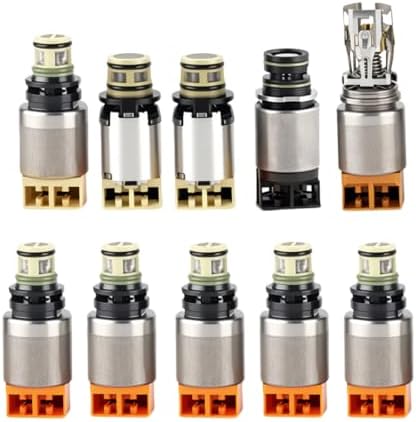
On both valve bodies the system pressure solenoid is normally high and has a white cap; the clutch control solenoids are normally low and have orange caps. Sonnax warns that the white and orange solenoids share the same snouts and can be installed in the wrong bores. The A and F dog clutch solenoids, the PBW park solenoids and the PBC limp-home solenoid are on-off types. If a valve body has been apart before you got it, confirm every solenoid sits where the layout says it should before chasing a lockup fault.
Electrical Check: TCC Solenoid Resistance
With the harness unplugged at the case, Sonnax gives these resistance values (terminal pairs at the valve body connector):
| Solenoid | Terminals | Resistance |
|---|---|---|
| TCC solenoid | 1 & 10 | 5–6 ohms |
| Pressure control solenoid | 1 & 9 | 5–6 ohms |
| B, C, D, E clutch solenoids | 4 & 3 / 4 & 5 / 4 & 6 / 4 & 7 | 5–6 ohms |
| A dog / F dog solenoids | 1 & 2 / 1 & 8 | 10–12 ohms |
| Limp home (PBC) / hydraulic park (PBW) | 1 & 11 | 10–12 ohms |
| Mechanical park (PBW) | 1 & 12 | 24–26 ohms |
Measure at operating temperature if you can; a winding that reads fine cold and opens hot is a classic intermittent. An in-spec reading only proves the coil is intact. It does not prove the solenoid regulates correctly, and it says nothing about the LC-V bore. Use it to rule out the easy stuff, then move to the scan tool.
Reading Lockup on the Scan Tool
Converter slip is engine speed minus turbine (input shaft) speed. The 948TE has input and output speed sensors on the valve body harness, so the TCM always knows actual slip. The test Gears Magazine lays out works on this unit:
- Road test and reproduce the complaint. Note vehicle speed, gear, engine rpm and throttle when it happens.
- Record a data stream at that speed. Watch TCC commanded slip against TCC actual slip.
- Confirm the data is stable by also logging TCC solenoid current, vehicle speed, throttle percentage and engine load. Ignore sections where throttle or load jumped.
- Compare actual slip to the manufacturer's value. Gears notes most lockup clutches run under 60 rpm of slip when applied; parameter names vary between wiTECH, Honda HDS and aftermarket tools.
How to read what you see:
- Commanded slip is low, actual slip is high or hunting, and solenoid current follows the command: the electrical side is doing its job. The problem is hydraulic (LC-V, switch valve, regulator feed, leaking converter seals) or the friction ring itself.
- Actual slip follows the command but the vehicle shudders in a narrow band: Gears ties shudder at roughly 35–45 mph in 3rd or 4th to lockup engagement, and notes late-model controls can apply lockup as early as 10–15 mph in 2nd. Remember the 9HP48 normally launches in 2nd gear (ATRA), so early, low-speed lockup is normal behavior, not a fault.
- Solenoid current does not follow the command: back to the wiring, the connector, the TCM output, or the solenoid itself.
Rule out what only feels like a converter
Before pulling a transmission, check Mode 6 misfire counters. Gears points out that misfires can feel exactly like shudder, get worse under load at low rpm, and do not always set a check engine light because the MIL waits for a set count per drive cycle. If the counters climb every time you feel the shake, it is the engine. Check engine and transmission mounts too.
On this unit there is one more impostor. The A and F clutches are dog clutches with no friction discs, so the TCM asks the engine controller for an rpm change and slips the multi-plate clutches to speed-match the dogs before they engage (ATRA). That speed-matching can feel like a flare or a bump during shifts. It is shift control, not converter clutch slip, and the slip data will show the difference.
Fluid Comes First
Lockup quality depends on friction characteristics that only the correct fluid provides. Gears flatly rejects "lifetime fluid," and points out that fluid loses its friction modifiers over time and no fluid is compatible with every application. On the 948TE that means Mopar ZF 8 & 9 Speed ATF (Gears lists part 68157995AB) or ZF's own LifeguardFluid 9, which ZF's product data sheet describes as developed for its 9-speed automatic transmissions.
Level matters as much as type. Sonnax gives the check window as 37–45°C (99–113°F) and a dry fill of 6.5 L. Gears' 948TE level article gives the dipstick-tool range as 16–23 mm at 140°F and warns against adding leak dye. A unit that is a quart low will aerate under load, and aerated fluid makes lockup slip look like a converter problem.
Adaptation: The Step Shops Skip
The TCM learns clutch fill and apply values over time. ATRA's training material is specific about which learn to run:
- Run the adaptation (drive) learn any time the valve body has been replaced or the transmission overhauled, after clearing adaptation memory with wiTECH or an equivalent tool.
- Quick Learn (later renamed Valve Body Solenoid Learn) matches the TCM to the solenoids on the valve body. Run it only when the valve body or TCM has been replaced. It erases factory settings and all adaptation memory cells.
- Do not run Quick Learn when the complete transmission assembly has been replaced, and do not run it when the adaptation learn is all that is needed.
Sonnax's procedure ends a valve body job the same way: shift Park-Reverse-Drive four or five times with the brakes applied, disable stop-start, drive to at least 45 mph and back to a stop four or five times, then run the learn and follow FCA bulletin 21-013-16 Rev B. A good valve body with stale adaptation values can still produce a lockup complaint.
Converter, Valve Body, or Fluid: Making the Call
| What you see | Most likely fix |
|---|---|
| Shudder only at lockup, slip data normal, fluid old or unknown | Correct-spec fluid service and level set at temperature, then re-test |
| Actual slip high or hunting, solenoid current tracks command, low mileage fluid | Valve body: LC-V, switch valve, regulator feed. Vacuum test or replace |
| Solenoid out of resistance spec or current does not follow command | TCC solenoid or wiring; check the connector first |
| Shudder returns after fluid and valve body are verified, or debris in the pan | Converter (friction ring, damper, piston seals); transmission comes out |
When the converter is the answer, flush the cooler circuit. Friction material from a failed lockup ring will otherwise ride straight back into the new unit.
Valve Body or Solenoids for a Lockup Complaint
If slip data points at the valve body, our remanufactured 9HP48 valve body comes with all 10 solenoids installed, TCC solenoid included. Confirm PBW vs PBC (10 vs 9 solenoids) before you order.
See the 9HP48 valve body →FAQ
Does the 9HP48 torque converter lock up in every gear?
The TCM decides lockup from vehicle speed, gear, throttle and temperature, and late-model calibrations apply it early. Gears Magazine notes lockup can begin as low as 10 to 15 mph in 2nd gear on modern controls, and the 9HP48 normally launches in 2nd. Watch TCC commanded slip on the scan tool to see what the TCM is asking for at any moment.
How do I test the TCC solenoid on a 948TE?
Unplug the transmission harness at the case and measure across terminals 1 and 10. Sonnax lists the TCC solenoid at 5 to 6 ohms. A good reading only proves the coil is intact, so follow up with a road test comparing TCC commanded slip to actual slip and checking that solenoid current follows the command.
How much converter slip is normal when the 9HP48 is locked?
Gears Magazine says most lockup clutches run under about 60 rpm of slip when applied, but you should check the manufacturer's value for the vehicle. Slip is engine speed minus input shaft speed. Slip that is high or hunting while the command is steady points at the hydraulics or the converter clutch itself.
Is 9HP48 lockup shudder always a bad torque converter?
No. Old or incorrect fluid, a low fluid level, worn valve body bores such as the Lockup Clutch Valve or solenoid pressure regulator, stale adaptation values, and engine misfires can all feel like converter shudder. Service the fluid with the correct ZF 8 and 9 speed ATF, verify slip data and misfire counts, and only then pull the transmission for a converter.
Sources
- ATRA (Automatic Transmission Rebuilders Association), “948TE / ZF9HP48 Introduction” technical webinar: conventional converter with a single-disc friction clutch splined to the damper spring assembly; six clutches A–F including two dog clutches; dog clutch speed matching; normal 2nd-gear launch; adaptation learn vs Quick Learn rules; ZF and Chrysler parts not necessarily interchangeable. atracom.blob.core.windows.net (PDF)
- Sonnax, Zip Kit 948TE-ZF9-HONDA-ZIP product page and instruction booklet (2022): PBW 10 vs PBC 9 solenoid identification; Lockup Clutch Valve (LC-V) and Converter Switch Valve locations; solenoid cap colors; TCC solenoid 5–6 ohms at terminals 1 and 10 and the full resistance table; fluid check at 37–45°C, 6.5 L dry fill, post-repair drive cycle and bulletin 21-013-16 Rev B. sonnax.com
- Sonnax, ZF9HP48 / 948TE unit parts listing: torque converter friction rings B45285HTE and B45120HTS with dimensions, thrust bearings ZF-N-2, ZF-N-6 and ZF-N-7, and the Honda/Acura and Land Rover-only fitment notes. sonnax.com
- Gears Magazine (ATRA), Aaron Golas, “Shudder Diagnosis” (April 2023): TCC commanded vs actual slip test, typical slip under 60 rpm, 35–45 mph shudder band, early lockup at 10–15 mph in 2nd, fluid and misfire (Mode 6) causes. gearsmagazine.com
- Gears Magazine (ATRA), Jarad Warren, “948TE: Checking Fluid Levels” (April 2017): Mopar ZF 8 & 9 Speed ATF 68157995AB, no leak dye, and the 16–23 mm dipstick-tool range at 140°F. gearsmagazine.com
- ZF Friedrichshafen AG, LifeguardFluid 9 product data sheet: fluid developed for ZF 9-speed automatic transmissions. aftermarket.zf.com (PDF)