"It's making a noise" gets you nowhere on an E4OD, because there are at least four genuinely different sources hiding under that complaint: pump noise, planetary or bearing whine, a rear case bushing going away, and a center support knocking on shifts. Chase the wrong one and you'll pull a good pump, or worse, pull the whole transmission to fix a bushing that a bench job would have solved in an afternoon. Before any of that, there's a short sequence of no-teardown checks that will point you at the right system.
This covers the Ford E4OD as built from 1989 through 1997 in the F-Super Duty, Bronco, and E-Series vans. The pump wear data, casting history, bushing failure mode and center support wear mechanism come from Sonnax and Transmission Digest; full list under Sources.
Four noises, four systems
Before you touch a wrench, get the complaint pinned to one of these:
- Whine or growl tied to engine rpm, present in Park and Neutral with the truck sitting still. This is the pump (or, less often, the torque converter). It will not change if you let off the brake and coast at the same engine speed.
- Whine or growl tied to road speed, present in some gears and gone in others. This points at a planetary gearset or a rotating bearing, because those elements only do work, and generate noise, in certain gear ranges.
- Growl or rumble tied to road speed that does not care what gear you're in. This points at the output shaft, the rear case bushing, or a bearing that's loaded all the time, like the one under the output shaft.
- A clunk or knock specifically on a shift, especially the 2-3 shift. This points at the center support, where it seats against the case.
Check the fluid before you chase a noise. A low level lets the pump pull air, and aerated fluid makes the same rpm-tied whine as worn pump gears. Ford's 1997 F-250/350 owner guide says to check the E4OD at 150-170°F (66-77°C) after about 20 miles of driving, with the fluid in the crosshatched area of the dipstick. It also says the fluid type is stamped on the dipstick, and to add fluid in 1/2 pint increments so you don't overfill it (Ford 1997 F-250/350 owner guide, Source 5).
That same guide sets no 30,000-mile fluid change for the E4OD under normal use. It does call for a fluid, filter and seal change every 21,000 miles under severe conditions: extended high-speed driving at or above 90°F, towing over 1,000 miles per trip, 5,000 or more miles a month, extensive idling, or severe dust (Source 5). A work truck that has never had that service is the one most likely to come in whining, and dark, burnt fluid on the stick tells you the friction material and bushings have been running hot.
Run the engine in Park or Neutral first and note whether the noise is there with the truck not moving. Then road test and note which gears it's in, whether it changes with load, and whether it's present on deceleration as well as acceleration. That's enough to put you on the right page below before anything comes apart.
Step 1: Pump noise, tied to engine rpm
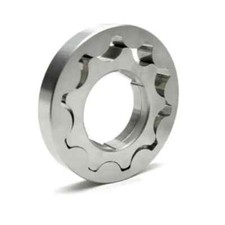
Sonnax's listing for its E4OD/4R100 pump gear set is direct about this: the OE pump gears wear, which drops pressure and volume, and it names excess pump noise as a symptom right alongside low line pressure, codes 62/628/1744, and repeat converter failure from a starved torque converter charge. A worn pump doesn't always throw a code first. Sometimes the noise is the first warning you get.
The pump has a documented history on this unit, and it matters for parts matching. Sonnax identifies the pre-1995 castings as E9 or F1, with 11 lobes on the outer gear, and says they ran low output. Ford superseded them with the F5 casting in 1995 (10 lobes), and with F8 in 1998 when the E4OD became the 4R100. Transmission Digest's Mike Riley independently confirms the timing from the OE side: "A noticeable change occurred in 1995, when the output volume was increased," and the 1998 facelift brought a common F81P-marked casting across the E4OD and both 4R100 pump variants, under Ford part number F81Z-7A103BA for the E4OD assembly.
| Casting | Years | Notes |
|---|---|---|
| E9 / F1 | 1989-1994 | 11 outer-gear lobes. Sonnax lists these as low-output castings. |
| F5 | 1995-1997 | 10 outer-gear lobes. TD ties this change to a 1995 output-volume increase. |
| F8 | 1998-up (4R100) | Common F81P casting shared across E4OD-retro and both 4R100 lockup variants. |
Practically: if a 1995-or-later E4OD is whining with engine rpm, check the pump gears against Sonnax's drop-in replacement set (36438A-03, no machining required on F5/F8 housings) before you assume the whole pump assembly or the converter is bad. If the housing itself is worn beyond the gear set's spec, Sonnax's oversized set (36438AX-01K) is built to let the pump cavity be machined and refurbished rather than replaced outright.
Step 2: Planetary or bearing whine, tied to road speed and gear
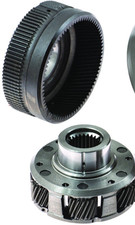
Third gear on the E4OD is direct, a straight-through 1:1 ratio where the planetary gearsets stop multiplying torque and the rotating members lock together. A whine or growl generated by a worn planetary pinion or a bad bearing on a rotating member typically goes quiet in 3rd and comes back in 1st, 2nd or overdrive, because those ratios put the gearsets back to work. If your road test shows a noise that disappears specifically in 3rd and reappears in every other gear, you're looking at the gear train, not the pump, the output shaft, or anything downstream of it.
A noise that stays exactly the same in every gear, including 3rd, is not the planetary. At that point go back to Step 1 (pump, rpm-tied) or forward to Step 3 (output shaft, road-speed-tied regardless of gear).
Step 3: Rear case bushing, growl tied to road speed in every gear
The E4OD and 4R100 share a documented weak point here. Sonnax's own listing states plainly that the OE rear case bushings "tend to wear out prematurely," and attributes it to inadequate lubrication, excessive journal clearance, or too much load for the bearing area. These bushings support the output shaft, so when they go, you get a growl or rumble that tracks road speed in every gear and range, not just certain ones, because the output shaft is always turning with the wheels.
The factory design is two separate bushings pressed into the case. Sonnax's fix is a one-piece replacement that it describes as an improvement specifically because of "increased bearing surface area and superior lubrication characteristics" compared to the OE two-piece setup. Fitment splits by year: 36008B covers 1989-1994 units (early style, three grooves to the front, none to the back) and 36008D covers 1995-and-later E4OD and 4R100 units (late style, three grooves front, one to the back). An oversized version, 36008C, is sold for cases where the OE bore has already been damaged by a spun bushing. Sonnax is specific that its installation tool (T36008A) should be used so the long, thin-walled bushing doesn't deform going in, since the tool's shoulder sets the correct seating depth.
This is a bench-level fix once the transmission is apart for other reasons, but it's not a noise you can chase from the outside. If Step 1 and Step 2 rule out the pump and the gearsets, and the growl is constant across every gear at a given road speed, budget for this bushing while the unit is open rather than sending it back together and hoping.
Step 4: The center support clunk, on the shift itself
A clunk or knock that happens specifically during a shift, most often the 2-3 shift, is a different animal from the whines above because it's not continuous noise, it's an impact. Sonnax documents the mechanism directly: the center support moves slightly every time the intermediate clutch applies and releases, and that repeated movement wears the contact points between the center support and the case lugs. The same movement can wear the input drum where it rides against the support. Over enough cycles, the support rocks far enough in the case to produce a felt or audible knock exactly when that clutch comes on or off.
Sonnax's fix is a steel center support ring that installs between the case lugs and the support, adding contact area and controlling that movement going forward. Because the ring's own thickness (0.048-0.051 in.) gets machined off the rear of the center support during installation, a support that's already worn can be salvaged and reused instead of sourced new. If you're seeing shift-specific clunk on a high-mileage unit, inspect the center support contact points and the input drum bore before you write the support off or replace it blind.
Putting it together
- Rev the engine in Park/Neutral. Noise present and rpm-tied with the truck still: pump. Go to Sonnax's pump gear set and match it to your casting (E9/F1, F5, or F8).
- Noise absent at idle in Park, present on the road and gone specifically in 3rd: planetary gearset or a rotating bearing in the gear train.
- Noise present on the road in every gear, constant with road speed: rear case bushing. Check which bushing your build year needs (36008B pre-95, 36008D 95-up) before ordering.
- Noise is actually an impact on a specific shift, not a continuous tone: center support wear at the case lug contact points, or input drum wear at the support.
- Before any of the above gets blamed: pull the dipstick and confirm fluid level and condition hot, per Ford's procedure above (Source 5), and rule out the accessory belt, water pump, power steering pump and driveline U-joints with the engine running and the truck in neutral.
Shop the part for this fix: 4R100/E4OD remanufactured pump assembly, F8 casting
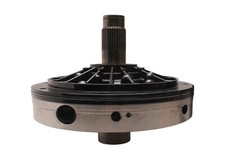
If your rpm-tied whine traces back to a worn pump on a 1998-up F8-casting unit, a remanufactured drop-in assembly solves it without chasing individual gear sets and seals. Fits the shared E4OD/4R100 pump architecture used from the F8 casting forward.
See the pump assembly at CoreTransmissionPartsNeed parts for this job?
Our E4OD parts page has pumps, planetary assemblies, valve bodies and master rebuild kits by year, with checkout on site. Match the pump casting and bushing style to your build year before you order; the 1989-1994 and 1995-up parts are not interchangeable in every case.
FAQ
How do I tell an E4OD pump whine from a planetary or bearing noise?
Put the truck in Park or Neutral and rev the engine. A pump or converter noise rises and falls with engine rpm whether the truck is moving or not, because the pump turns off the input shaft. A planetary gear or output bearing noise instead tracks road speed and gear selection, and will not change pitch if you rev the engine with the truck sitting still in Park.
Why does my E4OD whine go away in 3rd gear?
Third is the E4OD's direct gear, so the planetary gearsets are not multiplying torque and the rotating members turn as a unit. A whine caused by a worn planetary gear or a bad bearing on a rotating member commonly quiets down in 3rd and comes back in 1st, 2nd or overdrive, because those gears put the planetary sets back to work. If the noise is identical in every gear including 3rd, it is not coming from the gearsets.
What causes pump noise on an E4OD?
Sonnax's pump gear set listing says the OE pump gears in E4OD and 4R100 units wear, dropping pressure and volume, with symptoms including excess pump noise, low line pressure, codes 62/628/1744 and repeat converter failure. Sonnax also notes the pump casting changed over the years: E9 or F1 before 1995, F5 starting in 1995, and F8 from 1998, which Transmission Digest ties to a 1995 output-volume increase.
What causes a clunk on an E4OD shift?
Sonnax documents wear at the center support where it contacts the case lugs, caused by the support moving slightly every time the intermediate clutch applies and releases. That same movement can wear the input drum where it rides on the support. A worn rear case bushing letting the output shaft move in its bore is the other documented wear point, and Sonnax notes the factory two-piece bushing design is prone to failing from inadequate lubrication or excess journal clearance.
Should I check anything before pulling the pan on a noisy E4OD?
Yes. Check the fluid level hot and look at its condition and smell. Low or burnt fluid can produce a whine or rattle on its own and will mask or mimic a hard-part problem. Also rule out the accessory drive belt, water pump, power steering pump and driveline U-joints before you commit to a transmission-only diagnosis, since all of those can produce a similar noise under the truck.
Related guides
- E4OD Torque Converter Shudder
- E4OD Rebuild Guide: Known Wear Points and Upgrades
- E4OD Identification Guide
- E4OD Fluid Type and Capacity
- 4R100 Noise Diagnosis: Whine and Clunk Explained
Sources
- Sonnax, "Pump Gear Set," Part No. 4514 / 36438A-03 (Ford E4OD/4R100). Backs the pump gear wear mechanism, the symptom list (codes 62/628/1744, low line pressure, excess pump noise, damaged pump gears, repeat converter failure), and the E9/F1, F5 and F8 casting identification. sonnax.com
- Transmission Digest, "Technically Speaking," Mike Riley, "E4OD/4R100 Component Upgrade: Mix and Match Is Not an Option" (September 1, 2014). Backs the 1995 pump output-volume increase, the 1998 F81P casting standardization across E4OD and 4R100 pump variants, and the OE part number F81Z-7A103BA. transmissiondigest.com
- Sonnax, "Rear Case Bushing," Part No. 2050 (36008B) and "Oversized Rear Case Bushing," Part No. 2051 (36008C/36008D) (Ford E4OD/4R100). Backs the OE two-piece bushing's premature wear and causes (inadequate lubrication, excessive journal clearance, bearing-area overload), the one-piece replacement's advantages, and the 1989-94 vs. 1995-later fitment split. sonnax.com (2050) and sonnax.com (2051)
- Sonnax, "Center Support Ring," Part No. 2080 (36743-02) (Ford E4OD/4R100). Backs the center support wear mechanism (movement during intermediate clutch apply/release wearing the case-lug contact points and the input drum), the steel ring fix, and the machine-and-reuse repair for a worn support. sonnax.com
- Ford Motor Company, 1997 F-250/350 Owner Guide, Maintenance and Specifications (archived copy). Backs the E4OD hot check at 150-170°F after about 20 miles, the crosshatched dipstick range, the fluid type stamped on the dipstick, the 1/2 pint top-off increment, no 30,000-mile scheduled change, and the 21,000-mile fluid, filter and seal change under the listed severe operating conditions. Ford 1997 F-250/350 owner guide (PDF)