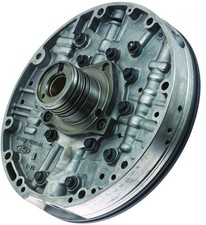
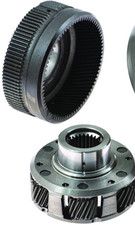
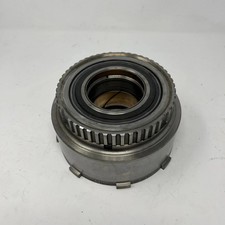
"It's making a noise" is the least useful complaint in the shop, and the 4R100 gives you three genuinely different problems that all get lumped into it: a whine, a growl, and a clunk. Tear into the wrong one and you've pulled a transmission for a wheel bearing, or worse, pulled a differential chasing a noise that was actually the transmission's output shaft bearing the whole time — which is exactly the mistake Sonnax says shops make on this bearing problem. Before any of that, there's a sequence of no-teardown tests that will tell you which system is making the noise, and on the 4R100 you get a free diagnostic tool the Chevy guys don't talk about as much: a true 1.00:1 direct gear.
This covers the 1999-2004 4R100 as built behind the 7.3L Power Stroke, the 6.8L V10, and the gas V8s in the F-Super Duty, Excursion, Econoline and SVT Lightning. The gear ratios, element count and fluid spec come from ATSG's Ford 4R100 technical manual. The bearing and center support wear data come from Sonnax (full list under Sources).
Three noises, three different systems
Per ATSG's description of the unit, the 4R100 is built around three simple planetary gearsets, seven friction apply elements (one band and six multi-disc clutches), and three one-way clutches — the Overdrive Roller Clutch, the Intermediate Sprag, and the Low Roller Clutch. Any of those, plus the pump and the torque converter, can make noise. The trick is narrowing it down before you touch a wrench.
ATRA's Gears Magazine lays out the standard triage, and it applies directly to this unit:
- Pump or converter whine tracks engine rpm, shows up in Park and Neutral with the truck standing still, and doesn't care what gear you're in.
- Planetary gear whine tracks vehicle speed and load, and it has to go through specific gears to make noise, because only certain planetary members are doing work in each gear.
- Bearing noise usually tracks output shaft speed — road speed, not engine speed — and per Sonnax it's commonly mistaken for a torque converter problem because it can seem to fade once the converter locks up.
Step 1: The two tests you can run without moving the truck
Test A — the rev test. With the truck in Park or Neutral, bring the rpm up and down. If the pitch of the noise rises and falls with engine speed while the truck sits still, you're listening to the pump or the converter, not the gear train. Rule out the obvious rpm-tied noisemakers first — alternator, power steering pump, serpentine idler — before you blame the transmission.
Test B — the reverse test. From idle, shift to Reverse. Per Gears Magazine, most transmission pumps raise line pressure in Reverse, and gear and crescent-style pumps (what the 4R100 uses) are the most sensitive to that pressure increase. If the whine gets noticeably louder in Reverse than in Park, that's a strong vote for the pump itself, not an intake leak or low fluid.
Both tests are free and take under a minute. Do them before you put the truck on a lift.
Step 2: Fluid, before anything mechanical
Low or aerated fluid is the single most common cause of pump whine, full stop. Air pulled in at the pump inlet collapses into bubbles as it moves through the pump, and that produces an erratic whine that can sound exactly like a worn pump. Check it before you condemn anything:
- Fluid type and level. ATSG's original spec for the 4R100 is Motorcraft Mercon (XT-2-QDX). Ford's TSB 06-14-4 later replaced Mercon with Mercon V as the service fluid for F-Super Duty, E-Series and Excursion applications, and that TSB also warns against ATF additives and supplements. Set the level hot, at 150-170°F, engine idling in Park, per ATSG — checking it cold will read wrong and send you chasing a phantom low-fluid whine or ignoring a real one.
- Suction-side leaks. A pan gasket, filter O-ring, or cracked pickup tube lets air into the pump inlet before the fluid ever gets there. This produces the same aeration whine as low fluid even with the dipstick reading full.
- Filter condition. A restricted filter starves the pump and can produce noise along with slow or delayed engagement.
If the whine fades noticeably once the fluid is hot and fully circulated, that by itself points at aeration rather than a worn part.
Step 3: Use 3rd gear as your direct-drive reference
This is the part that's easy to skip and shouldn't be. Per ATSG's component and solenoid application chart, the 4R100's four forward ratios are:
| Gear | Ratio | What's doing the work |
|---|---|---|
| 1st | 2.71:1 | Planetary sets under full load |
| 2nd | 1.54:1 | Planetary sets under partial load |
| 3rd | 1.00:1 (direct) | Straight-through; planetary sets not multiplying torque |
| 4th (OD) | 0.71:1 | Planetary sets under load again, in overdrive |
| Reverse | 2.18:1 | Planetary sets, reverse path |
Drive it through the gears and listen specifically for what happens in 3rd. A noise caused by a worn planetary gear, a chipped pinion, or a bad bearing on one of the rotating planetary members should quiet down or disappear in 3rd, because the gearsets aren't doing multiplication work at 1.00:1. If it comes back in 1st, 2nd and overdrive but goes quiet in 3rd, you've confirmed the planetary gear train (or a bearing tied to a specific planet) as the source, and you can stop guessing. If the noise is identical in every gear including 3rd, look at the pump, the converter, or the output shaft bearing instead — something that spins regardless of which planetary members are loaded.
Step 4: Isolating an output shaft bearing whine
Sonnax has documented this exact failure pattern on the 4R70W and 4R75W, Ford's other RWD overdrive automatic family, and the diagnostic method transfers directly to any Ford RWD unit with a bearing supporting the output shaft in the extension housing — the 4R100 included. Per Sonnax, the complaint is routinely misdiagnosed as a torque converter bearing problem because it can seem to go quiet once the converter clutch locks up, when in fact it never had anything to do with the converter. Shops have torn into the differential chasing this noise by mistake.
Sonnax's method for confirming it: use a stethoscope on the case, and listen specifically at the rear of the case, just ahead of where the extension housing bolts on. Confirm the noise is present only while the output shaft is turning — it should track road speed, not engine rpm, and it should persist whether the vehicle is in 2WD or 4WD. Don't pull anything apart on a guess; Sonnax's own note is that the bearing shows visible pitting or spalling on the rollers and races once you do get it open, which is your confirmation. Catching it early means replacing a bearing instead of a scored case or output shaft.
Step 5: The 4R100/E4OD-specific clunk — center support wear
This is the one that's actually documented for this exact unit, not borrowed from a sibling family. Per Sonnax, the 4R100 and E4OD center support shifts slightly every time the intermediate clutch applies and releases. Over time that repeated movement wears the contact points between the center support and the case lugs, and it can also wear the input drum where it rides against the center support. The symptom a tech hears is a clunk or knock, commonly on the shifts that apply or release the intermediate clutch.
Sonnax's fix is a steel center support ring (part 36743-02) that drops into a machined step on the rear of the support, adding contact area between the support and the case lugs so the wear doesn't recur and the support stays aligned. It reuses the existing center support rather than requiring a new one. If you've confirmed a clunk tied to a specific shift and ruled out driveline causes (next section), this is the first internal part to inspect.
A second, related wear point: Sonnax documents that the OE rear case bushings on these units wear out early, driven by poor lubrication, excess journal clearance, or too much load carried on the bearing area. A worn rear bushing lets the output shaft move slightly in the case under load reversal, which shows up as noise or a knock rather than a classic bearing whine. Sonnax's fix is a one-piece replacement bushing (36008D for 1995-and-later 4R100/E4OD units) in place of the factory two-piece bushing arrangement, installed with Sonnax's dedicated driver tool so the thin-walled part doesn't deform going in.
Step 6: Rule out the driveline before you blame the transmission
Not every clunk is internal. Before pulling the pan:
- Check engine and transmission mounts. Per Gears Magazine, rubber mounts are what isolate normal transmission noise from the cab, and a collapsed or torn mount lets noise and movement through that wouldn't otherwise be noticeable.
- Check the driveshaft and U-joints for play, especially on 4x4 trucks with a front driveshaft and a transfer case in the noise path.
- A clunk on throttle reapply right after coasting is frequently normal driveline lash reversing direction, not a transmission fault by itself. What's not normal: lost engine braking along with the clunk, or metal in the pan. That combination points at wear in one of the three one-way clutches ATSG lists — the Overdrive Roller Clutch, Intermediate Sprag, or Low Roller Clutch — and a failing one-way clutch is a teardown item, not a part you can diagnose from the driver's seat.
Diagnostic order at a glance
| Step | Check | Pull the unit? |
|---|---|---|
| 1 | Rev test in Park/Neutral; Reverse test for pump | No |
| 2 | Fluid level hot (150-170°F) and condition; suction-side leaks | No |
| 3 | Gear-by-gear road test; listen for whine disappearing in 3rd | No |
| 4 | Stethoscope at rear of case for output shaft bearing whine | No |
| 5 | Check mounts and driveshaft/U-joints for clunk | No |
| 6 | Center support/case lug wear, rear case bushing | Yes |
| 7 | One-way clutches, planetary bearings, pump internals | Yes |
Keeping it from coming back
- Check fluid level hot and in Park every service, not cold — a cold check can hide a real low-fluid condition.
- Use Mercon V per TSB 06-14-4, with no additives or "noise stop" treatments.
- If you're already in the unit for another repair, inspect the center support contact points and rear case bushing as wear items, even if they aren't the complaint that brought the truck in.
- Don't condemn a converter for a whine until you've confirmed with a stethoscope that the noise actually tracks converter/engine speed and not output shaft speed.
Shop the part for this fix: Sonnax 4R100 Center Support Ring 36743-02
Fixes the documented 4R100/E4OD center support and case lug wear that causes a clunk on intermediate clutch apply/release, without replacing the whole center support.
See the Sonnax center support ring at CoreTransmissionPartsNeed parts for this job?
Our 4R100 parts page carries pumps, planetary assemblies and sprag/roller clutches, with checkout on site. Confirm 2WD vs 4WD and model year before you order.
FAQ
How do I tell a 4R100 pump whine from a planetary whine?
Rev the engine in Park or Neutral. A noise that rises and falls with engine rpm with the truck sitting still and not moving is the pump or converter, per ATRA's Gears Magazine testing method. Then shift to Reverse at idle: most pumps raise line pressure in Reverse, so a noise that gets noticeably louder there points hard at the pump. A planetary or bearing noise instead tracks vehicle speed and gear selection, and on the 4R100 it should disappear in 3rd gear, since ATSG's component chart shows 3rd is the unit's 1.00:1 direct ratio.
Why does my 4R100 whine go away in 3rd gear?
Per ATSG's Ford 4R100 technical manual, 3rd gear runs at a 1.00:1 ratio, meaning the transmission's three planetary gearsets are not multiplying torque in that gear. A whine caused by a worn planetary gear or a bad bearing on one of the rotating members typically disappears in 3rd and comes back in 1st, 2nd or overdrive (0.71:1), because those ratios put load back on the planetary sets. If the noise stays the same in every gear including 3rd, it is not the planetary gearing.
What causes a clunk on a 4R100 shift?
The documented 4R100/E4OD-specific cause is wear at the center support, where it contacts the case lugs. Sonnax explains the center support moves slightly every time the intermediate clutch applies and releases, and that repeated movement wears the contact points and can also wear the input drum where it rides on the support. The result is commonly felt as a clunk or knock on shifts that apply or release the intermediate clutch. A worn rear case bushing letting the output shaft move in the case is the other documented wear point.
What fluid should I check first when a 4R100 is making noise?
ATSG's original fluid call for the 4R100 was Motorcraft Mercon (XT-2-QDX). Ford's TSB 06-14-4 later made Mercon V the service fluid for F-Super Duty, E-Series and Excursion applications. Low or aerated fluid is the single most common cause of a pump whine, so check the level hot, at 150 to 170 F with the engine idling in Park per ATSG, before you chase anything mechanical.
Can a bad torque converter cause a whine that sounds like a bearing?
Yes, and Sonnax specifically warns that output shaft bearing noise is often misdiagnosed as a torque converter problem because it can seem to disappear once the converter locks up. The reliable way to separate them is to confirm whether the noise is present only while the output shaft is turning, with a stethoscope at the rear of the case near the extension housing, rather than assuming based on when the noise seems to quiet down.
Related guides
- 4R100 Pump Failure Symptoms
- 4R100 Torque Converter Lockup Shudder Fix
- 4R100 Valve Body Problems and Testing
- 4R100 Gear Ratios and Specs
- 4R100 vs E4OD Differences
- E4OD Common Problems and Fixes
Sources
- ATSG (Automatic Transmission Service Group), Ford 4R100 technical service manual (2003). Backs the three planetary gearsets, seven friction apply elements, the three named one-way clutches (Overdrive Roller Clutch, Intermediate Sprag, Low Roller Clutch), the component and solenoid application chart with gear ratios (1st 2.71, 2nd 1.54, 3rd 1.00 direct, 4th/OD 0.71, Reverse 2.18), and the original Mercon (XT-2-QDX) fluid spec and 150-170°F hot-check procedure. ATSG manual (PDF)
- Ford Motor Company, TSB 06-14-4, "Mercon ATF Is Being Replaced by Mercon V ATF as a Service Fluid" (2006). Backs Mercon V as the current service fluid for F-Super Duty, E-Series and Excursion, and the caution against ATF additives and supplements. TSB 06-14-4 (PDF)
- Sonnax, "4R70W/4R75W Mystery Bearing Noise" (tech resource #278). Backs the output shaft bearing noise diagnostic method — stethoscope at the rear of the case near the extension housing, confirming the noise tracks output shaft speed rather than converter lockup, and the pitting/spalling confirmation on teardown. sonnax.com
- Sonnax, "Center Support Ring" (part 36743-02, parts page #2080). Backs the 4R100/E4OD center support wearing against the case lugs from movement during intermediate clutch apply/release, the related input drum wear, and the ring's fix. sonnax.com
- Sonnax, "Rear Case Bushing" (part 36008D, parts page #2052). Backs the OE rear case bushing wearing early from poor lubrication and excess clearance, and the one-piece bushing replacement for 4R100/E4OD units. sonnax.com
- Gears Magazine (ATRA), "The Sound of Silence: Diagnosing Transmission Noises." Backs the pump-whine rev and Reverse tests, the planetary noise isolation method using the gear application chart and a 1:1 direct gear as a reference point, and checking engine/transmission mounts before condemning internal parts. gearsmagazine.com