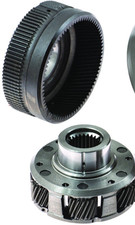
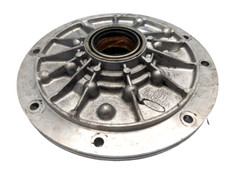
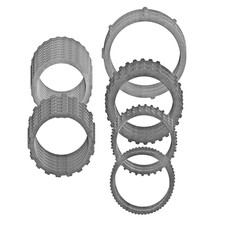
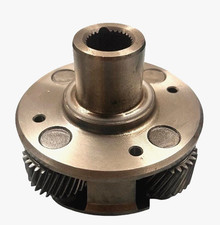
If your E4OD-equipped F-250, F-350, Bronco or E-Series van has started to howl at highway speed, dropped out of overdrive after a long pull with a trailer, or left bright metal on the pan magnet, the planetary is near the top of the suspect list. This is a remanufactured planetary assembly for the Ford E4OD, the electronic four-speed Ford built from 1989 until the 4R100 took over. The photo shows a pinion carrier with helical gears and a splined hub, together with the ring gear it runs inside. Buying it remanufactured means the carrier has already been inspected and set up, so you are not betting a rebuild on a used gearset with an unknown heat history.
What the planetary does in an E4OD
The E4OD is essentially a C6 gear train with an electronic overdrive unit added at the front of the case. That gives it three planetary gearsets. The overdrive set comes first. According to the ATRA clutch and band chart, the overdrive one-way clutch holds it at 1:1 in 1st, 2nd and 3rd in Drive, the coast clutch locks it for Reverse, the manual ranges and engine braking with overdrive cancelled, and the overdrive clutch holds the overdrive sun gear to produce 4th. Behind it, the forward and reverse sets share one sun gear and produce the 2.71, 1.54 and 1.00 ratios, with 0.71 in overdrive and 2.18 in Reverse.
Each carrier holds its pinions on pins and needle bearings, with thrust washers at each end. None of that hardware tolerates a lack of oil. Sonnax traces E4OD overdrive planetary failure to the plastic front lube/drainback valve: at high fluid temperature its ball seat can melt and restrict the front lube circuit, and the overdrive planet then runs short of oil.
Symptoms of a worn E4OD planetary
- Whine that rises and falls with road speed, often loudest in 4th
- No overdrive, or slipping in 4th, after towing or an overheat
- No engine braking in manual ranges even though the coast clutch is good
- Needles, bronze thrust washer material or steel chips on the magnet and in the filter
- Dark, burnt-smelling fluid that comes back quickly after a service
How to confirm it before you buy
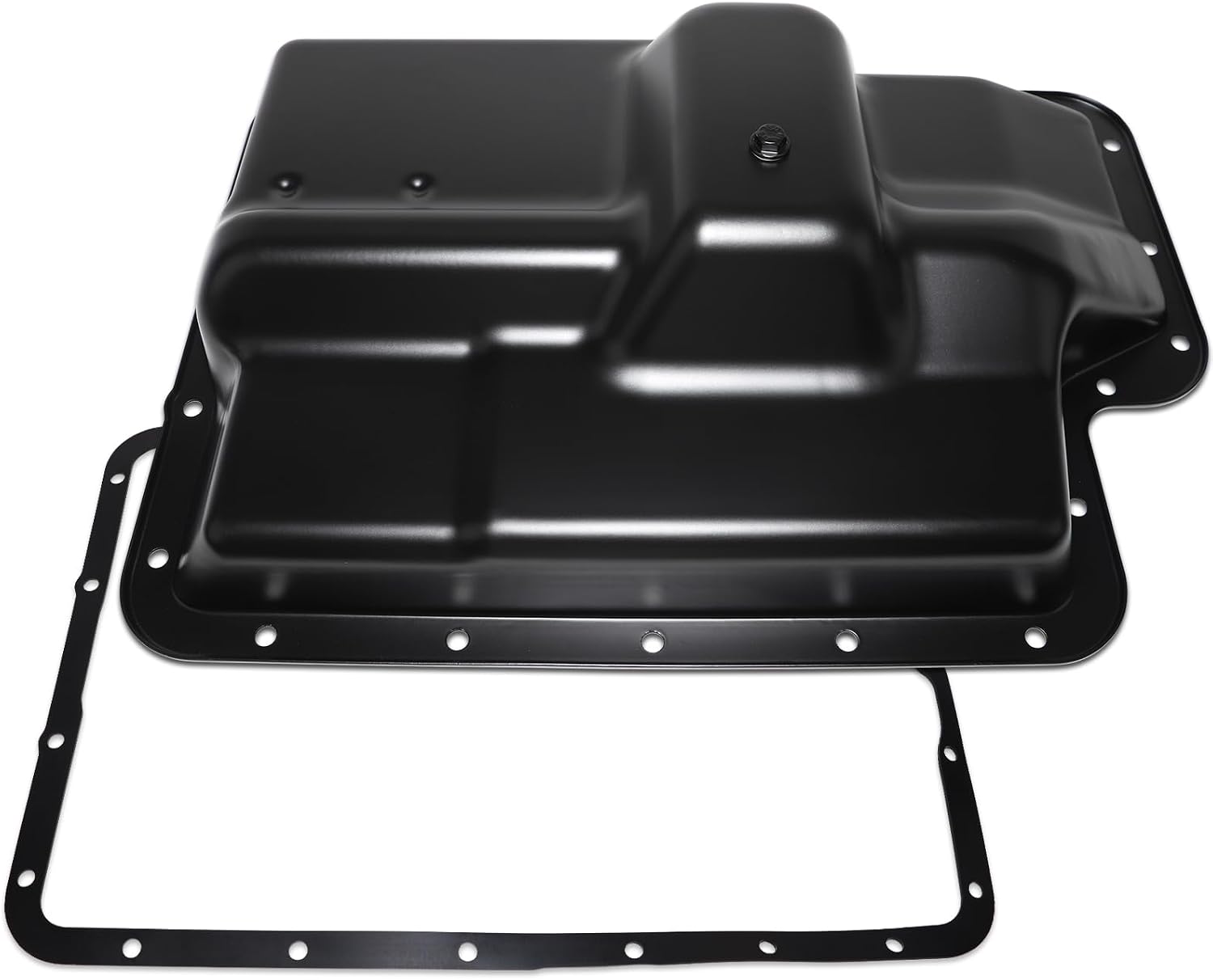
Rule out the cheap causes first. A no-4th complaint can also be electrical: on these units, a failed solenoid circuit can hold the truck in the wrong gear, and an overdrive cancel switch fault changes how the unit shifts. Pull codes and check the solenoid pack before you decide the gears are gone. Our E4OD shift solenoid guide covers resistance checks. If the codes are clean, drop the pan. Friction dust alone points at clutches; needles, washer material or chunks of gear tooth point at a planetary. Once the unit is apart, rotate each pinion by hand and check for roughness, pitting and excess end play. The E4OD common problems guide explains the overheated overdrive pattern in more detail.
Fitment
The listing is for the E4OD, which ran from 1989 through the 1997 model year and into some 1998 applications before the 4R100 replaced it. That covers heavy F-Series pickups, the Bronco and E-Series vans with big gas engines and the 7.3L diesel. The listing does not state the Ford part number or which of the three gearset positions is included, so compare it with your old part before you install it: pinion count, hub spline count, ring gear tooth count and overall height must all match. If you are not sure, send us your year and VIN and we will check it. Browse the full E4OD and 4R100 parts collection for the other hard parts in this unit.
Install notes
- Replace the thrust washers and needle thrust bearings on both sides of the carrier, and check the bushings they run against.
- Check pinion end play and confirm every pinion turns freely before you install the assembly.
- If the old planetary failed from heat, fix the lube problem as well. Sonnax sells an aluminum front lube/drainback valve that will not melt.
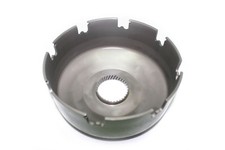
- Inspect the matching shells and drums. The 1989-1997 E4OD reaction shell often shows wear from the same failure.
- Install a full gasket and seal set such as the 1996-2005 E4OD master rebuild kit, flush the cooler and lines, and refill with MERCON V.