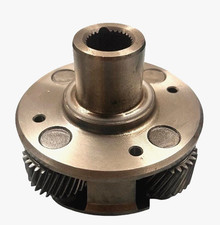
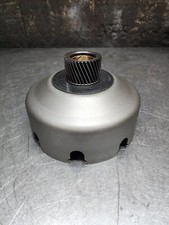
A late E4OD that has started to whine on the highway, lost a gear after a hot tow, or shed needle bearings onto the pan magnet usually has a planetary carrier that ran short of oil. This is a used OEM planetary listed for the 1994-98 Ford E4OD, the electronic four-speed found behind the 7.3L diesel and the big gas V8s in F-250, F-350 and E-Series vans of that era. The photo shows a carrier with helical pinions and a long internally splined hub. A good used carrier from the same family is often the sensible fix when one gearset is damaged and the rest of the unit is sound.
What the planetary does in an E4OD
The E4OD stacks an overdrive gearset ahead of a C6-derived Simpson gear train, so the case holds three carriers. Every ratio, including overdrive, comes from holding or driving one member of a gearset while another member turns. The carrier is the part that takes the load: its pinions spin on pins and needle rollers, and steel and bronze thrust washers locate it fore and aft. When a carrier is healthy you hear nothing. When the needles or pins wear, the pinions tip, the gear mesh changes and the noise follows road speed rather than engine speed.
Oil supply is the weak point. Sonnax lists two separate causes of E4OD overdrive planetary failure. One is the plastic front lube/drainback valve in the stator support, which can melt and choke the lube feed. The other is the main pressure regulator valve: Sonnax notes that a worn OE valve can close off converter charge and cooler flow under high demand, leading to overheat and lube failures, often with codes 628 and 1744. Both problems starve the gearsets before anything else, which is why a replacement carrier needs the lube circuit fixed too.
Symptoms of a worn planetary
- Whine or howl that rises with road speed, often loudest in one gear
- Loss of 4th, or of one gear in the lower range, after heavy towing
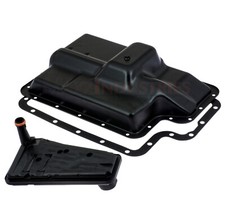
- Needle rollers, bronze flakes or fine steel on the magnet and in the filter
- Blue or heat-discolored pinions and thrust washers on teardown
- Torque converter slip or overheat history in the scan data (code 628)
How to confirm it before you buy
Gear whine can be confused with a bad rear axle bearing or pinion, so drive the truck and note whether the noise changes when you shift into a lower gear at the same speed. A transmission gear noise usually changes with the gear selected; an axle noise does not. Rule out electrical causes of a missing gear first, since a solenoid fault can lock the unit in one range; our E4OD shift solenoid guide covers the checks. Then drop the pan. Needles and bronze point to a carrier, while dark friction dust alone points to clutches. The E4OD common problems guide walks through the rest.
Fitment
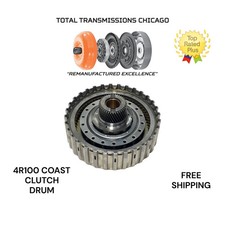
This carrier is listed for the E4OD from 1994 through 1998. That window straddles a running change: Sonnax splits the E4OD solenoid block at 1989-94 and 1995-98, and Ford revised other internals during the same period. The listing does not give a Ford part number or say which of the three gearsets this carrier is, so lay it next to your old carrier and match the hub spline count, the hub length, the pinion count and the overall height before you install it. If you are not sure, send us your year and VIN. The E4OD and 4R100 parts collection lists the other gear train parts, including a remanufactured sun shell and sun gear.
Install notes
- Check pinion end play on this carrier and spin each pinion by hand; it should turn smoothly with no catch.
- Replace every thrust washer and thrust bearing on that gearset, and the bushings it rides on.
- Replace the front lube/drainback valve and inspect the pressure regulator valve and bore, or the new carrier will starve the same way.
- Flush the cooler and lines; a 1994-95 E4OD cooler is worth fitting if the original is plugged with debris.
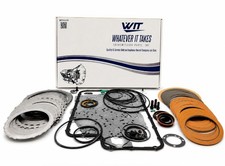
- If the unit is apart anyway, a master rebuild kit covers the seals, gaskets and frictions.
- Refill with MERCON V, check the level hot, and road test through every gear.