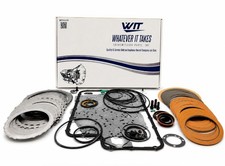
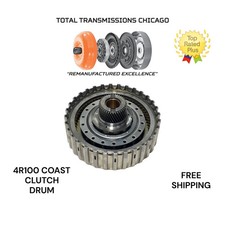
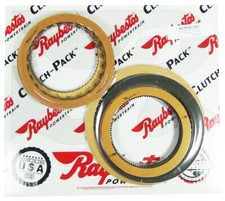
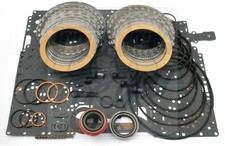
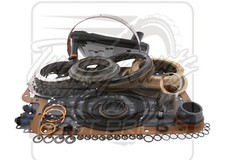
1998 was the changeover year for Ford's heavy-duty automatic. Some 1998 trucks and E-Series vans left the plant with the E4OD and some with its replacement, the 4R100, and the two look almost identical on a jack. If your 1998 unit is an E4OD and it now slips when hot, flares on the 2-3 shift, has lost overdrive, or dropped black fluid and lining onto the pan magnet, this new E4OD master rebuild kit is the soft-parts package for that last-year unit. The listing photo shows the boxed kit with friction plates, steel plates, the gasket set and the seal set.
What the master rebuild kit does in a 1998 E4OD
The E4OD is a four-speed, fully electronic unit built on a C6-style case with an overdrive section in front. Every gear change is a clutch pack being squeezed by a hydraulic piston, and every piston is sealed with rubber or Teflon. When the lining is glazed and the seals have hardened, pressure leaks off and the packs slip. A master kit renews the frictions, steels, seals and gaskets in one job so nothing new is stacked against something worn out.
A 1998 E4OD is a late-design unit. Sonnax splits many E4OD parts at 1989-94 and 1995-98: the solenoid block, the rear case bushing, the pump gear set and the rear sun gear bearing all changed for 1995, and the main valve body went to the F6 casting for 1996-98. Transmission Digest adds that for 1998 Ford moved the E4OD to the common F81P pump body casting it shared with the 4R100. That is why a 1998 kit is its own listing and not a copy of the early-unit kit.
Symptoms that point to a full overhaul
- Slip or flare on the 2-3 or 3-4 shift that gets worse as fluid temperature rises
- No overdrive, often with burnt fluid; Sonnax notes the open-end ring behind the overdrive piston return spring can pull out of its groove and cause overdrive loss
- Burnt smell and dark fluid after towing, the unit's known weak spot
- Clutch lining and metal on the pan magnet
- Leaks from the front pump seal and the case at the same time as the slip
How to confirm before you order
Many E4OD shift complaints start outside the case. Pull codes, check solenoid resistance at the case connector, and run a line pressure test before the unit comes out. Transmission Digest singles out the E4OD/4R100 case connector for corroded pins and broken lock tabs that set codes and mimic internal failure. Our E4OD common problems guide walks through those checks, and the EPC solenoid guide covers the pressure fault that is often mistaken for burnt clutches.
Fitment
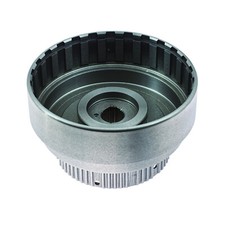
This kit is listed for the 1998 E4OD only. Before you order, confirm the unit is an E4OD and not a 1998 4R100. The fastest check from our 4R100 vs E4OD guide: a 4R100 case has a PTO opening and an E4OD case does not, and the coast clutch drum on an E4OD is cast iron while the 4R100 drum is stamped steel. If yours is a 4R100, use the 1998 4R100 master rebuild kit instead. Also keep in mind that a unit that has been rebuilt before may carry parts from another year, so match the tag and the castings you find. Every E4OD and 4R100 part we carry is on the E4OD/4R100 parts page. If you are unsure, send us your year and VIN and we will check it.
Install notes
- Clean and inspect the pump, drums, bushings and planetaries before any new part goes in. A master kit does not repair a scored pump pocket or a blued overdrive planet.
- Replace the plastic front lube/drainback valve with an aluminum one if the unit still has the original; Sonnax ties the melted plastic valve to overdrive planetary failure.
- Fit a locking spiral ring behind the overdrive piston return spring, and inspect the low sprag. A worn one should be replaced with the 1998 E4OD sprag clutch.
- Soak new frictions in MERCON V, set clutch pack clearances to spec, and air-check each drum before final assembly.
- Flush the cooler and lines, and service or replace the torque converter so the old debris does not go into the rebuilt unit.
The E4OD wear points guide covers the center support, the bore wear and the other updates worth doing while the case is open.