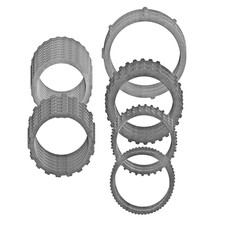
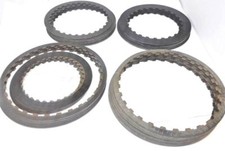
1989 was the first model year Ford built the E4OD, its electronically shifted four-speed for full-size F-Series pickups and Econoline vans. If your launch-year truck now slips when it is pulling a load, flares between gears, or leaves a burnt smell on the dipstick, the clutch packs are the usual reason. This is a new clutch module listed for the 1989 E4OD. The photo shows sets of lined friction plates and steel plates in several diameters, the material you stack back into the drums during a rebuild so the unit holds torque again.
What the clutch module does in a 1989 E4OD
The E4OD puts an overdrive planetary in front of a heavy C6-style gear train, and nearly every ratio is made by clamping a multi-disc pack. The ATRA application chart for the E4OD/4R100 lists six of them: coast, overdrive, intermediate, direct, forward and low/reverse. The only band is the intermediate band, and it is applied only in manual 2nd. The forward clutch is applied in every forward gear, the direct clutch carries 3rd, 4th and Reverse, and the coast clutch holds the overdrive section whenever you need engine braking or Reverse.
Each pack alternates friction plates with steels. Line pressure pushes a piston into the stack and the friction lining grips the steels. When the lining glazes or wears thin, the pack needs more pressure than the computer is commanding, and that difference shows up as slip and heat. Once a pack has burned, everything behind it is contaminated, which is why a slipping E4OD rarely gets better with a fluid change.
One detail matters for a 1989 unit. Transmission Digest notes that the E4OD coast clutch drum is cast iron and stayed the same through the whole E4OD run, while the 1998 4R100 went to stamped steel drums that take coast steels with wider teeth. Plates for your truck have to match the cast drum, not a later 4R100 drum.
Symptoms of worn clutches in a 1989 E4OD
- The engine revs up on a hill in overdrive without the truck picking up speed
- A flare on the 2-3 or 3-4 shift that gets worse when the fluid is hot
- No engine braking when you lift off the throttle in 2 or 1, which points at the coast clutch
- A slow or soft engagement into Drive or Reverse
- Dark fluid with a burnt smell and friction material in the pan
How to confirm it before you buy
The early E4OD is known for electrical faults that feel like mechanical slip, so rule them out first. Inspect the solenoid body connector for a broken lock tab and green pins, pull the EEC-IV codes, and check line pressure. Our E4OD common problems and fixes guide covers those tests, and the EPC solenoid symptoms guide shows how low pressure can imitate worn frictions. If the electrics and pressure check out and the slip shows up in specific gears, the packs are your problem. Sonnax also lists case feed passage leaks behind burnt intermediate and direct clutches, so air-check each circuit when the unit is apart.
Fitment
The listing is for the 1989 E4OD only. Sonnax splits the E4OD solenoid block at 1995, and Transmission Digest notes the pump output went up that same year, so a 1989 unit is the earliest version of the design. Those changes do not move the clutch packs, but count your old plates and measure their diameter and tooth form against the new ones before assembly. If you are not sure your truck has the original unit, send us the year and VIN before you order. For a module listed across more years, see the 1989-1996 E4OD clutch module, and the full E4OD parts collection covers everything else for this transmission.
Install notes
- Soak every new friction in clean fluid for at least 30 minutes before you stack it.
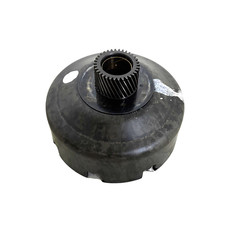
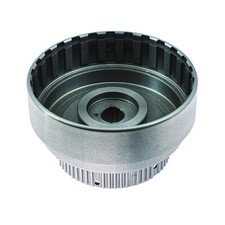
- Inspect each drum for heat discoloration, cracked lugs and worn sealing ring lands; a damaged drum will burn new plates. A replacement E4OD/4R100 clutch drum is listed for 1989-2004.
- Replace the piston seals for each pack you open, and set clutch clearance with a feeler gauge or dial indicator.
- Air-check every circuit before the valve body goes on.
- Fill with MERCON V ATF and check the level hot, then clear codes and road test with a light load first.
If you are weighing a later 4R100 upgrade instead, read 4R100 vs E4OD differences first, since many internal parts do not cross over.