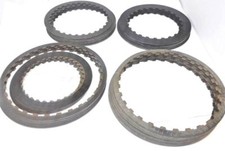
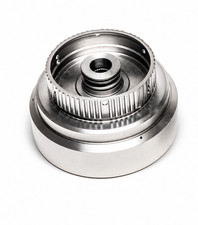
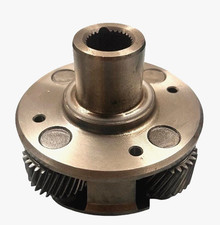
This listing is for the first-generation years of Ford's heavy-duty electronic automatic: the E4OD built from 1989 through 1996 for F-150 through F-350 pickups, Broncos and Econoline vans with the 5.0L, 5.8L, 7.5L and 7.3L diesel engines. The photo shows the module itself, a new set of lined friction plates in several diameters, which is what you need when a truck has started to slip under load, flare on the 2-3 shift, or leave a scorched smell on the dipstick after a tow. At $139.92 it lets you reline the packs in a rebuild instead of reusing tired material.
What the clutch module does in an early E4OD
The E4OD is a C6-style three-speed gear train with an overdrive planetary added up front, all shifted by the computer through a solenoid pack. Apart from the intermediate band, every gear is made by clamping a multi-disc pack: the coast and overdrive clutches in the front section, then the intermediate, direct, forward and low/reverse clutches behind them. Each pack alternates friction plates with steels. Line pressure drives a piston into the stack, the plates lock, and a planetary member is held or driven.
The friction lining is the wear item. Heat from towing, idling loaded in traffic, or a converter that never locks glazes the paper surface, and a glazed plate needs more pressure to hold than the solenoid pack is commanding. The forward clutch is on in every forward gear and the coast clutch holds the overdrive section for engine braking, so on a high-mileage 1989-1996 unit those two packs are usually the most worn.
One detail is specific to these years. Transmission Digest notes the E4OD coast clutch drum is cast iron and never changed through the E4OD run, while the 1998 4R100 went to stamped steel drums with wider-tooth coast steels. Frictions and steels for an early E4OD therefore have to match the cast drum, not a 4R100 part.
Symptoms of worn E4OD clutches
- One shift slips or flares while the rest feel normal, most often 2-3 or 3-4 under throttle
- The engine revs up on a grade in overdrive without the truck gaining speed
- Soft or slow engagement into Drive or Reverse once the fluid is hot
- No engine braking when you lift off the throttle in a manual range (coast clutch)
- Dark, burnt-smelling fluid with friction material and fine metal in the pan
- The slip started right after a long tow or a stretch of overheating
How to confirm it before you buy
Early E4OD trucks are notorious for electrical faults that feel like a mechanical slip, so rule those out first. Check the solenoid pack connector for a broken lock tab and corroded pins, pull EEC-IV codes on 1989-1995 trucks or OBD-II codes on 1996 models, and verify the EPC solenoid. Our E4OD common problems and fixes guide walks through those checks, and the EPC solenoid symptoms guide explains how low line pressure mimics worn clutches. If the electrics test good and the slip shows up in one range only, a pressure test plus burnt fluid confirms the packs are the problem.
Fitment
This module is listed for the 1989-1996 E4OD. Inside that span Ford made running changes: Sonnax splits the solenoid block at 1995, and Transmission Digest notes pump output was raised that same year. Those changes do not move the clutch packs, but they are a reminder to count and measure your old plates against the new ones before you assemble anything. A 1997 truck is still an E4OD; for that year see our 1989-1997 E4OD clutch module. If you are unsure which unit is in your truck, send us the year and VIN before ordering, or browse the full E4OD parts collection.
Install notes
- Soak every new friction in clean fluid for at least 30 minutes before stacking it.
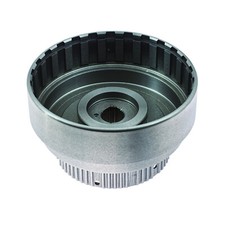
- Inspect each steel for heat bluing and flatness and replace any that are scored or warped; the drums and hubs should have clean splines with no notching. A cracked or worn drum calls for an E4OD clutch drum.
- Replace the piston seals for each pack you open, and set clearance on every pack with a feeler gauge or dial indicator using the selective snap ring.
- Flush the cooler and lines; burnt friction debris left in the cooler will ruin new plates. Our cooler line guide covers that.
- Fill with MERCON-type fluid. These units were originally specified for MERCON, and Ford now services those applications with MERCON V.
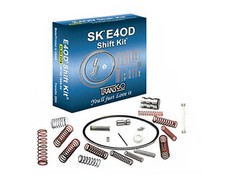
- For towing trucks, a E4OD shift kit firms up apply pressure and shortens slip time, which helps new frictions last.