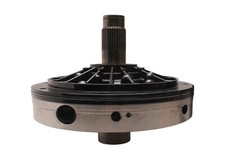
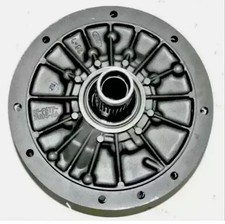
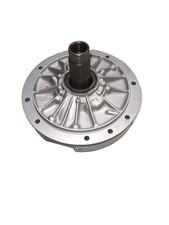
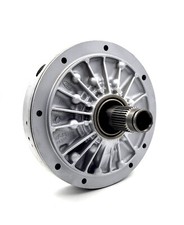
This is a used front pump assembly for the first-generation Ford E4OD, the 1989-1994 units found in F-150 through F-350 pickups, the Bronco and the Econoline vans behind gas V8s, the 7.3L IDI diesel and, at the very end of the run, the early 7.3L Power Stroke. It is for the owner whose truck sits a second or two before it grabs Drive or Reverse, loses grip in every gear once the fluid is hot, or howls in step with the engine, and who needs a pump that bolts into an early case without paying remanufactured prices.
What the pump does in a 1989-1994 E4OD
The torque converter hub drives the pump gears whenever the engine turns. That oil becomes line pressure for every clutch and band, converter charge and release oil, cooler flow and lube for the geartrain. The E4OD pump also carries the pressure regulator valve, including the line-to-lube regulator that keeps oil moving to the converter and cooler. So a worn early pump does not just feel soft: it can let the converter clutch drag, run the converter hot and starve the overdrive section of lube.
Pumps from these years have a known limitation. Sonnax notes that every E4OD pump casting before 1995 was an E9 or F1 design with an 11-lobe outer gear, and that those castings suffered from low output. Ford moved to the F5 casting with a 10-lobe gear for 1995. Sonnax's Ed Lee traced early lockup drag, first blamed on engine hesitation and stumble, to low pump volume at low engine speed that could not keep enough release oil on the converter clutch.
Symptoms of a worn early E4OD pump
- Delayed engagement into Drive and Reverse, worse after a highway run or towing
- Slipping in all ranges rather than on one shift
- A whine that rises and falls with engine RPM, even in Park
- Engine stall or stumble when you drop it into Reverse, which Sonnax links to a worn line-to-lube regulator valve in the pump
- EEC-IV converter clutch codes 62 or 628 that come back after a converter swap
- Fluid that runs hot and dark, and a front seal that weeps as the pump bushing wears
How to confirm it is the pump
Put a gauge on the line pressure tap and check idle and stall pressure in each range. Low pressure everywhere points to the pump or its regulator; a single low range points to a leak downstream. Rule out the electronic pressure control side with our EPC solenoid symptoms guide, and check cooler flow before blaming the converter, as covered in the E4OD cooler line guide. For codes 62 and 628 on these trucks, the E4OD common problems guide explains why the pump and line-to-lube valve are checked first.
Fitment
This pump is listed for the E4OD from 1989 through 1994, the years that share the early pump castings and the early solenoid body. It is a like-for-like replacement for an original pump in that range. The 4R100 and late E4OD pumps are not automatic swaps: the stator support journal and converter clutch valve changed, as our 4R100 vs E4OD guide shows. Compare the casting code on your old pump body and cover before you install, or send us your year and VIN and we will check it. Every other early-unit part is on our E4OD collection page, and if you would rather start with a rebuilt assembly, see the remanufactured E4OD pump for 1989-1997.
Install notes
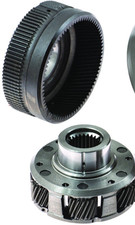
Because this is a used assembly, inspect it on the bench before it goes in: spin the gears for roughness, look for scoring in the gear pocket and on the cover face, and check the bushing for an oval wear pattern. Install a new front seal and pump-to-case seals, and replace the bushing if it shows any wear. Align the pump to the case as you torque it so the converter hub does not bind, inspect the hub for grooves, and prime the pump with fluid before first start. Fill with MERCON V ATF and set the final level on the dipstick hot. If the old pump shed metal, clean or replace the cooler, and while the front of the unit is open check the overdrive section; a lube-starved unit often needs an E4OD overdrive planetary as well.