P0741 only shows up on a 1996-97 E4OD, because that's the only window Ford built this transmission under OBD-II. The generic definition is "Torque Converter Clutch Circuit Performance or Stuck Off," which is a mouthful for a simple symptom: the PCM commanded the torque converter clutch to lock, watched engine RPM and turbine speed, and never saw them come together. The truck feels like it's slipping on the highway, the fuel mileage drops, and the converter runs hotter than it should.
ATSG's own 4R100 technical manual - the 4R100 is Ford's 1999-and-later update of the E4OD, sharing the same solenoid pack design and diagnostic trouble code chart for the overlap years - lists P0741 with a plain description: the PCM picked up an excessive amount of TCC slippage during normal operation, and the symptom is TCC slippage, erratic lockup, or no torque converter clutch operation, with the TCIL possibly flashing. This guide works through what sets the code, the companion codes that narrow it down, the exact solenoid resistance spec, and the order of tests that keeps you from buying a solenoid pack a worn converter actually needs.
Why P0741 is a 1996-97-only code
The E4OD ran from 1989 to 1997 (1998 and later is badged 4R100). OBD-II didn't arrive until the 1996 model year, so only the last two model years of E4OD production can set a P-code at all. A 1989-95 truck uses EEC-IV self-test and reports a flash code instead, and the equivalent converter clutch fault there is code 62. If you plug a generic OBD-II scanner into a pre-96 truck and get nothing, that's expected, not a sign the computer is dead. You need an EEC-IV code reader and the key-on-engine-off or engine-running self-test procedure for those years.
What sets the code, and what doesn't
ATSG's 4R100 diagnostic trouble code chart lists P0741 next to several related codes that narrow down what's actually wrong. Knowing which one you have before you start testing saves a teardown:
| Code | ATSG description | Symptom |
|---|---|---|
| P0741 | PCM picked up an excessive amount of TCC slippage during normal operation | TCC slippage, erratic or no TCC operation; may flash TCIL |
| P0743 | TCC solenoid circuit failure | Short: engine stalls in D or 2 at idle with brake applied. Open: TCC never engages |
| P1740 | TCC solenoid mechanical failure detected | Transmission slippage, erratic or no TCC operation; may flash TCIL |
| P1744 | Excessive amount of transmission slippage has been detected | Erratic harsh shift engagements |
P0741 and P1740 read almost the same to the driver, but they come from different diagnostic logic: P0741 is the PCM's strategy watching for excessive slip across the board, where P1740 points more specifically at the solenoid's mechanical response. P0743 is a hard circuit fault (open or shorted), which is the easiest of the four to confirm with a meter. If you have P0741 by itself, with no P0743, you most likely have a circuit that electrically checks out fine at idle but the clutch itself isn't holding under load, which shifts the suspect list toward converter condition, line pressure, or EPC performance rather than a dead short.
How the E4OD commands lockup
ATRA's E4OD/4R100 solenoid sequence chart marks the torque converter clutch solenoid as PCM-controlled in every forward gear in Drive (1st through 4th) - it isn't tied to a single gear the way the shift solenoids are. The PCM decides when conditions (vehicle speed, throttle position, coolant temperature, brake switch) are right to apply the converter clutch, in any forward gear except manual 1. That's why P0741 can set at highway cruise in overdrive on one truck and during a light 2nd-gear pull on another - it's whenever the PCM tried to apply the clutch and didn't get the slip number it expected back.
Early E4OD solenoid packs use a simple on-off TCC solenoid: it's either commanding full apply or it isn't. Later packs (and the 4R100 that followed) added a PWM (pulse-width-modulated) TCC solenoid that can modulate the apply pressure for a smoother, controlled lockup rather than an on-off clunk. Confirm which type is in your truck before you test it, because the resistance spec is different for each.
Step 1: Confirm the code and the companion codes
Pull all stored codes, not just the one that triggered the light. If P0743 or P1740 are present alongside P0741, follow those first since they point at a more specific fault. Write down freeze-frame data if your scanner captures it: vehicle speed, RPM, and coolant temp at the moment the code set tell you whether this happens cold, hot, at cruise, or under load, which changes where you look first.
Step 2: Test the TCC solenoid at the case connector
ATSG's solenoid pack testing procedure gives exact resistance specs, measured with the ignition off and a DVOM in the ohms position at the transmission case connector:
| Solenoid | Case connector pins | Resistance |
|---|---|---|
| TCC solenoid, on-off style | 1 and 4 | 20-30 ohms |
| TCC solenoid, PWM style | 1 and 4 | 10-20 ohms |
| EPC solenoid | 11 and 12 | 3.0-5.0 ohms |
| Shift solenoid 1 (A) | 1 and 3 | 20-30 ohms |
| Shift solenoid 2 (B) | 1 and 2 | 20-30 ohms |
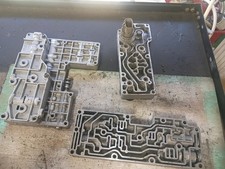
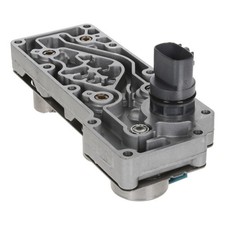
An open or badly out-of-spec reading on the TCC circuit points at the solenoid pack. ATSG is specific that the solenoid assembly - shift solenoid 1, shift solenoid 2, coast clutch solenoid, TCC solenoid, EPC solenoid and the TFT sensor - all live in one sealed assembly bolted inside the pan, and none of them are serviced individually. If the TCC circuit is bad, you're replacing the whole pack, which is also why it's worth confirming the fault is actually electrical before you order one.
A reading in spec doesn't clear the circuit completely - check the wiring between the case connector and the PCM for chafing or a loose pin, since a connector that reads fine on the bench can still open up under vibration on the road.
Step 3: Rule out an EPC or line-pressure problem
The converter clutch needs adequate apply pressure to hold, and that pressure is set by the EPC solenoid. ATSG's chart notes that an EPC circuit fault that's open causes maximum EPC pressure with harsh engagements, while a shorted EPC circuit causes minimum EPC pressure. Neither extreme is "normal," and a weak or marginal EPC solenoid that isn't bad enough to set its own code can still starve the converter clutch of the pressure it needs to hold, which shows up as P0741 instead. ATRA's pressure chart lists E4OD/4R100 line pressure at idle as 50-65 psi in Overdrive and 2, climbing to 165-185 psi at stall in those same ranges - a mechanical line pressure gauge on the transmission's test port is the fastest way to confirm the EPC side is actually doing its job rather than guessing from the solenoid's resistance alone.
Step 4: Check fluid before you condemn anything electrical
ATSG's fluid requirement for the E4OD/4R100 family calls for Motorcraft MERCON multi-purpose automatic transmission fluid (or an equivalent MERCON-spec fluid), checked with the dipstick at normal operating temperature - 150 to 170 degrees F - with the engine idling in Park. Low fluid reduces the volume available to apply and hold the converter clutch, and old, varnished fluid changes the friction characteristics the clutch needs to grip cleanly, both of which read to the PCM as slip. It costs nothing to check and rules out the cheapest possible cause before a solenoid pack gets ordered.
Ford's MERCON spec itself has been superseded for current service fill - Ford's Motorcraft automatic transmission fluid chart (which only covers transmissions built 2007 and later) authorizes MERCON V as the modern replacement fluid family, and states plainly that "the fluids listed... are unique fluids and MUST be used in applications recommending that particular fluid. Use of any other fluid may cause reduced functionality or transmission damage." Since the E4OD predates that chart, confirm the exact spec on your dipstick handle or in the owner's manual for your build year rather than assuming it carries over from a later platform.
Step 5: If everything electrical checks out
A solenoid pack and wiring that test perfectly in spec, with line pressure in range and fresh fluid, points at the converter itself. Worn or glazed converter clutch friction material won't hold even with correct apply pressure and a good solenoid signal - it slips the same way a worn clutch disc does, and no amount of electrical testing will find it. At that point the fix is a converter, not another round of solenoid swaps.
Before you condemn the clutch lining, know that a converter can set P0741 with perfectly good friction material. Sonnax documented a P0741 comeback on a 2003 F-350 with the 4R100, the E4OD's direct descendant, where endplay and clutch release clearance were in spec and the clutch showed no sign of slipping. The real cause was the TCC piston bushing: these converters have no O-ring or lathe-cut seal between the piston and the turbine hub, so that bushing clearance acts as an orifice. OE clearance is roughly .0015-.002 in.; the failed unit measured .007 in., and almost five times as much apply oil was leaking past it as should have been. A rough turbine hub (Sonnax estimated about 300 RA against a 10-20 RA target) had worn the bushing out, and a new piston alone did not fix it (Sonnax, "Mystery P0741 Code").
The opposite flow problem matters too. Sonnax notes the 4R100 inherited its converter flow issues from the E4OD, and that converter endplay needs a minimum of about .035-.040 in. so there is enough release oil to keep the clutch from dragging on the cover (Sonnax, "4R100 Flow Issues"). If you are sourcing a replacement converter for a P0741 truck, ask the builder how they check bushing-to-hub clearance and endplay. A converter that skips those checks can bring the code right back.
Working a P0741 E4OD, in order
- Pull all codes. P0743 or P1740 alongside P0741 point at a harder circuit fault - chase those first.
- Check the dipstick. Confirm MERCON-spec fluid at 150-170F, correct level, and condition before testing anything electrical.
- Ohm the TCC solenoid at the case connector. 20-30 ohms on-off, 10-20 ohms PWM. Confirm which type your pack uses first.
- Check EPC solenoid resistance (3.0-5.0 ohms) and, if available, line pressure at idle and stall against the chart above.
- Inspect the harness between the case connector and PCM for chafing, corrosion or a loose pin.
- Electrical and pressure both good? The converter clutch itself is the suspect - plan on a converter, not another solenoid pack.
Shop the part for this fix: 4R100/E4OD remanufactured torque converter
When the solenoid, wiring and line pressure all check out and the slip doesn't go away, the converter clutch itself is worn. This is a remanufactured 6-stud converter for 1998-and-up applications.
See the remanufactured torque converter at CoreTransmissionPartsNeed parts for this job?
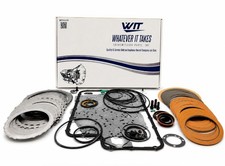
Our E4OD parts page has solenoid kits and EPC/governor pressure solenoids by year plus master rebuild kits, with checkout on site. Match your build year before ordering - 1989-94, 1995-97 and 1998 solenoid packs are not interchangeable.
FAQ
What does code P0741 mean on a Ford E4OD?
P0741 is the generic OBD-II torque converter clutch (TCC) circuit performance / stuck-off code. ATSG's own 4R100 diagnostic trouble code chart describes it as the PCM picking up an excessive amount of TCC slippage during normal operation, with the listed symptom being TCC slippage, erratic lockup, or no torque converter clutch operation at all, and the TCIL may flash.
Can a 1989-95 E4OD set a P0741 code?
No. P0741 is an OBD-II code and only 1996-97 E4OD trucks run OBD-II. 1989-95 trucks run EEC-IV and report a flash code instead, most commonly code 62, for a converter clutch error. If you are working on a pre-96 truck, pull EEC-IV codes with a code reader, not a generic OBD-II scanner.
What usually causes TCC stuck off on an E4OD?
Start electrical: the TCC solenoid or its circuit, since the solenoid pack is a single sealed assembly and the whole pack gets replaced rather than one solenoid. ATSG's resistance spec is 20-30 ohms for an on-off TCC solenoid and 10-20 ohms for a PWM unit, tested at the case connector. If the solenoid and wiring test good, low converter charge flow, worn converter clutch friction material, or contaminated fluid can all produce the same slip pattern.
Does low transmission fluid cause P0741?
It can contribute. Low or badly worn fluid reduces the oil available to apply and hold the converter clutch, which the PCM reads as slippage. ATSG's fluid requirement for the E4OD/4R100 family calls for Motorcraft MERCON fluid, checked with the dipstick at 150-170F fluid temperature with the engine idling in Park, before you condemn a solenoid or the converter.
Related guides
- E4OD Torque Converter Shudder: Causes and Fix
- E4OD Pressure Control Solenoid Symptoms
- E4OD Shift Solenoid Symptoms and Replacement
- E4OD Limp Mode Causes and Fix
- E4OD Common Problems and Fixes
Sources
- ATSG (Automatic Transmission Service Group), Ford 4R100 Technical Service Information manual (2003). Backs the full diagnostic trouble code chart including P0741, P0743, P1740 and P1744 descriptions and symptoms, the solenoid pack testing procedure with pin numbers and resistance specs for the TCC (on-off and PWM), EPC, and shift solenoids, the EPC open/shorted circuit failure modes, the one-piece non-serviceable solenoid assembly, and the MERCON fluid requirement checked at 150-170F in Park. ATSG manual (PDF)
- ATRA (Automatic Transmission Rebuilders Association), "Quick Reference E4OD/4R100" (2009). Backs the solenoid sequence chart showing the torque converter clutch solenoid as PCM-controlled in every forward Drive gear, and the line pressure chart (idle and stall psi by gear range). ATRA quick reference (PDF)
- Wayne Colonna, Transmission Digest, "Even Failsafe Is Subject to Change" (January 2003). Backs the EEC-IV-era E4OD control strategy context for FMEM and EPC behavior under a detected fault. transmissiondigest.com
- Ford Motor Company / Motorcraft, "Automatic Transmission Fluid Chart" (published September 2026, FCSD Chemicals and Lubricants). Backs MERCON V as the current authorized service fluid family and Ford's caution against substituting a non-specified fluid. fcsdchemicalsandlubricants.com (PDF)
- Sonnax, "Mystery P0741 Code." Backs the 4R100/5R110W converter case study: no seal between TCC piston and turbine hub, OE bushing clearance of about .0015-.002 in. vs .007 in. measured, roughly five times normal leakage, and the 10-20 RA hub finish target. sonnax.com/tech_resources/21
- Sonnax, "4R100 Flow Issues." Backs the 4R100 inheriting its converter flow problems from the E4OD and the .035-.040 in. minimum converter endplay for adequate release oil. sonnax.com/tech_resources/79