Ford's E4OD ran behind full-size trucks, the Bronco, and E-series vans from 1989 through 1997 before the 4R100 replaced it. Most of the complaints that walk through the door as "transmission problems" on these trucks -- a surge at cruise, a stumble on light throttle, an intermittent OD light -- actually trace back to the torque converter clutch circuit. The TCC on an E4OD is a simple system on paper: one solenoid, one valve, lock or unlock. In practice it is one of the more commonly misdiagnosed circuits on the unit, partly because the failure modes do not always throw a code and partly because the symptoms look exactly like an engine performance complaint.
For more on this transmission family, see our E4OD parts collection and the related guides at the end of this article.
How TCC Apply Actually Works on This Unit
Strip away the marketing and the E4OD's TCC circuit is a hydraulic switch, not a proportional valve. Transmission Digest's Technical Editor, Mike Riley, laid out the component history: the E4OD uses an on-off lockup-clutch apply, period. The modulated, pulse-width-modulated (PWM) TCC valve that lets a transmission ease into lockup and slip-control the clutch during the transition did not exist on this unit. It arrived with the 4R100 in 1998, and even then Ford only put PWM on some 4R100 applications -- gas trucks with lighter-duty needs kept the on-off design, while most diesel applications and several gas models got PWM.
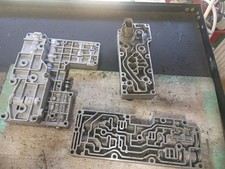
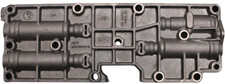
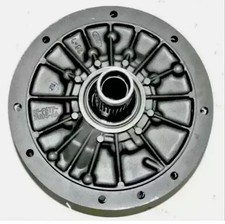
That distinction is not academic. The two valve lineups are not interchangeable, and Riley's article gives the field test: look at the TCC valve bore's end-plug depth. On an E4OD or a non-PWM 4R100, the end plug sits more than an inch in from the pump-cover face. On a PWM 4R100, the end plug is recessed only about a quarter inch, because the "plug" is actually a long sleeve housing a separate control valve. If you are buying a solenoid or valve body for an E4OD, confirm the F81P-series casting and the correct solenoid part number before you assume a part off a later truck will bolt in and work.
When Lockup Is Supposed to Happen
On a healthy E4OD, the PCM schedules TCC apply in 3rd and in overdrive once the truck is at a steady cruise speed and the transmission has reached normal operating temperature -- the computer will not apply the clutch on a cold transmission, and it releases lockup on deceleration, during most part-throttle transients, and any time the brake pedal is applied. A converter that locks and unlocks cleanly on that schedule, with no flare and no shudder, is doing its job. The failure modes below are what shows up when it does not.
The E4OD's Signature Failure: Clutch Crowding, Not Just Clutch Failure
Before you pull a converter, understand the mechanism that makes this transmission different from a typical lockup unit. Sonnax technical specialist Ed Lee, writing in Transmission Digest, traced the E4OD's early reputation for TCC trouble to a specific hydraulic cause: at low pump speed, the unit does not supply enough converter-charge and clutch-release oil to keep the lockup clutch fully off the cover. The clutch rides -- or "crowds" -- against the cover even though the PCM has not commanded lockup.
Lee's account of how this got diagnosed is worth knowing because it explains why so many E4OD "engine problems" turn out to be transmission problems. Technicians chasing this complaint in the early 1990s had no reason to suspect the converter -- the symptom was an off-idle hesitation, a stumble, or a lean-feeling surge, not a shift complaint. Years of comebacks on fuel systems and ignition components later, shops finally tapped the TCC-apply oil passage and found zero pressure any time the circuit was not charged, which shifted the focus to the release-oil side. Low pump volume at low engine speed was starving the release circuit, the clutch dragged on the cover, and the drag read exactly like an engine performance fault at the shop's end of the diagnosis. Sonnax publishes the same finding directly in its own technical library: the E4OD converter has an open passage between the clutch and cover specifically to keep the clutch from dragging and to feed the lube circuit, which is the passage that low pump volume starves at idle.
The practical takeaway: if a customer describes a hesitation or surge that a tune-up did not fix, and the transmission otherwise shifts fine, put a scan tool on it and watch TCC command versus converter slip RPM before you hand the truck back to the engine side of the shop. A converter that is crowding will show slip that never quite reaches zero even with no lockup commanded, or drag that shows up specifically at low RPM.
The Bench Check: Converter Endplay
Lee's companion piece on the 4R100 -- which inherited this same clutch architecture from the E4OD -- gives the spec to check on the bench. Converter endplay needs to fall between roughly 0.035 and 0.040 inch. Too little endplay and release oil cannot exhaust fast enough, so the clutch drags on the cover. Too much endplay and you shift the problem to the thrust bearing, which takes repeated impact every time the clutch applies and releases. There is not much margin between "friendly to the clutch" and "friendly to the bearing," which is exactly why a shop that just throws a new converter at a crowding complaint without checking endplay often sees the comeback. Sonnax's own write-up on the 4R100 explains why endplay matters more on that unit than on the E4OD: the 4R100 turbine hub bearing has no lube passages that bypass it, so release oil has to pass through or squeeze past the bearing itself instead of using a separate open passage.
Reading the Codes Correctly
What code you are chasing depends on which side of the OBD-I/OBD-II line your truck falls on. Pre-1996 E4OD trucks run Ford's EEC-IV self-test and flash a TCIL (transmission control indicator lamp) Code 62 for a torque converter clutch failure -- logged when the PCM commands lockup and the output shaft speed does not respond the way the strategy expects. 1996-97 OBD-II trucks use a different code set. Ford's own 1996 and 1997 OBD System Operation Summaries list the E4OD converter clutch codes as P0743 (TCC circuit open or short, caught by the PCM's feedback circuit) and P1744 (the functional check). In 1996, P1744 sets when converter slip stays above the threshold with the TCC commanded on; in 1997 it sets on duty-cycled TCC drivers when switching the clutch on and off under high load fails to change the calculated speed ratio, while on/off drivers get an inductive-signature solenoid check that sets P1740. Ford titles the E4OD section "no turbine speed sensor," so the PCM judges slip from engine rpm and the vehicle speed sensor, and a bad VSS signal can make a good converter look like it is slipping.
Either code means the same thing operationally: the PCM asked for lockup and did not see the result it expected. That can be the solenoid, the wiring, the valve body, converter crowding or wear, or -- per Bob Warnke's Transmission Digest write-up on a related 4R100 converter failure -- a restricted cooler circuit robbing the converter of apply pressure. Warnke's case study (codes 1728 and 1744 on a 7.3-liter diesel truck with repeated converter failures) is a good reminder that a code pointing at the TCC does not automatically mean the clutch itself is bad: his root cause was insufficient pressure at the TCC piston from a circuit-flow issue, not a worn-out clutch pack, and swapping converters without finding that restriction just produced the next failure.
For the step-by-step repair procedure on the functional code, see our E4OD P1744 fix guide, which includes the solenoid resistance specs and the cooler flow test; our E4OD P0741 guide covers the generic stuck-off code. If the complaint is a shudder at light cruise rather than a stuck-off code, that is a different (and more common) complaint covered in our torque converter shudder article.
The Wiring Fault That Mimics a TCC Problem
Not every lockup-adjacent complaint lives in the valve body. Ford issued TSB 92-22-5 on October 21, 1992, covering 1992 Bronco and F-Series Super Duty trucks, though Sonnax's Ed Lee notes in his Transmission Digest coverage that any E4OD or 4R100 truck with a column-mounted overdrive-cancel button can have the same problem. The overdrive-cancel switch wiring can be routed close enough to a steering-column-cover mounting screw that normal road vibration wears through the insulation and shorts the wire against the screw, blowing the number 17 fuse.
The symptom list on that bulletin reads like a TCC complaint: early shifts, 3-4 shift cycling, the transmission control light cycling on and off or going dark entirely, and an inoperative overdrive switch. On 1995-and-later trucks with drive-by-wire throttle, Lee's article adds a sharper edge -- losing that same fuse drops the engine straight to idle, because the early drive-by-wire throttle module shared the number 17 circuit. If you have a lockup or OD complaint on a column-shift truck and the electrical checks on the TCC solenoid come back clean, pull the shift lever and inspect the OD-switch wiring near the pivot point before you go any further into the valve body.
A Practical Diagnostic Sequence
- Pull codes and note which strategy applies. Code 62 on a pre-OBD-II truck, or P1744 on a 1996-97 truck, means the same starting point: a commanded lockup that did not confirm. P0743 is a circuit fault, so fix it first, and fix any P0500 speed sensor code before trusting a TCC code.
- Watch slip RPM, not just the command. Compare commanded TCC apply against actual converter slip on a scan tool. Slip that never drops near zero with lockup commanded points to the solenoid, valve body, or converter. Drag with no lockup commanded, especially at low RPM, points to clutch crowding from insufficient release oil.
- Confirm the correct parts are installed. Check the pump casting and TCC valve end-plug depth against Ford's E4OD-vs-4R100 specification before condemning a solenoid that may simply be the wrong one for this valve body.
- Rule out the wiring on column-shift trucks. Inspect the OD-cancel switch wiring near the shift-lever pivot for chafing against the steering column, and check fuse 17.
- Check cooler flow and head pressure. A restricted cooler circuit starves the TCC piston of apply pressure the same way a weak pump starves the release circuit -- both show up as the same slip symptom on a scan tool.
- Measure converter endplay before reinstalling. Target roughly 0.035-0.040 inch. This single check prevents the single most common comeback on this circuit.
For solenoid-specific testing steps once you have isolated the circuit, our E4OD shift solenoid guide and EPC solenoid symptoms guide cover the electrical checks in detail, and our valve body symptoms guide covers the hydraulic side beyond the TCC circuit specifically.
FAQ
Does the E4OD have a modulated (PWM) torque converter clutch?
No. Per Transmission Digest's coverage of the component changes between these units, the E4OD runs an on-off TCC apply strategy -- the clutch is either fully locked or fully released, with no in-between modulation. The modulated, PWM-controlled TCC valve arrived with the 4R100 that replaced the E4OD starting in 1998, and even then only certain 4R100 applications got it; others kept the on-off design. Identifying which valve lineup your pump has (by TCC valve end-plug depth) matters before you order a solenoid or valve body.
Why would an E4OD feel like it is slipping or surging at cruise when there is no code?
This is often TCC drag or clutch crowding, not a commanded slip. Sonnax's Ed Lee traced the E4OD's clutch-crowding complaints to insufficient converter-charge and clutch-release oil at low pump speed, which lets the clutch ride against the cover even when the PCM has not commanded lockup. Because the symptom shows up as a hesitation, stumble, or lean-feeling surge, Lee notes it was frequently misdiagnosed as an engine performance problem for years before shops traced it back to pump volume and converter flow.
What codes point to a torque converter clutch problem on an E4OD?
Pre-1996 trucks run Ford's EEC-IV self-test and flash Code 62 for a TCC-related failure, picked up when the PCM commands lockup and the output shaft does not slow down the way it should. On 1996-97 OBD-II trucks, Ford's OBD summaries list P0743 for the TCC circuit and P1744 for the functional slip or speed-ratio check, plus P1740 for the 1997 solenoid signature check on on/off drivers. Transmission Digest's coverage of a related 4R100 converter failure also references codes 1728 and 1744 in this same family on Ford's own code set -- treat any of these as a reason to check slip RPM on a scan tool before condemning parts.
Can a problem that looks like a TCC fault actually be a wiring short?
Yes, on E4OD/4R100 trucks with a column-mounted overdrive-cancel button. Ford TSB 92-22-5, covered by Sonnax's Ed Lee in Transmission Digest, documents the OD-cancel switch wire chafing against a steering-column screw and shorting the number 17 fuse. The symptom list includes a cycling or inoperative transmission control light, 3-4 shift cycling, and early shifts -- all of which can look like a TCC or overdrive complaint until you find the chafed wire near the shift-lever pivot.
What should I check before replacing an E4OD TCC solenoid?
Confirm you have the correct pump and solenoid-block combination first. Per Transmission Digest's component-upgrade coverage, the E4OD, the early on-off 4R100, and the PWM 4R100 all use different TCC valve end-plug depths and different solenoid part numbers, and mixing them causes exactly the no-lockup or erratic-lockup symptoms a bad solenoid produces. After confirming the correct parts are installed, check converter endplay -- a 4R100/E4OD-family converter needs roughly 0.035 to 0.040 inch of endplay to keep the clutch from dragging on the cover without wearing the thrust bearing.
Related E4OD guides
Chasing a TCC complaint on an E4OD this week?
Solenoid kits, valve bodies, pumps, and rebuild kits for the E4OD -- in stock, shipped from the USA.
Shop E4OD parts →Sources
- Transmission Digest — "4R100 Flow Issues," Torque Converter Tech Tips, Ed Lee (Sonnax), May 1, 2006. Backs the clutch-crowding/drag mechanism on the E4OD (insufficient converter-charge/clutch-release oil at low pump speed), how early shops misdiagnosed it as an engine performance problem, the shop fixes (milled bypass slots, drilled turbine hub), and the roughly 0.035-0.040 inch converter endplay target inherited by the 4R100. transmissiondigest.com
- Transmission Digest — "E4OD/4R100 Component Upgrade: Mix and Match Is Not an Option," Technically Speaking, Mike Riley (Technical Editor), September 1, 2014. Backs the on-off vs. PWM TCC valve distinction, the TCC valve end-plug depth field check, the F81P pump casting standardization, and the solenoid/pump part numbers that are not interchangeable across E4OD and 4R100 variants. transmissiondigest.com
- Transmission Digest — "4R100: Repeated Converter Failure," Bob Warnke (Sonnax VP of Technical Development), June 1, 2006. Backs the on-off E4OD vs. modulated 4R100 TCC circuit comparison, converter codes 1728 and 1744, the cooler bypass valve opening at roughly 60 psi, and the diagnostic method of checking cooler flow and head pressure together. transmissiondigest.com
- Transmission Digest — "E4OD/4R100 Safety Alert," TASC Force Tips, Ed Lee (Sonnax), February 1, 2003, covering Ford TSB 92-22-5 (October 21, 1992). Backs the overdrive-cancel switch wiring short against the steering column, the number 17 fuse failure, the symptom list (early shifts, 3-4 cycling, inoperative transmission control light), and the drive-by-wire throttle interaction on 1995-and-later trucks. transmissiondigest.com
- Sonnax — "4R100 Flow Issues," technical resource library. Backs, directly from Sonnax rather than through syndication, the E4OD's open clutch-to-cover passage that prevents drag and feeds the lube circuit, and the flow differences that carried into the 4R100. sonnax.com
- Ford Motor Company — 1996 Model Year OBD System Operation Summary, "4R100 (E4OD) (RWD) Transmission (no turbine speed sensor)." Backs the E4OD's VSS-only speed input, the P0743 TCC circuit check, and P1744 set by converter slip above threshold with the TCC commanded on. Ford 1996 OBD summary (archive.org PDF)
- Ford Motor Company — 1997 Model Year OBD System Operation Summary, same section. Backs the on/off or duty-cycled TCC output, P1740 from the inductive-signature check on on/off drivers, and P1744 from the speed-ratio check on duty-cycled drivers. Ford 1997 OBD summary (archive.org PDF)
- Sonnax — "4R100 Repeated Converter Failure," technical resource library. Backs, directly from Sonnax, why the 4R100 turbine hub bearing has no bypass lube passages and must pass release oil through or past the bearing itself, which is why converter endplay is critical on this shared clutch architecture. sonnax.com