P1744 on a 1996 or 1997 E4OD means the PCM asked the torque converter clutch to do something and didn't see the result in its speed math. It is a functional code, not a wiring code. The electrical side of the TCC circuit has its own code, P0743, so when P1744 shows up alone the circuit usually checks out and the problem is in how the clutch actually applies: the solenoid sticking, the valve it strokes, the oil feeding the converter, or the converter clutch itself.
The E4OD makes this code trickier than it is on later Fords, because the PCM has less to work with. Ford's own 1996 and 1997 OBD System Operation Summaries title the E4OD section "4R100 (E4OD) (RWD) Transmission (no turbine speed sensor)." With no turbine sensor, the PCM can't measure converter slip directly the way it does on a 4R100 or a 5R110W. It works from engine rpm and the vehicle speed signal. This guide covers exactly what Ford's monitor checks for each model year, how to split a solenoid problem from a hydraulic or converter problem with a meter and a flow gauge, and what to replace once you've proven it. The full source list is at the bottom.
What Ford's monitor actually checks
P1744 only exists on the E4OD for two model years. The E4OD ran from 1989 through 1997, and OBD-II didn't arrive until 1996, so a 1989-95 truck reports converter clutch faults through EEC-IV self-test codes instead. For the two OBD-II years, Ford changed the test between 1996 and 1997, and that change matters when you read the code.
| Model year | TCC output (per Ford) | How P1744 sets | Related TCC codes |
|---|---|---|---|
| 1996 | Duty-cycled output, electrically checked through a feedback circuit | Converter slip measured under steady-state conditions with the TCC commanded on; slip above the malfunction threshold stores P1744 | P0743 (circuit open/short) |
| 1997 | On/off or duty-cycled, depending on application | Duty-cycled applications only: turning the TCC on and off under high engine load should change the calculated speed ratio; no change stores P1744 | P0743 (circuit), P1740 (inductive signature check on on/off drivers) |
Read the 1997 wording carefully. Ford's 1997 summary says applications with on/off TCC drivers use an inductive signature (ISIG) check: the PCM watches solenoid current for the small dip that happens when the plunger moves, and sets P1740 if the current never changes. The speed-ratio check that sets P1744 is described for duty-cycled drivers. So on a '97 truck, P1740 points you at the solenoid's own movement, while P1744 says the solenoid may be moving fine but the converter didn't respond the way the speed ratio says it should.
Either way, the PCM is judging the converter with only two numbers: engine rpm and the vehicle speed signal. Ford's summaries list the VSS as the E4OD's only speed input. That has a practical consequence. A VSS signal that drops out or reads wrong throws off the speed ratio the PCM calculates, so a speed sensor fault can make a healthy converter look like it's slipping. If P0500 is stored with P1744, fix the speed signal first. Our E4OD P0500 guide covers that test.
What the driver notices
The complaint usually sounds like one of these:
- Highway rpm too high: the tach sits a few hundred rpm higher at cruise than it used to, or flares when the truck climbs a grade under load. That's a converter clutch that applies but can't hold.
- Lockup cycling in and out: a slow surge at steady speed as the PCM applies, sees bad numbers and releases.
- O/D OFF lamp flashing: the transmission control indicator lamp flashes on many E4OD trucks when a transmission code is stored.
Compare that to P0743 symptoms, which ATSG's code chart describes in plain terms: a shorted TCC circuit can stall the engine in D or 2 at idle with the brake applied, and an open circuit means the TCC never engages at all. If the truck locks up hard and stays locked, or never locks, you're more likely chasing a circuit or stuck-valve problem than the slip that sets P1744.
Step 1: Pull every code and the freeze frame
Get all stored codes, not just the one that lit the light. Then sort them:
- P0500 present: fix the speed signal first and retest. The TCC monitor depends on it.
- P0743 present: fix the circuit first. It's the easiest fault to prove with a meter and it can cause the other.
- P1740 present (1997): the solenoid isn't moving. Go straight to the solenoid pack.
- P1747 present: Ford's summary describes this as the EPC current feedback seeing a short to ground (low pressure). Low line pressure means low converter clutch apply pressure, so fix it first.
- P1744 alone: keep going. This is the case the rest of the guide is about.
Write down the freeze-frame data. P1744 that sets only under heavy load points toward a clutch that can't hold torque; at light cruise it points more toward a valve or solenoid that isn't fully stroking.
Step 2: Test the solenoid at the case connector
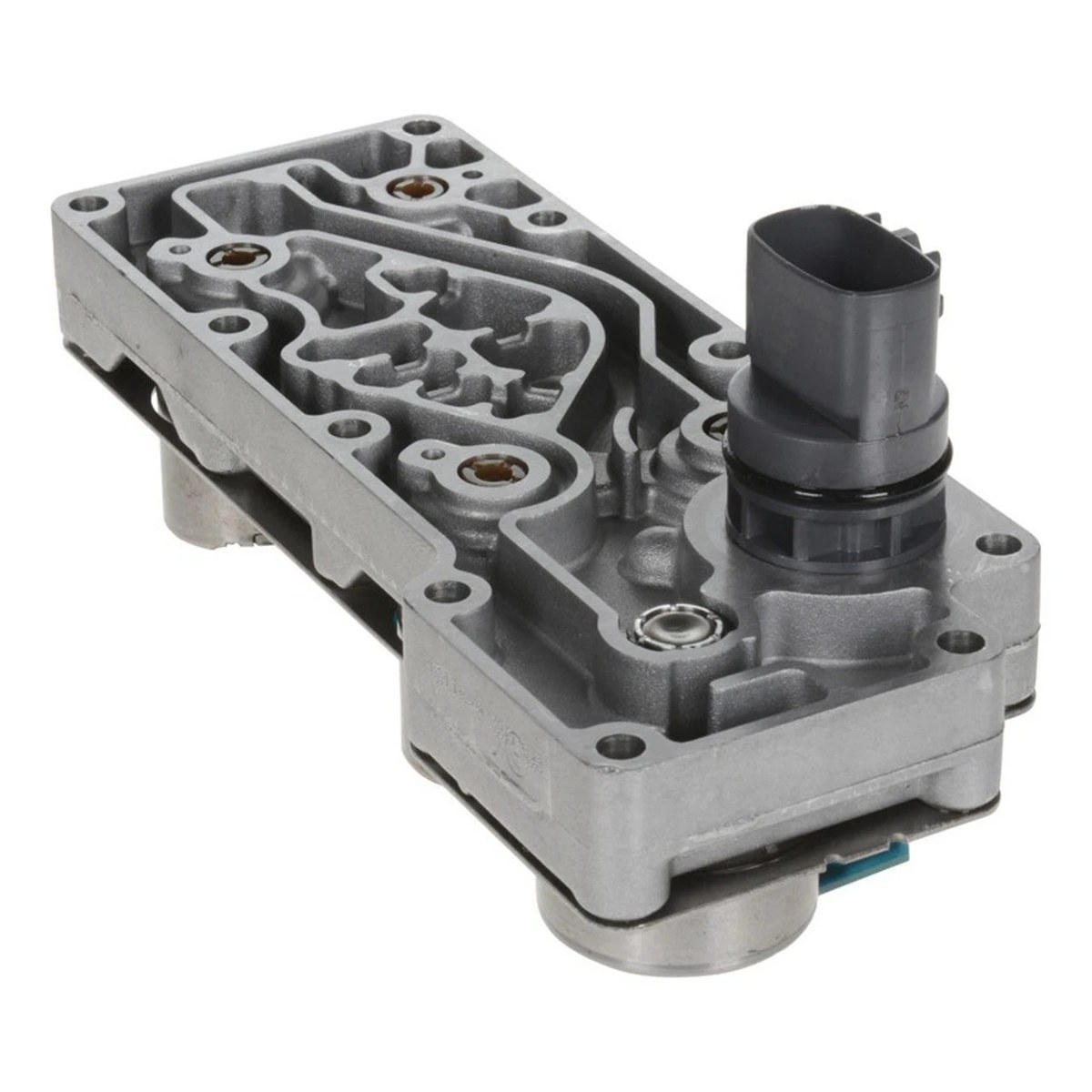
The TCC solenoid lives in the solenoid pack inside the pan with the shift solenoids, coast clutch solenoid, EPC solenoid and the TFT sensor. ATSG's manual for the 4R100, the E4OD's direct successor, which keeps the same solenoid body connector layout, gives these specs with the ignition off and the case connector unplugged:
| Circuit | Connector pins | Spec |
|---|---|---|
| TCC solenoid, on/off type | 1 and 4 | 20-30 ohms |
| TCC solenoid, PWM type | 1 and 4 | 10-20 ohms |
| Shift solenoid A (1) | 1 and 3 | 20-30 ohms |
| Shift solenoid B (2) | 1 and 2 | 20-30 ohms |
| EPC solenoid | 11 and 12 | 3.0-5.0 ohms |
Pin 1 is solenoid power (VPWR) for the shift, coast and TCC solenoids. Measure the TCC reading against the type your pack actually has, because the two specs don't overlap. A pack with a PWM solenoid reading 25 ohms, or an on/off one reading 12, is the wrong pack or a bad one.
A good reading doesn't clear the solenoid on a P1744. The code is functional, and a solenoid can measure perfect and still stick partway or bleed signal oil past a worn seat. Varnish and fine clutch debris do exactly that. If the pan magnet is covered in friction material and the fluid is burnt, a new solenoid pack will cure the code for a few weeks at best. Find where the debris came from first.
Step 3: Prove the apply valve strokes with a flow test
This is the test that separates the E4OD from its successor, and it's the one most shops skip. Sonnax technical director Bob Warnke explains that the E4OD uses an exhaust orifice and an apply orifice with on/off control of the converter clutch, and that its cooler flow behaves the opposite way from the modulated 4R100. On an E4OD, cooler flow is lower when the TCC is off and rises sharply when lockup is commanded. His average numbers in 3rd gear:
- TCC not applied: 1.2 to 1.4 GPM
- At TCC command: 1.8 to 2.0 GPM
Warnke also points out that the E4OD doesn't have the external cooler pressure bypass the 4R100 uses, which makes it easier to diagnose: a rise in flow or pressure at the moment the TCC is commanded tells you the apply valve stroked. So put a flow meter (or at least a pressure gauge) in the cooler line, warm it up, and drive it in 3rd with a scan tool showing the TCC command.
- Command on, flow rises into range, P1744 still sets: the solenoid and valve did their job. The converter clutch isn't holding. That's a converter, or apply pressure that's too low under load.
- Command on, flow doesn't change: the converter clutch control valve didn't stroke. Suspect the solenoid (stuck or leaking signal oil) or a sticking valve in the pump.
- Flow low in every condition: look at pump volume, a restricted cooler and the filter before you blame anything on the TCC side.
Step 4: Think of the converter as a one-way valve
Transmission Digest's lockup troubleshooting article gives the cleanest way to picture what's going on inside the converter. Charge and release oil normally flows out through the input shaft, between the TCC piston and the cover, past the piston and out to the cooler. When the TCC control valve strokes to apply, flow reverses until the piston contacts the cover, and the piston itself then blocks the flow. If release oil isn't exhausting cleanly, or apply oil can't build, the piston never clamps hard enough to hold.
The same article recalls that the early E4OD would stall the engine only in reverse. Line pressure is higher in reverse, and as the pressure regulator valve strokes toward high pressure it can also limit charge/TCC release oil. A worn pump, a sticking pressure regulator valve or a TCC valve that's hanging up in a worn bore can all end in P1744 even with a new solenoid pack.
Step 5: When it's the converter
If the solenoid tests good, the flow test proves the valve strokes, line pressure is correct and the speed signal is clean, the converter clutch is worn or glazed. Pull the pan. Burnt fluid and black friction material on the magnet back that up. At that point the honest fix is a rebuilt converter, and if the debris has made it into the clutches and valve body, a full overhaul. Flush and flow-test the cooler and lines before the new unit goes in, because the debris from a cooked converter clutch is what kills the replacement.
Use the right fluid and fill it correctly. Ford's 1997 F-250 Heavy Duty/F-350 owner guide calls for Motorcraft MERCON (XT-2-QDX) in the E4OD with refill capacities of 15.9 quarts for 4x2 and 16.4 quarts for 4x4, and says to set the final level with the fluid hot (150-170 F). Straight MERCON has since been replaced; see our E4OD fluid type and capacity guide for what to buy today.
How to keep it from coming back
- Fix the cause of the heat, not just the code. A truck that tows heavy and still has a stock cooler is cooking its converter clutch every trip.
- Flow-test the cooler circuit after any converter or pump job. The 1.2-1.4 to 1.8-2.0 GPM rise is your proof the job is right before the truck leaves.
- Match the solenoid pack to the truck. On/off and PWM TCC solenoids don't share a resistance spec, and a mismatched pack can set TCC codes from day one.
Shop the part for this fix: E4OD/4R100 solenoid pack, 1995-97
If the meter or the flow test pointed at the TCC solenoid, this is the complete 1995-97 solenoid block with the TCC, shift, coast clutch and EPC solenoids in one assembly. Match the TCC type to the pack you pulled before you order.
See the solenoid pack at CoreTransmissionPartsNeed parts for this job?
Our E4OD parts page has solenoid packs, pumps and master rebuild kits for 1989-97 trucks and vans, with checkout on site.
Shop E4OD parts →FAQ
What does P1744 mean on a Ford E4OD?
P1744 means the PCM commanded the torque converter clutch and the result didn't show up in its speed calculations. Ford's 1996 summary sets it when converter slip stays above the threshold with the TCC commanded on, and the 1997 summary sets it when switching a duty-cycled TCC on and off under high load doesn't change the calculated speed ratio. It is a functional code, so the wiring often tests fine.
What is the difference between P0743, P1740 and P1744 on an E4OD?
P0743 is an electrical fault in the TCC circuit, an open or short the PCM sees through its feedback circuit. P1740 is the 1997 inductive signature check on on/off TCC drivers, which sets when the solenoid's current never dips because the plunger didn't move. P1744 is the speed-based check that the converter actually responded.
Can a bad speed sensor cause P1744 on an E4OD?
It can. Ford's summaries list the vehicle speed sensor as the E4OD's only speed input, and there is no turbine speed sensor, so the PCM judges converter slip from engine rpm and vehicle speed. A signal that drops out can make a good converter look like it is slipping, so fix P0500 first if both codes are stored.
Will a new solenoid pack fix P1744?
Only if the solenoid was the problem. Check resistance at pins 1 and 4 (20-30 ohms on/off, 10-20 ohms PWM per ATSG) and run a cooler flow test. If flow rises from about 1.2-1.4 GPM to 1.8-2.0 GPM when lockup is commanded, the valve is stroking and the converter clutch is the more likely cause.
Related guides
- E4OD P0741: TCC Stuck Off Causes & Fix
- E4OD TCC Lockup Explained
- E4OD Torque Converter Shudder
- E4OD Shift Solenoid Symptoms
- E4OD P0500: Vehicle Speed Sensor Causes & Fix
- 4R100 P1744: TCC System Performance Causes & Fix
Sources
- Ford Motor Company, 1996 Model Year OBD System Operation Summary, "4R100 (E4OD) (RWD) Transmission (no turbine speed sensor)." Backs the VSS as the only speed input, the duty-cycled TCC output and P0743 feedback check, and P1744 set by converter slip above threshold with the TCC commanded on. Ford 1996 OBD summary (archive.org PDF)
- Ford Motor Company, 1997 Model Year OBD System Operation Summary, "4R100 (E4OD) (RWD) Transmission (no turbine speed sensor)." Backs the on/off or duty-cycled TCC output, the ISIG check and P1740 on on/off drivers, the speed-ratio rationality check and P1744 on duty-cycled drivers, and P1747 EPC feedback. Ford 1997 OBD summary (archive.org PDF)
- ATSG (Automatic Transmission Service Group), Ford 4R100 technical service manual (2003). Backs the solenoid body connector pinout, TCC resistance (20-30 ohms on/off, 10-20 ohms PWM), shift and EPC solenoid specs, and the P0743 short/open symptoms. ATSG 4R100 manual (PDF)
- Sonnax, Bob Warnke, "4R100 Repeated Converter Failure." Backs the E4OD on/off apply and exhaust orifices, the E4OD cooler flow of 1.2-1.4 GPM rising to 1.8-2.0 GPM at TCC command, and the lack of an external cooler bypass on the E4OD. sonnax.com
- Transmission Digest, "Troubleshooting Lockup Issues." Backs the one-way valve model of charge, release and apply oil in a lockup converter, and the early E4OD stalling only in reverse when the pressure regulator limited release oil. transmissiondigest.com
- Ford Motor Company, 1997 F-250 Heavy Duty/F-350/F-Super Duty owner guide, lubricant specifications and refill capacities. Backs Motorcraft MERCON XT-2-QDX for the E4OD, the 15.9/16.4 quart capacities and the hot dipstick check. Ford 1997 owner guide (archive.org PDF)