P1744 on a 4R100 is the code that tells you the PCM thinks the converter clutch hardware is not doing what it was told. The ATSG 4R100 code chart lists it as "TCC solenoid mechanical failure detected," with a harsh shift and a possible flashing O/D OFF lamp (TCIL) as the symptoms. That wording matters. A wiring fault on the TCC solenoid sets P0743. P1744 sets when the circuit is electrically fine but the commanded result never shows up in the speed data.
That puts P1744 in the same family as P0741, and on a lot of 7.3L Power Stroke and V10 trucks you will see both. The difference is where you start looking. With P1744 the PCM is pointing at the TCC solenoid and the valve it drives, but in practice the 4R100 sets it just as often for a converter or cooler circuit problem that starves the clutch piston. Sonnax documented a 2000 7.3L that ate four converters and kept coming back with codes 1728 and 1744. Below is how the system works, how to split solenoid from hydraulic from converter, and what fixes it for good. Specs come from the ATSG 4R100 manual, monitor logic from Ford's OBD system summary, and the hydraulic case history from Sonnax and Transmission Digest. Full list under Sources.
What P1744 means on a 4R100
The 4R100 applies its torque converter clutch with oil, and the PCM controls that oil through one solenoid in the solenoid pack. ATSG notes the TCC can be applied in any forward gear except Manual 1st once the PCM decides conditions are right. When it commands apply, it expects engine rpm and turbine shaft speed (TSS) to come together. If the PCM commands the clutch and the speeds don't match the way they should, it decides the solenoid or its valve is mechanically stuck and sets P1744.
Ford's 2004 OBD System Operation Summary describes how its generic converter clutch check works. The electrical side (P0740, P0742, P0744) is checked continuously. The functional check runs only during lockup, needs a working TSS signal, and takes five lock-up events. The malfunction threshold is slip above 100 rpm, or on some applications a speed ratio below 0.93. Ford's document doesn't name the 4R100 directly, so treat those numbers as Ford's general strategy, not a 4R100-specific spec. They still tell you what to look for on the scan tool: commanded lockup, then slip that never comes down.
The harsh shift that ATSG lists comes along with the fault strategy, so don't chase it as a separate shift-quality complaint until P1744 is fixed. Clear the code, get the TCC working, then judge the shifts.
Two different TCC systems: know which one you have
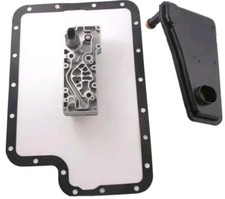
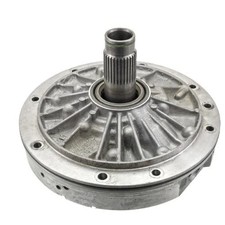
This is the part that catches people. ATSG documents that starting with 1999 production, Ford built the 4R100 with two different converter clutch strategies. The V10 gas trucks and all diesels got a pulse width modulated (PWM) TCC. All other gas engines got a non-PWM, on/off TCC. That change needed two different solenoid packs and two different pump assemblies, and ATSG says none of those parts interchange.
| Part | Non-PWM (on/off TCC) | PWM TCC (V10 gas, diesel) |
|---|---|---|
| Solenoid pack | F81Z-7G391-BA | F81Z-7G391-AB |
| Pump assembly | F81Z-7A103-AA (cast iron coast clutch drum), F81Z-7A103-BA (stamped steel drum) | F81Z-7A103-CA (stamped steel drum) |
| TCC solenoid resistance, pins 1 and 4 | 20-30 ohms | 10-20 ohms |
| Converter clutch control valve | Standard spool | Rear spool about .070 in larger, plus bushing and plunger valve |
| Pump cover changes | .070 in converter release orifice | Release orifice omitted, .036 in orifice and air bleed added to TCC signal passage |
Part numbers, resistance values and pump cover details are from the ATSG 4R100 manual. If someone has put a non-PWM pack in a PWM truck, or a pump from the wrong version, you can get a clutch that slams on, never applies right, or sets P1744 on day one. Before you condemn anything, check what is in the truck against what it came with.
Step 1: scan data
Start with a scan tool that shows engine rpm, TSS, output shaft speed, the TCC command (duty cycle on PWM trucks), and transmission fluid temperature (TFT). Drive it at steady cruise in 4th, light throttle, and warm fluid. You want to see the command go up and engine rpm fall into line with TSS.
- Command goes up, slip stays high: the oil isn't getting to the piston, the clutch is burnt, or the valve is stuck. Keep going to Steps 2 and 3.
- Command never goes up: look at why the PCM isn't asking for it. ATSG lists brake pedal position switch, TFT and TSS faults as things that change or block TCC operation. Fix those codes first.
- TSS reading is erratic or zero: Ford's check needs TSS to run. Fix P0715, P0717 or P0718 before you trust any TCC code.
Look at TFT as well. ATSG's TFT chart puts the sensor around 16k to 5k ohms between 105 and 158 F, and 5k to 2.7k ohms between 159 and 194 F. A reading stuck cold can change the TCC strategy and confuse the picture.
Step 2: rule out the solenoid electrically
With the ignition off and the case connector unplugged, measure across solenoid body pins 1 and 4. ATSG gives 20-30 ohms for the on/off TCC solenoid and 10-20 ohms for the PWM solenoid. Pin 1 is solenoid power (VPWR, PCM pins 71 and 97). While you are there, check shift solenoid A on pins 1 and 3, shift solenoid B on pins 1 and 2, and the coast clutch solenoid on pins 1 and 5. ATSG lists 20-30 ohms for those, EPC on pins 11 and 12 at 3.0-5.0 ohms, and TFT on pins 7 and 8.
A good reading doesn't clear the solenoid on a P1744. The code is mechanical: a solenoid can measure perfect and still stick, or flow too little oil because of varnish or debris. ATSG notes the solenoids aren't sold separately, so the fix is a complete solenoid pack of the right version. If the pan has clutch material or metal in it, a new pack alone won't last. Find out where the debris came from first.
Step 3: the hydraulic side Sonnax documented
Bob Warnke's Sonnax article "4R100 Repeated Converter Failure" is the best explanation of why this unit sets 1744 when the solenoid is fine. The truck was a 2000 7.3L diesel with four converter failures. The first sign was a longer, softer TCC apply on the test drive. Warnke's conclusion: there wasn't enough pressure at the TCC piston to stop slip as engine torque went up.
On the 4R100's modulated circuit, oil from the TCC regulator valve goes to the apply piston with no restriction, and release oil between the piston and cover exhausts without an orifice. Any restriction matters more on the 4R100 than on the on/off E4OD. Warnke ranks the other causes, most likely first:
- The external cooler bypass check ball leaking or stuck open. The ball, seat and spring are meant to open at about 60 psi of cooler head pressure, so lube still flows around a plugged cooler.
- Poor pump volume.
- Modified pump orifices. Making the orifice bigger feeds the cooler but lowers pressure at the piston. Making it smaller raises piston pressure but cuts lube. Leave them stock.
His test method is to measure cooler flow and head pressure together, or at least head pressure if you can't measure flow. The 4R100 behaves the opposite of the E4OD. On an E4OD, Warnke gives average cooler flow in 3rd of 1.2 to 1.4 GPM with the TCC off, rising to 1.8 to 2.0 GPM when lockup is commanded. On a 4R100 with modulated control, cooler flow is higher before lockup and drops during TCC apply. If flow barely changes at lockup and head pressure doesn't come up to normal, the converter or the circuit feeding it is the problem, not the solenoid.
The PWM plunger valve
On PWM units there is one more wear point. Sonnax explains that PWM 4R100s use a plunger valve and coil spring to cushion the TCC control valve, with regulated converter pressure working as a variable hydraulic spring to control apply rate. Constant motion of that plunger wears the sleeve bore and leaks converter pressure, causing early or bumpy apply and shudder. Their 36424-08K kit replaces the valve and sleeve. It fits PWM units only and doesn't convert anything to on/off.
Step 4: the converter itself
If the solenoid pack and the hydraulics check out, the converter is next. Ed Lee, in Transmission Digest, explains that the 4R100 inherited its flow problems from the E4OD. Converter charge and release oil flows between the stator support and turbine shaft, around the front stator bushing, and out three slots between the turbine shaft and hub. The 4R100 hub with a bearing has no lube passages around that bearing, so the bearing restricts release flow.
Lee gives a minimum converter endplay of about .035 to .040 inch for enough release oil to keep the clutch from dragging. Too much endplay brings impact damage to the bearing. Ask your converter builder how they set endplay on a 4R100. A converter built like an E4OD unit can apply soft or slow, and the PCM reads that as a mechanical failure.
Fluid
ATSG specifies MERCON multi-purpose fluid in every 4R100. Check level with the dipstick at normal operating temperature, 150 to 170 F, engine idling in Park. Motorcraft lists MERCON V (XT-5-QMC quarts) as suitable for transmissions previously serviced with MERCON. Dark, burnt fluid on a P1744 truck means the clutch has been slipping and making heat for a while. Service it, and look hard at the cooler and lines, because a restricted cooler is half of Warnke's bypass problem.
Fix order and prevention
Go in this order so you don't buy parts twice:
- Clear the TSS, TFT, brake switch and circuit codes (P0743 included) before anything else.
- Confirm the solenoid pack and pump match the truck's PWM or non-PWM version.
- Check fluid level and condition at 150 to 170 F.
- Measure cooler flow and head pressure, and check the external bypass check ball.
- Replace the solenoid pack if it is the wrong version or the TCC solenoid is sticking.
- On PWM units, inspect the TCC control plunger valve and sleeve. Check pump volume.
- Replace the converter last, with endplay checked, and flush or replace the cooler.
After any converter or pump job, check cooler flow and head pressure again before the truck goes back to the customer. Warnke's shop learned that the hard way after four converters. A truck that tows heavy should get regular fluid service, and the cooler should be replaced after any converter failure, since debris raises head pressure and opens the bypass.
Shop the part for this fix: Sonnax 4R100 TCC control plunger valve kit
The Sonnax 36424-08K valve and sleeve for the PWM 4R100 TCC control plunger, the wear point behind bumpy apply and shudder. Fits PWM units only, so confirm your version first.
See the Sonnax 36424-08K kit at CoreTransmissionPartsNeed parts for this job?
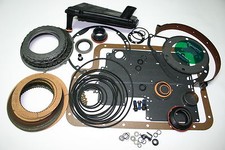
Our 4R100 parts page carries solenoid packs, pumps, valve bodies and master rebuild kits, with checkout on site. Confirm model year, engine, and PWM or non-PWM TCC before you order a pump or solenoid pack.
Shop 4R100 parts →FAQ
What does P1744 mean on a 4R100?
The ATSG 4R100 code chart lists P1744 as TCC solenoid mechanical failure detected, with a harsh shift and a possibly flashing O/D OFF lamp. The circuit tests fine electrically, but the PCM commanded the converter clutch and didn't see the result in engine and turbine speed. A wiring fault on the TCC solenoid sets P0743 instead.
What is the difference between P1744 and P0741 on a 4R100?
Both mean the converter clutch didn't do what the PCM commanded, and they often show up together on 7.3L and V10 trucks. P1744 points at the TCC solenoid and its valve sticking mechanically, while P0741 is the converter slip performance code. On the 4R100 both can be caused by low pressure at the TCC piston from the cooler bypass, pump or converter, so diagnose the hydraulics before replacing parts.
Can I use any 4R100 solenoid pack to fix P1744?
No. From 1999, ATSG documents two versions: PWM TCC for V10 gas and all diesels, with solenoid pack F81Z-7G391-AB, and on/off TCC for other gas engines, with F81Z-7G391-BA. The pumps are different too, and none of the parts interchange. The wrong pack can make the converter clutch slam on or never apply properly.
Why does my 4R100 keep setting P1744 after a new converter?
Sonnax documented a 2000 7.3L that went through four converters and kept setting codes 1728 and 1744 because there wasn't enough pressure at the TCC piston. The most likely causes were a leaking or stuck external cooler bypass check ball, poor pump volume, and modified pump orifices. Measure cooler flow and head pressure before you put in another converter.
Related guides
- 4R100 P0741: TCC Stuck Off Causes & Fix
- 4R100 TCC Lockup Explained
- 4R100 Torque Converter Shudder
- 4R100 Shift Solenoid Symptoms
- 4R100 Harsh Shift Causes
Sources
- ATSG (Automatic Transmission Service Group), Ford 4R100 technical service manual (2003). Backs the P1744 and P0743 code chart wording and symptoms, TCC apply in any forward gear except Manual 1st, the 1999 PWM and non-PWM split with its pump cover, valve and solenoid pack differences and part numbers, the solenoid body pinout and resistance values, the TFT resistance chart, and the MERCON fluid and 150-170 F level check. ATSG 4R100 manual (PDF)
- Ford Motor Company, 2004 OBD System Operation Summary (revision August 7, 2003), Comprehensive Component Monitor, "Torque Converter Clutch Check Operation." Backs the electrical vs functional TCC checks, the TSS requirement, five lock-up events, and the 100 rpm slip or 0.93 speed ratio threshold. Ford OBD summary (archive.org PDF)
- Sonnax, Bob Warnke, "4R100 Repeated Converter Failure" (June 22, 2006). Backs the four-converter 2000 7.3L case, codes 1728 and 1744, insufficient TCC piston pressure, the unrestricted modulated circuit, the ranked causes, the bypass check ball opening at about 60 psi, and the E4OD vs 4R100 cooler flow behavior. sonnax.com
- Transmission Digest, Ed Lee, "4R100 Flow Issues" (May 1, 2006). Backs the converter release oil path, the turbine hub bearing restriction, and the .035-.040 inch minimum endplay. transmissiondigest.com
- Sonnax, 4R100 TCC Control Plunger Valve Kit 36424-08K. Backs the PWM plunger valve and spring function, sleeve wear causing bumpy apply and shudder, and PWM-only fitment. sonnax.com
- Motorcraft (Ford), MERCON V Automatic Transmission Fluid product details. Backs part number XT-5-QMC and its use in transmissions previously serviced with MERCON. fcsdchemicalsandlubricants.com