The car starts and idles, the cluster shows D or R, and when you let off the brake nothing happens. Or, on a BMW with the joystick shifter, the display walks from P to N to D and snaps straight back to P. On a ZF 6HP19, 6HP26 or 6HP32, getting the first five minutes right decides whether you find a $7 seal or pull a transmission for nothing.
This guide is for the true no-movement complaint: no drive in any forward gear and no reverse. Forward but no reverse? See the ZF6HP no reverse guide. Late but eventually moves? See the delayed engagement guide.


Why "No Movement" Means Something Different on a 6HP
Two design choices change how you diagnose this unit. First, there is no freewheel anywhere in the gear train. ATSG's Niel Speetjens, writing in Transmission Digest, points out that the 6HP has no direct drive and "no freewheeling features of any type." Every gear, including first, needs two shift elements held by hydraulic pressure. Lose the pressure supply and you lose every range at once, so a total no-move points at fluid, pump and pressure supply before any one clutch.
Second, the TCM, speed sensors, temperature sensor and range sensor all live inside the Mechatronic on top of the valve body. The same article notes they cannot be serviced separately. On BMW applications using E-shift (shift-by-wire), there is no manual valve at all; Park is released hydraulically by the MV2 and MV3 solenoids. So on many BMWs "it won't go into gear" can mean the TCM put it back in Park on purpose.
There is also an anti-theft wrinkle. Speetjens notes that Audi ties the transmission electronics into its immobilizer, so if the car is started in an unconventional way the pressure-control solenoid will not let pressure build. The engine runs, the transmission never applies. On an Audi that has had a module, key or cluster swapped, check immobilizer status first.
Step 1: Put a Scan Tool on It Before You Lift It
Do not condemn the transmission from the driver's seat. Hook up a scan tool that reads the transmission control module and watch these values with the engine idling, foot on the brake:
- Selector / gear position requested vs. gear engaged. If they disagree, suspect an input or network problem first.
- Turbine (input shaft) speed. With the engine idling in P or N, input speed runs close to engine speed. When a forward or reverse range engages with the brakes held, the input shaft is being held through the gear train and input speed should drop to 0 rpm. If it stays up near idle speed, the clutches are not applying.
- Output shaft speed. It should read zero at a standstill. If output speed rises and the car still is not moving, look past the transmission at the driveshaft, flex disc, differential or axles.
- Transmission oil temperature. You need it to set the level correctly.
- Engine idle speed. ZF's level-check procedure requires idle between 650 and 950 rpm. Outside that range, ZF says the level cannot be set correctly.
That input-speed check is the most useful test on this list, and it comes straight from a documented case. In ATSG's Transmission Digest "Shift By Wire" write-up, a 2002 BMW 745Li came in on a flatbed: the indicators went from P to N to D and immediately back to P. The TCM saw the input shaft speed sensor still reading when it should have gone to 0 rpm with the range engaged and the brakes applied, decided the clutches were not holding, and put the car back in Park to protect the transmission.
Cause 1: Low Fluid or a Leak That Emptied It
This is the first thing to rule out and the one most often guessed at. On BMW applications the oil pan is plastic and has the filter built in, there is no dipstick, and the level is set by overflow at the fill plug. A car that "suddenly" lost all gears after a cooler-line or pan leak may have a healthy transmission that is a couple of liters low.
ATSG's Pete Luban documented a BMW X5 with a 6HP26 that came in on the hook with no movement and a major leak from a cooler line. The unit was torn down and no clutch damage was found. What it did have was a converter that had turned blue from heat and a plastic pressure-relief valve in the valve body that had melted and welded itself to its spring. Melted plastic later turned up blocking a lube passage in the pump cover, and the pump had to be replaced too. Run low long enough, and it cooks parts that are hard to find later.
Check the level the way ZF's own oil-change service information (SI 50145) describes it:
- Vehicle level, Park engaged, parking brake on, scan tool reading transmission oil temperature.
- Never start the engine with no oil in the transmission, and do not tow the vehicle with the transmission empty. ZF calls out both.
- With the engine idling, open the fill screw. At an oil temperature of 30 to 35°C, fluid should run out of the fill hole. If none comes out, fill with the specified ZF LifeguardFluid until it does.
- Close the fill screw when only single drops come out. ZF warns the temperature must not exceed 50°C during the check. Above that, the fluid has expanded and you will set it low.
- For versions with a thermostat valve in the cooler circuit, ZF says the oil must reach at least 75°C on the test drive (so the thermostat opens), then cool and be rechecked at 35°C.
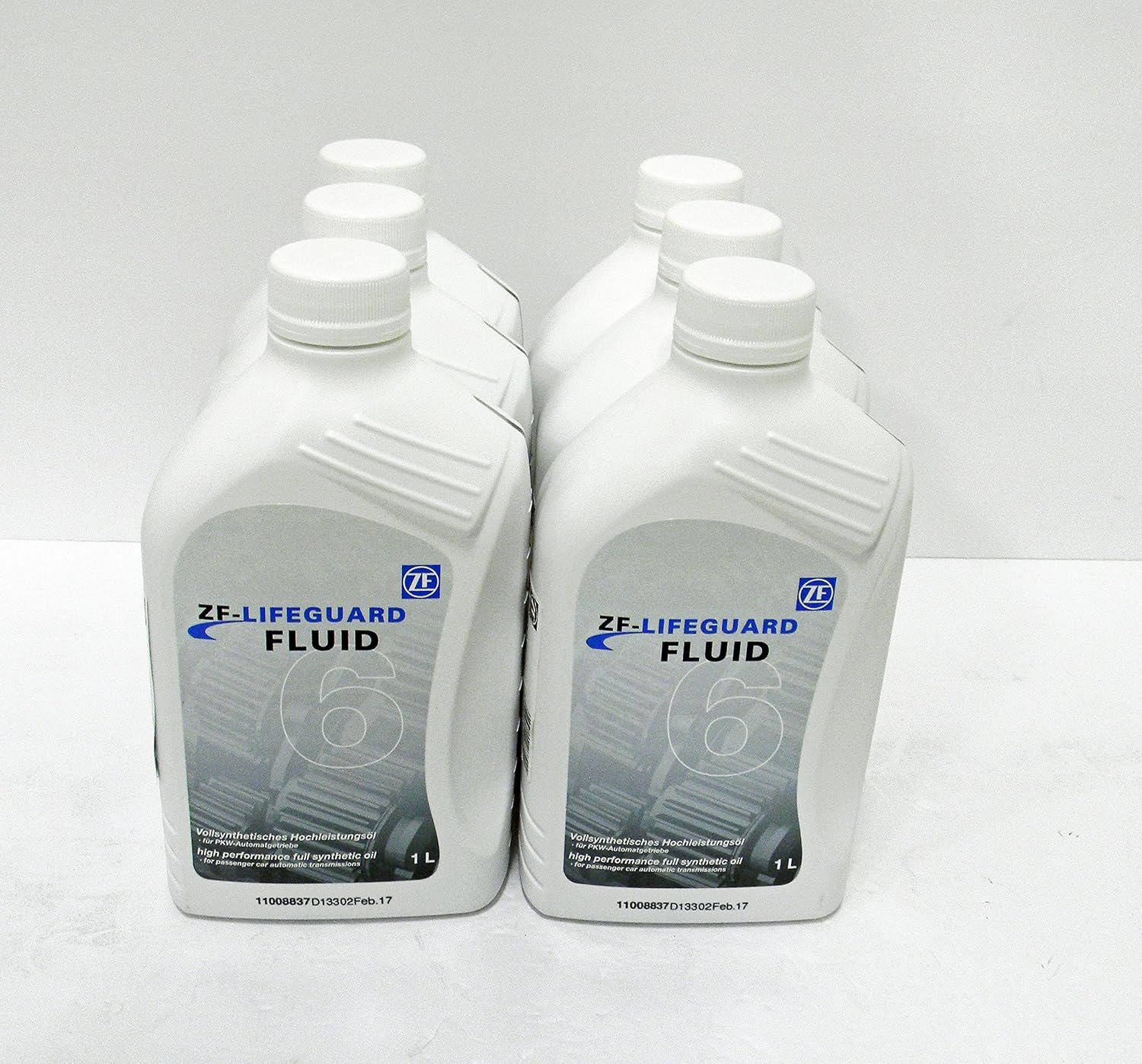
ZF says no additives, only the listed LifeguardFluid. See our ZF6HP fluid type and capacity guide. If the fluid you drain smells burned or carries large chips or fragments, ZF's flowchart says to stop the oil change because the transmission is defective. A refill will not save it.
Cause 2: The Bridge Seal or Sealing Sleeve
If the level is correct and input speed never drops when a range is selected, the pressure is leaking out somewhere between the pump and the clutches. On the 6HP, the cheapest and most overlooked place is the bridge seal between the Mechatronic and the pump. On the 745Li in the ATSG case, the shop pulled the transmission and found nothing wrong except that seal. Replacing a $7 part fixed it. With the seal leaking, system pressure dropped and the clutches could not fully apply.
The other seal to look at is the electrical sealing sleeve (the guide sleeve) where the Mechatronic connector passes through the case. ZF's service information sends techs to SI 50324 for the 6HP guide sleeve and SI 50638 for 6HP seal kits during any oil change. A weeping sleeve is the classic slow leak that empties a 6HP over months. Do the seals as a set while the pan is off, and do not touch the connector pins: ZF and ATSG both warn the Mechatronic is static-sensitive.
Cause 3: Pressure Supply Inside the Valve Body
The 6HP's linear solenoids all draw from a single regulated feed. Sonnax states it directly on its 95740-17K oversized solenoid pressure regulator valve kit page: "All the linear solenoids are fed by this regulator valve." When that valve-to-bore clearance opens up, Sonnax lists delayed forward, delayed reverse, wrong gear starts, flare and neutral shifts, gear ratio codes and solenoid performance codes. A badly worn bore can starve every clutch circuit at once.
On Gen. 1 units (6HP19/26/32, not the 6HP21/28/34 Gen. 2) there is also the clutch A control boost valve. It rides in a plastic sleeve that Sonnax says is prone to damage, especially during removal. When it fails you get delayed or harsh forward engagement, a 5-4 flare and no 4-5 upshift. Sonnax's 95740-21K replaces it with an aluminum sleeve and hardcoat-anodized valve. The A clutch is the forward launch element; ATSG notes ZF's standby control releases it at a stop to cut drag. Forward dead but reverse fine points here; both dead points at the shared supply.
Do not try to find valve wear by eye. Vacuum-test the bores against Sonnax's published minimums, and identify your valve body generation (with or without the 053 separator plate) before you order anything. See our ZF6HP valve body symptoms guide.
See the 6HP26 sleeve and seal kit → Or browse CoreTransmissionParts rebuild kits
Cause 4: It Keeps Going Back to Park (E-Shift BMWs)
On shift-by-wire BMWs, the TCM decides when Park releases, so a car that "won't go into gear" may be one where the TCM is pulling it back into Park. The 745Li bridge-seal case is one version of that. Transmission Digest documented another in 2025: a 2009 BMW with a 6HP26 that went back into Park whenever it was shifted into forward or reverse, with no transmission codes stored. The bridge seal had already been replaced without fixing it. The engine was misfiring on cylinder 1, and the bad ignition coil was throwing high-voltage interference into the Mechatronic's inputs. A new coil fixed the transmission complaint.
Clear engine-side faults first: misfires, low voltage and network faults make a healthy transmission act broken.
If the car is stuck in Park and has to be moved, do not drag it. ATSG notes the E-shift BMWs have a mechanical emergency park release under the dash, behind an access door that the ignition key unlocks. Know the other half of that system too: left in Neutral, the car will select Park on its own after 30 minutes unless N is selected again. A car being towed or pushed in N can lock its park pawl partway through.
Cause 5: Actual Internal Failure
Once you have proven correct fluid level, no leaking bridge seal or sleeve, a valve body that holds vacuum, and a TCM that is commanding the range, but input speed still will not drop, the problem is inside the case. Common finds on high-mileage 6HP26 units are burned clutch packs from long-term pressure loss, a damaged pump, or a converter that has overheated. Sonnax's bushing kit page for the 6HP26/28 says the OE bushings wear early because of their material and can cause loss of E- and B-clutch pressure. That shows up as slipping and ratio codes long before a no-move; a unit with a history of slip codes that finally quit is a rebuild, not a seal job.
When it comes apart, check what the X5 case taught: converter heat discoloration, melted plastic valves, and debris in the pump cover lube passages. If it failed from heat, replace the cooler lines and flush or replace the cooler.
The Order I Work It
- Scan all modules. Fix misfires, voltage and network faults; on an Audi, confirm immobilizer status.
- Watch input shaft speed with a range selected and brakes held. If it drops to 0, the transmission is holding; look at the driveline.
- Set the level by ZF's procedure at 30 to 35°C. If it is low, find the leak before you refill.
- Burned fluid or chips: stop, the unit is coming out.
- Clean and full but still no hold: replace the bridge seal and sleeve seals, then vacuum-test the valve body.
- Only then plan the R&R and rebuild.
Frequently Asked Questions
Why won't my ZF 6HP move in drive or reverse?
On a 6HP every gear needs two shift elements held by hydraulic pressure and there is no freewheel, so a loss of pressure supply takes out every range at once. The usual causes, in order, are low fluid, a leaking bridge seal or sealing sleeve, a worn solenoid pressure regulator valve, and then internal damage. On BMWs with shift-by-wire, also confirm the TCM is not putting the car back into Park.
How do you check the fluid level on a ZF 6HP transmission?
There is no dipstick. Per ZF service information 50145, park the car level with the engine idling between 650 and 950 rpm, read the transmission oil temperature on a scan tool, and open the fill screw at 30 to 35 degrees C. Fill with the specified ZF LifeguardFluid until it runs out, then close the screw when only single drops come out, and never let the oil go above 50 degrees C during the check.
Why does my BMW keep shifting back into Park?
On E-shift BMWs the TCM controls Park through the MV2 and MV3 solenoids, and it will return the car to Park if it sees a problem. ATSG documented a 745Li where a leaking bridge seal dropped pressure, the input speed did not fall to 0 rpm, and the TCM put it back in Park. Transmission Digest also documented a 2009 BMW where a bad ignition coil caused the same complaint with no transmission codes.
Can you tow a BMW with a ZF 6HP that will not move?
Use a flatbed. ZF says not to tow the vehicle if the transmission is without oil. On E-shift BMWs the car also selects Park on its own after 30 minutes in Neutral, so a car towed in N can lock up partway through. If it is stuck in Park, ATSG notes an emergency park release under the dash.
Sources
- Transmission Digest — Wayne Colonna (ATSG), "Shift By Wire," September 2007. Backs the E (shift-by-wire) vs. M Mechatronic versions, Park release by the MV2 and MV3 solenoids, the 2002 BMW 745Li that returned to Park because input speed did not drop to 0 rpm, the leaking bridge seal between Mechatronic and pump as the fix, the emergency park release under the dash, and automatic Park after 30 minutes in Neutral. transmissiondigest.com
- Transmission Digest — Niel Speetjens (ATSG), "To 6HP or Not to 6HP," March 2007. Backs no direct drive and no freewheels in the gear train, the TCM and sensors integrated into the Mechatronic and not separately serviceable, the Audi immobilizer blocking pressure build-up, standby control releasing the A clutch at a stop, the plastic oil pan with built-in filter, and the ESD warnings. transmissiondigest.com
- Transmission Digest — Pete Luban (ATSG), "Bad Bimmer, Bad," August 2008. Backs the BMW X5 6HP26 no-move with a major cooler-line leak, the heat-blued converter, the melted plastic pressure-relief valve, and the blocked pump-cover lube passage. transmissiondigest.com
- Transmission Digest — Wayne Colonna, "BMW ZF 6HP26 Keeps Going Back into Park," May 2025. Backs the 2009 BMW that returned to Park with no transmission codes, the bridge seal already replaced without a fix, and the bad cylinder 1 ignition coil interfering with Mechatronic inputs. transmissiondigest.com
- ZF Friedrichshafen AG, ZF Aftermarket Service Information 50145, "Oil change kit for ZF 5HP/6HP automatic transmission," 03.2023. Backs never starting or towing with no oil, the 650-950 rpm idle requirement, the 30-35°C overflow level check and 50°C limit, the 75°C/35°C thermostat-valve procedure, no additives, stopping if the oil is burned or full of chips, and the references to SI 50324 (guide sleeve) and SI 50638 (seal kits). aftermarket.zf.com (PDF)
- Sonnax — part pages 95740-17K (solenoid pressure regulator valve kit), 95740-21K (clutch A control boost valve kit) and 95030-26K (6HP26/28 bushing kit). Backs all linear solenoids fed by the solenoid pressure regulator and its wear symptoms including delayed forward and reverse, the Gen. 1 plastic boost valve sleeve and its delayed/harsh forward symptoms, Gen. 2 incompatibility, and OE bushing wear causing E- and B-clutch pressure loss. 95740-17K; 95740-21K; 95030-26K