P0716 gets treated like a death sentence for the transmission more often than it should. It's not a "the sensor died" code -- it's a performance/range code, which means the TCM is getting a signal from the input (turbine) speed sensor circuit and has decided that signal doesn't add up. That's a meaningfully different problem than P0715 (a flat-out circuit malfunction) or P0717 (no signal at all), and on a ZF8HP, 845RE or 850RE it comes with a complication those other platforms don't always have: there's no standalone sensor sitting on the case to unplug and test.
This guide covers what P0716 is actually checking, a real factory bulletin from a different platform that shows exactly what a physical sensor-circuit failure looks like underneath a P0716/P0717 pair, the companion TCM bulletin on the 845RE that can produce a related code under similar symptoms, the documented non-electrical failure that mimics a sensor fault without ever setting one, and the diagnostic order that keeps you from replacing a $280-plus valve body you didn't need.
What P0716 Is Actually Checking
The TCM doesn't just read the input speed sensor in isolation -- it cross-checks that signal against other things it already knows: output shaft speed, the gear it currently has commanded, and (via the vehicle network) engine RPM. When input speed is in the ballpark of plausible, voltage-wise, but doesn't track correctly against those other values -- it's flatlined when the vehicle is clearly moving, it's erratic, or it implies a ratio the transmission can't physically be in -- that's a range/performance fault, and that's what sets P0716. Compare that to P0715, where the raw signal itself is out of its expected electrical range (a wiring or connector problem is a common cause), or P0717, where there's no signal present at all. All three live in the same P071x family and often get lumped together in symptom write-ups, but they're diagnosing different failure signatures, and P0716 specifically means "the circuit is alive, but what it's telling me doesn't make sense."
That distinction changes where you look first. A P0715 or P0717 points you toward the circuit itself -- continuity, connectors, power and ground. A P0716 can be caused by the same wiring problems, but it can just as easily be caused by something corrupting a signal that's otherwise intact: fluid contamination inside the case, a damaged reluctor or tone-ring surface the sensor is reading from, or an internal TCMA fault. You can't assume which one you've got from the code alone.
Why There's No Sensor to Swap on This Platform
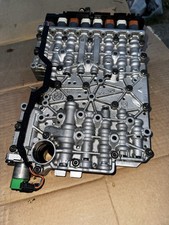
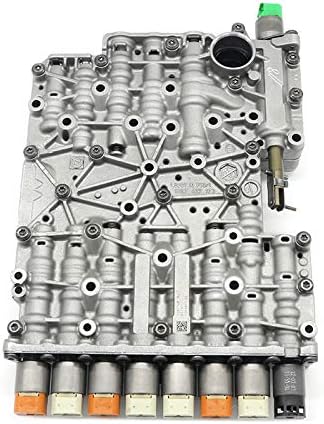
Trade publication AutoInc., the Automotive Service Association's technical journal, lays out the ZF8HP's architecture directly: the transmission control module assembly (TCMA) sits completely inside the transmission, and it's "comprised of the control module, speed sensors, temperature sensor, park position sensor and solenoids." The article notes the TCMA "is serviced/sold complete with a valve body." In practice that means the input speed sensor circuit isn't a $40 part with its own connector outside the case -- it's a conductor-plate trace built into the same assembly that holds the solenoids. If a confirmed internal fault is setting P0716, the repair is a valve body/TCMA replacement, full stop. There's no intermediate step where you order just a sensor.
That's exactly why the diagnostic order matters more here than it does on a transmission with an external, bolt-on sensor. Every step below that can rule the TCMA out is a step that can save you from an unnecessary valve body job.
What a Confirmed Sensor-Circuit Failure Actually Looks Like
It helps to see a documented case of what sets this exact code pair for a mechanical reason, even on a different platform. GM Service Bulletin 16-NA-013, hosted by NHTSA, covers 2016 Buick Enclave/LaCrosse/Regal, Cadillac XTS/SRX, Chevrolet Equinox/Impala/Traverse and GMC Acadia/Terrain models with GM's 6T70-family transaxles (RPO codes MH2, MHM, M7U, M7V, M7W, M7X). The bulletin's condition statement: "Some customers may comment on a condition of no Reverse. Some may also comment on no 3rd gear. Technicians may find an erratic input speed signal. DTCs P0716 and/or P0717 may be found as active or history DTCs." The documented cause: the input shaft speed sensor reluctor ring retainer ring sitting out of its groove. The fix is a hard-parts job -- replacing the retainer ring, the reluctor wheel itself, the 3-5-Reverse clutch piston, and the 3-5-Reverse and 4-5-6 clutch housing assembly.
That's not a ZF8HP bulletin, and the two platforms build their speed sensors differently -- GM's 6T70 family reads a toothed reluctor wheel with an externally-referenced sensor, while the ZF8HP's sensor circuit lives inside the TCMA with no separate reluctor ring to inspect from outside the case. But the mechanism is the lesson worth taking: a real, physical, mechanical problem (a ring out of its groove) corrupted the signal badly enough to set exactly this code pair, with no wiring fault anywhere in the circuit. P0716 doesn't tell you whether you're looking at wiring, fluid contamination, a damaged sensing surface, or a dead module -- it only tells you the signal failed a plausibility check. On the ZF8HP that same category of internal mechanical fault is one of the reasons a confirmed P0716 so often ends at a valve body/TCMA replacement rather than a connector repair.
The Companion Bulletin: TSB 21-003-14 Rev. A and P215C
On 845RE-equipped Chrysler products, there's a real, documented TCM software bulletin that addresses a related -- but not identical -- correlation fault. FCA's Technical Service Bulletin 21-003-14 Rev. A, dated December 5, 2014 and hosted by NHTSA, covers 2014 Dodge Charger (LD), Chrysler 300 (LX), Jeep Grand Cherokee (WK), Dodge Durango (WD) and Ram 1500 (DS) models equipped with the 845RE (sales code DFL). Among several shift-quality calibration fixes, it specifically addresses "Malfunction Indicator Lamp (MIL) illumination and Diagnostic Trouble Code (DTC) P215C Output Shaft Speed, Wheel Speed Correlation setting on AWD equipped vehicles" with a TCM reprogram -- software only, no hardware.
P215C is not P0716 -- it's an output-side correlation code, not an input/turbine performance code -- but it belongs to the same family of plausibility checks the TCM runs on speed data, and it's worth knowing this bulletin exists before you assume every speed-correlation complaint on an 845RE needs a valve body. The bulletin's own diagnostic instructions are specific and worth following to the letter: using wiTECH, verify all systems first, and "if any DTCs other than the ones listed above are present, record them on the repair order and repair as necessary before proceeding further with this bulletin." After the reflash, the procedure requires driving the transmission up to at least 55°C (131°F) and explicitly warns: "Do not perform the Quick Learn procedure if TCM DTCs are present. Repair transmission as required per the DTC flow chart." In other words, even Chrysler's own documented software fix assumes you've cleared and confirmed any real fault codes -- including a genuine P0716 -- before you run an adaptive relearn on top of it. Reflashing over an unresolved sensor-circuit fault doesn't fix the fault; it just adds a relearn on top of bad data.
Rule Out the Solenoid Before You Condemn the Sensor Circuit
This platform has a well-documented failure mode that produces nearly identical drivability symptoms to a speed sensor fault without ever setting a P07xx code. Sonnax's own product documentation for its ZF8HP45/55/70 and 845RE solenoid test manifold states plainly that the leading cause of solenoid failure on this platform is "an inability to maintain an internal mechanical seal, resulting in a multitude of drivability concerns," and specifically notes that failure "is not an electrical failure." A solenoid that's lost its internal seal can produce harsh shifts, erratic shifts, flare and delayed engagement that feel exactly like a bad speed signal on a test drive -- but because it's a hydraulic/mechanical failure, not an electrical one, it won't throw a sensor circuit code at all. If you've got drivability complaints and no stored P07xx code, look at the solenoid pack before you start chasing a sensor problem that was never there.
Confirm the Generation Before You Order Anything
If the diagnosis does point to a confirmed internal fault and a valve body/TCMA is the real fix, ordering the wrong generation is the single most common way to waste a day. Sonnax technical specialist Jim Dial's identification guide, published through Transmission Digest in April 2023, documents a hard split on this platform: Gen 1 units are classified 8HP45, 8HP70 and 8HP90 (badged 845RE); starting in 2019, some of the same vehicle lines moved to Gen 2, classified 8HP50, 8HP75 and 8HP95 (badged 850RE). The article explains that Gen 2's "B" brake piston eliminated the separate B2 release circuit in favor of a return spring, the valve body casting changed to match, and the B and D solenoids swapped physical positions between generations with new-style caps that use different snout diameters than the earlier units. None of that is interchangeable. Read the valve body casting and separator plate stamp -- Sonnax's published ZF8 separator plate chart lists OE codes like A048/B048 for Gen 1 845RE/ZF8HP45/70 fitment -- before you place an order, not after.
Diagnostic Order
- Pull all stored and pending codes, not just P0716. A scan tool with full transmission-module access will show you whether you're looking at an isolated P0716, a P0715/P0717 alongside it, or an unrelated correlation code like P215C.
- Check for an applicable TCM software bulletin first. On an 845RE with AWD and a companion P215C, TSB 21-003-14 Rev. A's software fix is the documented starting point -- but don't run the Quick Learn relearn until any TCM DTCs, including a real P0716, are resolved.
- Watch live input speed against output speed and calculated engine RPM on a road test. A signal that's flatlined, erratic, or implies an impossible ratio confirms a genuine performance fault rather than a one-time glitch.
- Inspect the harness and connector outside the transmission case. Corrosion, a backed-out pin, or chafed wiring between the TCM harness and the case can produce the exact same code as an internal fault, and it's dramatically cheaper to fix.
- Rule out the solenoid pack if the symptoms are shift-quality related and no P07xx code is stored. Sonnax's documented mechanical-seal failure mode causes similar symptoms without setting a sensor code.
- If the fault is confirmed internal, read the valve body casting and separator plate code before ordering. Match Gen 1 (845RE/8HP45/70/90) or Gen 2 (850RE/8HP50/75/95) exactly -- the parts are not interchangeable.
- Clear codes and road test after any repair -- reflash, wiring repair, or valve body replacement -- before calling the job done.
P0716 tells you the TCM stopped trusting what the input speed circuit was telling it. It doesn't tell you whether that's a cheap wiring fix or a valve body job, and on this platform the cost difference between those two outcomes is significant enough that the diagnostic order above is worth the extra twenty minutes before you order parts.
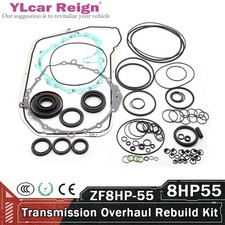
850RE Transmission Overhaul Kit
If the valve body is coming out anyway and the unit shows internal wear beyond the sensor circuit, Core Transmission Parts stocks a full overhaul kit for the 850RE.
Shop the 850RE overhaul kit at Core Transmission Parts →FAQ
What's the difference between P0716, P0715 and P0717 on a ZF8HP, 845RE or 850RE?
They're all input/turbine speed sensor codes, but they describe different failures. P0715 is a circuit malfunction -- the signal is out of its expected voltage or frequency range entirely, often a wiring or connector problem. P0717 means no signal at all, a dead or open circuit. P0716 is narrower: the TCM is receiving a signal, but it's implausible -- it doesn't track with output speed, calculated engine speed, or the commanded gear the way a real input shaft speed should. That distinction matters because a P0716 by itself tells you the circuit is alive and talking; it's the plausibility of what it's saying that failed.
Can I replace just the input speed sensor on a ZF8HP to fix P0716?
Not as a standalone part. AutoInc. documents that on this platform the input speed sensor, output speed sensor, temperature sensor, park position sensor and solenoids are all built into the transmission control module assembly (TCMA), which sits completely inside the transmission and is serviced and sold as one unit with the valve body. There's no sensor connector outside the case to unplug and replace. If the fault is confirmed to be inside the sensor circuit itself, the repair is a valve body/TCMA replacement, not a discrete sensor swap.
Does P0716 always mean the TCMA has physically failed?
No. P0716 only means the signal looked implausible to the TCM -- it doesn't say why. A real GM Service Bulletin (16-NA-013) covering a different transmission family documents the same P0716/P0717 pairing being caused by an input shaft speed sensor reluctor ring retainer ring sitting out of its groove -- a mechanical problem that corrupted the signal the sensor was reading, not a dead sensor. On the ZF8HP the sensor is a conductor-plate circuit rather than a separate reluctor-based unit, but the underlying lesson carries over: a performance code points at a bad signal, and a bad signal can come from wiring, a connector, fluid contamination, or an internal fault, not only a dead TCMA.
Will a TCM reprogram clear a P0716 on an 845RE?
Sometimes, but it depends what's actually stored. FCA's TSB 21-003-14 Rev. A, hosted by NHTSA, documents a TCM software update for 845RE-equipped 2014 Charger, 300, Grand Cherokee, Durango and Ram 1500 models that addresses a related companion code, P215C (Output Shaft Speed, Wheel Speed Correlation), among other shift-quality fixes -- not P0716 directly. The bulletin's own diagnostic instructions are explicit: if other DTCs are present beyond what the bulletin lists, record and repair them first, and don't run the post-flash Quick Learn procedure while TCM DTCs are active. Confirm what's actually stored and resolve any real fault before assuming a reflash is the whole fix.
What's the fastest way to rule out a wiring problem before ordering a valve body for P0716?
Watch live input speed on a scan tool against calculated engine RPM and output speed while road testing, and physically inspect the harness and connector between the TCM wiring and the transmission case for corrosion, a backed-out pin, or chafed insulation. A signal that drops out, spikes, or goes erratic in a pattern that tracks with harness movement (flexing a wiring loom, hitting a bump) points at wiring outside the case, which is a far cheaper fix than a valve body. A signal that's wrong in a consistent, repeatable way regardless of wiring position points more toward the internal circuit. Also rule out Sonnax's documented solenoid-seal failure mode first, since it produces similar harsh-shift and erratic-shift symptoms without setting a P07xx code at all.
Sources
- AutoInc. (Automotive Service Association) — "Chrysler ZF 8HP Service Slants." Backs the TCMA architecture: the control module, input/output speed sensors, temperature sensor, park position sensor and solenoids are housed inside the transmission and serviced/sold complete with the valve body, with no standalone external sensor. autoinc.org
- General Motors LLC / NHTSA — Service Bulletin 16-NA-013, "No Reverse, No Third, DTC P0716, P0717," January 2016. Backs the documented real-world case of P0716/P0717 being set by an input shaft speed sensor reluctor ring retainer ring out of its groove on GM 6T70-family transaxles, and the hard-parts repair that resolved it. static.nhtsa.gov (PDF)
- FCA US LLC / NHTSA — Technical Service Bulletin 21-003-14 Rev. A, "Flash: 845RE Transmission Shift Enhancements, 2-1 Downshift," December 5, 2014. Backs the 845RE (sales code DFL) population across 2014 LD/LX/WK/WD/DS vehicles, the companion DTC P215C software fix, and the diagnostic/Quick Learn procedure requiring TCM DTCs to be resolved before the post-flash relearn. static.nhtsa.gov (PDF)
- Sonnax — Solenoid Test Manifold Kit (35430-VTK) product documentation. Backs the leading cause of solenoid failure on ZF8HP45/55/70 and 845RE units being a non-electrical loss of internal mechanical seal, and the resulting drivability symptoms that mimic a sensor fault. sonnax.com
- Sonnax — ZF8 Valve Body Separator Plate Application Chart. Backs the OE separator plate codes (including A048/B048 for Gen 1 845RE/ZF8HP45/70) used to confirm correct valve body/TCMA fitment before ordering. sonnax.com
- Sonnax (Jim Dial) — "Chrysler ZF8 generations 1 and 2 identification guide," Transmission Digest, April 20, 2023. Backs the Gen 1 (8HP45/70/90, 845RE) vs. Gen 2 (8HP50/75/95, 850RE) split, the B2 circuit elimination, valve body casting changes, and the non-interchangeable B/D solenoid positions and snout diameters between generations. transmissiondigest.com