If you've pulled a speed sensor code on a ZF8HP and gone looking for a bolt-on replacement sensor the way you would on a lot of other transmissions, you've probably noticed there isn't one. That's not a parts-sourcing problem -- it's how the unit is built. On the Chrysler 845RE/ZF8HP45/55/70 and the BMW, Audi, Jeep and Land Rover ZF8HP variants, the input and output speed sensors aren't separate components wired to a connector on the case. They're built into the transmission control module assembly (TCMA), the same housing that carries the solenoids, and it's sold and serviced as one unit with the valve body.
That architecture changes how you should approach a speed sensor code. Before you order anything, you need to know what's actually failing, what codes and symptoms it produces, and why a "just replace the sensor" mentality doesn't apply here the way it does on a transmission with an external reluctor-style sensor bolted to the case.
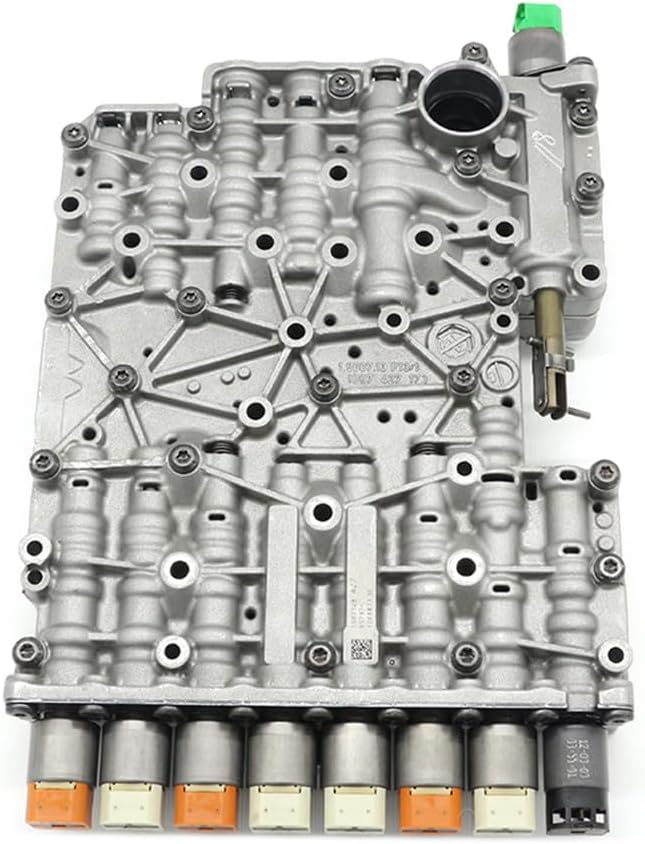
What the Speed Sensors Actually Are, and Why There's No Standalone Part
Trade publication AutoInc., the Automotive Service Association's technical journal, lays out the architecture plainly in its ZF 8HP service guide: the TCMA sits completely inside the transmission rather than under the hood like a conventional PCM, and it's "comprised of the control module, speed sensors, temperature sensor, park position sensor and solenoids." The article goes on to note the TCMA "is serviced/sold complete with a valve body, which makes diagnosis fairly simple" -- simple in the sense that you aren't chasing which of a dozen individually-replaceable parts failed, but it also means there's no five-dollar sensor to swap when one of those circuits goes bad.
That's a different design philosophy than a lot of older transmissions, where the input and output speed sensors are discrete magnetic or Hall-effect units bolted to the case with their own connector, replaceable in a few minutes without touching the valve body. On the ZF8HP, the speed sensor circuits are conductor-plate traces integrated into the TCMA itself. If the sensor circuit fails -- as opposed to a wiring or connector problem outside the transmission -- the repair is a valve body/TCMA replacement, not a sensor replacement.
Confirm the Generation Before You Diagnose or Order Anything
Sonnax technical specialist Jim Dial's generation identification guide, published through Transmission Digest, documents a hard split in this platform: Gen 1 units are classified 8HP45, 8HP70 and 8HP90 and badged 845RE on Chrysler/Dodge/Jeep/Ram applications. Starting in 2019, some of those same vehicle lines moved to Gen 2, classified 8HP50, 8HP75 and 8HP95 and badged 850RE. The valve body castings differ, the solenoids use different cream-and-blue caps with non-interchangeable snout diameters between generations, and even the B and D solenoid positions swap locations on the Gen 2 valve body.
None of that is cosmetic when you're chasing a TCMA/sensor fault. A replacement valve body or TCMA ordered for the wrong generation will not bolt in. Read the valve body casting and separator plate code before you order -- Sonnax's published separator plate chart lists codes A048/B048 (stamped 1087-327-175 ZFS or Mopar 52854725AA/AB) as a Gen 1 845RE/ZF8HP45/70 fitment, distinct from the Gen 1 A028/B028 and A049/B049 codes used across ZF8HP45/55/70.
Symptoms of a Failing Input or Output Speed Sensor Circuit
Without a valid, continuous speed signal from either sensor, the TCM loses the data it needs to control shift timing and shift quality. Expect some combination of:
- Harsh or erratic shifts -- the TCM can't properly time clutch apply/release without accurate input and output speed data
- Delayed or flared engagement going into gear from Park or Neutral
- Transmission holding a gear or refusing to shift out of a gear at all
- Limp mode / fail-safe mode, where the TCM defaults to a conservative gear to protect the hardware when it can't trust the speed data it's getting
- MIL illumination with a stored P07xx speed sensor code
- Inaccurate speedometer reading or cruise control dropping out, since output speed feeds both
On the code side, the generic OBD-II codes are P0715/P0716/P0717 for the input (turbine) speed sensor circuit and P0720/P0721/P0722 for the output speed sensor circuit, depending on whether the fault is a general circuit malfunction, a performance/range issue, or a complete loss of signal. On Chrysler 845RE applications specifically, FCA's Technical Service Bulletin 21-003-14 Rev. A documents DTC P215C -- Output Shaft Speed, Wheel Speed Correlation -- as a code that can set on AWD-equipped LD, LX, WK and DS vehicles, alongside complaints of a harsh bump feel on the 2-1 downshift. The bulletin's entire fix for that code and symptom set is a TCM software reprogram, not a hardware replacement, which is the first thing to rule out before you assume you're looking at a failed TCMA.
Don't Jump Straight to "It's the Sensor"
This platform has a documented failure mode that produces nearly identical symptoms to a sensor fault without setting a sensor code at all. Sonnax's own product documentation for its ZF8HP45/55/70 and 845RE solenoid test manifold states plainly that "the leading cause of solenoid failure" on this platform "is an inability to maintain an internal mechanical seal, resulting in a multitude of drivability concerns" -- and specifically calls out that this failure mode "is not an electrical failure." A solenoid that's lost its internal seal will produce harsh shifts, erratic shifts and delayed engagement that look exactly like a speed sensor problem on a test drive, but it won't throw a P07xx sensor code because the sensor circuit itself is fine.
Work the diagnosis in this order before you commit to a TCMA or valve body:
- Pull codes and confirm TCM software level. If you're seeing DTC P215C on an 845RE and no other stored speed-sensor fault, TSB 21-003-14 Rev. A's software reprogram is the documented fix -- check that before replacing anything.
- Confirm the generation. Read the valve body casting and separator plate code so any replacement assembly you order actually fits (Gen 1: 8HP45/70/90, 845RE. Gen 2: 8HP50/75/95, 850RE).
- Check wiring and connectors outside the transmission. Damaged wiring, a corroded connector pin, or a pin not fully seated between the PCM/TCM and the transmission harness can produce the same P07xx codes as an internal TCMA fault, and it's a far cheaper fix if that's where the problem actually is.
- Watch input speed vs. output speed on a scan tool while driving. A signal that's flatlined, erratic, or doesn't track with calculated vehicle speed and current gear points at a real sensor circuit fault rather than a seal-related solenoid issue, which typically shows up as pressure/shift-quality symptoms without a dead or erratic speed trace.
- If the sensor circuit is confirmed bad and wiring outside the case checks out, the repair is a TCMA/valve body replacement matched to the correct generation and application -- not a standalone sensor part.
Fluid Matters Too
ZF's own product data sheet for LifeguardFluid 8 specifies that only LifeguardFluid 8 or the newer LifeguardFluid 9 may be used in these transmissions. That's worth confirming any time you're chasing an intermittent speed-sensor-adjacent complaint, because low or incorrect fluid changes hydraulic behavior across every circuit the valve body controls and can produce flare, shift hunting, or delayed engagement that reads a lot like a sensor or TCMA problem on a test drive. Rule out fluid level and type before you spend money on a valve body.
8HP70 Valve Body with Solenoids, Remanufactured
If a P07xx speed sensor code is confirmed real -- wiring checks out, TCM software is current, and the speed trace is genuinely dead or erratic on a scan tool -- a remanufactured valve body replaces the TCMA's sensor circuits along with the solenoid pack in one part.
View the remanufactured 8HP70 valve body →FAQ
Can I just unplug and replace the ZF8HP input or output speed sensor?
Not as a standalone part on the Chrysler 845RE/ZF8HP45/55/70 and the BMW/Audi/Jeep ZF8HP variants. AutoInc. documents that the TCMA -- which houses the control module, input and output speed sensors, the fluid temperature sensor, the park position sensor and the solenoids -- sits completely inside the transmission and is sold and serviced as one unit with the valve body. There is no sensor connector to access from outside the case; a confirmed sensor-circuit fault means a valve body/TCMA job, not a five-minute sensor swap.
What codes does a ZF8HP input or output speed sensor fault set?
The generic OBD-II input/turbine speed sensor codes are P0715 (circuit malfunction), P0716 (performance) and P0717 (no signal); the output speed sensor equivalents are P0720, P0721 and P0722. On Chrysler 845RE applications specifically, FCA's TSB 21-003-14 Rev. A documents DTC P215C, Output Shaft Speed/Wheel Speed Correlation, as a code that can set on AWD-equipped 845RE vehicles, with a TCM software update as the documented fix for that code -- which is why confirming current TCM calibration comes before condemning any hardware.
My 8HP70 is shifting harsh and I suspect a speed sensor -- is it definitely the sensor?
Not necessarily. Sonnax's documentation for the ZF8HP45/55/70 and 845RE solenoid pack states the leading cause of solenoid failure on this platform is a loss of internal mechanical seal, and specifically notes this failure "is not an electrical failure" -- meaning it won't set a sensor or solenoid circuit code even though it produces similar harsh-shift, erratic-shift and delayed-engagement symptoms. A genuine sensor fault pairs a stored P07xx code with an unstable or missing speed signal on a scan tool; harsh shifting with no stored speed-sensor code points elsewhere first.
Does the fix differ between Gen 1 and Gen 2 ZF8HP units?
Yes, and it affects what you can order. Sonnax technical specialist Jim Dial's generation guide documents that Gen 1 units (8HP45, 8HP70, 8HP90, badged 845RE) and Gen 2 units (8HP50, 8HP75, 8HP95, badged 850RE) use different valve body castings, different solenoid cap styles with non-interchangeable snout diameters, and swapped B/D solenoid positions. A TCMA or valve body ordered for the wrong generation will not fit. Confirm the generation from the valve body casting and separator plate code before ordering a replacement assembly.
Sources
- AutoInc. (Automotive Service Association) — "Chrysler ZF 8HP Service Slants." Backs the TCMA architecture: the control module, input/output speed sensors, temperature sensor, park position sensor and solenoids are housed inside the transmission and serviced/sold complete with the valve body. autoinc.org
- Chrysler Group LLC Service Bulletin 21-003-14 REV. A, "Flash: 845RE Transmission Shift Enhancements, 2-1 Downshift" (hosted by NHTSA). Backs DTC P215C (Output Shaft Speed, Wheel Speed Correlation) on AWD-equipped 2014 LD/LX/WK/WD/DS 845RE vehicles, and the TCM software reprogram as the documented fix. static.nhtsa.gov
- Sonnax — Solenoid Test Manifold Kit (35430-VTK) product documentation. Backs the leading cause of solenoid failure on ZF8HP45/55/70 and 845RE units being a loss of internal mechanical seal rather than an electrical failure, and the resulting drivability symptoms. sonnax.com
- Sonnax — ZF8 Valve Body Separator Plate Application Chart. Backs the OE valve body codes, stamped numbers and Sonnax/Mopar cross-reference part numbers used to confirm fitment across ZF8HP45/55/70 and 845RE. sonnax.com
- Sonnax (Jim Dial) — "Chrysler ZF8 generations 1 and 2 identification guide," Transmission Digest, April 20, 2023. Backs the Gen 1 (8HP45/70/90, 845RE) vs. Gen 2 (8HP50/75/95, 850RE) split, non-interchangeable solenoid caps and snout diameters, and the B/D solenoid position swap between generations. transmissiondigest.com
- ZF Friedrichshafen AG — ZF LifeguardFluid 8 Product Data Sheet. Backs the requirement that only ZF LifeguardFluid 8 or ZF LifeguardFluid 9 may be used in these transmissions. aftermarket.zf.com