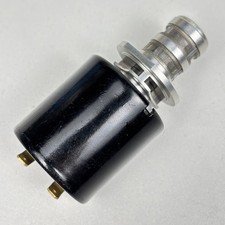
If you drive a 1991-2003 Isuzu Trooper or Rodeo, Honda Passport, Acura SLX, Cadillac Catera, or an older BMW 3 or 5 Series automatic, and the transmission has started banging into gear, shifting soft and late, or dropping into a fixed-gear backup mode with a light on, the pressure control solenoid is one of the first parts worth testing. This is a new 4L30E pressure control solenoid, the cylindrical force motor with two spade terminals and a spool valve on the nose, as shown in the photo. The listing references GM number 24203101.
What the pressure control solenoid does in a 4L30E
The 4L30E was built by GM at its Strasbourg, France plant and sold to several automakers, so the same small rear-drive four-speed sits behind both a BMW inline-six and an Isuzu V6. It has no throttle cable and no governor. The transmission control module decides every shift by switching the on-off shift solenoids, and it decides how hard each shift is by changing the current it sends to this force motor. The force motor is a variable solenoid: more or less current moves its spool, which changes the signal that the pressure regulator works against, and that sets line pressure for every clutch and band in the unit. When the coil weakens, the spool sticks, or its inlet screen plugs with debris, line pressure stops following the computer. Too little pressure gives slipping and flares; too much gives harsh engagements and firm, banging shifts.
Symptoms of a failing 4L30E pressure control solenoid
- Harsh engagement into drive or reverse, and firm shifts at light throttle
- Soft, slow or flared upshifts, worst once the fluid is hot
- Transmission locked in a backup gear with the check-trans or check engine light on
- A pressure control circuit code on 1996-2003 OBD-II vehicles; earlier Trooper, Rodeo and Passport models store their own codes and need a reader for that system
- Shift quality that changes as the engine warms up, which points at a weak coil or a sticking spool
How to confirm before you buy
Start with the fluid. Burnt fluid with friction material in the pan means clutch or band damage that a solenoid will not fix. Then pull codes and measure the force motor circuit at the transmission connector for resistance and for shorts to ground, using our multimeter solenoid test guide. A good coil can still have a stuck spool, so the best proof is a gauge on the line pressure tap while the commanded pressure changes; our line pressure guide walks through it. If pressure is correct but the 2-3 shift still flares, the valve body bores are the more likely cause.
Fitment
This solenoid is listed for the 4L30E from 1991 through 2003. That covers the Isuzu Trooper, Rodeo and Amigo, Honda Passport, Acura SLX, Cadillac Catera, Opel Omega, and the BMW 3 and 5 Series cars that used the 4L30E. GM and its partners changed several parts across this run, including the 2000-up converter clutch and pump on the Trooper and BMW, and the BMW units use a different control system and connector routing than the Isuzu and Honda units. Compare the body shape, terminals and nose of your old force motor with the photo before you install it, or send us your year and VIN and we will check it. If testing shows worn bores instead, the new 1991-2004 4L30E valve body covers the same years.
Install notes
- Drop the pan and filter, unplug the solenoid lead, and remove the retainer holding the force motor in its bore. Note the orientation before it comes out.
- Check the bore for scoring and look for the inlet screen; a missing or torn screen means debris went somewhere and should be found before the new part goes in.
- Lube the new O-rings with clean fluid and push the solenoid in by hand until it seats; never pull it in with the retainer bolt.
- Change the filter at the same time. The 4L30E filter and pan gasket kit covers the BMW E34, E36 and E39. Refill with the GM-spec Dexron fluid or the fluid your owner's manual lists for your vehicle.
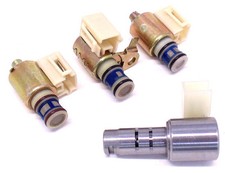
- If the shift solenoids are original as well, the 1990-99 4L30E solenoid kit replaces them in the same pan-off job.
- Clear codes, then road test with a gauge if you have one so you can see line pressure rise with throttle.