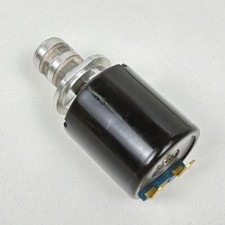
This page is for owners of a 1993-2003 vehicle with the GM 4L30E four-speed automatic, most often an Isuzu Rodeo or Trooper, a Honda Passport, an Acura SLX, a Cadillac Catera, or a six-cylinder BMW automatic, whose transmission now thumps hard into Drive, slurs its shifts once warm, or has fallen back to a fixed backup gear. It is a new GM-branded pressure control solenoid, the round black force motor with an aluminum spool nose and two flat terminals at the base, exactly as the photo shows. The listing references GM/ACDelco number 24220158. Compare the old part with the photo before ordering, because the 4L30E did not use one pressure solenoid design for its whole life.
What the pressure control solenoid does in a 4L30E
The 4L30E has no throttle valve cable. Line pressure is set entirely by the transmission controller through this force motor. The controller sends it a varying current; the coil moves a small spool in the nose, and the spool meters a signal oil that pushes on the pressure regulator. Low current gives high line pressure, and the controller raises current as it wants softer applies. Because every clutch and band in the 4L30E is applied with that line pressure, the force motor decides how firm each shift feels, while the separate on/off shift solenoids decide when a shift happens. A force motor with a weak coil, a worn spool, or debris packed around its nose screens no longer gives the pressure the controller asked for, and the unit either slips or bangs.
Symptoms of a bad 4L30E force motor
- Hard engagement when shifting from Park into Drive or Reverse, and harsh light-throttle upshifts
- Shifts that flare or feel long and soft after the fluid gets hot
- Shift feel that changes from day to day, which often means the spool is hanging in its bore
- A pressure control solenoid code such as P0748 on 1996-2003 OBD-II vehicles; 1994-1995 Trooper, Rodeo and Passport models set their own non-OBD-II codes and drop into limp mode
- Check-trans or check engine light with the transmission held in a backup gear
Not every 4L30E complaint is a pressure problem. A transmission that will not back up, or goes to neutral in Reverse, is more often a reverse clutch or center support fault, which a new solenoid will not cure.
How to confirm before you buy
Check the fluid first. Burnt, dark fluid with friction material in the pan means internal clutch wear, and a new force motor will only make that more obvious. Next, read the codes, then measure the force motor circuit at the transmission connector for resistance and shorts using our multimeter solenoid test guide. On the earlier Isuzu and Honda vehicles without a full OBD-II scan path, our guide to solenoid testing without a factory scan tool fills the gap. The final check is a gauge on the line pressure tap; if pressure does not move as throttle increases, the force motor or its circuit is the cause. Our flare versus slip guide helps separate a pressure problem from worn clutches.
Fitment
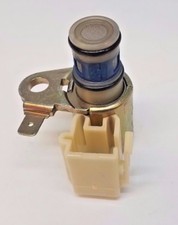
This listing is for the 4L30E from 1993 through 2003. That span covers the Isuzu Rodeo, Trooper and Amigo, the Honda Passport and Acura SLX, the Cadillac Catera, and the BMW 3 Series, 5 Series and Z3 automatics that used the 4L30E. The important caution is the late years. Parts catalogs show that 2000-and-later 4L30E applications can use a different electronic pressure control solenoid, so a 2000-2003 vehicle may need our 2000 4L30E pressure control solenoid instead of this force motor. The surest check is the old part itself: match the round body, the two flat terminals and the spool nose to the photo, or send us the year and VIN and we will confirm before it ships.
Install notes
- Drain the fluid, drop the pan, and remove the filter for access to the valve body.
- Unplug the force motor lead, remove its retaining clip or bracket, and twist it out of the bore without levering on the nose.
- Inspect the bore and the old screens. Metal or friction material packed on the screens points to wear elsewhere that needs attention.
- Lube the new O-rings with clean fluid, press the new force motor in by hand, then refit the retainer and connector.
- Install a new filter and pan gasket; the 4L30E filter and pan gasket kit suits the BMW E34, E36 and E39 versions. Fill with the Dexron-type fluid your owner's manual specifies, as BMW lists its own approved fluid.
- On a high-mileage unit, the 4L30E TCC solenoid sits on the same valve body and is worth replacing in the same job.
- Clear codes and road test, watching for firm but clean engagements and shifts that stay consistent once hot.