

Pressurizes a cylinder with shop air and reads leakage percent on dual gauges so you can separate bad rings from burnt valves or a blown head gasket.
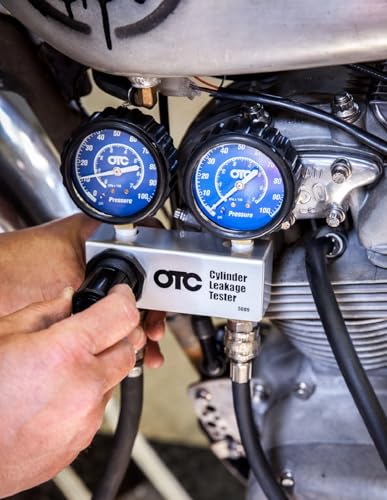
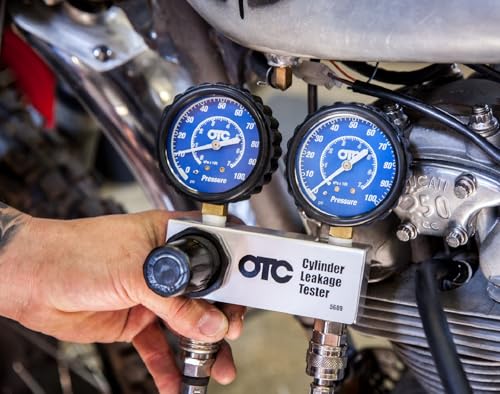
A compression test tells you a cylinder is low. It does not tell you why. This is the tool that answers the why. You bring the cylinder to top dead center on the compression stroke, thread the 14mm flex hose into the plug hole, and feed regulated shop air into it. The left gauge shows the air you put in, the right gauge shows what the cylinder is holding. The gap between them is your leakage percentage.
Where the air escapes tells you the failure. Air out the tailpipe is an exhaust valve. Air out the throttle body or intake is an intake valve. Air out the oil fill or dipstick tube is rings or a scored bore. Bubbles in the radiator or air into the neighboring cylinder is a head gasket. A healthy engine runs single digit to low teens; anything past about 20 percent on a warm engine is a real problem you can now point at before you pull a head.
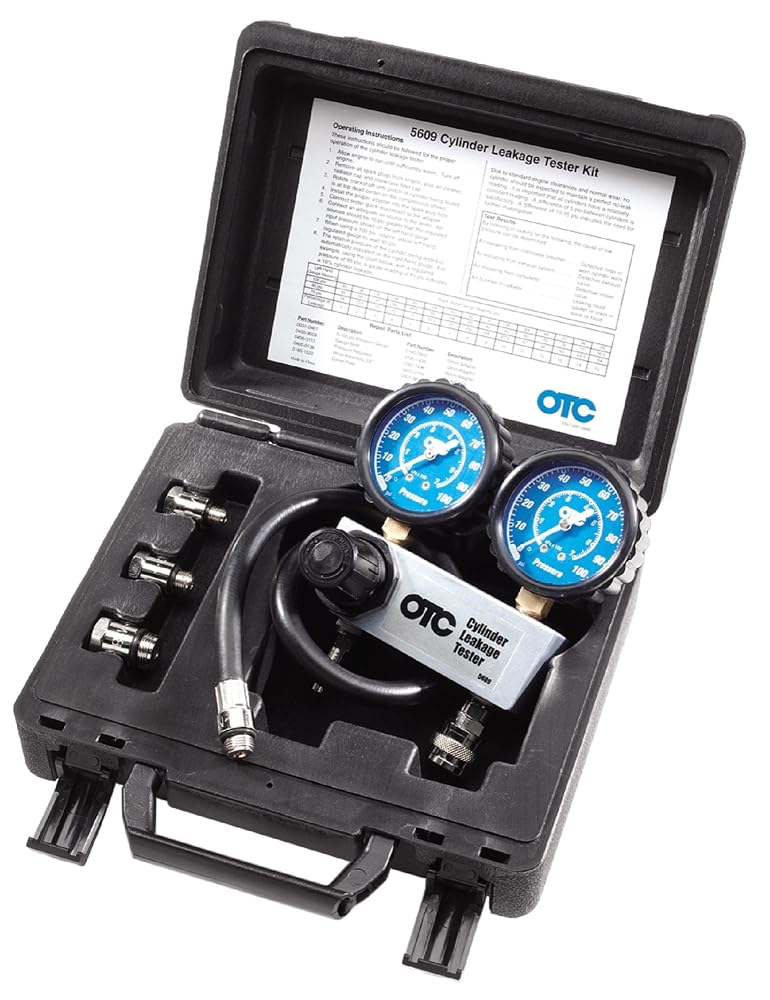
The kit is the OTC 5609: two 2-1/2 inch gauges reading 0-100 psi and 0-700 kPa, chrome bezels with rubber protective boots, and a pressure-regulated aluminum manifold with quick couplers so you set the input pressure once and it stays put. It ships with a 24 inch 14mm flex hose plus 10mm, 12mm, and 18mm thread adapters, which covers most gas engines from small four cylinders through big block V8s and older 18mm plug threads. Everything stores in a blow-molded hard case with the operating instructions under the lid.
You need about 100 psi of shop air to run it. Do the test on a warm engine with the throttle held open, and lock the crank or hold the breaker bar - a cylinder at TDC full of air will try to spin the engine over on you.
| Gauges | |
| Manifold | |
| Hose | |
| Adapters | |
| Air supply required | |
| Case | |
| Part number |