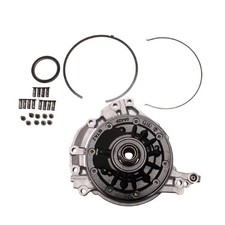
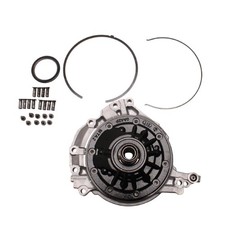
If your V6 Camry, Avalon, Venza, Highlander, Lexus ES350 or RX350 takes a long pause before it bites into Drive or Reverse, slips in every gear once it is hot, or makes a whine that rises and falls with engine speed, the front pump in the U660E six-speed is a prime suspect. This is a remanufactured U660E oil pump assembly. The product photo shows the pump body and gear housing with its center bushing, a new front seal, sealing rings and a set of mounting bolts, so the parts you normally need at the pump come together.
What the oil pump does in a U660E
The U660E is the Aisin six-speed front-drive transaxle that Toyota put behind its V6 engines, starting in the 2007 Camry and ES350 and spreading to the Avalon and Venza. ATSG's technical information describes a gear train with two driving clutches (C1 and C2), three brake clutches (B1, B2, B3), one one-way clutch, a Ravigneaux planetary set and an underdrive planetary. Every one of those clutches is applied by fluid, and the pump is where that fluid pressure starts. The converter hub turns the pump gears whenever the engine runs, and the primary regulator valve in the valve body trims that flow down to line pressure. Toyota then uses pulse-width-modulated solenoids to meter line pressure, clutch apply and converter lockup. The control side can only work with what the pump supplies, so a pump with worn gear clearances or a scored bushing starves all of it at once.
Symptoms of a worn U660E pump
- Delayed engagement into Drive and Reverse, worst after a long hot drive or at idle
- Slipping or flaring that shows up in all six gears rather than on one shift
- A whine that follows engine rpm, present even in Park or Neutral
- Low line pressure on a gauge at the pressure tap
- Fluid that runs hot and darkens soon after a service
- A front seal leak caused by a worn pump bushing letting the converter hub wobble
How to confirm it is the pump
Start with a scan of every module, not just the transmission. Gears Magazine points out that the U660E's transmission control module bolts directly to the case and plugs into the solenoid connector, and those modules have their own failure pattern that can set U0402 and circuit performance codes. Rule that out first. Check the fluid level hot through the overflow plug, because a low level produces exactly the same delayed engagement as a weak pump. Then put a pressure gauge on the line pressure tap; ATSG's pressure tap chart shows line pressure, cooler, rear lube and separate C1 and C2 clutch taps on the case. Low pressure in every range points at the pump or the regulator side of the valve body. Since valve body bore wear is common on this unit, read our U660E and U760E problems guide on the primary regulator and solenoid modulator valves before you condemn the pump.
Fitment
This listing covers the U660E, the front-wheel-drive version used behind the V6. The listing data cross-references Toyota pump assembly numbers 35410-33250, 35410-33260, 35410-73010 and 35410-0R010. Toyota revised parts over the production run, so compare the casting, bolt holes and stator support length with the pump you remove, or send us your year, model and VIN and we will check it. All-wheel-drive V6 models use the U660F; it has its own U660F pump listing. The four-cylinder U760E is a different unit. Browse every part for this family on the U660E collection page.
Install notes
- Gears Magazine reports that the U660E case wears at the main bearing support bore under V6 torque. If the outer bearing race moves at all, repair or replace the case, or the new pump will not run on centerline.
- Look at the converter hub before it goes back in. A grooved or rough hub will cut a new bushing and seal quickly.
- Lube the new seal, rings and bushing with WS fluid, tighten the pump bolts evenly in a cross pattern, and confirm the input shaft spins freely.
- Seat the converter fully into the pump drive gear before mating the transmission to the engine.
- Refill with Toyota WS and set the level at 185 to 194 F per bulletin T-SB-0036-13; our U660E fluid capacity guide walks through it.
- Clear the adaptive values with a scan tool that can perform Toyota's ECT memory reset, then drive cold to hot.
If line pressure was low long enough to cook the valve body, a remanufactured U660E valve body or the U660E shift kit should go in at the same time.