Shift complaints on a 2018-2024 Expedition come in a few flavors: a bang into reverse on a cold morning, a hard 3-4 or 4-5 upshift at part throttle, a clunky 4-3 or 5-3 coming down a grade with a trailer, or an upshift that hangs and then lands late. They all get written up as "shifts rough," but on the 10R80 they come from different causes, and Ford has written a different bulletin for each build window. The cheapest repair is the one that matches the truck in your bay. Swapping a valve body because it is the part everyone talks about is not that.
Everything below comes from Ford's service bulletins as filed with NHTSA, Ford's 10R80 workshop manual section 307-01 and Sonnax's 10-speed tech material. Links are in the Sources section at the bottom. If the complaint is a true slip or RPM flare rather than a harsh or late shift, start with our 10R80 Expedition slipping guide instead.

Three build windows, three different problems
Before anything else, read the door tag for model year and build date. Ford splits Expedition shift complaints like this:
- 2018-2021 Expedition and Navigator: TSB 23-2152 (22 May 2023), "10R80 - Harsh Engagement And/Or Harsh/Delayed Shift." Ford gives the cause as keep alive memory (KAM) in the PCM/TCM or the main control valve body. The fix path is a transmission strategy download and adaptive learning drive cycle, then a valve body overhaul if the complaint stays.
- 2022 Expedition and Navigator built on or before 15-Aug-2022: TSB 26-2226 (08 May 2026, the current version of a bulletin that has been revised several times). Same harsh/delayed engagement and shift symptoms, but Ford adds a hard-parts cause: axial movement of the CDF clutch cylinder (7H351) sleeve, which leaks oil out of the clutch circuits. There is a pressure test to prove it before the unit comes out.
- 2022-2024 Expedition and Navigator built 16-Aug-2022 through 23-Sep-2024: TSB 26-2408 (16 Sep 2026, supersedes 26-2309). Harsh 3-4 and 4-5 upshifts, harsh 5-3 and 4-3 downshifts and harsh reverse engagement, usually worse cold. Ford blames F clutch friction plates brinelling into the clutch and planetary container cylinder (7B177).
The first two bulletins list the same DTCs: P0751 through P0772 (shift solenoid A-F performance and stuck on), P2700 through P2708 (friction element apply time), and the gear ratio codes P0729, P0731-P0736, P076F, P07D9, P07F6 and P07F7. A harsh-shift Expedition with no codes at all is still in scope. Ford's procedure just takes a different branch.
Name the shift before you name the part
The 10R80 has six friction clutches (A through F), and every gear change releases one clutch and applies another while the rest stay on. Ford's 307-01 clutch application chart gives 3rd as A, C, D, E; 4th as A, C, D, F; 5th as A, C, E, F; and reverse as A, B, D, F. Work the shifts in the complaint through that chart:
| Shift | Released | Applied | F clutch role |
|---|---|---|---|
| 3-4 upshift | E | F | Oncoming |
| 4-5 upshift | D | E | Held, carrying torque |
| 4-3 downshift | F | E | Offgoing |
| 5-3 downshift | F | D | Offgoing |
| Reverse engagement | - | A, B, D, F | Applied |
Every shift on 26-2408's symptom list involves F applying, releasing or holding torque while the others swap. That is why a late-build truck with a harsh 3-4 and a harsh 4-3, and nothing wrong on 1-2 or 2-3, points so strongly at the F pack. When F plates have brinelled into the container, the clutch does not release or pick up smoothly, and the adaptive strategy cannot fully learn around it, especially in cold, thick fluid.
A complaint spread across many shifts with no common clutch reads differently. That pattern points at something every clutch shares: line pressure, a sticking regulator in the valve body, bad adaptive values, or a leak in the CDF cylinder that feeds three clutches at once. Log it before you decide. Record commanded gear, turbine and output shaft speed (TSS, OSS), TFT, and line pressure desired through the bad shift, and note whether it happens cold, hot or both. The cold/hot split matters for the 2022 bulletins, as you will see below.
The basics that fake a valve body problem
Battery and keep alive memory
Sonnax's 10-speed valve body article covers a complaint every 10R80 shop knows: a work truck whose battery needs a charge after sitting a few days. After the repair, the unit does not adapt properly and comes back with harsh engagements or erratic shifts. The rebuilder suspects the valve body, but the cause is voltage. Load test the battery and check charging before anything else. Ford's change between bulletin versions points the same way. TSB 23-2123 blamed the adaptive calibration not keeping up with hardware break-in. Its replacement, 23-2152, names the keep alive memory in the PCM/TCM. Either way, the shift tables are the first thing to reset.
Fluid level and fluid type
Ford's 10R80 specification calls for Motorcraft MERCON ULV (XT-12-QULV, spec WSS-M2C949-A), with 12.5 qt (11.8 L) for a dry unit. A pan drain takes far less, so fill to the hot mark, not by quart count. Sonnax's 10-speed clutch pack article says plainly that universal and older fluids cause shift complaints and early failure in these units. If the truck has had a quick-lube flush, find out what went in. The wrong viscosity changes apply timing on every shift, and no relearn fixes that.
2018-2021 Expedition: software, relearn, then the valve body
TSB 23-2152's procedure is short. If none of the listed DTCs are stored, reprogram the transmission strategy download into the PCM/TCM and run the adaptive learning drive cycle from WSM 307-01. If the complaint is gone, the job is done. Ford pays 0.8 hours for that branch. If DTCs are present, or the complaint survives the relearn, the main control valve body gets overhauled. Ford allows 4.6 hours for an Expedition or Navigator overhaul and 5.3 hours if the reprogram and relearn were tried first.
Two details from the bulletin save comebacks. First, metal flakes on the pan magnet are normal on these units. Ford shows a picture of an acceptable amount, so do not sell a rebuild off the magnet alone. Second, the separator plate depends on the shifter. JL1Z-7Z490-C is for an Expedition with the rotary gear shift knob and for the Navigator. JL3Z-7Z490-E is for an Expedition with column shift. The wrong plate in the wrong truck puts you right back where you started.
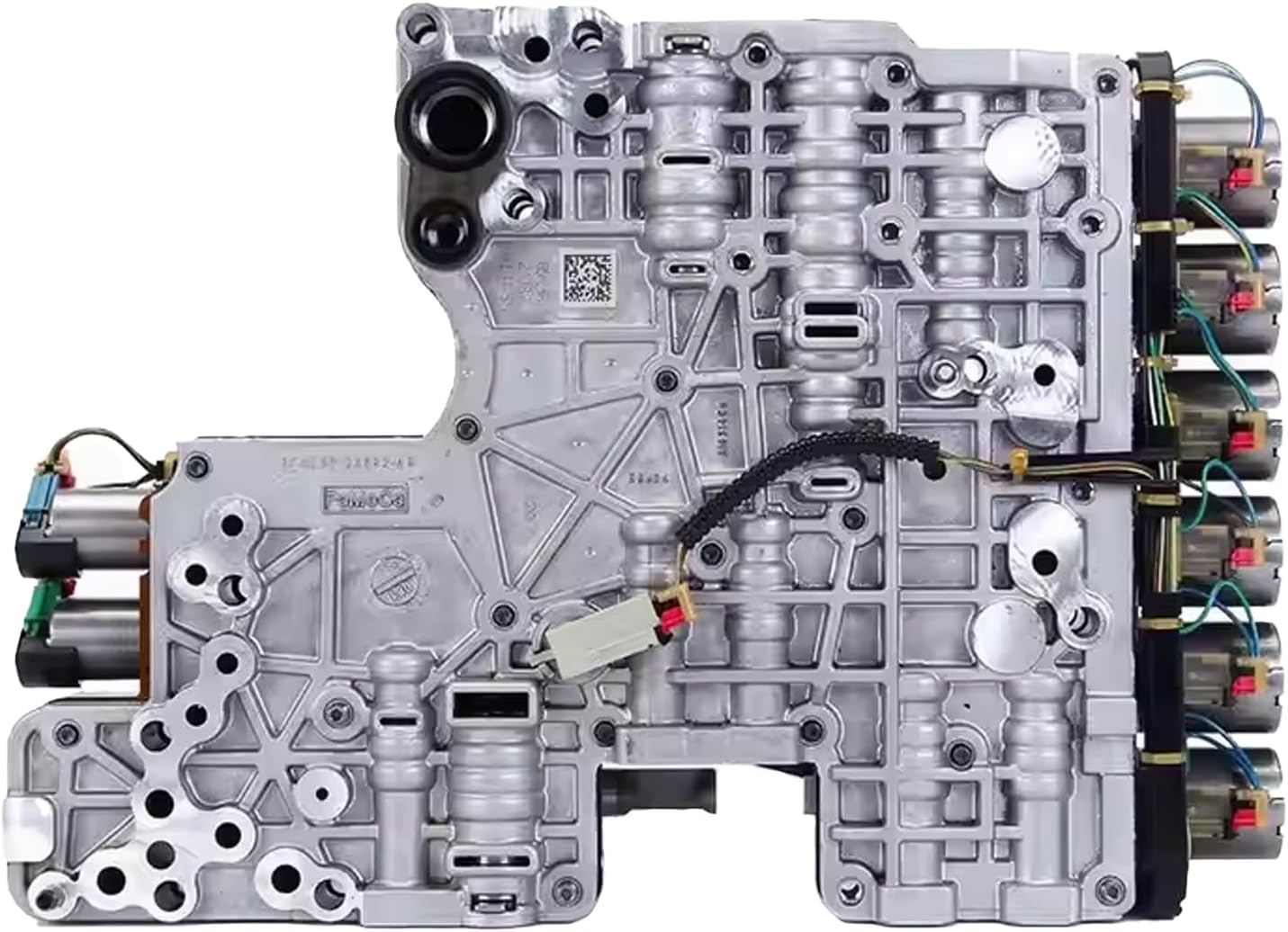
Sonnax's inspection list for the 10R80 valve body is where I start. Check the main pressure regulator, TCC priority, TCC regulator and boost valves for bore wear, and check the latch valves for damage from the retainer clips. Check the solenoid bores for tightness. Ford's solenoids are direct acting and clipped into the casting, and Sonnax notes they rarely fail. One more tip from the same article: new OE separator plates are light brown, and Ford used yellow plates earlier. A "new" valve body with a yellow plate is a used core. For harsh shifts with high line pressure, Sonnax lists the LPC signal damper piston kit (105740-04K). For low line pressure and delayed engagement, it lists the main pressure regulator valve kit (105740-12K or the oversized 105740-20K). The Zip Kit (10L80-G1-10R80-ZIP) bundles the common fixes for an overhaul.
2022 early build: prove the CDF sleeve before you pull it
For a 2022 Expedition or Navigator built on or before 15-Aug-2022, TSB 26-2226 starts with software. Use the latest FDRS to check for a newer PCM calibration, flash it if there is one, and run the adaptive drive cycle. If the shift complaint is still there, test the CDF circuit. Ford gives two ways to do it.
With a VCMM pressure transducer (PVT): install it in the line pressure port and run the FDRS Transmission Clutch Circuit Leak Test. FDRS asks whether the complaint happens only at TFT of 49 C (121 F) or below, or at 50 C (122 F) and above. Answer from your road test log. A red result sends you to the repair procedure.
With a mechanical gauge:
- Use a vibration-dampened gauge rated to at least 300 psi (2,000 kPa). The port is M10x1.0. Ford warns that threading an NPT fitting into it damages the case, so use an M10x1.0 male to 1/8 in. FNPT adapter.
- In FDRS, pull up RPM_DSD, PVT pressure, TFT and SSA_AMP through SSF_AMP. Put the truck in Park with the parking brake set, at the TFT range where the complaint occurs.
- Command all six shift solenoids to 0 mA, drop desired engine speed to 500-600 RPM, and raise desired line pressure to 1900-2000 kPa (275-290 psi). Actual pressure will read below commanded, and Ford says that is expected.
- Record the gauge as Pre Ramp. Command SSA to 1.0 A and record Applied A. Return SSA to 0 mA, command SSC to 1.0 A and record Applied C.
- Enter all three values into Ford's CDF calculator. If the A-clutch leakage rate is red, the problem is in the A circuit and the bulletin does not apply. If A is green but "C-Clutch vs A-Clutch" is red, the CDF cylinder is leaking.
The labor numbers show why you test first. A passing CDF test is 0.8 hours. A failed test with cylinder replacement is 11.4 hours on an Expedition 4x2 and 12.4 hours on a 4x4. The repair takes the unit out, removes the clutch and planetary assembly, replaces the CDF cylinder and the seals around it, and inspects the C and D clutch packs. Sonnax's CDF Drum Saver Kit (129910-01K) covers worn 10R80 drums for builders who repair them. Sonnax also lists shift flares and bumpy downshifts among CDF drum failure symptoms, and says sleeve movement and sealing ring damage are not usually the valve body's fault. A new valve body on top of a leaking CDF cylinder does not fix it.
2022-2024 late build: the gray silt check
On an Expedition built 16-Aug-2022 through 23-Sep-2024, TSB 26-2408 has the simplest first step of the three. Drop the pan, remove the filter and look at the top side of the filter. If there is gray silt on it, the bulletin applies. If there is not, Ford says the article does not apply and sends you back to normal 307-01 diagnosis. Ford pays 2.2 hours for that inspection on either drive type. The silt is the F clutch friction material and container wearing into each other.
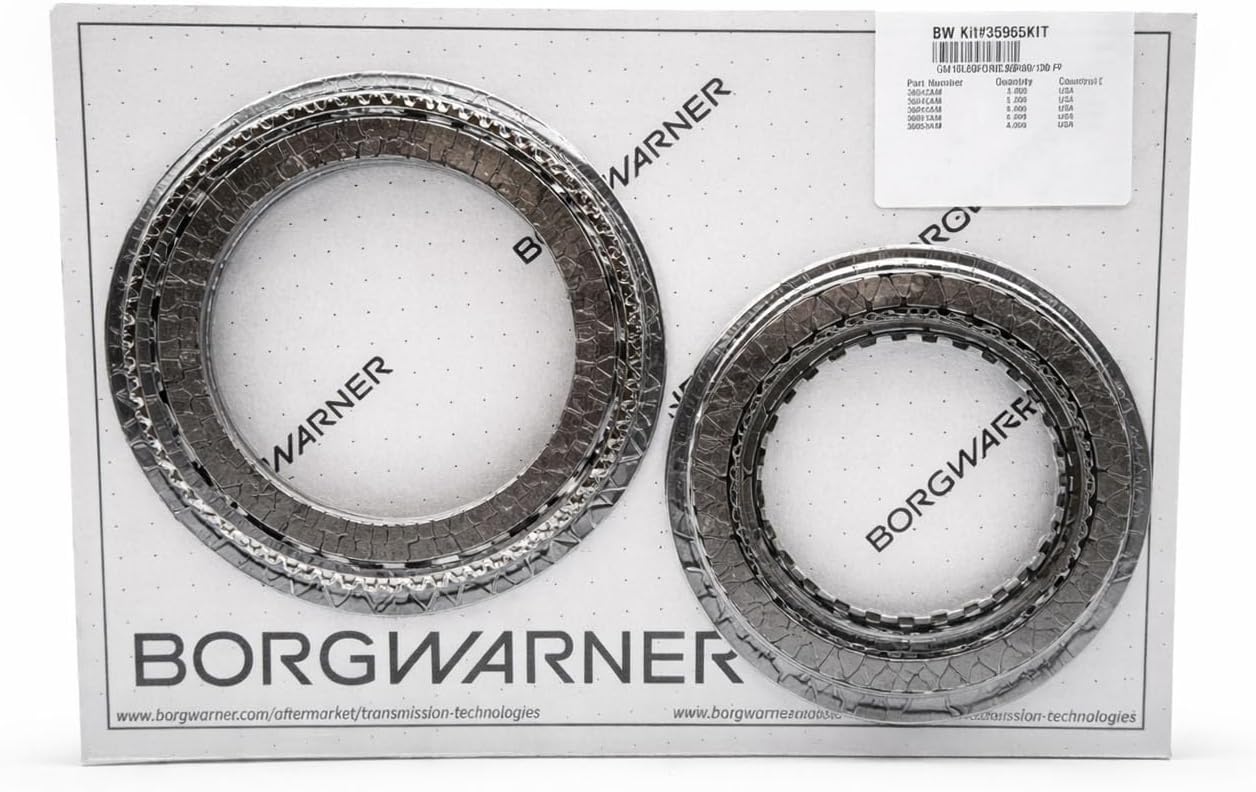
If the filter fails, the transmission comes out: 10.4 hours on a 4x2 Expedition and 11.6 hours on a 4x4. That covers the valve body overhaul and F clutch job. The parts list is specific:
- Clutch and planetary container cylinder PC3Z-7B177-A
- 4 F clutch friction plates HL3Z-7B164-D and 4 F clutch steel plates HL3Z-7B164-G (Expedition and Navigator part numbers)
- A selective F clutch snap ring from 1.5 mm (HL3Z-7H365-C) to 2.3 mm (HL3Z-7H365-G), set by the F clutch pack endplay measurement
- Seals the teardown disturbs: converter hub seal, front support to case seal, the four No. 3 sun gear shaft seals, input shaft seals and front support bolt seals
- Separator plate L1MZ-7Z490-M if the F-150/Expedition/Navigator 10R80 plate needs replacing during the valve body overhaul
Do the endplay check. With a fresh pack and a new container, the old snap ring rarely gives the right clearance. A pack that is too tight drags, and one that is too loose gives you a harsh 3-4 again, which is the shift you were hired to fix.
After any repair: the relearn is part of the job
All three bulletins end with the adaptive learning drive cycle from WSM 307-01, and all three carry the same customer note. When the adaptive strategy is reset, the computer has to relearn, and that "may result in firmer than normal upshifts and downshifts for several days." Tell the owner before they leave. If you skip that conversation, a correct repair comes back as a comeback in two days. If the truck was on a weak battery during the repair, replace or charge it first, or the relearn will not stick.
How I work a harsh-shifting Expedition 10R80
- Door tag. Model year, build date, rotary or column shift.
- Battery and charging. Load test it before anything else.
- Codes and a log. Name the shift, the clutch that is releasing and the one applying, and whether it happens cold or hot.
- Fluid. MERCON ULV only, level checked hot.
- Software and relearn on any build year.
- Then the bulletin for that build: valve body for 2018-2021, CDF pressure test for 2022 early build, filter silt check for 2022-2024 late build.
Sonnax Zip Kit for the 10R80 valve body overhaul
TSB 23-2152's fix for a 2018-2021 Expedition that still shifts hard after the relearn is a valve body overhaul. The Sonnax 10L80-G1-10R80-ZIP kit bundles the regulator, TCC and solenoid fixes Sonnax lists for this valve body, all in one box.
Shop the part for this fix →Need individual valve kits or solenoids? The 10-speed parts collection covers the parts the Ford 10R80 and GM 10L80 share.
Need parts for this job?
Our 10R80 parts page has the Sonnax Zip Kit, OEM valve bodies, friction modules, master rebuild kits and MERCON ULV-spec fluid for the Expedition 10R80, with checkout on site.
FAQ
Why does my Ford Expedition shift hard?
On a 10R80 Expedition the cause depends on build date. Ford's bulletins point to keep alive memory or the main control valve body on 2018-2021 trucks, a moving CDF clutch cylinder sleeve on 2022 trucks built by 15-Aug-2022, and F clutch plates brinelling into the 7B177 container on trucks built 16-Aug-2022 through 23-Sep-2024. A weak battery and the wrong fluid can cause the same harsh shifts on any year.
Is there a TSB for Expedition 10R80 harsh shifting?
Yes, three. TSB 23-2152 covers 2018-2021 Expedition and Navigator with software, an adaptive relearn and a valve body overhaul. TSB 26-2226 covers 2022 units built on or before 15-Aug-2022 with a CDF leak test, and TSB 26-2408 covers 2022-2024 units built 16-Aug-2022 through 23-Sep-2024 with an F clutch and container replacement.
Why is my Expedition harsh going into reverse when cold?
On a 2022-2024 Expedition built 16-Aug-2022 through 23-Sep-2024, TSB 26-2408 lists harsh reverse engagement, harsh 3-4 and 4-5 upshifts and harsh 5-3 and 4-3 downshifts, worse when cold. The F clutch is applied in reverse and works in all of those shifts. Pull the filter and look for gray silt on its top side to confirm.
Will a software update fix 10R80 harsh shifts?
Sometimes. On 2018-2021 trucks with no stored codes, Ford's first step is a strategy download and adaptive drive cycle, and that can be the whole repair. On 2022 early-build trucks a newer PCM calibration comes first too. Software will not fix a leaking CDF cylinder or brinelled F clutch plates.
Why does my Expedition shift firm right after a transmission repair?
Ford's bulletins note that when the adaptive strategy is reset, the relearn may cause firmer than normal upshifts and downshifts for several days. Run the adaptive learning drive cycle after the repair and make sure the battery is healthy, or the shift tables will not learn correctly.
Related guides
- 10R80 Expedition Common Problems and Fixes
- 10R80 Expedition Slipping: Causes and Fix
- 10R80 Harsh and Delayed Shifts
- 10R80 Valve Body Problems and Testing
- 10R80 F150 Shift Problems: Diagnosis and Fix
Sources
- Ford Motor Company — Technical Service Bulletin 23-2152, "10R80 — Harsh Engagement And/Or Harsh/Delayed Shift" (22 May 2023, supersedes 23-2123). 2018-2021 Expedition/Navigator applicability, DTC list, keep alive memory and valve body causes, reprogram and relearn sequence, labor times, normal magnet flakes, shifter-specific separator plates. The superseded 23-2123 (13 April 2023) gave the earlier cause, adaptive calibration not adapting to hardware break-in. 23-2152 (PDF) · 23-2123 (PDF)
- Ford Motor Company — Technical Service Bulletin 26-2226, "Harsh/Delayed Engagement And/Or Harsh/Delayed Shift" (08 May 2026). 2022 Expedition/Navigator built on or before 15-Aug-2022, CDF clutch cylinder 7H351 sleeve movement, M10x1.0 port warning, PIDs, commanded pressures, CDF calculator steps, 121 F/122 F split, labor times. static.nhtsa.gov (PDF)
- Ford Motor Company — Technical Service Bulletin 26-2408, "Harsh Shifts Between 3rd And 5th Gears And/Or Harsh Reverse Engagement, Symptoms Worse When Cold" (16 September 2026). 2022-2024 build window, F clutch brinelling into container 7B177, gray silt filter check, parts list and selective snap rings, labor times. static.nhtsa.gov (PDF)
- Ford Motor Company — Workshop Manual Section 307-01, 10R80 "Specifications" (2019 model year). MERCON ULV XT-12-QULV, WSS-M2C949-A, 12.5 qt (11.8 L) fill. Specifications (PDF)
- Sonnax — "Tackling Ford & GM 10-Speed Valve Body Problems, Failing Batteries & More." Battery and adaptation complaints, valve wear points, separator plate color, solenoid notes, CDF drum symptoms, kit numbers 105740-04K, -12K, -20K, 129910-01K and the Zip Kit. sonnax.com
- Sonnax — "Troubleshooting Pressure Loss in 10-Speed Clutch Packs." Universal and older fluids causing shift complaints and early failure, MERCON ULV only, sealing ring and bushing wear, CDF Drum Saver Kit 129910-01K for the 10R80. sonnax.com