A red puddle under a 10R80-equipped F-150, Mustang, Explorer, or Transit sends most owners straight to the worst-case assumption: internal failure. Most of the time it isn't. Ford's own workshop manual documents exactly two serviceable external sealing points on this transmission that account for the bulk of real leaks — the output shaft seal and the fluid pan gasket — plus a fill plug and cooler line seals that weep after the pan or lines have been opened. None of that requires pulling the transmission. What does complicate the picture is a 2024 Ford Technical Service Bulletin that also uses the word "leak" to describe a completely different, internal problem. Mixing the two up is how people end up replacing a seal that was never the issue.
The short version: the output shaft seal (service part 7052, base part 7B215) at the rear of the case and the fluid pan gasket (HL3Z-7A191-B) are the documented external leak points on a 10R80, per Ford's own workshop manual and parts catalog. Output shaft locknut torques to 148 lb-ft (200 Nm), the new output shaft flange bolt to 81 lb-ft (110 Nm), and the fluid fill plug to 52 lb-ft (70 Nm). Separately, Ford TSB 24-2304 (Sept. 2024) covers an internal hydraulic circuit leak from a worn CDF clutch cylinder sleeve — it causes harsh or delayed shifts, not fluid on the ground, and it needs a teardown, not a gasket.
Where a 10R80 Actually Leaks From
There are really only three places Ford's own documentation treats as serviceable sealing points for this transmission, plus one wildcard on 4WD trucks:
- Output shaft seal (service part 7052, base part 7B215) — at the back of the case where the output shaft exits to the rear driveshaft flange on RWD trucks, or into the transfer case on 4WD trucks.
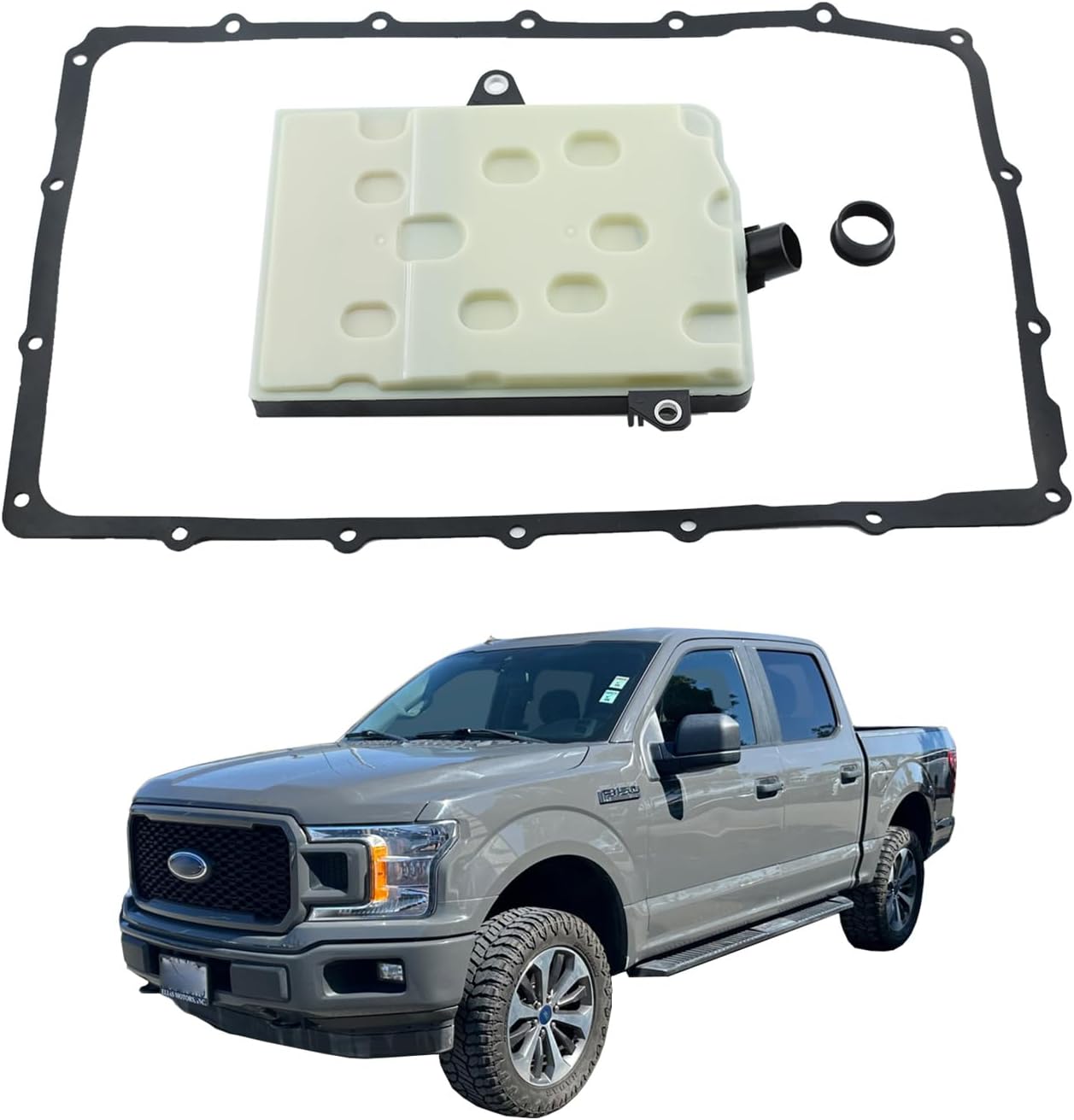
- Fluid pan gasket (HL3Z-7A191-B) — the full perimeter seal under the aluminum pan.
- Transmission fluid fill plug — a threaded plug that doubles as the fluid level indicator housing; it gets removed and reinstalled every time the fluid is checked or topped off.
- Fluid cooler tube seals and backing rings (5L7Z-7D285-A, 5L7Z-7J324-A) — the O-ring style seals where the cooler lines thread into the case, listed as service items in Ford's own parts catalog whenever that area is opened.
A wet pan on a shop floor doesn't automatically mean the pan gasket is the culprit. Fluid thrown off the output shaft seal, especially on a 4WD truck where the leak point sits right next to the transfer case mating surface, runs forward along the case and drips off the lowest point — which is usually the pan. Clean the whole underside, run the truck, and recheck before you commit to a gasket.
Output Shaft Seal: the Most Common External Leak
Ford's documented procedure for replacing this seal starts with the vehicle in neutral on a hoist. On rear-wheel-drive trucks, the driveshaft comes off first, then the output shaft flange bolt is removed and discarded — it's a one-time-use fastener — and the flange is index-marked and pulled. The output shaft nut comes off next using special tool 307-458. On 4x4 vehicles, the transfer case has to come off before any of that, since the seal sits at the transmission's rear face under where the transfer case bolts up [1].
The seal itself gets pulled with special tool 307-309 (a torque converter seal remover) and a slide hammer, then the new seal is driven in with installer 307-660. On reassembly, the output shaft nut torques to 148 lb-ft (200 Nm), and the new output shaft flange bolt — again, always replaced, never reused — torques to 81 lb-ft (110 Nm) [1]. Those numbers matter more than they look: an undertorqued flange bolt lets the flange walk slightly under load and chews the new seal's sealing lip; an overtorqued one can distort the flange face. Either way you're back under the truck in a few thousand miles.
Practical note: on a 4WD truck, don't assume the fluid at the transmission/transfer-case joint is automatically transmission fluid. The transfer case has its own seal and its own fluid on the other side of that same joint. A shop towel and a sniff test tells you red ATF from gear oil most of the time; if you need certainty, UV dye run through the transmission (not the transfer case) and a blacklight after a drive cycle will confirm which side is actually leaking before you pull anything apart.
Pan Gasket and Fill Plug: Check These First
The pan gasket is the lowest-effort check and the lowest-cost fix, which is exactly why it's worth ruling out before you plan an output shaft seal job. Ford's own parts catalog lists the fluid pan gasket (HL3Z-7A191-B) alongside the fluid filter and filter seal as parts to "inspect and replace only if necessary" any time the pan comes off for service [2]. In the field, a warped pan from a bottomed-out skid plate or a pan that's been over-torqued on a prior service is a documented real-world cause of a weeping gasket on this generation of truck, and pan bolts on an aluminum case strip easily if someone's used an impact gun instead of a torque wrench.
The fill plug is the other easy miss. It gets removed and reinstalled during every fluid level check and every drain-and-refill, and Ford specifies 52 lb-ft (70 Nm) for reinstallation — both for the initial fill and for the final fill after the temperature-controlled top-off [3]. A plug that was left loose or snugged by hand after a fluid check is a surprisingly common source of a slow weep that owners chase for weeks before someone actually puts a wrench on it.
| Fastener / Seal | Spec |
|---|---|
| Output shaft locknut | 148 lb-ft (200 Nm) |
| Output shaft flange bolt (replace, don't reuse) | 81 lb-ft (110 Nm) |
| Transmission fluid fill plug | 52 lb-ft (70 Nm) |
| Output shaft seal | Service part 7052 (base 7B215) |
| Fluid pan gasket | HL3Z-7A191-B |
| Fluid | Motorcraft MERCON ULV, XT-12-QULV, WSS-M2C949-A |
Torque values and part numbers above are Ford's own 10R80 workshop manual and parts catalog figures [1][3].
Don't Confuse This With the CDF Cylinder "Hydraulic Leak"
Here's where a lot of confusion starts. Ford Technical Service Bulletin 24-2304, issued September 24, 2024, describes a "hydraulic circuit leak" on the 10R80 — but it has nothing to do with fluid on your garage floor. The bulletin covers 2020-2022 Explorer, 2020-2023 Transit, 2021-2022 F-150, 2021-2022 Mustang, and 2022 Expedition/Navigator vehicles built on or before August 15, 2022 (excluding 10R80 MHT hybrids), and the root cause is axial movement of the CDF clutch cylinder (part 7H351) sleeve inside the case, which lets hydraulic pressure leak between clutch apply chambers [2].
The symptom isn't a puddle — it's harsh or delayed engagements and harsh or delayed shifts, with the MIL lit and any of more than two dozen possible stored codes, including P0751, P0729, the P2700-series, and P076F [2]. Confirming it requires Ford's VCMM pressure transducer connected to the transmission's line pressure port and a scripted pressure test comparing the A-clutch and C-clutch circuits; if the test fails, the fix is pulling the transmission, disassembling the clutch and planetary assembly, and replacing the CDF cylinder along with new input shaft seals, sun gear shaft seals, a new torque converter seal, and a new front-support-to-case seal [2]. That's a transmission-out repair with a labor time north of 11 hours on most applications — a completely different job than a seal or gasket. Sonnax has built its own repair kit around this same family of pressure-loss failures in the 10-speed clutch pack, which gives you a sense of how often shops see it [4].
If your truck is dry underneath but shifting harsh or hesitating on engagement with a stored code, you're looking at the CDF cylinder issue, not an external seal. If there's fluid on the ground and the shifts feel normal, you're almost certainly looking at the output shaft seal, the pan gasket, or the fill plug covered above.
Fluid Spec Once You've Fixed the Leak
Whatever the source, refill with Motorcraft MERCON ULV only — part number XT-12-QULV, Ford spec WSS-M2C949-A. It's dyed red specifically to make the next leak easier to spot, and Motorcraft's own documentation is blunt about substitutes: due to its ultra-low viscosity, it must not be used in anything that calls for MERCON V, MERCON SP, MERCON LV, or other Ford ATF specs, and the reverse is just as true — putting a heavier fluid in a 10R80 changes clutch apply feel and can produce shift complaints that look exactly like a mechanical problem [5]. Top off through the fill plug with the special fill tube Ford specifies, bring the fluid to 96-101°C (206-215°F) on a scan tool before trusting the level reading, and torque that plug back to 52 lb-ft when you're done [3].
Need the full drain-and-refill numbers, including the staged initial fill quantities? See our 10R80 flush vs. drain-and-fill breakdown for the complete procedure.
FAQ
Where does a Ford 10R80 actually leak fluid from?
Ford's own workshop manual documents the output shaft seal, at the rear of the case where the output shaft exits to the driveshaft flange or transfer case, and the fluid pan gasket as serviceable sealing points. The fill plug and the fluid cooler tube seals are also sealed joints that can weep after the pan or cooler lines have been disturbed. A wet pan doesn't always mean the pan gasket itself is the source; fluid thrown from the output shaft seal can run forward and pool on the pan, so the actual leak point has to be confirmed before you replace anything.
Is the 10R80 output shaft seal a hard repair?
Per Ford's documented procedure, on a rear-wheel-drive truck it requires removing the driveshaft, discarding the output shaft flange bolt, indexing and removing the flange, then removing the output shaft nut with special tool 307-458. On 4x4 vehicles the transfer case comes off first. The seal itself (service part 7052) is pulled with a torque converter seal remover and slide hammer and driven in with a front pump seal installer. It's a driveway-feasible job with the right tools, but a 4WD truck adds the transfer case removal step.
What torque do the 10R80 output shaft fasteners need?
Ford's workshop manual specifies 148 lb-ft (200 Nm) for the output shaft locknut and 81 lb-ft (110 Nm) for the new output shaft flange bolt, which must be replaced, not reused, every time the flange comes off. The transmission fluid fill plug torques to 52 lb-ft (70 Nm). Overtightening any of these doesn't make the seal tighter; it distorts the flange or strips the plug threads and creates a new leak path.
Is the 10R80 "hydraulic leak" TSB the same as a fluid leak on the ground?
No. Ford TSB 24-2304 covers axial movement of the CDF clutch cylinder (part 7H351) sleeve, which creates an internal hydraulic circuit leak between clutch apply chambers inside the case. That shows up as harsh or delayed engagements and shifts with stored codes like P0751 or the P2700-series, not as fluid dripping under the truck. It takes a line-pressure test with Ford's VCMM tooling to confirm, and the fix is a full transmission teardown to replace the CDF cylinder, not a seal or gasket swap.
What fluid does a leaking 10R80 need after the repair?
Motorcraft MERCON ULV only, part number XT-12-QULV, Ford spec WSS-M2C949-A. It's dyed red specifically to make leak detection easier, and Motorcraft's own warning is explicit: do not use MERCON V, MERCON SP, MERCON LV, or any other Ford automatic transmission fluid in a transmission that calls for MERCON ULV. The wrong fluid changes clutch apply feel and can mimic the symptoms of a real leak or internal fault.
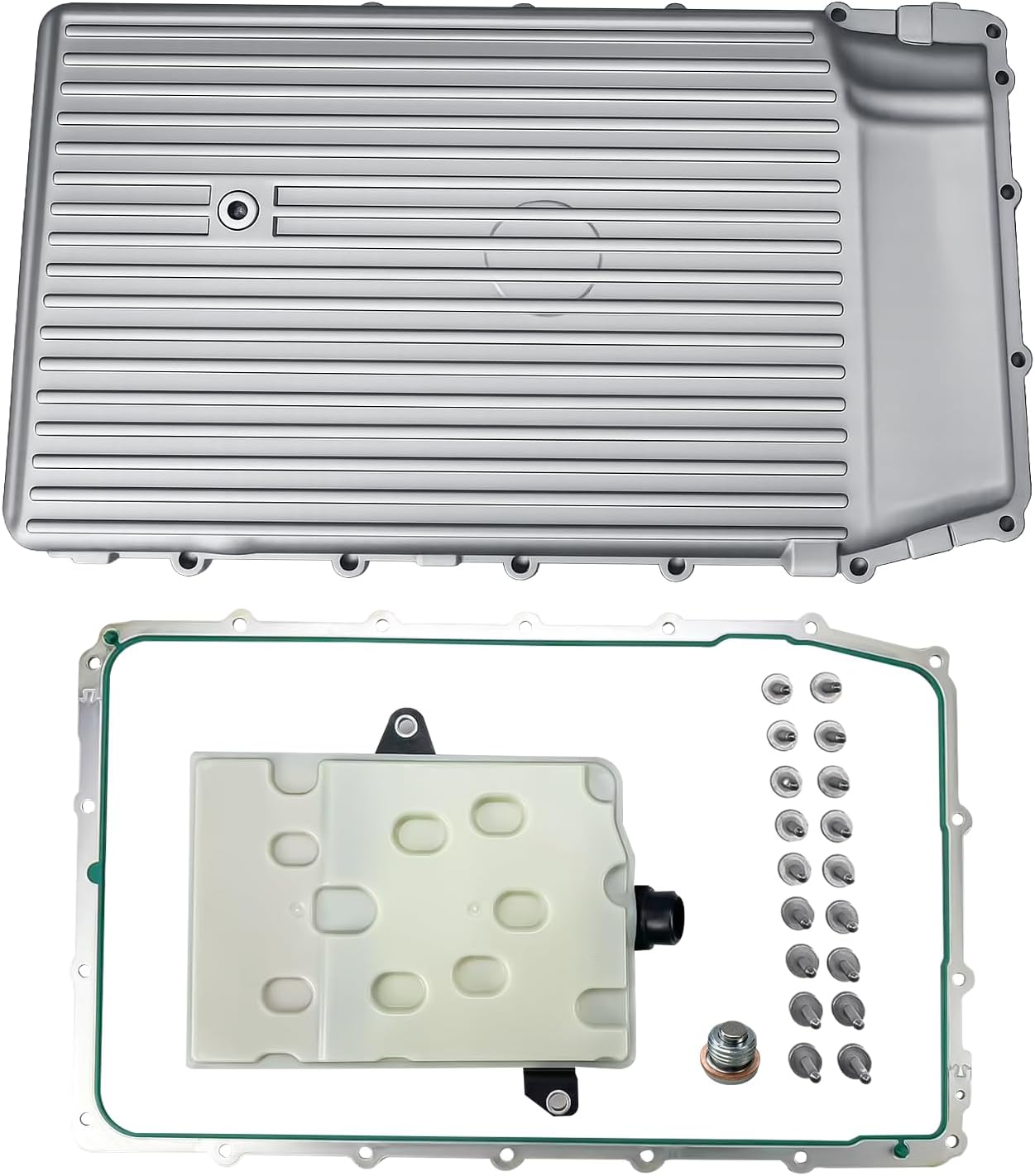
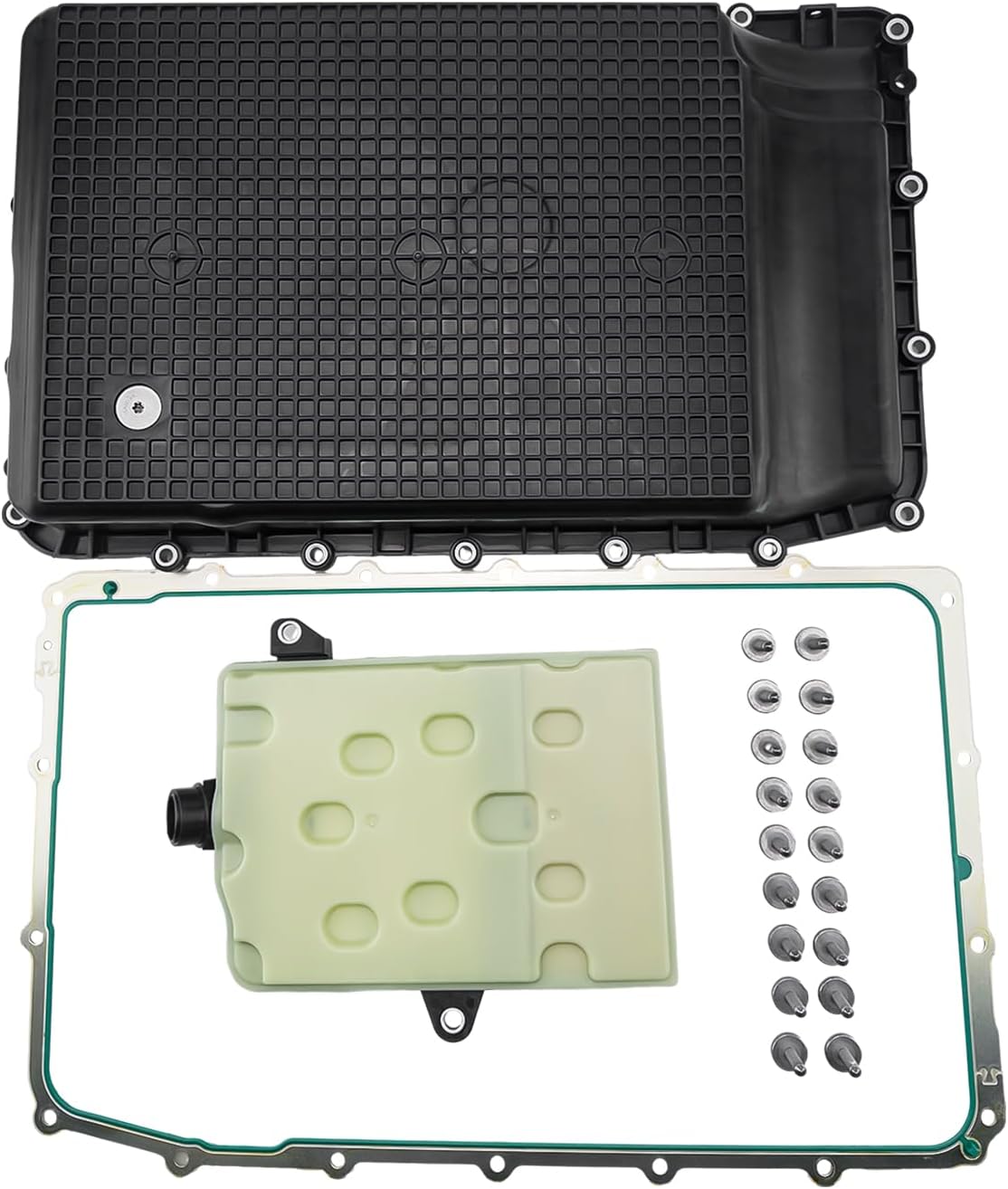
10R80 Mishimoto Cast Aluminum Pan + Filter
Replacing a warped or leaking stock pan is also the moment to add a drain plug and a magnet, so the next fluid check doubles as a wear inspection instead of another pan drop.
Shop the 10R80 Mishimoto Pan Kit →Sources
- Ford Motor Company, Workshop Manual, "Output Shaft Seal" (307-01 Automatic Transmission — 10-Speed Automatic Transmission — 10R80, Removal and Installation), 2019 Ranger, procedure revision date 6/1/2018. Backs the output shaft seal part numbers (service part 7052, base part 7B215), the RWD/4WD removal steps, special tool numbers 307-309, 100-001, 307-458 and 307-660, and the 148 lb-ft output shaft nut and 81 lb-ft flange bolt torque specs. Ford Workshop Manual — Output Shaft Seal (PDF)
- Ford Motor Company, Technical Service Bulletin 24-2304, "Various Vehicles Equipped With A 10R80 Automatic Transmission — Harsh/Delayed Engagement And/Or Harsh/Delayed Shift — Built On Or Before 15-Aug-2022," 24 September 2024, via NHTSA. Backs the CDF clutch cylinder (7H351) sleeve root cause, the internal hydraulic circuit leak mechanism, the affected models/years, the stored DTC list, the VCMM pressure test method, and the fluid pan gasket (HL3Z-7A191-B) and related seal part numbers. static.nhtsa.gov/odi/tsbs/2024/MC-11008391-0001.pdf
- Ford Motor Company, Workshop Manual, "Transmission Fluid Drain and Refill" (307-01 Automatic Transmission — 10-Speed Automatic Transmission — 10R80, General Procedures), 2019 Ranger, procedure revision date 12/11/2018. Backs the 52 lb-ft (70 Nm) fill plug torque, the MERCON ULV material spec (XT-12-QULV, WSS-M2C949-A), the staged fill quantities, and the 96-101°C fill/purge temperature window. Ford Workshop Manual — Transmission Fluid Drain and Refill (PDF)
- Sonnax, "Troubleshooting Pressure Loss in 10-Speed Clutch Packs." Backs the existence of a dedicated repair kit for CDF-adjacent sleeve-movement pressure loss on the 10R80/10L80/10L90 family, and the requirement for ultra-low-viscosity ATF in these units. sonnax.com/tech_resources/1481
- Motorcraft / Ford Customer Service Division Chemicals and Lubricants, "MERCON ULV Automatic Transmission Fluid" product specification page. Backs the XT-12-QULV part number, the red dye for leak detection, and the warning against substituting MERCON V, MERCON SP, or MERCON LV. fcsdchemicalsandlubricants.com — MERCON ULV