A Mustang that revs in Drive and sits there gets condemned fast. It is easy to assume the transmission is junk, and sometimes it is. Just as often the power is stopping somewhere you can find in twenty minutes: a half shaft, a fluid level that was never set right, a dead solenoid circuit, or a part that went in wrong during the last repair. The job is to find where the power stops before anything comes out of the car.
This is the Mustang version of the no-move diagnosis. It covers the 10R80 automatic in the 2018-up GT and EcoBoost, both the S550 cars and the 2024-up cars. Our general 10R80 no movement guide goes deeper on the Park-by-Wire return-to-Park problem and rebuild mistakes. Every bulletin and article I lean on is listed at the bottom.
Step 1: Find out where the power stops
A Mustang is rear-drive only, so you do not get the F-150 trick of shifting into 4H to see whether power reaches the front axle. You have to look. Put the car on a lift with the wheels hanging, start it, and have a helper hold the brake lightly and select Drive and then Reverse while you watch three things: the driveshaft, the left half shaft and the right half shaft.
- The driveshaft turns and both half shafts turn. Power is getting to the hubs. Look at the axle splines and the wheel end on the side that does not drive the car on the ground.
- The driveshaft turns but one or both half shafts do not. The problem is in the differential or a half shaft. A sheared shaft or stripped splines inside the differential will spin the driveshaft and leave the car sitting. On a car that has seen launches or drag radials, look here first.
- The driveshaft does not turn, or barely creeps. The problem is in the transmission or the converter. Go to Step 3.
- It moves in one direction but not the other. The pump is making pressure and the problem is a specific clutch or the low one-way clutch. Go to Step 6.
Step 2: Keep the Park complaints separate
Two Ford recalls on the 10R80 involve Park, and both have a Mustang connection. Neither one causes a no-move. Both describe a transmission that will not hold Park.
Recall 18V-213 (Ford 18S09) covers 2018 Mustangs built at Flat Rock from November 6, 2017 through February 12, 2018, along with some F-150, Expedition and Navigator trucks. Per Ford's Part 573 report, the roll pin that holds the park pawl rod guide cup to the case may not have been installed. With repeated use the transmission can lose Park even when the display shows P, and nothing on the dash warns the driver. The whole campaign was 142 vehicles. The dealer remedy is to inspect and install the pin.
Recall 25E070 (Ford 25SB3) covers remanufactured 10R80s built from May 30, 2020 through June 13, 2025 that may be missing the T10 bearing. This one started with a Mustang. Ford's chronology says the first warranty report, on May 21, 2025, came from a 2019 Mustang whose transmission would not hold Park, and the supplier's teardown found the bearing missing. Ford's own vehicle evaluations showed failures at under 3,000 miles. Its statistical analysis concluded that the problem shows up within 8,000 miles, so reman units past that mileage are not inspected. If your Mustang has a reman unit and rolls in Park, run the VIN. If it simply will not drive, keep going.
Step 3: Fluid first, and only MERCON ULV
If the driveshaft is not turning, check the fluid before anything else. Ford Special Service Message 47093 names the 2018 Mustang specifically. It says the 10R80 needs Motorcraft MERCON ULV, XT-12-QULV (spec WSS-M2C949-A), or an equivalent, and that improper fluid can cause internal damage. For capacities it points to Workshop Manual Section 307-01.
At this stage you are looking for gross loss: nothing on the level indicator at idle, a wet underbody, a blown cooler line. A car that is a quart low usually still moves, with a flare or a soft engagement. A car that has pumped half its fluid out does not. The final level must be set hot. Sonnax gives the check temperature as 96-101 C (206-215 F), and found that as little as one quart over full causes overheating and venting on these units. If you add fluid cold to get the car moving, set the level properly once it is hot.
Step 4: Scan tool and solenoid power
Scan every module and look at live data in Park and Neutral with the engine running. Confirm the transmission range reading matches what the selector says. A TCM that thinks the car is in Park or Neutral will not apply a drive clutch.
Then think about how the 10R80 applies its clutches, because it changes how you read a no-move. GEARS Magazine explains that the six shift solenoids, A through F, are linear force solenoids that Ford calls CIDAS. They are directly proportional: zero current means zero pressure. Lose power to the shift solenoids and none of the clutches can apply, so the car will not move. The line pressure control solenoid works the other way. It is normally high, giving full line pressure at low current (about 50 mA) and very low pressure at 850 mA.
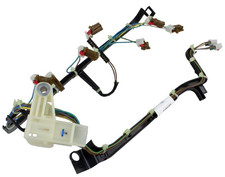
Put those two facts together and you get a useful split. A car with a dead feed to the solenoid body can show strong line pressure on the gauge and still not move, because pressure is there but nothing is commanding a clutch. So if the car has no movement, good line pressure and a string of solenoid circuit codes, look at the case connector, the internal harness and the module before you condemn hard parts.
If the car has just had a valve body, TCM or transmission replaced, check the programming too. GEARS notes that solenoid strategy programming is required after any of those jobs, that the software ID can be read in Mode $09 and must match the case label, and that the modules need about ten minutes key-off after programming. A strategy mismatch can cause driveability problems and transmission damage.
Step 5: Line pressure in Drive and Reverse
Put a gauge on the line pressure tap and read it at idle in Drive and in Reverse.
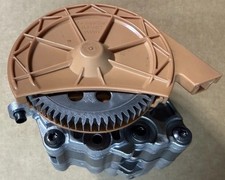
Zero or near-zero pressure in both ranges means the problem is upstream of the clutches, almost always the pump. The 10R80 pump lives in the pan, not up against the bell housing. Transmission Digest's Builder's Bench covered a 10R80 that barely moved in forward or reverse with no pressure on the gauge. With the pan down, the shop found the pump slide pivot pin pushed out of the back of the pump, so the slide could no longer build pressure. If you see that pin proud of the housing with the pan off, you have your answer. Our no movement guide covers the interference fit and the plug repair that keeps a reset pin from walking out again.
Good pressure in both ranges and still no movement means pressure is being made but not used. That points to the solenoid power issue in Step 4, a clutch circuit leak, a sticking valve, or a part installed wrong.
The Mustang separator plates
Here is a Mustang detail that matters on any car that has had the valve body off. Ford TSB 22-2428 lists two different separator plates for the Mustang: JL3Z-7Z490-D for Mustangs built on or before January 3, 2021, and L1MZ-7Z490-J for Mustangs built on or after January 4, 2021. The same bulletin lists separate plates for the F-150, Expedition, Ranger and other 10R80 applications. Rebuild kits and used valve bodies do not always come with the right one. Transmission Digest has documented a 10R80 where a spacer plate meant for a different application left the unit dropping back to Park instead of driving, until the correct plate went in. Our no movement guide has the casting numbers from that case. Read the build date off the door tag and match the plate before you button it up.
TSB 22-2428 is also the bulletin to know for a car that engages late rather than not at all. It covers 2018-2023 Mustangs with a 10R80 built on or before August 15, 2022, with harsh or delayed engagement and harsh or delayed shifts. Ford lists four possible causes: PCM or TCM software, the solenoid ID strategy, sticking valves in the main control, and axial movement of the CDF clutch cylinder (7H351) sleeve. A delayed engagement of several seconds often reaches the shop described as "won't go into gear." Watch for it on the test drive.
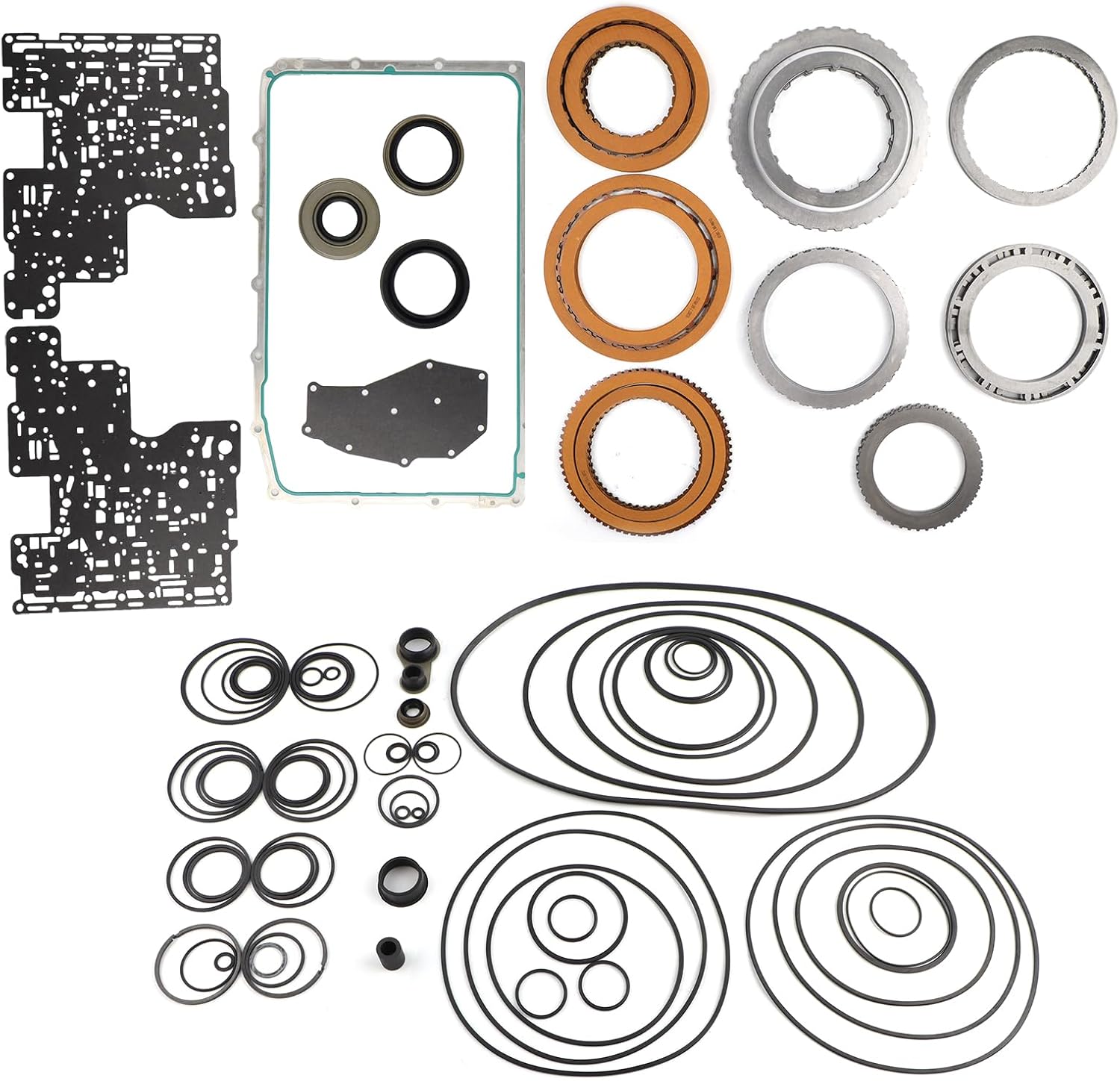
10R80 deluxe rebuild kit for the teardown
When the gauge says the pump or a clutch pack has to come out, this kit covers the seals, gaskets and pistons for a 2017-up 10R80, Mustang included, so you are not ordering a second time halfway through.
Shop the part for this fix →Need more 10-speed parts? The 10-speed parts collection covers the parts the Ford and GM units share.
Step 6: One direction only, or stuck in second
When one direction works, the clutch application chart does most of the work. The A and D clutches apply in both Reverse and first gear, so good reverse with no forward points at the E clutch and the low one-way clutch. If the car just came out of a rebuild, measure the E clutch piston against the original. Our no movement guide walks through a case where a kit piston built for a different friction count could not clamp the pack. For the opposite case, see the 10R80 no reverse guide.
On a 2024-up Mustang, there is a bulletin for the one-way clutch. Ford TSB 26-2263 (May 28, 2026, superseding 26-2112) covers 2024-2026 Mustangs with the 10R80 that will not upshift past second, cannot reach the third gear ratio, and set P0757 and P2701. Ford blames a damaged one-way clutch. Ford's check is a directional test of the one-way clutch with the fluid pump removed. If it fails, the fix is a new front support assembly, JL3Z-7A130-B.
Ford's Mustang labor times show what that costs. The inspection alone, with the pump out, is 2.7 hours on a 2.3L EcoBoost and 2.9 hours on a 5.0L. A failed one-way clutch with the transmission removed and installed is 7.7 hours on a 2.3L coupe and 10.0 hours on a 5.0L coupe. Pull the pump and do the directional test before you quote a transmission.
The order, in short
- On a lift, watch the driveshaft and both half shafts. Driveshaft turning with a dead wheel is a driveline job.
- Check fluid for gross loss: MERCON ULV only, level set hot at 206-215 F.
- Scan for range and solenoid circuit faults, then gauge line pressure. Zero in both ranges means the pump.
- Good pressure after valve body work: match the separator plate to the build date.
- One direction only, or a 2024-up car stuck in second: use the apply chart and TSB 26-2263.
Need parts for this job?
Pumps, internal harnesses, solenoid kits, master rebuild kits and MERCON ULV-spec fluid for the Mustang 10R80 are on our 10R80 parts page, with checkout on site.
FAQ
Why won't my Mustang move in Drive or Reverse?
On a lift, watch the driveshaft and both half shafts in Drive and Reverse. If the driveshaft turns but a wheel does not, the problem is in the differential or a half shaft. If the driveshaft does not turn, the common 10R80 causes are a large fluid loss, zero pump pressure, or lost power to the shift solenoids.
Can a bad wire or connector make a 10R80 Mustang not move?
Yes. The six A-F shift solenoids on the 10R80 are directly proportional, so zero current means zero clutch pressure, and losing power to them leaves no clutch applied. Line pressure can still read high, because the line pressure solenoid is normally high. Good pressure with no clutch apply points at the solenoid circuit, internal harness or module.
Which separator plate does a 10R80 Mustang use?
Ford TSB 22-2428 lists two Mustang plates: JL3Z-7Z490-D for Mustangs built on or before January 3, 2021, and L1MZ-7Z490-J for Mustangs built on or after January 4, 2021. Check the build date on the door tag before installing a plate from a kit, because the wrong plate can cause no-move or instant return-to-Park complaints.
My 2024 Mustang is stuck in second gear. Is that the transmission?
Ford TSB 26-2263 covers 2024-2026 Mustangs with the 10R80 that will not upshift past second or reach third gear, with codes P0757 and P2701. Ford blames a damaged one-way clutch and confirms it with a directional test after removing the fluid pump. A failed test means a new front support assembly, JL3Z-7A130-B, and Ford pays 7.7 hours on a 2.3L coupe and 10.0 hours on a 5.0L coupe with the transmission removed.
Is the Mustang Park recall the same as a no-move problem?
No. Recall 18V-213 covers 2018 Mustangs that may be missing the park pawl rod guide cup roll pin, and recall 25E070 covers remanufactured 10R80s that may be missing the T10 bearing. Both are about a transmission that will not hold Park. A Mustang that will not drive in gear is a different problem.
Related guides
- 10R80 Mustang Common Problems and Fixes
- 10R80 Mustang Slipping: Causes and Fix
- 10R80 Mustang Shift Problems: Diagnosis and Fix
- 10R80 F150 Won't Move: Diagnosis
- 10R80 No Movement in Any Gear: Diagnosis
Sources
- NHTSA / Ford Motor Company — Part 573 Safety Recall Report 18V-213 (Ford 18S09), April 4, 2018: 2018 Mustang production dates November 6, 2017 to February 12, 2018, missing park pawl rod guide cup roll pin, loss of Park with no warning, 142 vehicles, assembly machine cause. Part 573 report 25E070 (Ford 25SB3): remanufactured 10R80s built May 30, 2020 to June 13, 2025, missing T10 bearing, first warranty report from a 2019 Mustang, failures under 3,000 miles, 8,000-mile inspection cutoff. 18V-213 (PDF) · 25E070 (PDF)
- Ford Motor Company — Technical Service Bulletin 22-2428, "10R60/10R80/10R80 MHT Automatic Transmission - Harsh/Delayed Engagement And/Or Harsh/Delayed Shift" (May 26, 2023): 2018-2023 Mustang applicability, August 15, 2022 build cutoff, software/solenoid ID/sticking valve/CDF sleeve causes, Mustang separator plates JL3Z-7Z490-D and L1MZ-7Z490-J. Also SSM 47093: MERCON ULV XT-12-QULV (WSS-M2C949-A) required for the 2018 Mustang 10R80, capacities in WSM 307-01. TSB 22-2428 (PDF) · SSM 47093 (PDF)
- Ford Motor Company — Technical Service Bulletin 26-2263 (supersedes 26-2112), "No Upshift Past Second Gear, Unable To Achieve Third Gear Ratio, And/Or Illuminated MIL With DTCs P0757 And P2701" (May 28, 2026): 2024-2026 Mustang 10R80, damaged one-way clutch, directional test with pump removed, front support JL3Z-7A130-B, Mustang 2.3L and 5.0L labor times. static.nhtsa.gov (PDF)
- GEARS Magazine (ATRA) — "Direct Connection: 10R60, 10R80 and 10R140 Solenoids Make Shifts Happen": six CIDAS shift solenoids A-F, zero current equals zero clutch pressure, LPC normally high (50 mA full pressure, 850 mA very low), solenoid strategy programming, Mode $09 software ID, ten-minute key-off module write. gearsmagazine.com
- Transmission Digest — Builder's Bench (with ATSG), "Ford 10R80 No-Move Pump Issue": barely moving in forward or reverse, zero line pressure, pump located in the pan, pump slide pivot pin pushed out of the pump. transmissiondigest.com
- Sonnax — Jim Mobley, "Tips for Troubleshooting Ford 10-Speed ATF Venting & Overheating": hot level check at 96-101 C (206-215 F), one-quart overfill causing overheating and venting. sonnax.com