A 10R80 that will not move in Drive or Reverse is one of the few complaints on this transmission that does not call for a scan tool first. It calls for a pressure gauge. Across the F-150, Mustang, Expedition, Navigator and the 2019-up Ranger, Transmission Digest has documented the same handful of root causes showing up again and again, and almost none of them are electrical. The unit is either starving for line pressure inside the pump, losing a seal between the pump and valve body during a rebuild, or missing a clutch component that only shows up when you ask the transmission to pull the truck instead of just spin freely on the bench.
One owner thread even describes a dealer finding no stored codes at all on a truck that kept dropping itself out of gear, which makes the point worth repeating: a clean scanner does not clear the transmission. Here is the order that actually finds these failures.
Check fluid level, then go straight to a pressure gauge
Confirm the fluid level and condition first because it takes thirty seconds and rules out the cheapest possible cause. Past that, do not spend an hour chasing TCM data before you know what the pump is actually producing. Connect a line pressure gauge and check pressure in Drive and in Reverse at idle. That single test splits every no-move complaint on this unit into two different repair paths.
If pressure reads zero or close to it in both ranges, the problem is upstream of the valve body entirely, almost always inside the pump itself. The ATSG Builder's Bench segment on this exact complaint describes a shop that did exactly this: gauge on, no pressure anywhere, pan down. If pressure is present and the transmission still will not move, or it immediately kicks back to Park the moment you select a gear, you are looking at a seal or spacer plate problem instead, which is covered below.
The pump slide pivot pin walks out, and pressure goes to zero
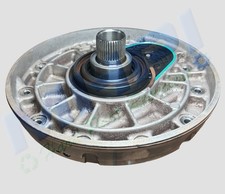
The pump assembly on a 10R80 lives in the pan, not up against the bell housing the way a lot of techs expect. Transmission Digest's Builder's Bench column on this unit describes a shop that called ATSG with a truck barely moving in forward or reverse. With no pressure on the gauge, they dropped the pan, checked that the filter was not cracked, and noticed a pin sticking out of the pump housing. That pin turned out to be the pump slide pivot pin, and it had walked out far enough to compromise the slide's ability to build pressure at all.
A separate Shift Pointers column walks through the same failure on a 2019 F-150 in more detail. The pin is held in the filter cover plate on one end and the drive gear cover on the other by an interference fit: the pin's outer diameter measures 0.3128 inch against a 0.312 inch bore, a crush fit of roughly eight ten-thousandths of an inch. If the pin does not fully seat into the drive gear side during assembly, it gets pushed toward the filter side as the slide rocks on the pivot during normal operation, and over time it walks completely out. Once that happens, the pump cannot hold the slide in position and pressure collapses. The fix the shop used was to reposition the pin and then tap the opening and install a pipe plug, because a pin that has already traveled the full length of its bore only has about half the original interference fit left and will walk again without something physically blocking it.
The takeaway for anyone rebuilding one of these: this is a self-inflicted failure that can happen during a routine pump assembly, not a wear item. If a 10R80 was recently rebuilt or had the pump serviced and it is now making zero pressure, check this pin before you order anything.
Park-by-Wire trucks that drop straight back to Park
If the truck has the Park-by-Wire (E-Shift) rotary or push-button selector, there is a second failure pattern that looks different from a simple no-move: the transmission briefly accepts Drive or Reverse and then immediately returns to Park on its own, usually with a P0868 low fluid pressure code. Transmission Digest's Shift Pointers column has documented three separate shops hitting this after a rebuild.
The 10R80 (and the GM 10L80, which shares the design) has a pump pressure output port and a decrease pressure return port sealed by a molded rubber gasket where the valve body bolts down over the pump. On a 2019 Lincoln Navigator, that seal fell out of position during reassembly and the boot seal on the pressure side got pinched and torn, producing the P0868 and instant return-to-Park. The same seal problem showed up independently on a 2018 F-150. A third shop, working a 2018 Expedition with identical symptoms, pulled the valve body and found that seal completely intact. The actual cause there was a parts mix-up: the rebuild kit shipped a non-E-Shift spacer plate (stamped HL3P-7Z490-CH, with a slanted V notch) and it got installed in place of the correct E-Shift plate (stamped JL1P-7Z490-AC, with a half-moon and square notch). Swapping in the correct plate restored both forward and reverse immediately.
If you are chasing a return-to-Park complaint with a clean pump-to-valve-body seal, do not stop there. Pull the spacer plate and read the casting number against what the application actually calls for.
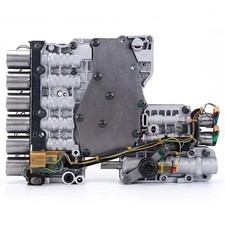
10R80 Valve Body, OEM part JL3Z-7A100-C
If the sticking valve or seal damage has gone past a seal-and-reseal repair, this is the direct OEM replacement main control for 2017-2024 applications rather than a bore-by-bore rebuild.
Check the 10R80 valve body at Gearbox Insider →Good reverse, no forward: a rebuild that is close but not quite right
A different pattern shows up strictly after a rebuild: the truck has reverse but will not move forward in any gear. Transmission Digest's Shift Pointers column traced one of these on a 2021 Ford Ranger 2.3L Turbo. The shop worked a clutch application chart by process of elimination. The A and D clutches apply in both reverse and first gear, and since reverse worked fine, both were cleared. The D clutch does not contribute to a forward launch at all, which left the low one-way clutch and the E clutch as the only remaining suspects for a forward-only failure.
Air checks on the E clutch looked fine at first, both with the valve body on and pulled a second time with it off. Only after the unit was torn down further did the shop find the real problem: the clutch pack was too loose. It was tight enough that the piston contacted the pack without popping out of its housing, but not tight enough to actually compress the pack and move the vehicle. Comparing the original piston against the one supplied in the rebuild kit showed the difference: the original piston was machined for a four-friction stack-up, while the replacement piston in the kit was built for a five-friction stack-up. The kit only included one E clutch piston, so the height mismatch was easy to miss. The shop's fix was to add the fifth friction and steel plate to match the new piston rather than source a different piston.
If you are troubleshooting a no-forward, good-reverse complaint right after a rebuild, do not assume electronics. Pull the clutch application chart, work backward from the gear ranges that do work, and measure piston height against the friction count in the pack before you reassemble.
What Ford's bulletin says about sticking valves
Ford TSB 24-2101 covers 2017-2020 F-150, 2018-2021 Expedition/Navigator/Mustang and 2019-2023 Ranger trucks with a 10R80 that show harsh or delayed engagement, harsh or delayed shifts, or any of a long list of stored codes including P0729, P0751 through P0772, and the P2700-series TCM codes. The bulletin attributes the condition to the transmission solenoid ID strategy, sticking valves in the main control valve body, or axial movement of the CDF clutch cylinder sleeve (Ford part 7H351). This TSB supersedes the earlier 23-2350, issued November 2023.
The service procedure is sequenced to save a valve body teardown when possible: first check for the listed codes, and if none are present, reprogram the existing transmission strategy into the PCM/TCM and run the adaptive learning drive cycle before touching anything mechanical. Only if the condition persists, or one of the listed DTCs is already present, does the procedure move to overhauling the main control valve body. These codes describe harsh and delayed shifting rather than a total loss of movement, but a valve sticking badly enough can progress toward a no-move complaint, so it is worth checking against this list if your no-move truck also carries any of those codes.
Do not confuse this with the 2025 Park recall
Ford and NHTSA issued recall 25E070 in October 2025 covering certain remanufactured 10R80 transmissions, sold as service parts for 2017-2021 Ford and Lincoln vehicles, built between May 30, 2020 and June 13, 2025. The defect there is a missing T10 bearing, which can prevent the transmission from holding the Park position and creates a rollaway risk. Ford's remedy on affected units with 8,000 miles or less is a dealer inspection and, if needed, transmission replacement at no charge.
That is the opposite failure from everything above. This article covers a 10R80 that will not move out of Park into a drive gear. The recall covers a 10R80 that will not reliably stay in Park. If your complaint is a rollaway or the truck will not hold Park on a hill, check the VIN against campaign 25E070 before you do anything else. If the complaint is that it will not go into gear at all, the pump and valve body are still the right starting point.
The diagnostic order, start to finish
- Check fluid level and condition. Confirm it is full and not burnt before doing anything else.
- Scan for codes, but do not rely on a clean scanner to clear the transmission. Note any P0868, or anything from the TSB 24-2101 code list.
- Connect a line pressure gauge. Check pressure in Drive and Reverse at idle.
- Zero or near-zero pressure in both ranges: drop the pan and inspect the pump. Look for the slide pivot pin sticking out of the housing before you condemn the whole pump.
- Pressure present but the unit returns to Park the instant a gear is selected, with Park-by-Wire: pull the valve body and check the pump-to-valve-body seal for damage or displacement, then check the spacer plate casting number against the application.
- Good reverse, no forward, and the unit was just rebuilt: pull a clutch application chart, air check the E clutch and low one-way clutch, and verify piston height matches the actual friction count in the pack.
- If codes from the TSB list are present with harsh or delayed engagement rather than total no-move, reprogram the TCM strategy and run the adaptive learning drive before pulling the valve body.
- Rule out the Park recall (25E070) separately if the actual complaint is a rollaway or failure to hold Park, since that is a different defect with a different fix.
Fluid
The 10R80 is calibrated around Motorcraft MERCON ULV, an ultra-low viscosity fluid under Ford spec WSS-M2C949-A. Do not substitute MERCON V, MERCON SP or MERCON LV. If the pump or valve body comes apart for any of the repairs above, refill with MERCON ULV and set the level at operating temperature per the workshop manual procedure rather than by a dry-fill estimate.
Need parts for this job?
Pumps, valve bodies, solenoid kits, pan and filter kits, and MERCON ULV for the 10R80 are all on one page.
Shop 10R80 parts →FAQ
Will a 10R80 with no movement always throw a code?
No. Owners and dealers have reported no-move complaints where the scan tool came back clean. The pump pivot pin failure can starve line pressure without necessarily logging a code the first time it happens, and some shops have found the condition on a test drive before the TCM ever flags it. Do not let a clean scanner talk you out of a line pressure test. The gauge is the real answer here, not the code list.
My 10R80 immediately drops back into Park whenever I select Drive or Reverse. Is that the same as no movement?
It is a close cousin, specific to Park-by-Wire (E-Shift) applications. Transmission Digest documents two 2019-era cases, a Navigator and an F-150, where a molded rubber seal between the pump and valve body fell out of position during reassembly and caused an immediate return to Park with a P0868 low-pressure code. A third case on a 2018 Expedition had the same symptom with the seal intact, caused instead by installing the wrong spacer plate from the kit. Any of these three parts being out of place is enough to trigger the Park-by-Wire logic.
I just rebuilt my 10R80 and it has reverse but no forward. What should I check first?
Pull a clutch application chart for the unit and work backward from what you do have. Reverse working rules out any clutch that is also needed for reverse. On the 10R80 that leaves the low one-way clutch and the E clutch as suspects for a forward-only failure. Transmission Digest traced one case to an E clutch piston built for a four-friction stack that was swapped into a kit designed around a five-friction pack, which left the clutch too loose to move the truck even though it looked fine on an air check.
Can low transmission fluid alone cause a 10R80 to not move?
It can contribute, especially if the pump is drawing air through the pickup tube, but a fluid level low enough to stop all movement in both Drive and Reverse is unusual on its own. Check the level and condition first because it is a thirty-second check, then move straight to a pressure gauge. If pressure is still zero or near zero after confirming a correct fluid level, the problem is mechanical inside the pump or the valve body, not a fluid top-off.
Does the 2025 Ford recall on the 10R80 explain a no-movement complaint?
No, and it is worth not confusing the two. NHTSA campaign 25E070 covers certain remanufactured 10R80 units built between May 2020 and June 2025 that may be missing the T10 bearing, which can prevent the transmission from holding Park and creates a rollaway risk. That is a failure to hold Park, which is the opposite problem from a transmission that will not move out of Park. If your truck rolls away or will not stay in Park, that recall is the one to check by VIN. If it simply will not go into gear, look at the pump and valve body instead.
Shop the part for this fix
The pump, valve body and Zip Kit parts covering this 10-speed family, including the 10R80, are stocked at CoreTransmissionParts under the shared 10L80 catalog.
Check the 10L80/10R80 Sonnax Zip Kit at CoreTransmissionParts →Related 10R80 guides
Sources
- Transmission Digest — "Ford 10R80 No-Move Pump Issue," The Builder's Bench with Rino Partipilo (ATSG), 5 December 2025. Backs the shop's zero-pressure gauge reading, the decision to drop the pan and check the filter before anything else, the discovery of a pin sticking out of the pump, the confirmation that the 10R80 pump assembly is located in the pan, and the identification of the pump slide pivot pin as the failed component. transmissiondigest.com
- Transmission Digest — "Park-by-wire pin pain with the 10R80 transmission," Wayne Colonna, Shift Pointers, 15 October 2024. Backs the 2019 F-150 case at Coleman Taylor Transmissions, the pump slide pivot pin's interference fit of a 0.3128-inch pin in a 0.312-inch bore (roughly .0008 inch crush at both the filter cover plate and drive gear cover ends), the mechanism by which an incompletely seated pin walks out of position over time, the reduced .0005-inch fit once a pin has already traveled its full bore, and the repair of repositioning the pin and installing a pipe plug to prevent it from walking again. transmissiondigest.com
- Transmission Digest — "Shift Pointers: A self-inflicted injury with the Park-by-Wire system," Wayne Colonna, 9 August 2024. Backs the 2019 Lincoln Navigator case with a P0868 code and instant return to Park, the identification of the molded rubber pump-to-valve-body seal covering the pump pressure output and decrease pressure return ports, the matching 2018 F-150 case with the same torn seal, the 2018 Expedition case with an intact seal traced instead to an incorrect spacer plate, and the two spacer plate casting numbers (JL1P-7Z490-AC for E-Shift, HL3P-7Z490-CH for non-E-Shift). transmissiondigest.com
- Transmission Digest — "10R80 No Forward After Rebuild: A Difference in Height," Wayne Colonna, Shift Pointers, 5 June 2026. Backs the 2021 Ford Ranger 2.3L Turbo case with good reverse and no forward, the clutch application chart process of elimination that narrowed the fault to the low one-way clutch and E clutch, the E clutch pack air-check findings, and the root cause of a replacement piston machined for a five-friction stack-up installed in place of the original four-friction piston. transmissiondigest.com
- Ford Motor Company — Technical Service Bulletin 24-2101, "10R80 Automatic Transmission — Harsh/Delayed Engagement And/Or Harsh/Delayed Shift — Non-Main Control Break-In Capable" (reproduced by The Ranger Station). Backs the covered 2017-2020 F-150, 2018-2021 Expedition/Navigator/Mustang and 2019-2023 Ranger model list, the stored DTC list including P0729, the P0751-P0772 range and the P2700-series codes, the stated causes of transmission solenoid ID strategy, sticking main control valves and CDF clutch cylinder sleeve (7H351) axial movement, the sequenced repair procedure of reprogramming the TCM/PCM strategy and running the adaptive learning drive before overhauling the valve body, and the note that this bulletin supersedes TSB 23-2350. therangerstation.com
- NHTSA — Recall Report 25E070 (RCLRPT-25E070-6420), filed October 2025. Backs the recall population of certain remanufactured 10R80 transmissions sold as service parts for 2017-2021 Ford and Lincoln vehicles, the production date range of May 30, 2020 through June 13, 2025, the root cause of a potentially missing T10 bearing, the rollaway safety risk from a loss of Park function, and the free dealer inspection and replacement remedy for affected units with 8,000 miles or less. static.nhtsa.gov (PDF)