The Mustang got the 10R80 for the 2018 model year, behind both the 2.3L EcoBoost and the 5.0L Coyote, and it has been the automatic in the car ever since. It is the same basic 10-speed that goes in the F-150, but the bulletins do not always line up with the truck's. The Mustang has its own build-date cutoffs, its own CDF cylinder part numbers, and the 2.3L car uses fewer clutch plates than the V8. Our 10R80 common problems guide covers the transmission family. This post sticks to the Mustang.
Everything here comes from Ford's technical service bulletins and recall filings published through NHTSA, plus Sonnax's 10-speed tech notes. The links are at the bottom. Pull the VIN and the door tag build date on every car, because on the Mustang a few weeks of build date decides which bulletin applies.
The Mustang 10R80 bulletin map
| Mustang | Complaint | Ford's stated cause | Bulletin |
|---|---|---|---|
| 2018, built on or before 20-Nov-2017 | MIL with P0741 and P1744 | Sticking TCC valve in the main control valve body | TSB 20-2117 (supersedes 18-2160) |
| 2018, built 6-Nov-2017 to 12-Feb-2018 (specific VINs) | Can lose Park with no warning | Park pawl rod guide cup roll pin left out at assembly | Recall 18V-213 (Ford 18S09) |
| 2018-2021 | Harsh engagement, harsh or delayed shift, shift DTCs | Adaptive calibration not keeping up with hardware break-in; valve body | TSB 23-2123 (supersedes 22-2139) |
| 2018-2020 | Harsh or delayed engagement and shifts, shift DTCs | CDF clutch cylinder sleeve moving axially and leaking | TSB 25-2475 (supersedes 25-2301) |
| 2021-2022, built on or before 15-Aug-2022 | Same as above | Same CDF sleeve movement | TSB 25-2131 (supersedes 24-2436) |
| 2020, built 21-Oct-2019 through 16-Dec-2019 | High-pitched whine at low speed, light throttle or coast | Outer output shaft bearing | TSB 20-2198 (supersedes 20-2083) |
Ford revises these bulletins often, sometimes more than once a year. The numbers above are the versions published on NHTSA when this was written. Run the VIN through OASIS or a dealer before you bill against one, because a superseded bulletin can carry a different part list.
Harsh and delayed shifts: two different causes on the same car
This is the complaint that fills Mustang forums: a bang into drive or reverse, a slow, slurred 2-3 or 3-4, a harsh downshift coming to a stop, sometimes a check engine light. The DTC list Ford attaches to every one of these bulletins is identical: P0751 through P0772 (shift solenoids A through F), P2700 through P2708 (friction element apply time for clutches A through F), P0729 and P0731 through P0736 (gear ratio errors), plus P076F, P07D9, P07F6 and P07F7.
Read those codes for what they are. They say a clutch did not apply on the timeline the TCM expected. They do not say why. On a 2018-2021 Mustang, Ford gives two possible reasons in two different bulletins, and the cheap one has to be ruled out before the expensive one.
The cheap side: adaptives and the valve body (TSB 23-2123)
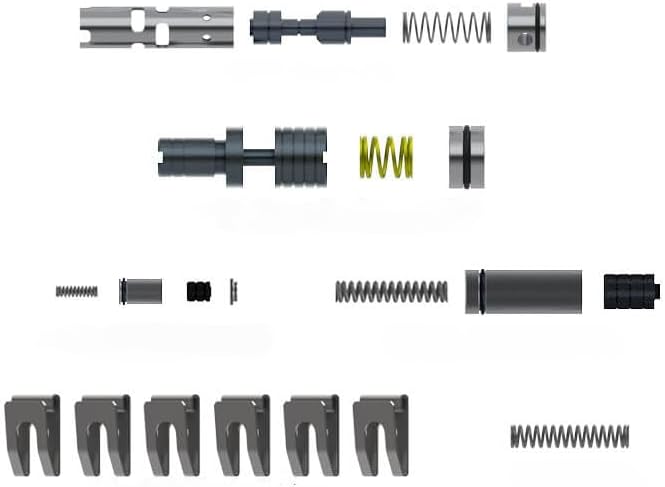
TSB 23-2123 lists the 2018-2021 Mustang along with the F-150, Expedition, Navigator and Ranger. It blames harsh engagement and harsh or delayed shifts on the adaptive calibration failing to keep up with hardware break-in over time. The repair is to overhaul the main control valve body and/or run the adaptive learning drive cycle. The part list is short: six solenoid retaining clips (HL3Z-7G007-A), a solenoid retaining plate bolt, and MERCON ULV (Motorcraft XT-12-QULV) as needed.
That tells you how Ford sees the problem. The 10R80 learns clutch fill times and pressures as it wears in. If the learned values drift away from what the hardware is actually doing, the shift gets harsh or late with nothing broken. On a Mustang that has had a battery disconnected, a tune flashed and flashed back, or a valve body swapped without a relearn, this is the first suspect. Start with a battery load test and a software update, clear adaptives, and do the full drive cycle before you condemn anything.
One more Mustang detail for that job: Ford TSB 22-2428 lists two Mustang separator plates, JL3Z-7Z490-D for cars built on or before 3-Jan-2021 and L1MZ-7Z490-J for cars built on or after 4-Jan-2021. Truck and Expedition plates are listed separately. Match the plate to the door-tag build date before you reinstall a valve body, because a wrong plate can turn a harsh-shift complaint into a no-move.
When the valve body does have to come apart, Ford's overhaul calls for new solenoid retaining clips, and it is the time to check every valve for free travel in its bore. A Sonnax Zip Kit covers the Gen 1 body used in these early cars.
The expensive side: the CDF cylinder sleeve (TSB 25-2475 and 25-2131)
Ford's newer bulletins point at a hard part. For 2018-2020 Mustangs, TSB 25-2475 (October 2025) ties the same symptoms and the same DTCs to axial movement of the CDF clutch cylinder sleeve, which causes hydraulic circuit leaks. For 2021-2022 Mustangs built on or before 15-Aug-2022, TSB 25-2131 says the same thing. The CDF cylinder carries the feed for the C, D and F clutches. When its sleeve walks, the circuit leaks, the clutch the TCM commands fills slowly or loses pressure, and you get a flare or a soft apply followed by a bump when the TCM pushes harder.
The Mustang detail that matters for parts ordering: the CDF cylinder is engine specific. Ford lists JL3Z-7H351-B for the 5.0L Mustang and JR3Z-7H351-B for the 2.3L Mustang. The repair also replaces the clutch and planetary container cylinder, PC3Z-7B177-A. The 2018-2020 bulletin also shows the 2.3L car runs fewer plates than the V8: 4 C clutch frictions instead of 5, 5 D clutch frictions instead of 6, and 3 F clutch frictions instead of 4. If you are building a 2.3L unit from a kit sized for a 5.0L or a truck, count the plates and set clearance with the selective snap rings rather than assuming.
Prove the CDF leak before you pull the car apart
Pulling a 10R80 out of a Mustang is not quick. Ford's warranty labor times for a failed CDF test and cylinder replacement on 2018-2020 cars are 10.8 hours (2.3L coupe), 11.2 hours (2.3L convertible), 11.7 hours (5.0L coupe) and 12.1 hours (5.0L convertible). On 2021-2022 cars the times are 10.4 to 12.0 hours. A test that passes is billed at 0.8 hours (0.7 on the 2021-2022 bulletin). That spread is the whole argument for running the test.
The procedure in TSB 25-2475, condensed:
- Install a pressure transducer on the line pressure port. The port is M10x1.0. Ford warns that an NPT fitting will damage the case, so use an M10x1.0 male to 1/8 in. FNPT adapter.
- Back probe the line pressure control (LPC) solenoid circuit, CET50, a white/orange wire, at the PCM/TCM or transmission connector. This sets a DTC, which you clear at the end.
- On a bidirectional scan tool, log LINE DSD, the transducer pressure, SSA_AMP through SSF_AMP and TFT.
- Pick the temperature to match the complaint. If the car only acts up with TFT at 49 C (121 F) or below, test cold. Otherwise test at 50 C (122 F) or above.
- Command all shift solenoids to 0 mA. At idle, ground the LPC circuit to raise line pressure until it stabilizes.
- Record, command SSA to 1.0 A for two seconds, then back to 0 mA. Repeat with SSC.
- Read the pressure peaks and valleys before and during each apply. Ford feeds those into its CDF calculator. A circuit that sags when its clutch is commanded is leaking.
An independent shop can run the same test with any good transducer and a scan tool that can command the shift solenoids. What you are looking for is a clear pressure drop when SSA or SSC is commanded, compared with the baseline. A car that passes goes back to the adaptive and valve body path above.
2018 Mustang: P0741 and P1744 on early builds
Early 2018 Mustangs, built on or before 20-Nov-2017, have their own bulletin. TSB 20-2117 covers an MIL with P0741 (torque converter clutch performance) and P1744 (TCC slip) and blames a sticking TCC valve in the main control valve body. The fix is a new main control valve body. Ford lists JL3Z-7A100-B for the 2018 Mustang, and the labor time is 2.0 hours. The bulletin also warns that after the swap the car relearns, and shifts can be firmer than normal for several days.
A 2018 Mustang setting P0741 and P1744 together, with a slight shudder at steady cruise, fits this pattern. Check the build date first. On cars built later, chase P0741 the normal way: fluid condition, the TCC solenoid and its circuit, then the converter. Our 10R80 P0741 guide walks that path.
2018 Mustang: the Park recall
Recall 18V-213 (Ford 18S09) covers a small number of 10R80s assembled without the roll pin that holds the park pawl rod guide cup to the case. Ford's filing lists 2018 Mustangs built 6-Nov-2017 to 12-Feb-2018 and says the population is not in VIN order, so you have to look the car up. Without the pin, the transmission can eventually lose Park even though the shifter and cluster show P, with no warning chime. The recall covered 142 vehicles across the F-150, Expedition and Mustang. Any 2018 Mustang that rolls in Park gets its recall status checked before anything else.
2020 Mustang: whine at low speed
TSB 20-2198 (August 2020) covers 2020 Mustangs, along with F-150s and Rangers, built 21-Oct-2019 through 16-Dec-2019 that whine from the transmission at low speed on light throttle or coasting. Ford blames the outer output shaft bearing. The repair replaces the inner output shaft bearing, the fluid passage sleeve and the outer output shaft bearing. That is a teardown job, so confirm the noise is the transmission and not the rear end or driveshaft first. A whine that changes with gear and goes away when you slip it into neutral and coast points at the gearbox. For general noise work, see our 10R80 noise diagnosis guide.
Fluid and level: what owners do to themselves
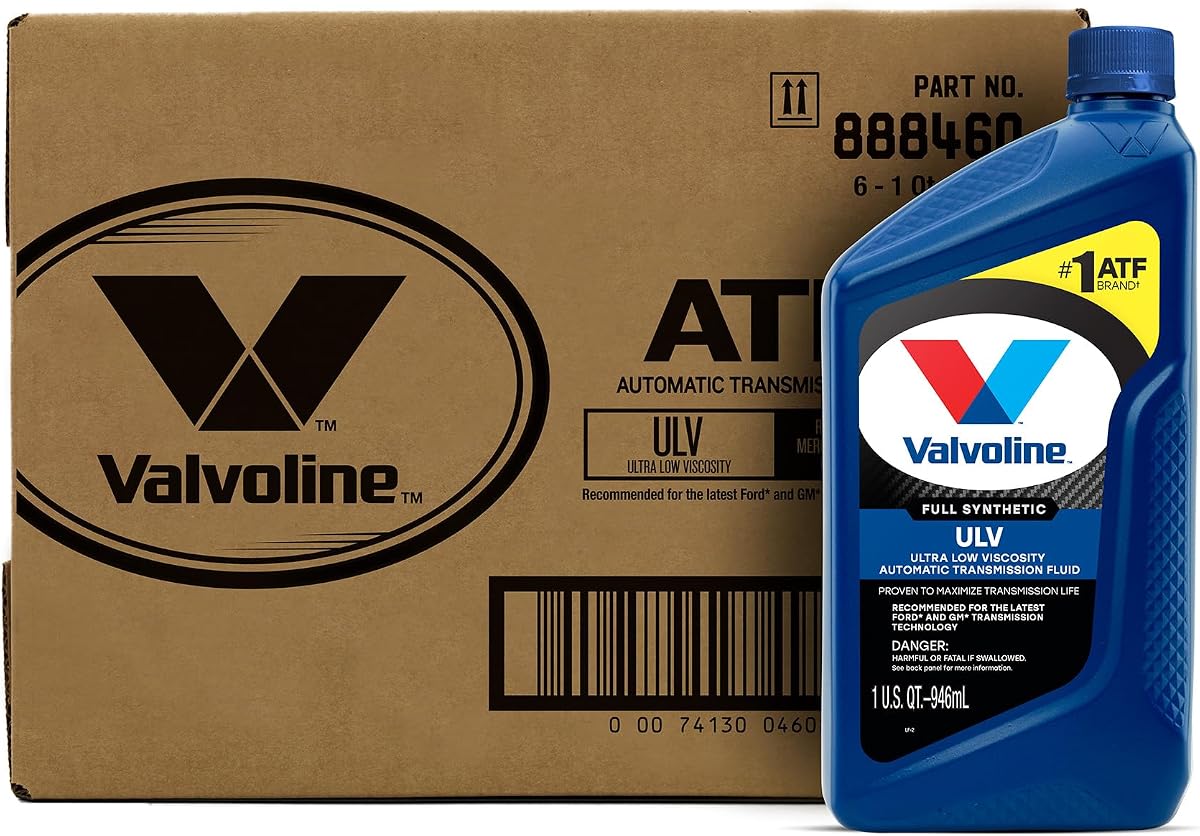
The 10R80 takes MERCON ULV, Motorcraft XT-12-QULV, and every bulletin above lists it. Do not top off with MERCON LV or a multi-vehicle fluid. ULV is a thinner fluid, and the shift calibration assumes it.
Set the level hot, not by counting quarts. Sonnax's 10-speed notes give a check temperature of 96 to 101 C (206 to 215 F), and found that as little as one quart over full causes overheating and venting out the breather. It shows up most after repairs, when the unit is filled cold, topped to the full mark, and ends up high once it is hot. On a Mustang that sees track days, fluid venting onto the exhaust is often the first sign. Check the level hot before you chase anything else.
How I triage a Mustang 10R80
- Door tag and VIN. Model year, build date, 2.3L or 5.0L, and any open recall. That picks the bulletin and the parts.
- Battery and codes. Load test, scan every module, and fix network and engine faults first. Note whether the car has been tuned.
- Hot fluid level. MERCON ULV only, set at 206 to 215 F.
- Software and relearn. Update, clear adaptives, and run the full drive cycle before any hard parts.
- Prove the CDF leak. On 2018-2020 cars, and 2021-2022 cars built on or before 15-Aug-2022, run the pressure test before you pull the transmission.
- Order engine-specific parts. A 2.3L and a 5.0L take different CDF cylinders and different plate counts.
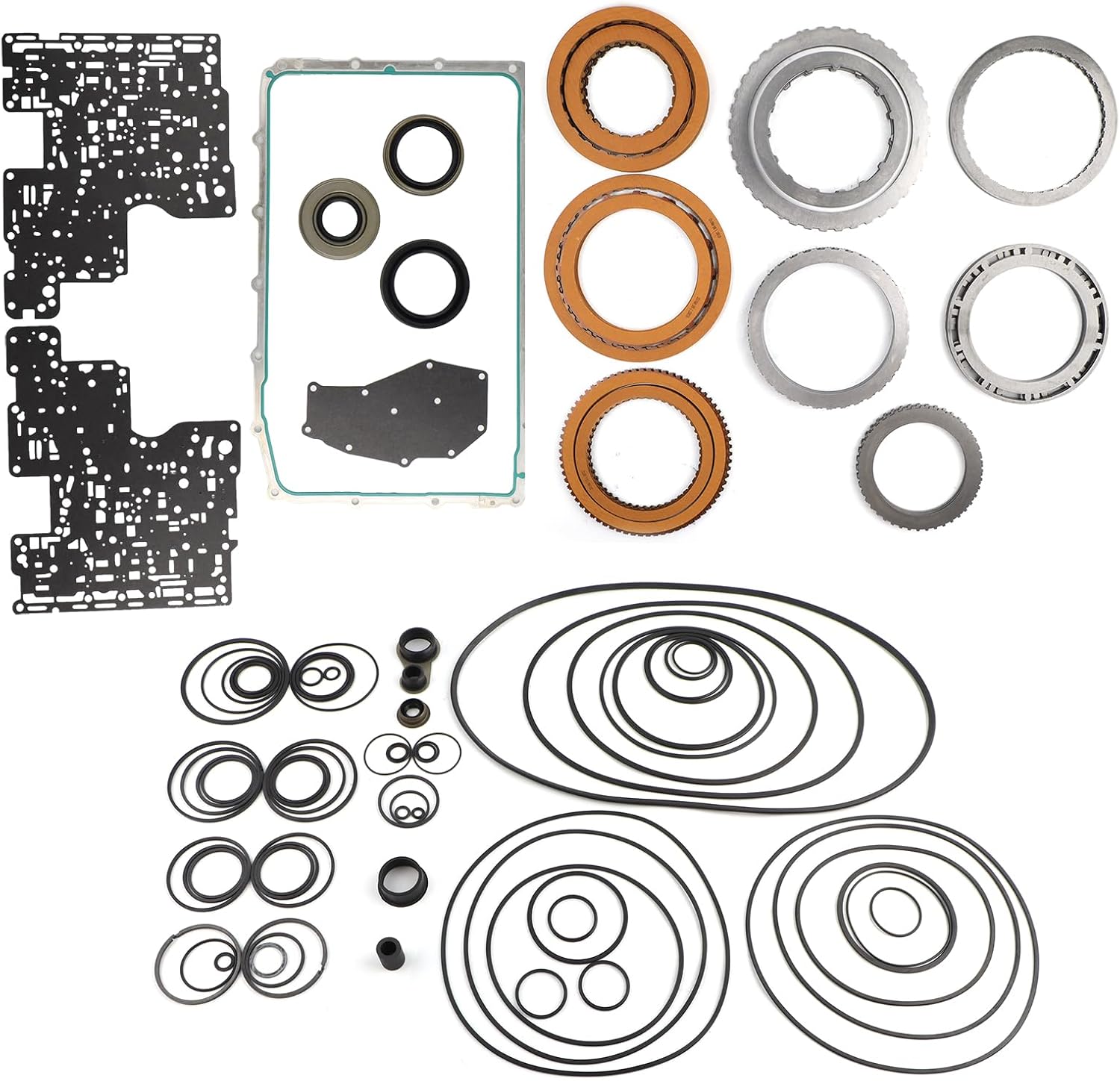
10R80 deluxe rebuild kit for a CDF teardown
The CDF cylinder repair pulls the clutch and planetary assembly and replaces the input shaft, sun gear shaft, balance dam and front support seals. This deluxe kit covers 2017-up 10R80s, so every seal is on hand once the unit is open.
Shop the part for this fix →Need valve body parts too? The 10-speed parts collection carries Sonnax valve body kits and other parts for the Ford and GM 10-speeds.
Need parts for this job?
The 10R80 master rebuild kit, Sonnax Zip Kit, filter and gasket kits, and MERCON ULV-spec fluid are all on our 10R80 parts page, with checkout on site.
FAQ
What years of Mustang have the 10R80 transmission?
The 10R80 10-speed automatic has been the Mustang's automatic since the 2018 model year, behind both the 2.3L EcoBoost and the 5.0L V8. Ford's bulletins split the cars by model year and build date, so pull the door tag before diagnosing.
Is there a TSB for Mustang 10R80 harsh shifting?
Yes. TSB 23-2123 covers 2018-2021 Mustangs and points at adaptive calibration and the main control valve body. TSB 25-2475 covers 2018-2020 Mustangs and TSB 25-2131 covers 2021-2022 Mustangs built on or before 15-Aug-2022, both for a leaking CDF clutch cylinder sleeve. Ford revises these often, so check the current version by VIN.
Why does my 2018 Mustang have codes P0741 and P1744?
On 2018 Mustangs built on or before 20-Nov-2017, Ford TSB 20-2117 blames P0741 and P1744 on a sticking torque converter clutch valve in the main control valve body. The fix is a new valve body, part JL3Z-7A100-B, followed by a relearn that can leave shifts firm for several days.
Do the 2.3L and 5.0L Mustang use the same 10R80 parts?
Not all of them. Ford lists a different CDF clutch cylinder for each engine, JR3Z-7H351-B for the 2.3L and JL3Z-7H351-B for the 5.0L. On 2018-2020 cars the 2.3L also runs one fewer friction plate in each of the C, D and F clutches.
What transmission fluid does a Mustang 10R80 use?
MERCON ULV, Motorcraft XT-12-QULV. Set the level hot at 206-215 F rather than by quart count, because Sonnax found that as little as one quart over full causes overheating and venting.
Related guides
- 10R80 Common Problems and Fixes
- 10R80 F150 Common Problems and Fixes
- 10R80 Harsh and Delayed Shifts
- 10R80 P0741 Fix
- 10R80 Fluid Type and Capacity
- 10R80 Mustang Won't Move: Diagnosis
Sources
- Ford Motor Company — Technical Service Bulletin 25-2475 (supersedes 25-2301), "Harsh/Delayed Engagement And/Or Harsh/Delayed Shift" (29 October 2025). 2018-2020 Mustang and 2017-2020 F-150 applicability, DTC list, CDF clutch cylinder sleeve cause, Mustang CDF cylinder part numbers JL3Z-7H351-B (5.0L) and JR3Z-7H351-B (2.3L), 2.3L plate counts, line pressure test procedure and Mustang labor times. static.nhtsa.gov (PDF)
- Ford Motor Company — Technical Service Bulletin 25-2131 (supersedes 24-2436), "Harsh/Delayed Engagement And/Or Harsh/Delayed Shift" (16 April 2025). 2021-2022 Mustang built on or before 15-Aug-2022, same CDF cause, 2021-2022 Mustang labor times. static.nhtsa.gov (PDF)
- Ford Motor Company — Technical Service Bulletin 23-2123 (supersedes 22-2139), "10R80 — Harsh/Delayed Engagement And/Or Harsh/Delayed Shift" (13 April 2023). 2018-2021 Mustang applicability, adaptive calibration cause, valve body overhaul and adaptive drive cycle, solenoid clips HL3Z-7G007-A, MERCON ULV XT-12-QULV. static.nhtsa.gov (PDF)
- Ford Motor Company — Technical Service Bulletins 20-2117, "10R80 — Illuminated MIL — DTCs P0741 And P1744 — Built On Or Before 20-Nov-2017" (14 April 2020), and 20-2198, "10R80 Transmission — High-Pitched Whine — Built On 21-Oct-2019 And Through 16-Dec-2019" (25 August 2020). Sticking TCC valve, 2018 Mustang valve body JL3Z-7A100-B and 2.0 hour labor; output shaft bearing whine repair. TSB 20-2117 (PDF) · TSB 20-2198 (PDF)
- Ford Motor Company — Technical Service Bulletin 22-2428, "10R60/10R80/10R80 MHT Automatic Transmission - Harsh/Delayed Engagement And/Or Harsh/Delayed Shift" (26 May 2023). 2018-2023 Mustang applicability, 15-Aug-2022 10R80 build cutoff, causes (software, solenoid ID strategy, sticking valves, CDF sleeve), Mustang separator plates JL3Z-7Z490-D and L1MZ-7Z490-J. static.nhtsa.gov (PDF)
- NHTSA — Ford Part 573 Safety Recall Report 18V-213 (Ford 18S09), April 2018. 2018 Mustang production dates 6-Nov-2017 to 12-Feb-2018, missing park pawl rod guide cup roll pin, loss of Park, 142 vehicles. static.nhtsa.gov (PDF)
- Sonnax — Jim Mobley, "Tips for Troubleshooting Ford 10-Speed ATF Venting & Overheating." One-quart overfill causes venting and overheating, 96-101 C (206-215 F) fluid check temperature. sonnax.com