"My 10R80 is making noise" covers two completely different complaints, and mixing them up is how people end up replacing the wrong part. A whine is a steady, pitch-shifting tone tied to speed or RPM. A clunk is a single mechanical impact tied to a shift event, usually Reverse to Drive or the reverse. Ford has separate, documented bulletins for each, and neither one starts with "replace the transmission." Here is what Ford's own paperwork says is actually going on, and when the noise is normal enough to leave alone.
First, figure out which complaint you actually have
Whine and clunk point to different parts of the transmission and different Ford bulletins, so do not start pulling anything until you know which one you are chasing. A whine is continuous and changes pitch with vehicle speed or engine RPM; it is audible whether you are accelerating, coasting, or sitting still in Park. A clunk is a single thump that happens at a specific moment, almost always right as the shifter moves between Reverse and Drive, or during coast-down when torque reverses through the driveline. If you can reproduce the noise on command tied to a shift, you are dealing with the clunk pattern below. If it rises and falls with road speed and never goes away, you are dealing with the whine patterns.
The whine Ford calls normal
Before chasing a repair, rule out the whine Ford has already told dealers not to fix. Special Service Message 47812 covers some 2019 Ford Ranger trucks with a 10R80 and describes a whine heard at idle and while driving, coming from the bell housing and front pan area of the transmission. The bulletin states that the noise may become louder at operating temperature and increases with higher engine RPM in the PARK position, and attributes it to the offset gear drivetrain in the front support. Ford's own conclusion: "a small amount of whine noise is considered to be characteristic of the 10R80 transmission" and it has no effect on durability.
That is a meaningful filter before you spend money. If your whine is mild, rises with RPM in Park, gets slightly louder once the fluid is hot, and nothing else about the truck's behavior has changed, you are likely hearing exactly what this bulletin describes, and Ford's position is that there is nothing to repair.
The whine with a real bearing behind it
A second, separate whine pattern does have a documented mechanical cause and a parts fix. Ford TSB 20-2198 (which supersedes the earlier 20-2083) covers 2020 F-150, 2020 Mustang, and 2019-2020 Ranger vehicles with a 10R80 built specifically between October 21, 2019 and December 16, 2019. The bulletin describes a high-pitched whine from the transmission at low speeds during light acceleration or coasting, and the diagnostic step is specific: road test at normal operating temperature, use Select Shift to hold 3rd gear on flat ground, and listen for the whine to peak between 30-40 km/h (18-25 mph). The noise goes away the moment the transmission is shifted to Neutral. If that test reproduces the complaint, Ford attributes it to the outer output shaft bearing and the fix replaces three specific parts: the inner output shaft bearing (HL3Z-7A415-C), the outer output shaft bearing (HL3Z-7A415-B), and the fluid passage sleeve (HL3Z-7A283-A) that sits between them, along with a new output shaft seal.
This is not a pan-and-filter job. The bulletin's own labor times run from 7.9 hours on a 2020 Mustang 2.3L up to 10.6 hours on a 2019-2020 Ranger 4x4, because the transmission has to come out and be partially disassembled: torque converter, auxiliary pump, main control assembly, all four speed sensors, the fluid pump, front support, and the clutch and planetary assembly all need to come off to reach the output shaft and planetary carrier No. 4 assembly where the bearings live. If your build date falls inside that two-month window and the Select Shift test reproduces the exact 18-25 mph whine, this is the bulletin to bring to a shop.
How a shop actually isolates a whine on this unit
GEARS Magazine, ATRA's trade publication, ran a case study on exactly this kind of complaint in its March 2022 issue: a 2019 Ford Ranger 2.3L with a 10R80 and a low-speed whine described by the customer as high-pitched. The shop's initial visual checks, hoses, belts, wiring, fluid level, and the full underside driveline, came back clean, and the noise could not be reproduced on a lift. It only showed up on a road test in city traffic between 5 and 45 mph, peaking around 18-25 mph during both acceleration and coast-down, and it stopped the instant the truck was shifted to Neutral while coasting, which is the same Neutral-cancels-the-noise behavior described in Ford's own TSB.
To pin down the source without pulling the transmission blind, the shop clipped chassis ears to the front, middle, and rear sections of the transmission and to the differential pinion area, then repeated the road test. The clips isolated the noise to the rear section of the unit. On teardown, both the inner and outer output shaft bearings were worn. The shop replaced both bearings along with the passage sleeve and a new output shaft seal, exactly the TSB 20-2198 parts list, and verified the fix with a follow-up road test: the whine was gone in city driving, stayed gone at freeway speed, and no leaks turned up after reassembly.
Two general rules from ATRA's technical side help here before you ever pull a pan. Dennis Madden's noise article in GEARS splits internal transmission noise into three sources: the converter, the pump and the geartrain, and says to check the engine and transmission mounts on every noise complaint because the rubber is what keeps normal gear noise out of the cab [5]. His pump test is to idle in Neutral and raise RPM, then idle in Reverse, where most units raise line pressure; a noise that gets louder in Reverse is pump-related [5]. For gear noise, he notes that if a transmission has a 1:1 ratio, a planetary noise must go away in that gear [5]. On the 10R80 that is 7th gear (1.00:1), so a whine that is still there when you hold 7th with Select Shift at the same road speed is not coming from the gearsets. Look at the output shaft bearings, the converter or the driveline instead.
The lesson for a DIYer or independent shop without access to chassis ears: use the same Select Shift, hold-3rd-gear, 18-25 mph test from the TSB. It is a free, repeatable way to confirm whether you are dealing with the output shaft bearing pattern before you commit to pulling the transmission.
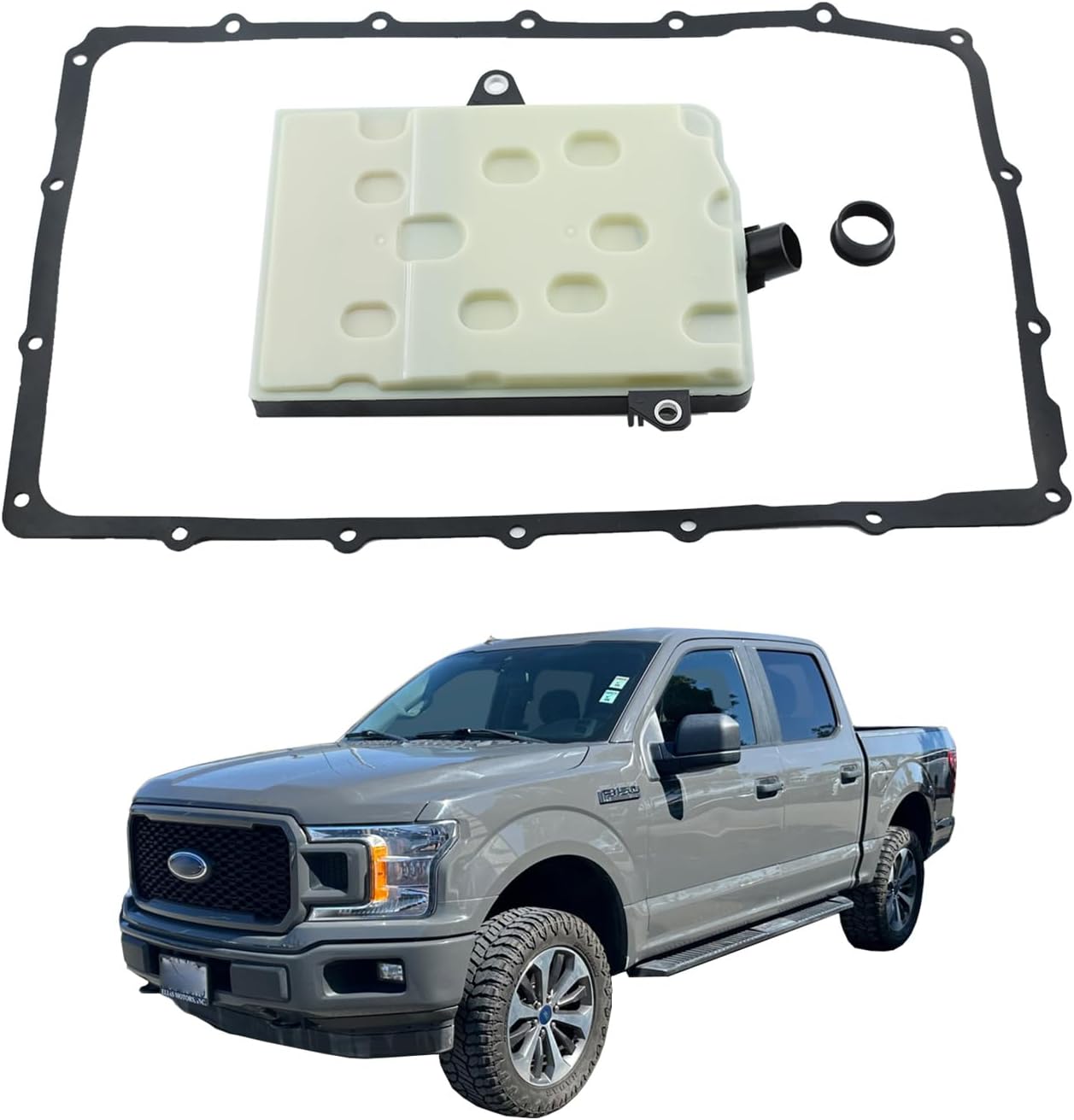
Ford 10R80 Transmission Filter and Gasket Kit
Any teardown deep enough to reach the output shaft bearings means the pan and filter are coming off. Replace both while the transmission is apart rather than reusing a gasket that has already been compressed once.
Check the 10R80 filter and gasket kit at Gearbox Insider →The clunk on Reverse-to-Drive and Drive-to-Reverse shifts
A completely different noise, and a completely different bulletin: Ford TSB 20-2253 (which supersedes 20-2097) covers 2018-2020 Expedition and Lincoln Navigator two-wheel-drive trucks with a clunk noise from the driveshaft area when shifting from REVERSE to DRIVE or DRIVE to REVERSE, and/or during coast-down. Ford's stated cause is a slip/stick condition at the transmission output flange and anti-ting ring interface, meaning the ring is binding against the flange instead of rotating smoothly against it as torque reverses direction.
The fix does not involve replacing any part. The procedure removes the four driveshaft flange bolts, disconnects the driveshaft, pulls the output shaft flange per the workshop manual, and gently pries the anti-ting ring off the flange. Both sides of the ring, plus the output shaft splines, get a light coating of Motorcraft High Temperature 4x4 Front Axle and Wheel Bearing Grease (keeping grease out of the threaded hole), and everything is reassembled. Ford's listed labor time for the whole job, including removing and reinstalling the output shaft flange, is 0.6 hours. This bulletin is explicitly limited to 2WD trucks; it does not apply to 4x4 Expedition or Navigator models, and it has not been published for F-150 or Ranger, even though some owners on other 10R80 applications report a similar-sounding clunk.
What the clunk bulletin does not cover
If your truck is a 4x4, or isn't an Expedition or Navigator, or the clunk doesn't specifically happen on a Reverse/Drive shift, do not assume TSB 20-2253 applies. A shift-related clunk can also come from normal driveline lash reacting to a sudden torque reversal, a loose transmission mount or crossmember bolt, or a worn U-joint, none of which are transmission-internal problems and none of which this bulletin addresses. Rule out the easy stuff first: check the transmission mount and crossmember bolts for looseness, and inspect the driveshaft U-joints for play before assuming the anti-ting ring is the culprit on a vehicle the bulletin doesn't cover.
Diagnostic order, start to finish
- Confirm which complaint you have: a continuous, speed- or RPM-linked whine, or a single clunk tied to a specific shift.
- For a whine: check the fluid level and condition first, since low or aerated fluid can add noise on top of anything mechanical.
- Road test and listen for whether the whine rises with RPM in Park and gets slightly louder hot. If so, compare it against SSM 47812's description of normal 10R80 gear whine before assuming a repair is needed.
- If the whine instead peaks specifically at 18-25 mph during light acceleration or coasting and disappears in Neutral, run the Select Shift hold-3rd-gear test from TSB 20-2198. If it reproduces the complaint and your build date falls in the covered window, the output shaft bearings are the documented cause.
- Use chassis ears if available to confirm the noise is coming from the rear of the transmission before committing to a teardown, the same method used in the GEARS Magazine case study.
- For a clunk on Reverse-to-Drive or Drive-to-Reverse shifts on a 2018-2020 2WD Expedition or Navigator, check TSB 20-2253 and the anti-ting ring/output flange grease fix before looking at anything else.
- For a similar clunk on a vehicle the bulletin doesn't cover, check driveline lash, transmission mount and crossmember bolts, and U-joint condition first.
Need parts for this job?
Filter and gasket kits, pump components, and diagnostic tools for the 10R80 are all on one page.
Shop 10R80 parts →FAQ
Does a 10R80 whine always mean something is wrong?
No. Ford's own Special Service Message 47812 covers 2019 Ranger trucks with a 10R80 whine at idle and while driving, coming from the bell housing and front pan area, and states that a small amount of whine noise is considered characteristic of the 10R80 transmission due to its offset gear drivetrain, with no effect on durability. The noise typically gets louder at operating temperature and rises with engine RPM in Park. If that description matches what you are hearing and nothing else is wrong, Ford's position is that there is nothing to fix.
My 10R80 whines between about 18 and 25 mph and goes away in Neutral. Is that the bearing TSB?
That matches the symptom in Ford TSB 20-2198, which covers a high-pitched whine that peaks at 30-40 km/h (18-25 mph) during light acceleration and coasting, confirmed by selecting and holding 3rd gear with Select Shift and disappearing in Neutral. But the bulletin only applies to 2020 F-150 and Mustang and 2019-2020 Ranger units built between October 21 and December 16, 2019, with the cause traced to the outer output shaft bearing. If your build date falls outside that window, the symptom may still point to a worn output shaft bearing, but confirm with a shop before ordering the bearing kit by VIN, since the exact fix covers a narrow production run.
What causes a clunk when I shift from Reverse to Drive on a 10R80?
On 2018-2020 Expedition and Navigator two-wheel-drive trucks, Ford TSB 20-2253 attributes this to a slip/stick condition at the transmission output flange and anti-ting ring interface. The fix is mechanically simple: remove the output shaft flange, pull the anti-ting ring, and apply a light coating of Motorcraft High Temperature 4x4 Front Axle and Wheel Bearing Grease to both sides of the ring and to the output shaft splines before reassembly. The bulletin is limited to 2WD trucks; 4x4 models are not covered by this specific repair.
Can low or dirty transmission fluid cause whine or clunk noises on a 10R80?
Low fluid can contribute to pump noise and aeration-related whine, and dirty or burnt fluid is worth ruling out before chasing a bearing or seal. Check the fluid level and condition at operating temperature before doing anything else, since it takes a few minutes and costs nothing. That said, both of Ford's documented fixes above are mechanical, a worn bearing and a dry anti-ting ring, not fluid-related, so do not expect a fluid change alone to resolve either one if the symptom matches those bulletins.
Is the 10R80 whine TSB repair covered under warranty?
TSB 20-2198 lists the repair as eligible under New Vehicle Limited Warranty, Service Part Warranty, Special Service Part, or Extended Service Plan coverage, with eligibility determined by the identified causal part (7A415) and verified through Ford's OASIS coverage tool. A technical service bulletin is repair guidance, not a recall, so coverage still depends on your specific warranty status rather than being automatic. Bring the TSB number to the dealer and ask them to verify eligibility against your VIN.
Shop the part for this fix
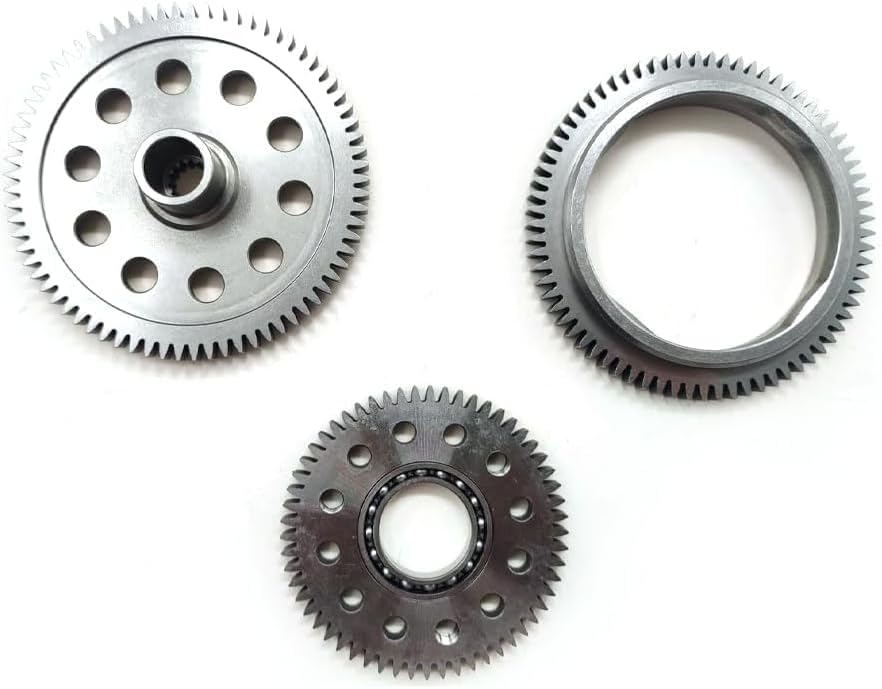
Pump, valve body, and hard-part kits covering the 10R80 and the shared GM 10L80 platform are stocked at CoreTransmissionParts.
Shop the 10R80/10L80 collection at CoreTransmissionParts →Related 10R80 guides
Sources
- Ford Motor Company — Technical Service Bulletin 20-2198, "10R80 Transmission – High-Pitched Whine - Built On 21-Oct-2019 And Through 16-Dec-2019," 25 August 2020 (supersedes 20-2083). Backs the covered 2020 F-150, 2020 Mustang and 2019-2020 Ranger model list and build-date window, the Select Shift hold-3rd-gear diagnostic procedure that isolates the whine at 30-40 km/h (18-25 mph), the Neutral-cancels-the-noise check, the cause attributed to the outer output shaft bearing, the disassembly scope needed to reach the output shaft and planetary carrier No. 4 assembly, the replacement part numbers (inner output shaft bearing HL3Z-7A415-C, outer output shaft bearing HL3Z-7A415-B, fluid passage sleeve HL3Z-7A283-A), the per-model labor times, and the causal part code 7A415. static.nhtsa.gov (PDF)
- Ford Motor Company — Technical Service Bulletin 20-2253, "2WD - Clunk Noise When Shifting REVERSE To DRIVE Or DRIVE To REVERSE And/Or During Coast Down," 11 August 2020 (supersedes 20-2097). Backs the covered 2018-2020 Expedition/Navigator 2WD model list, the described clunk symptom on Reverse/Drive shifts and coast-down, the stated cause of a slip/stick condition at the transmission output flange/anti-ting ring interface, the full repair procedure of removing the output shaft flange and greasing both sides of the anti-ting ring and the output shaft splines with Motorcraft High Temperature Grease, the new driveshaft flange bolt and output shaft flange bolt call-out, and the 0.6-hour labor time. Hosted via NHTSA's public TSB database. static.nhtsa.gov (PDF)
- Ford Motor Company — Special Service Message 47812, "Some 2017-2019 F-150, 2018-2019 Expedition/Navigator/Mustang, 2019 Ranger – 10R80 – Whine Noise." Backs the description of a whine heard at idle and while driving from the bell housing and front pan area, the behavior of the noise growing louder at operating temperature and with higher RPM in Park, and Ford's conclusion that a small amount of whine is characteristic of the 10R80's offset gear drivetrain in the front support with no effect on durability. Hosted via NHTSA's public TSB database. static.nhtsa.gov (PDF)
- GEARS Magazine — "Keep Those Trannys Rolling: Would You Like Some Whine With That 10R80?," Pete Huscher, March 4, 2022. Backs the 2019 Ford Ranger 2.3L case study, the initial inconclusive visual inspection, the road-test reproduction of the whine between 18-25 mph with the noise stopping in Neutral, the use of chassis ear clips on the front, middle and rear transmission sections and the differential to isolate the noise to the rear of the transmission, the teardown finding of worn inner and outer output shaft bearings, the replacement of both bearings plus the passage sleeve and output shaft seal, and the confirmed repair on a follow-up road test. gearsmagazine.com
- GEARS Magazine (ATRA) — "The Sound of Silence: Diagnosing Transmission Noises," Dennis Madden, January/February 2025. Backs the three internal noise sources (converter, pump, geartrain), the mount inspection advice, the Neutral-RPM and Reverse line-pressure pump test, and the rule that a planetary noise must disappear in a 1:1 gear. gearsmagazine.com